Mapping FET’s path to $0.35 as supply tightens amid $2.3M outflows

ambcryptoPublicado em 2026-03-27Última atualização em 2026-03-27

Resumo

FET has recorded over $2.33 million in exchange outflows, signaling tightening supply and reduced immediate sell pressure. The price has rebounded strongly from a low of $0.1422, reclaiming the $0.20 support level and approaching the $0.26 resistance zone. A sustained break above $0.26 could pave the next major resistance near $0.35. DMI readings show strong buying pressure with +DI at 33.10 and -DI suppressed at 14.25, while ADX at 38.43 confirms trend strength. Continued negative netflows reflect accumulation behavior, supporting gradual upside expansion as fewer tokens remain available for sale. Market structure and indicators align in favor of further recovery.

Artificial Superintelligence Alliance [FET] has recorded over $2.33 million in exchange outflows as price reclaimed $0.20, at press time, signaling tightening supply amid strengthening trend structure. This movement has directly reduced the amount of FET available on exchanges, which typically limits immediate sell pressure.

As tokens leave trading platforms, liquidity on the sell side tightens, allowing price to stabilize more efficiently during recovery phases. Such behavior often aligns with accumulation, especially when large holders choose to hold rather than distribute.

As a result, the market structure begins to favor controlled upside movement instead of sharp downside volatility driven by sudden inflows.

FET presses $0.26 after reclaiming $0.20

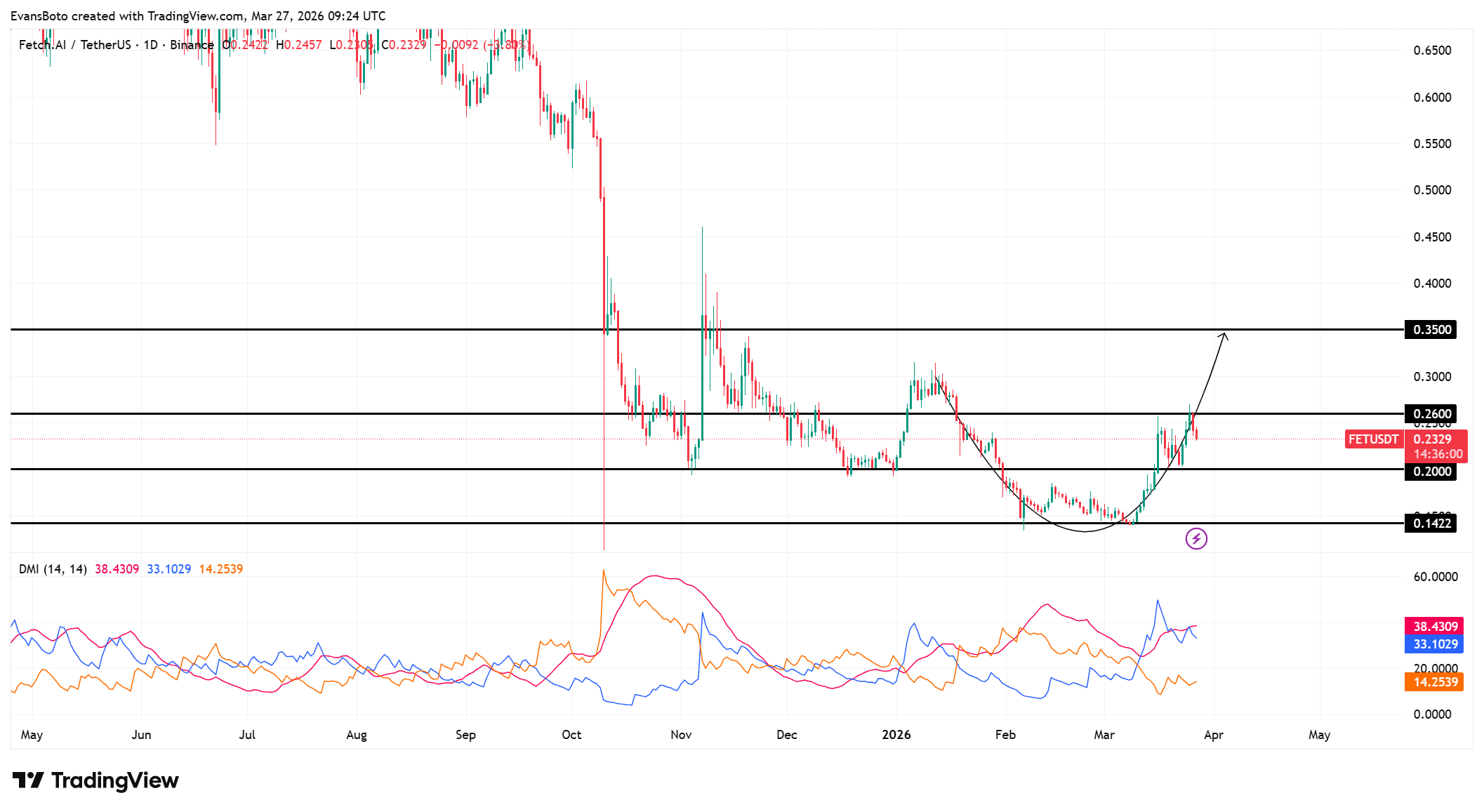
Price has rebounded strongly from the $0.1422 base and successfully reclaimed the $0.20 support level, marking a structural shift from prolonged downside pressure. After forming a rounded bottom, FET now trades near $0.2329 while pressing into the $0.26 resistance zone.

This level represents a critical barrier that previously capped recovery attempts. As price approaches this zone again, it reflects strengthening demand rather than weak relief rallies.

A sustained hold above $0.20 has already reinforced bullish intent, while a clean move through $0.26 would expose the next major level near $0.35, aligning with the broader recovery structure visible on the chart.

At press time, DMI readings have shifted decisively in favor of buyers, with +DI holding around 33.10 while -DI remained suppressed near 14.25. This spread clearly reflects dominant buying pressure rather than balanced conditions.

In addition, ADX has climbed to 38.43, confirming that the trend has strengthened rather than weakened.
Source: TradingView

Continued outflows reflect reduced sell pressure

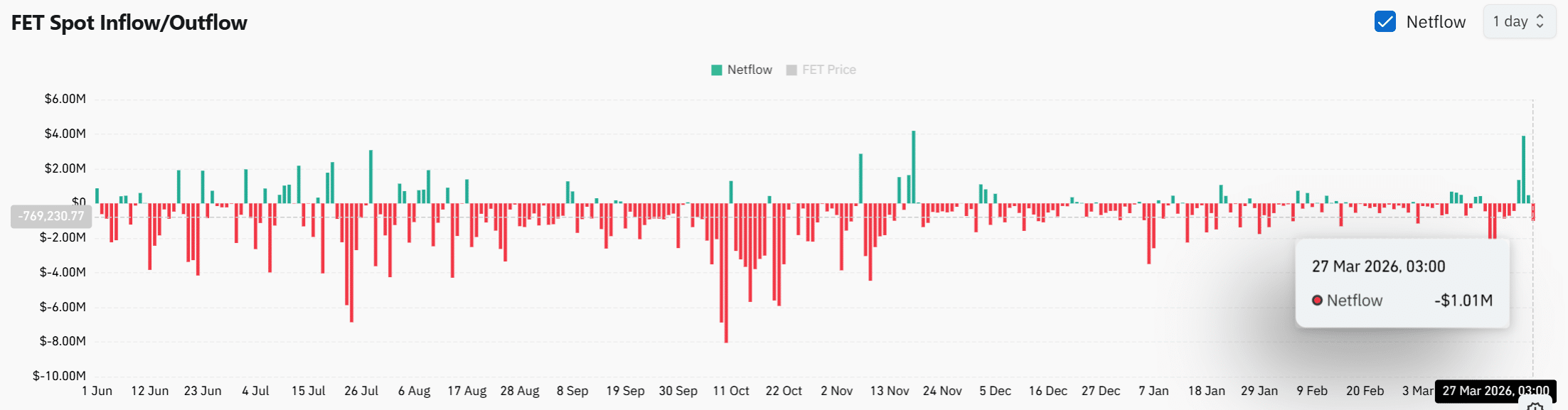
Spot Netflow data continues to print negative values, with the latest reading at approximately -$1.01 million. This consistent pattern of outflows indicates that more FET leaves exchanges than enters them, reinforcing the supply contraction already observed through whale withdrawals.

As this trend persists, fewer tokens remain available for immediate selling, which stabilizes price behavior during upward movements. Unlike inflow-driven markets that often signal distribution, sustained outflows suggest holders prefer retention over liquidation.

Such an environment supports gradual upside expansion, especially when paired with strengthening technical structure across price and indicators.
Source: CoinGlass

Can FET sustain this push toward $0.35?

FET now operates within a tightening supply environment while trend strength remains elevated and trader positioning favors continuation.

Price has already reclaimed key support and now challenges resistance with structural backing. As these conditions align, the market leans toward further upside progression rather than reversal.

A decisive move above $0.26 would likely extend the recovery toward $0.35, provided current dynamics persist without disruption.


Final Summary

  • FET structure reflects controlled strength as tightening supply and trend alignment continue favoring gradual upside expansion.
  • Price would likely extend higher if resistance breaks, as positioning and structural strength continue supporting directional conviction.


Criptomoedas em alta

Perguntas relacionadas

QWhat is the significance of the $2.33 million in exchange outflows for FET?

AThe $2.33 million in exchange outflows signals a tightening of supply, as it directly reduces the amount of FET available on exchanges. This typically limits immediate sell pressure, stabilizes the price during recovery, and aligns with accumulation behavior where large holders choose to hold rather than sell.

QWhat key price level did FET reclaim, and what is the next major resistance target mentioned?

AFET successfully reclaimed the $0.20 support level. The next major resistance target mentioned is $0.35, which would be exposed if the price makes a clean move through the $0.26 resistance zone.

QHow do the DMI and ADX readings support the current market structure for FET?

AThe DMI readings show +DI at 33.10 and -DI suppressed near 14.25, reflecting dominant buying pressure. The ADX has climbed to 38.43, confirming that the trend has strengthened rather than weakened, supporting a bullish market structure.

QWhat does the consistent negative Spot Netflow data indicate about FET's market dynamics?

AThe consistent negative Spot Netflow data, with the latest reading at approximately -$1.01 million, indicates that more FET is leaving exchanges than entering them. This reinforces supply contraction, reduces immediate selling pressure, and suggests holders prefer retention over liquidation, supporting gradual upside expansion.

QWhat conditions are necessary for FET to sustain its push toward $0.35?

AFor FET to sustain its push toward $0.35, it needs a decisive move above the $0.26 resistance level, continued tightening supply, elevated trend strength, and trader positioning that favors continuation without disruption to the current dynamics.

Leituras Relacionadas

Can Generative Models Finally Be Trained End-to-End? The Core Is a For Loop

This article introduces a novel training paradigm for generative models called Explorative Modeling (XM), which enables true end-to-end training. Traditionally, powerful generative models like autoregressive and diffusion models are not trained end-to-end. They are trained to predict a single small step but require iterative multi-step sampling for inference. This "exposure bias" leads to error accumulation and limits performance. The core challenge XM addresses is "mode blurring." In generative tasks, a single input (e.g., "generate a dog") corresponds to many valid outputs (multiple modes). Standard training objectives like reconstruction loss force the model to average these modes, producing unrealistic, blurry outputs. To avoid this, existing models break generation into many small, almost deterministic steps, sacrificing end-to-end training. XM tackles this by restructuring the training loop itself. Its key insight is to amplify "generative expressivity." For each training input, instead of generating one sample, the model generates K candidate outputs. Only the candidate closest to the real data is used for computing the loss and updating the model via backpropagation. This simple "best-of-K" mechanism is implemented as a short for-loop. By exploring multiple possibilities, the model learns to distribute its guesses across different modes rather than collapsing to their uninformative average. The paper demonstrates that "exploration" acts as a new, powerful scaling axis. Gains from XM increase with model size, data scale, and compute. Experiments show improvements in FID scores for image generation and significant efficiency gains, sometimes outperforming larger models without exploration. When pushed to the limit, XM enables fully single-step, end-to-end generative models. In robotics tasks, an "Explorative Policy" matched the performance of a 100-step Diffusion Policy with a single forward pass, drastically improving inference speed. While the best-of-K concept is not entirely new, the authors' contribution lies in formally understanding it as a direct method to boost generative expressivity without fragmenting the generation process. This work suggests that as models scale, enhancing exploration during training may become crucial for overcoming fundamental performance bottlenecks.

marsbitHá 8m

Can Generative Models Finally Be Trained End-to-End? The Core Is a For Loop

marsbitHá 8m

Annual Salary of Millions Competing for Electricians, Meta Rushes to Open Its Own Technical School

The AI boom is facing an unexpected bottleneck: a severe shortage of skilled construction workers and electricians. As tech giants like Meta, OpenAI, and Alphabet race to build massive data centers—such as OpenAI's $16 billion "Stargate" project—they are hitting a critical labor wall. The U.S. needs an estimated 130,000 more electricians, 240,000 construction workers, and 150,000 supervisors by 2030 for AI infrastructure alone, but tens of thousands of electrician jobs go unfilled each year. While AI companies offer high premiums, with electricians earning up to $280,000 annually, worker scarcity still causes massive losses—delays on a single project can cost $14.2 million per month. The complexity of building AI data centers, which require immense power (equivalent to powering hundreds of thousands of homes), sophisticated electrical systems, and advanced liquid cooling solutions, demands highly skilled technicians who are in short supply. To combat this, companies are investing heavily in training. Meta has committed $115 million to a free training school offering tuition, housing, and stipends, targeting 5,000 new workers. OpenAI is partnering with unions to secure skilled labor. These efforts are paying off, with a significant rise in Gen Z interest in trade schools over college. However, the power demands are staggering. AI data centers are driving a rapid surge in electricity consumption, projected to account for up to 12% of U.S. power use by 2028 and raising costs for consumers. Furthermore, the construction boom is project-based, leading to a potential future glut of trained workers once building peaks, which could depress wages industry-wide. The race for AI supremacy now depends as much on skilled hands as on advanced chips.

marsbitHá 1h

Annual Salary of Millions Competing for Electricians, Meta Rushes to Open Its Own Technical School

marsbitHá 1h

Trading

Spot

Artigos em Destaque

Como comprar FET

Bem-vindo à HTX.com!Tornámos a compra de FETCH.ai (FET) simples e conveniente.Segue o nosso guia passo a passo para iniciar a tua jornada no mundo das criptos.Passo 1: cria a tua conta HTXUtiliza o teu e-mail ou número de telefone para te inscreveres numa conta gratuita na HTX.Desfruta de um processo de inscrição sem complicações e desbloqueia todas as funcionalidades.Obter a minha contaPasso 2: vai para Comprar Cripto e escolhe o teu método de pagamentoCartão de crédito/débito: usa o teu visa ou mastercard para comprar FETCH.ai (FET) instantaneamente.Saldo: usa os fundos da tua conta HTX para transacionar sem problemas.Terceiros: adicionamos métodos de pagamento populares, como Google Pay e Apple Pay, para aumentar a conveniência.P2P: transaciona diretamente com outros utilizadores na HTX.Mercado de balcão (OTC): oferecemos serviços personalizados e taxas de câmbio competitivas para os traders.Passo 3: armazena teu FETCH.ai (FET)Depois de comprar o teu FETCH.ai (FET), armazena-o na tua conta HTX.Alternativamente, podes enviá-lo para outro lugar através de transferência blockchain ou usá-lo para transacionar outras criptomoedas.Passo 4: transaciona FETCH.ai (FET)Transaciona facilmente FETCH.ai (FET) no mercado à vista da HTX.Acede simplesmente à tua conta, seleciona o teu par de trading, executa as tuas transações e monitoriza em tempo real.Oferecemos uma experiência de fácil utilização tanto para principiantes como para traders experientes.

175 Visualizações TotaisPublicado em {updateTime}Atualizado em 2026.06.02

Como comprar FET

Discussões

Bem-vindo à Comunidade HTX. Aqui, pode manter-se informado sobre os mais recentes desenvolvimentos da plataforma e obter acesso a análises profissionais de mercado. As opiniões dos utilizadores sobre o preço de FET (FET) são apresentadas abaixo.

活动图片












