Mantra CEO tells OM holders to withdraw from OKX over ‘inaccurate’ migration plan

cointelegraphPublicado em 2025-12-08Última atualização em 2025-12-08

Resumo

Mantra CEO John Patrick Mullin has urged users to withdraw their OM tokens from the OKX exchange, accusing the platform of posting an "inaccurate" migration plan. Mullin claims OKX provided incorrect dates and details about the upcoming token migration from an Ethereum-based ERC-20 token to a native Mantra Chain token. He stated that OKX has not communicated with Mantra since April 13, when the OM token crashed over 90%, an event Mantra attributed to aggressive exchange leverage policies. Mullin advised users to avoid relying on OKX and complete the migration independently. The official migration is set to occur after January 15, contrary to OKX’s announced December timeline.

Tensions between blockchain platform Mantra and crypto exchange OKX are rising after Mantra accused the exchange of posting incorrect information about its token migration.

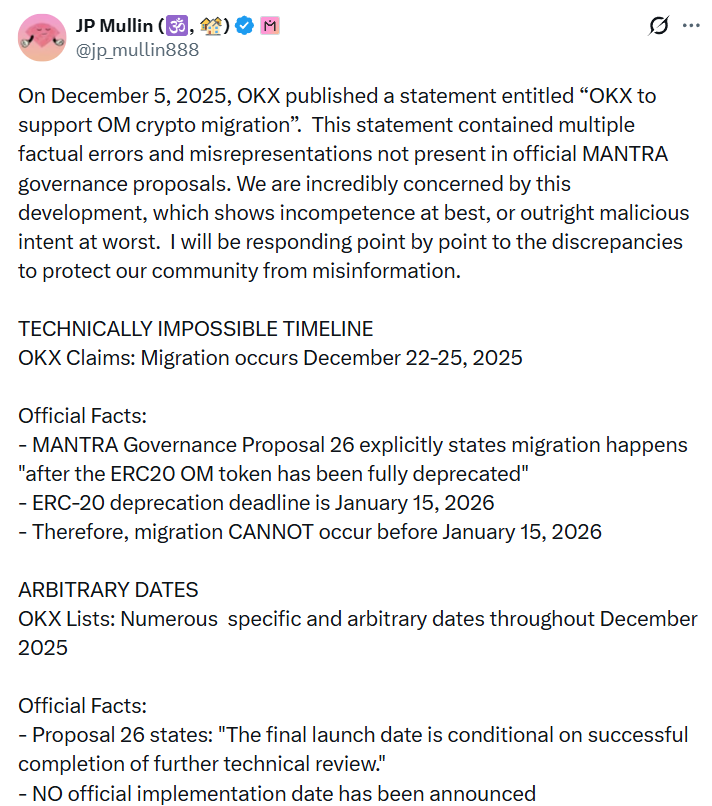
In a Monday X post, Mantra CEO John Patrick Mullin urged users of centralized cryptocurrency exchange (CEX) OKX to withdraw their Mantra (OM) tokens and cut their “dependency” on the platform.

“Users should consider withdrawing their OM tokens from OKX[...]. Avoid OKX Exchange Dependency: Complete migration without relying on potentially negligent or malicious intermediaries,” said Mullin.

His warning came in response to a Friday announcement from OKX about supporting the incoming OM token migration.
Source: JP Mullin

Related: BitMine buys $199M in Ether as smart money traders bet on ETH decline

According to Mullin, the OKX post contained multiple inaccuracies, including false migration and implementation dates.

OKX said the migration would occur between Dec. 22 and Dec. 25. Mantra’s governance proposal, by contrast, states that the migration will only take place after the Jan. 15 deprecation of the Ethereum-based ERC-20 OM token.

Mullin also said OKX’s post referenced “arbitrary dates throughout December 2025,” while Mantra has not yet announced an official implementation date.

He claimed OKX has not communicated with Mantra since “the events” of April 13, while Mantra has “helpfully [been] communicating with all other major exchanges regarding our migration.”
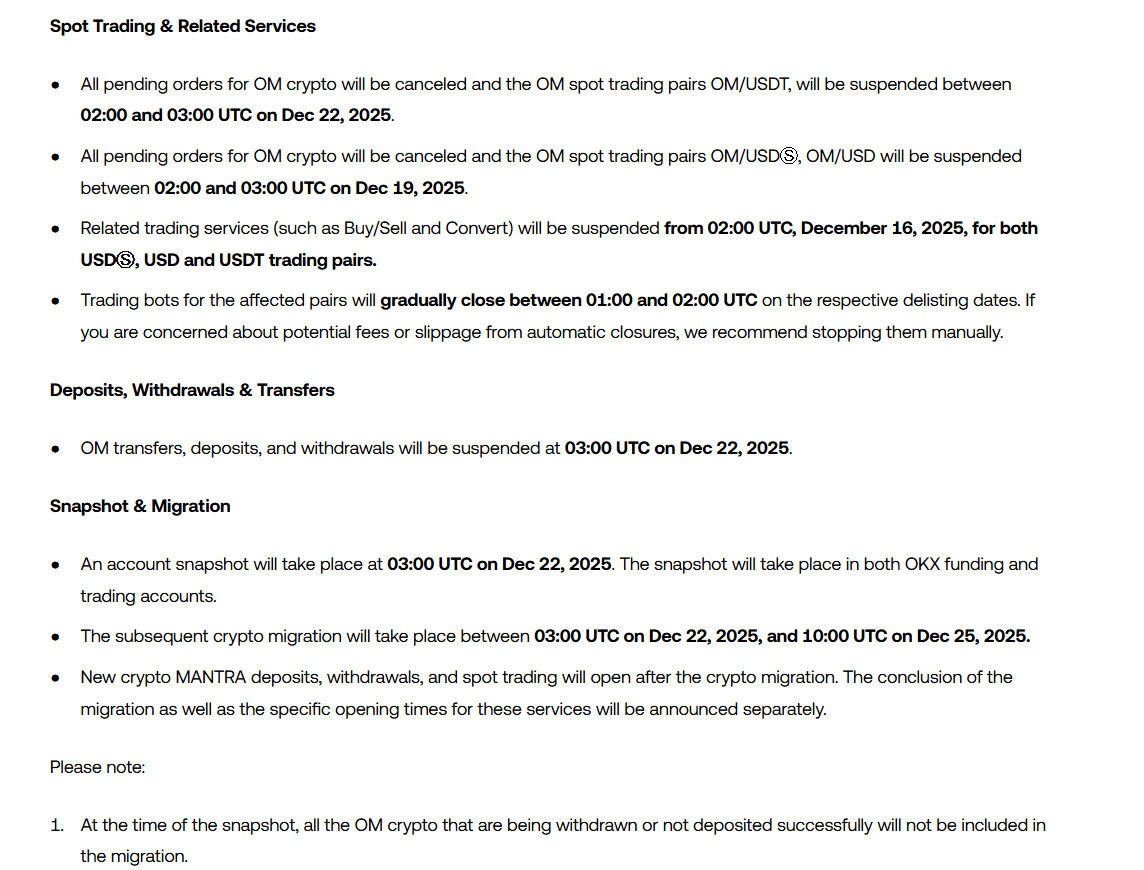
OKX’s OM Crypto Migration post. Source: okx.com

During the incoming migration, the OM token will migrate from an Ethereum-native ERC-20 token to a Mantra Chain-native token.

Cointelegraph has contacted OKX for comment but had not received a response by publication time.

Related: Prediction markets emerge as speculative ‘arbitrage arena’ for crypto traders

April crash still casting a shadow

On April 13, the Mantra’s OM token price fell by over 90% from around $6.30 to below $0.50.
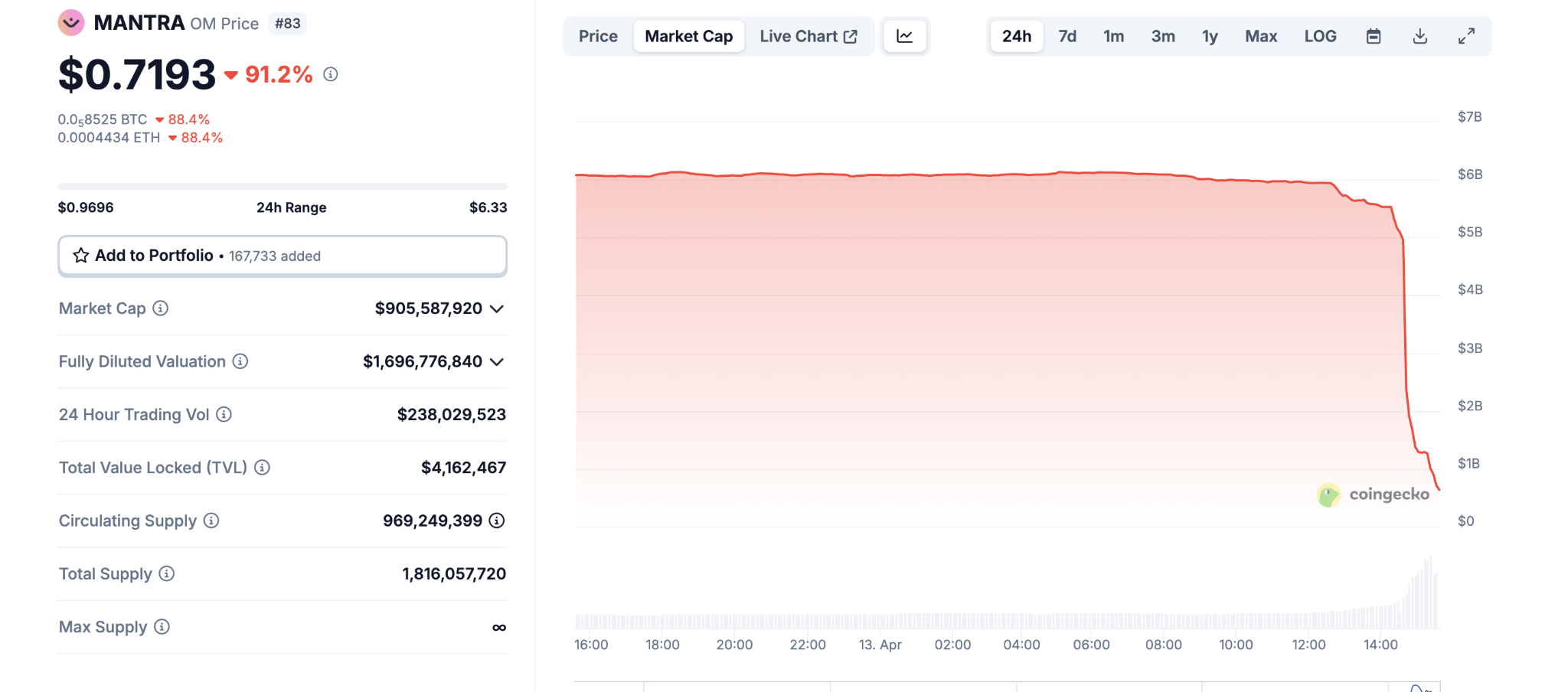
OM/USD, 1-day chart. Source: Coingecko.com

On April 30, Mantra published a post-mortem report that blamed the aggressive trading policies and high leverage on cryptocurrency exchanges for the token crash.

“Liquidation cascades could happen to any project in the crypto industry,” Mullin said in the post, pointing to the role of “aggressive leverage positions” on exchanges as a broader threat to investor safety.

Mullin also urged exchanges to review their leverage policies while implementing a transparency dashboard for OM tokenomics, along with announcing the burning of 150 million staked OM tokens, permanently removing them from circulation in a bid to tighten the token’s supply.

Magazine: If the crypto bull run is ending... it’s time to buy a Ferrari — Crypto Kid

Leituras Relacionadas

Crypto Winter is Near. Is Bitcoin Headed for a Deep Correction?

The cryptocurrency market is experiencing heightened anxiety, with high volatility and talks of a "crypto winter" fueling fears of a deep Bitcoin correction. While some investors are moving to stablecoins, others are looking at infrastructure projects built on Bitcoin. Despite being the foundational asset, Bitcoin's limitations—slow transactions, high fees, and lack of flexible smart contracts—hinder its use in DeFi and mass applications. This has increased interest in Layer 2 solutions. Infrastructure altcoins that aim to transform Bitcoin into a base for financial applications are gaining attention. Projects focusing on modular blockchains, virtual machines, and liquidity bridges are being viewed as potential leaders in the next cycle. Among them is Bitcoin Hyper and its token $HYPER, which positions itself as the first Bitcoin Layer 2 integrating the Solana Virtual Machine (SVM). This project aims to combine Bitcoin's security with Solana's high throughput, offering low latency and minimal fees. Bitcoin Hyper's architecture uses Bitcoin for finality and an SVM layer for real-time transactions and smart contracts. It claims to exceed Solana's performance with sub-cent fees, enabling DeFi, NFT platforms, and gaming applications using wrapped Bitcoin. The project has raised $29 million in its early sale, with on-chain data showing significant "smart money" interest. The $HYPER token features staking with high APY and governance rights. Bitcoin Hyper's goal is to address Bitcoin's core limitations, potentially making it a key infrastructure play that benefits from future Bitcoin growth.

bitcoinistHá 11m

Crypto Winter is Near. Is Bitcoin Headed for a Deep Correction?

bitcoinistHá 11m

Trading

Spot
Futuros
活动图片