‘Make TON great again’ – Block rate rises 6x, blockchain speed is now 10x

ambcryptoPublicado em 2026-04-10Última atualização em 2026-04-10

Resumo

The TON blockchain has increased its speed tenfold and now produces blocks six times faster, resulting in sub-second transaction times. This upgrade, part of the "Make TON Great Again" (MTONGA) framework announced by Telegram founder Pavel Durov, is the first of seven planned steps. The next phase aims to reduce transaction fees by six times. If achieved, lower fees would make TON significantly cheaper than competitors like Solana, potentially positioning it as a more cost-effective option for stablecoin transfers and DeFi applications. Despite currently ranking as the 14th fastest blockchain, TON has experienced a decline in activity since late 2024, with DEX volumes and TVL dropping significantly. However, these trends are partly attributed to broader market conditions. The upgrades are intended to attract new users amid intense competition among Layer 1 blockchains.

The TON blockchain has increased its speed tenfold and now plans to lower fees as top Layer 1 (L1s) compete for users.

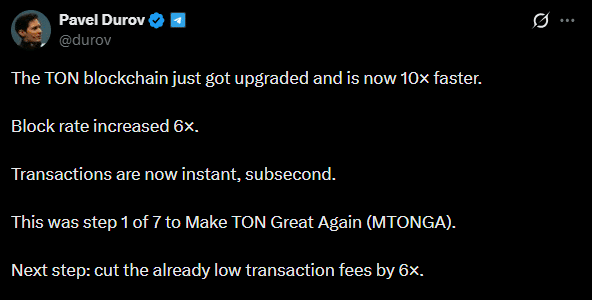
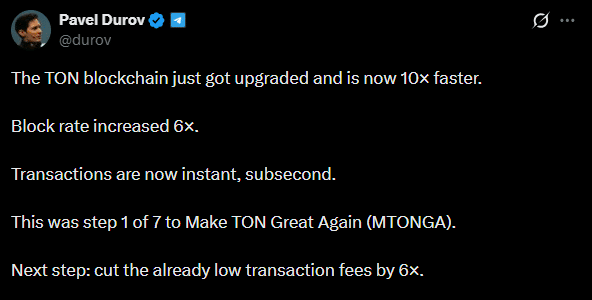
On the 9th of April, Telegram founder Pavel Durov announced that the recent upgrade, Catchain 2.0, was successful. According to him, the blockchain now creates blocks six times faster, and transactions are now ‘instant, subsecond.’
Source: X

Durov added that the 10x faster speed was the first of the seven steps of blockchain’s overhaul plan, dubbed the Make TON Great Again (MTONGA) framework. The second step will cut the transaction cost by 6x.

Will the upgrades improve TON activity?

According to ChainSpect, TON now ranks 14th among the fastest blockchain networks. On the sub-second block times, it only rivals Solana and BNB Chain.

Worth pointing out, BNB Chain also made updates to scale its speed and lower the costs of transactions. The end goal is to attract users seeking faster and cheaper transfers that can also empower other DeFi applications.

This is especially true for stablecoin transfers, which are dominated by Ethereum. However, rising competition from cheaper options like Tron, Solana, BNB Chain, and now TON has slashed its market share in stablecoin settlement.
Source: Token Terminal

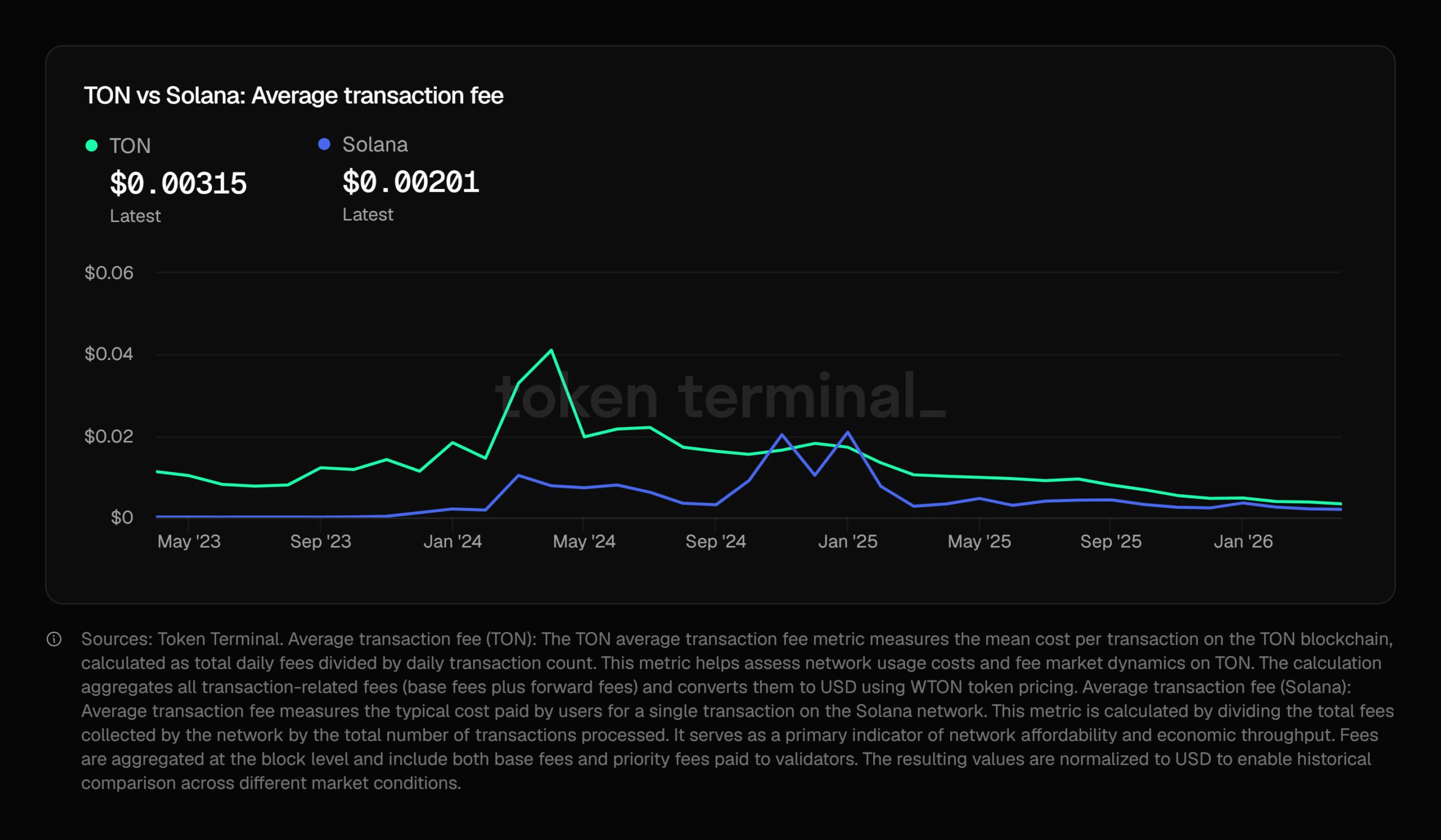
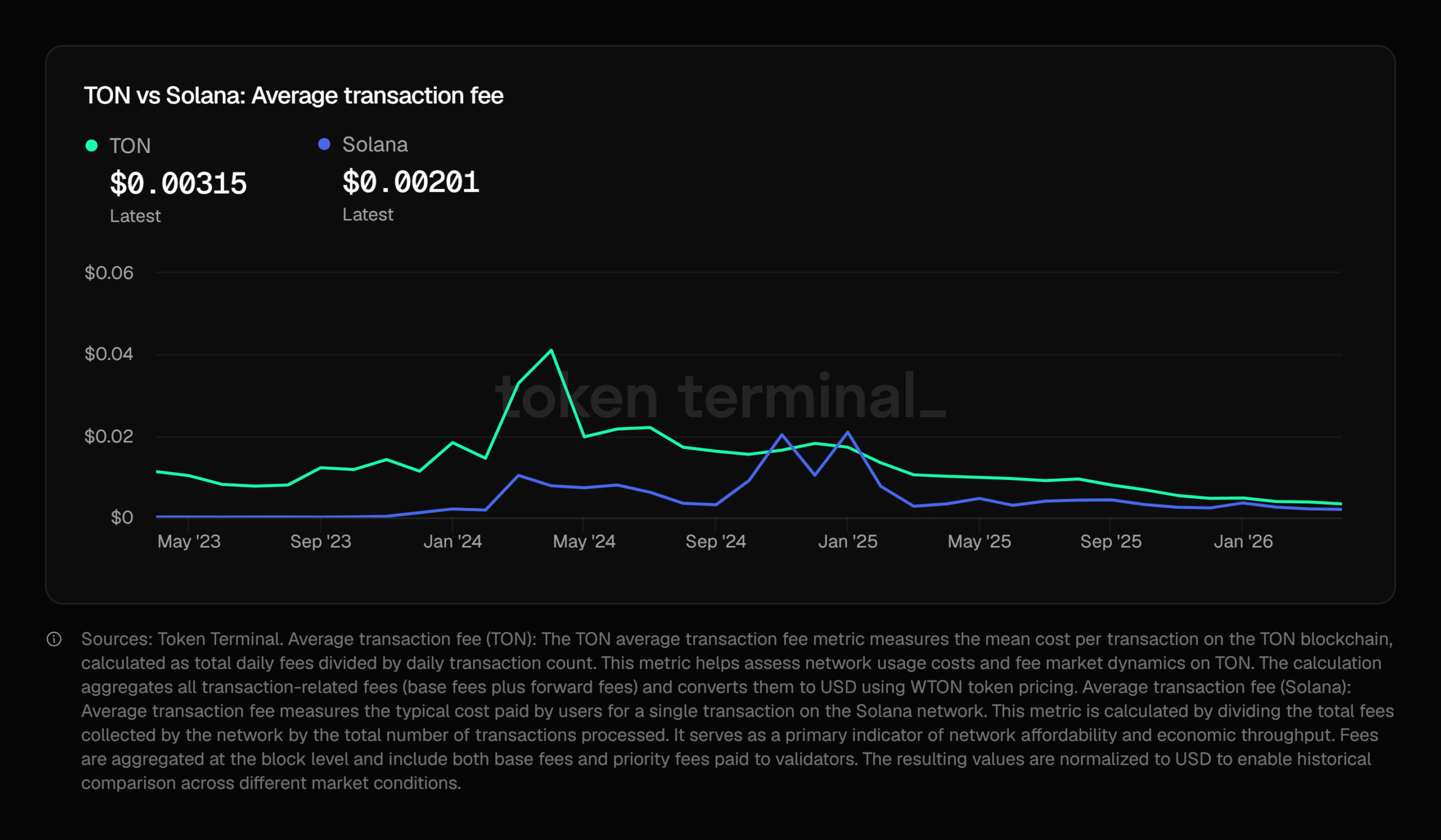
Currently, TON’s average transfer cost is about $0.00315, while Solana charges $0.00201. In other words, Solana is 40% cheaper than TON.

But if the 6x lower fees are achieved, TON would be 3.5x or 72% cheaper than Solana. That would be a competitive advantage, especially for stablecoin transfers.

As of writing, TON was the 13th largest chain in terms of stablecoin liquidity. Even so, the TON blockchain has seen a broader downtrend in activity since late 2024.

The DEX volumes have dropped from 2024 highs of $1.4B to $26M as of April 2026. Similarly, the TVL (total locked value) has decreased from a record high of $766M to $55M.
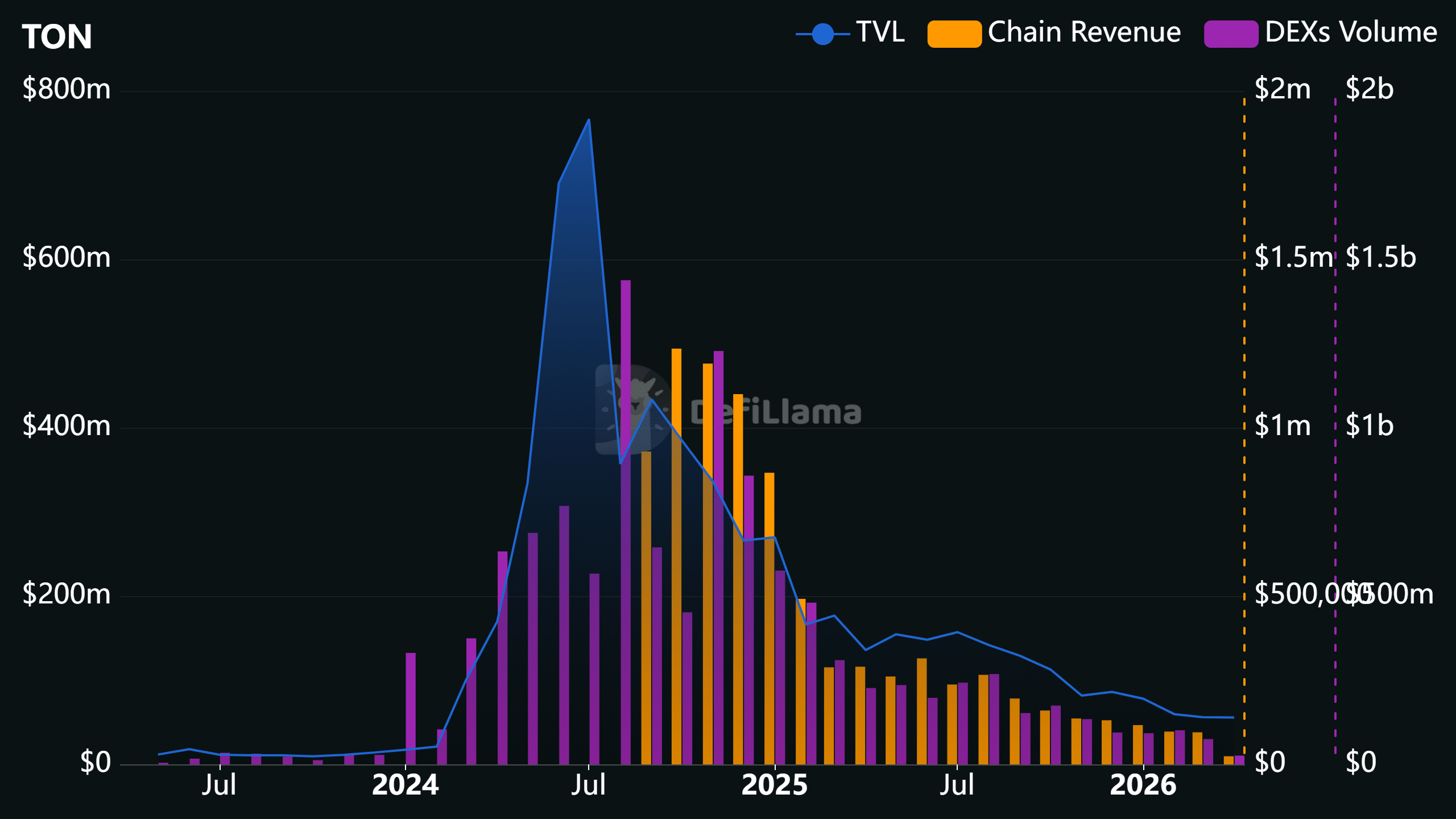
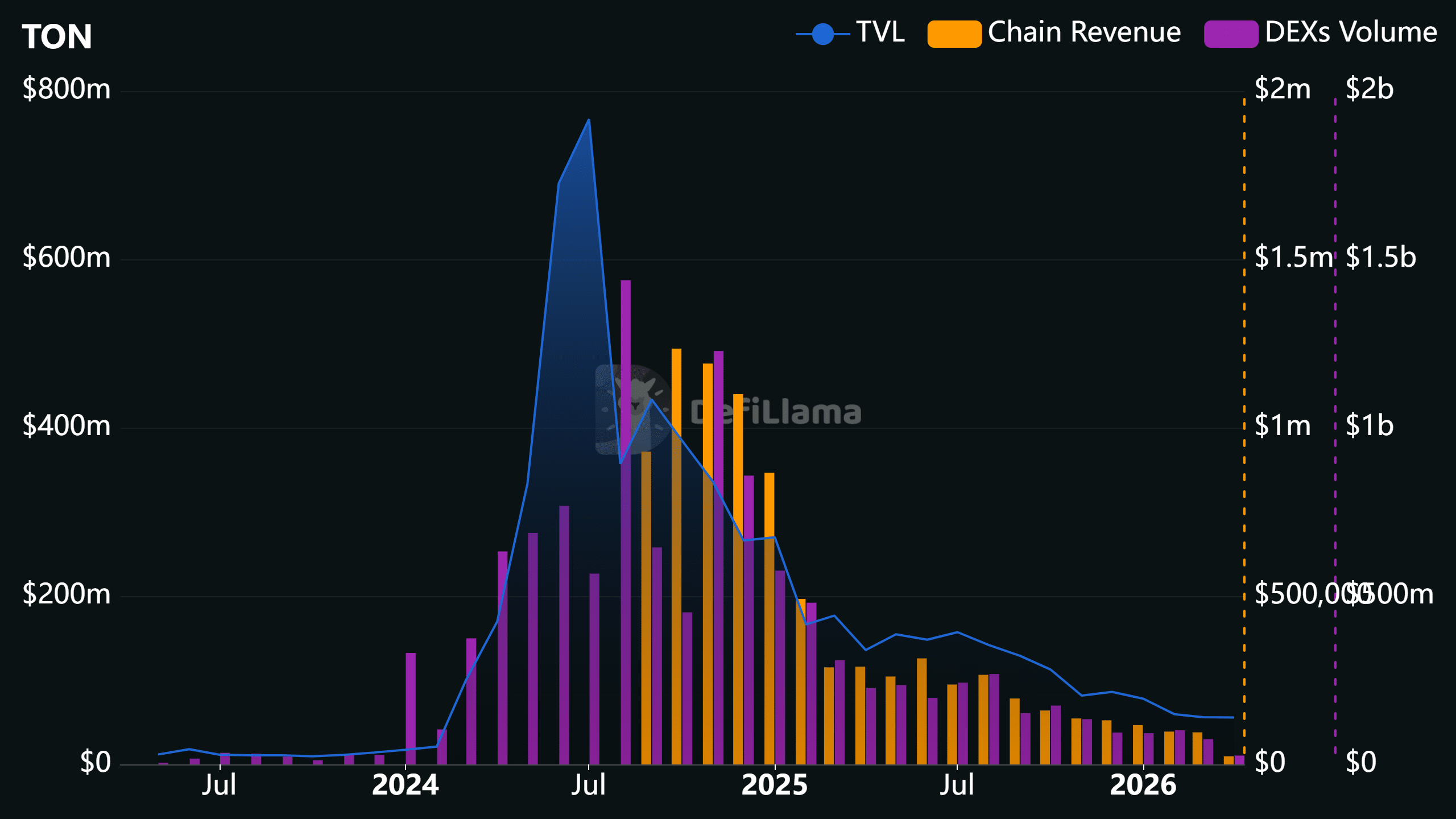
Source: DeFiLlama

But the dropping activity was due to broader market contraction. But it remains to be seen whether the lower fees will attract new users to the chain.


Final Summary

  • TON is now 10x faster and could soon be 3.5x cheaper than Solana amid cutthroat competition for on-chain users.
  • Telegram’s Pavel Durov said the plans are part of the Make TON Great Again (MTONGA) framework as chain activity slows.


Perguntas relacionadas

QWhat is the name of the upgrade that made TON blockchain 10x faster and who announced it?

AThe upgrade is called Catchain 2.0 and it was announced by Telegram founder Pavel Durov.

QAccording to the article, how much faster is TON at creating blocks and what is the new transaction speed?

ATON now creates blocks six times faster, and transactions are now 'instant, subsecond'.

QWhat is the second step in the 'Make TON Great Again' (MTONGA) framework?

AThe second step is to cut the transaction cost by 6x.

QHow does the article suggest TON's potential future fees would compare to Solana's if the 6x reduction is achieved?

AIf the 6x lower fees are achieved, TON would be 3.5x or 72% cheaper than Solana.

QWhat two key metrics (DEX volumes and TVL) have significantly decreased on TON since late 2024?

ADEX volumes dropped from $1.4B to $26M, and the TVL (total value locked) decreased from $766M to $55M.

Leituras Relacionadas

Michael Saylor: 110 Reasons to Oppose BIP-110

Michael Saylor presents 110 arguments against Bitcoin Improvement Proposal (BIP) 110, a soft fork aimed at restricting certain non-monetary data storage uses (like inscriptions) on the Bitcoin blockchain. He acknowledges the proponents' valid concerns—such as node costs, fee pressure, and preserving Bitcoin's monetary focus—but fundamentally disagrees with the proposed solution. Saylor argues that BIP 110 represents a dangerous precedent of using consensus rules to enforce value judgments on transaction validity, moving away from Bitcoin's core principles of neutrality and permissionless innovation. His key objections are organized into eleven categories: 1) It violates neutrality and hard consensus by banning currently valid transactions. 2) It fails to meet the high burden of proof required for a consensus change, lacking concrete data on the alleged crisis. 3) Its seven bundled technical restrictions are overly broad, targeting generic script functionalities and blocking future upgrade paths. 4) It sacrifices compatibility and future optionality by closing off designed upgrade hooks. 5) Its temporary rules add significant complexity (grandfathering, expiry states) without sufficient justification. 6) The economic and security impacts, particularly on miner revenue and fee markets, are uncertain and unmodeled. 7) Superior, market-based tools (fee markets, relay/mining policies) already exist to manage blockchain load. 8) It stifles innovation by creating a chilling effect for developers. 9) Its modified activation mechanism (55% threshold, forced signaling) is aggressive and risks network splits. 10) The precedent it sets—using consensus to suppress disliked but legal uses—is more dangerous than the problem it aims to solve. 11) A better path exists: improving measurements, refining resource-based policies, and allowing market forces to work. Saylor concludes that Bitcoin's strength lies in its neutral rules, open markets, and hard consensus. Changing these foundational elements to target specific use cases is an unnecessary and risky "iatrogenic" intervention. He advocates for guarding Bitcoin's neutrality rather than acting as its redeemer.

marsbitHá 17m

Michael Saylor: 110 Reasons to Oppose BIP-110

marsbitHá 17m

Trading

Spot
活动图片

