Major VCs Back Zcash Developers With $25 Million After ECC Split

bitcoinistPublicado em 2026-03-10Última atualização em 2026-03-10

Resumo

Zcash Open Development Lab (ZODL), formed by the team formerly known as Electric Coin Company, has raised over $25 million from major investors including a16z, Paradigm, and Coinbase Ventures. The funding will support the development of Zcash-focused wallets and protocol work without relying on the network’s development fund. According to ZODL, its wallet has driven a 400% increase in shielded pool adoption and facilitated over $600 million in ZEC swaps since October 2025. The team emphasizes continuity, with the full ECC engineering team moving to ZODL. Zcash founder Zooko Wilcox highlighted that the investment involves no new token and no control over the Zcash protocol, suggesting backers are betting on Zcash's broader adoption and long-term importance.

Zcash Open Development Lab, the company formed by the team formerly known as Electric Coin Company, has raised more than $25 million from a roster of heavyweight crypto investors including a16z, Paradigm, Winklevoss Capital, Coinbase Ventures, Cypherpunk Technologies, Maelstrom (family office of Arthur Hayes), Chapter One, David Friedberg, Haseeb Qureshi, Mert, Balaji and others.

What This Means For Zcash

The round lands just months after the ECC team regrouped under a new name, and gives the Zcash-focused builder fresh capital to expand its wallet and protocol work without leaning on the network’s development fund.
Josh Swihart, who now leads ZODL after previously serving as CEO of ECC, framed the raise as a bet on product traction rather than a brand reset. “The name is new, but our team has been building Zcash for a decade,” he wrote. “A couple of years ago, my team and I set out to change the trajectory of Zcash with an uncompromising focus on the user experience for shielded ZEC. We released Zodl (then called Zashi) and have never looked back.”

That pitch is backed by a set of numbers the team clearly wants the market to notice. According to ZODL, its wallet has helped drive adoption of the Zcash shielded pool by more than 400% since launch, while facilitating over $600 million in ZEC swaps since October 2025. Swihart said the company first shipped what he called a “normie-friendly wallet,” then layered in integrations with Flexa for retail spending, Keystone for cold storage and, more recently, NEAR-powered intents for ZEC swaps.

The capital raise is also meant to change how that work gets funded. “This funding allows us to bring these ambitions to life, without relying on Zcash dev fund grants to get there,” Swihart wrote. Alongside Zodl, the company said it is building Zallet, a full-node wallet that will serve as the foundation for new desktop software, with the longer-term goal of creating “a private, decentralized financial system as an alternative to legacy institutions.”

ZODL’s own announcement leaned heavily on continuity. The company said the full ECC team, including the engineers responsible for designing and maintaining some of Zcash’s core systems, moved over earlier this year. It added that protocol development remains central to the company’s work, but argued that future upgrades should stay tied to usability and product-market fit rather than protocol design in isolation.

Zcash founder Zooko Wilcox read the raise as something larger than a routine venture financing. “Twenty-five million dollars is a big investment! For a company that makes a wallet!?” he wrote in a thread reacting to the news. “This set of investors is a signal. They are big, sophisticated, long-standing, and reputable.”

He focused on what the deal does not appear to offer. There is no new token for investors to capture, he noted, and no control over the Zcash protocol itself. “There is no new token that the investors can get a cut of! The ZEC supply is locked in, with a 21M total supply cap, like Bitcoin,” Wilcox wrote. “The investors don’t get control of the protocol! Zcash is permissionless, open-source, and has a huge number and variety of stakeholders.”

From there, Wilcox sketched out a theory of the round: investors may see the wallet business as a monetizable entry point, but just as importantly, some may be underwriting broader ZEC adoption itself. He pointed to public disclosures from Cypherpunk Technologies, which he said already holds more than 1% of ZEC’s eventual supply, and argued that its equity stake in ZODL is smaller than its exposure to the coin.

His conclusion was blunt. “These people are betting that Zcash — not crypto, not privacy, not Bitcoin, not zero-knowledge-proofs — Zcash will be critically important for our civilization,” he wrote.

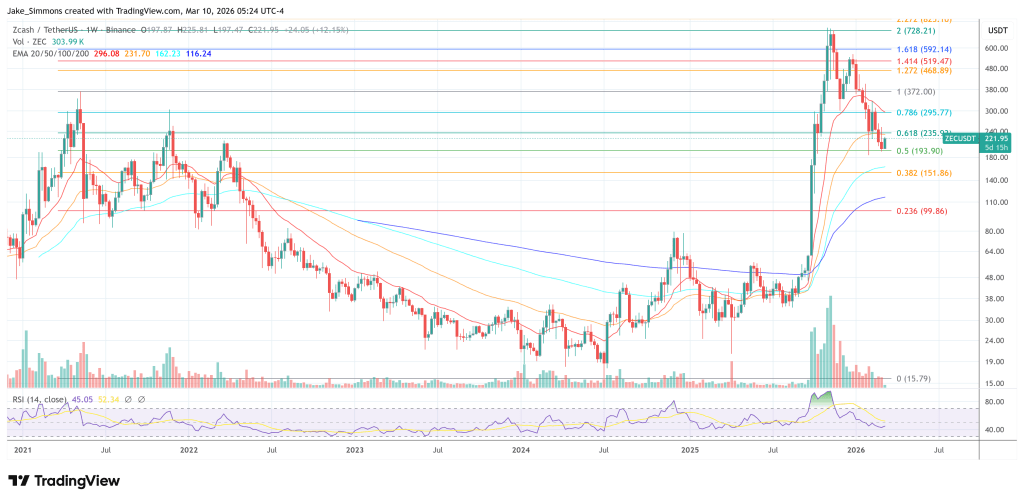
At press time, Zcash traded at $221.95.
ZEC bounces from the 0.5 Fib, 1-week chart | Source: ZECUSDT on TradingView.com

Leituras Relacionadas

$292 Million KelpDAO Cross-Chain Bridge Hack: Who Should Foot the Bill?

On April 18, 2026, an attacker stole 116,500 rsETH (worth ~$292M) from KelpDAO’s cross-chain bridge in 46 minutes—the largest DeFi exploit of 2026. The stolen assets were deposited into Aave V3 as collateral, causing $177–200M in bad debt and triggering a cascade of losses across nine DeFi protocols. Aave’s TVL dropped by ~$6B overnight. This legal analysis argues that KelpDAO and LayerZero Labs share concurrent liability, with fault apportioned 60%/40%. KelpDAO negligently configured its bridge with a 1-of-1 decentralized verifier network (DVN)—a single point of failure—despite LayerZero’s explicit recommendation of a 2-of-3 setup. LayerZero, which operated the compromised DVN, failed to secure its RPC infrastructure against a known poisoning attack vector. Both protocols’ terms of service cap liability at $200 (KelpDAO) or $50 (LayerZero), but these limits are likely unenforceable due to unconscionability, gross negligence exceptions, and potential securities law invalidation (if rsETH is deemed a security under the Howey test). Aave’s governance also faces fiduciary duty claims for raising rsETH’s loan-to-value ratio to 93%—far above competitors’ 72–75%—without adequately assessing bridge risks, amplifying the systemic fallout. Practical recovery targets include LayerZero Labs (a registered Canadian entity), KelpDAO’s founders, auditors, and identifiable Aave governance delegates. The incident underscores escalating legal risks for DeFi protocols, infrastructure providers, and governance participants.

marsbitHá 21m

$292 Million KelpDAO Cross-Chain Bridge Hack: Who Should Foot the Bill?

marsbitHá 21m

Insider Trading in War: 5 People Involved, the Highest Earner Was Arrested

On April 24, the U.S. Department of Justice arrested U.S. Army Special Forces Staff Sergeant Gannon Ken Van Dyke for insider trading related to the capture of Venezuelan President Nicolás Maduro on January 3. Van Dyke allegedly profited over $400,000 by placing bets on a prediction market, Polymarket, using insider knowledge of the covert operation. According to the indictment, Van Dyke registered an account (0x31a5) on December 26 and made a series of bets predicting Maduro’s capture and U.S. military involvement in Venezuela. He withdrew most of his funds on the day of the operation and attempted to obscure his tracks by transferring assets through crypto and brokerage accounts. This case marks the first time the DOJ has prosecuted insider trading on Polymarket. PolyBeats had previously identified five suspicious accounts, including Van Dyke’s—the highest earner—in January. The other accounts, with profits ranging from $34,000 to $145,000, remain under unofficial scrutiny but have not been charged. Their lower profits, indirect access to information, and unclear legal boundaries may complicate prosecution. Polymarket has since strengthened its market integrity rules, explicitly prohibiting trading based on confidential or insider information. Van Dyke’s arrest, nearly four months after his trades, signals increased regulatory attention and the persistent traceability of blockchain-based transactions.

marsbitHá 23m

Insider Trading in War: 5 People Involved, the Highest Earner Was Arrested

marsbitHá 23m

Bitwise: Bullish on Bitcoin's Performance in the Second Half of the Year, AI and Regulation Will Spark a New Altcoin Season

Bitwise CIO Matt Hougan and Research Lead Ryan Rasmussen express strong bullish sentiment on Bitcoin's long-term prospects, suggesting that its $1 million price target may be too conservative. They argue Bitcoin serves a dual role: as digital gold and a potential global settlement asset, especially amid declining trust in traditional monetary systems. Despite a weak Q1 2026 where nearly all crypto assets and prices saw double-digit declines, the analysts remain optimistic due to strong forward-looking catalysts, including institutional adoption via Bitcoin ETFs from major firms like Morgan Stanley and Goldman Sachs. Geopolitical instability, such as Iran’s mention of using Bitcoin for international payments, increases the value of Bitcoin’s “out-of-the-money call option” as a non-political, global settlement currency. This enhances its appeal beyond a mere store of value. . Additionally, Hougan highlights that a clearer regulatory token framework under current SEC leadership, combined with AI efficiency gains and high-performance blockchains, could fuel a new “altseason” by late 2026. This may lead to a wave of legitimate, value-capturing token projects, unlike the earlier ICO boom. . Bitwise also announced an Avalanche ETF, citing its unique architecture and rapid growth in real-world asset (RWA) tokenization, which has surged 10x to nearly $30 billion in two years. The firm believes Layer 1 blockchains are still early in their growth cycle, with significant potential ahead.

marsbitHá 1h

Bitwise: Bullish on Bitcoin's Performance in the Second Half of the Year, AI and Regulation Will Spark a New Altcoin Season

marsbitHá 1h

Trading

Spot
Futuros
活动图片


