LTC hits multi-month lows, yet Litecoin usage keeps climbing – Explained

ambcryptoPublicado em 2026-02-05Última atualização em 2026-02-05

Resumo

Litecoin (LTC) has declined to its lowest price level in over four months, dropping nearly 12% in the past week. Despite the bearish price trend, with LTC trading below key moving averages and showing negative momentum on indicators like RSI and MACD, its real-world usage and institutional adoption continue to grow. SBI VC Trade, a Japanese crypto exchange backed by SBI Holdings, recently added Litecoin to its crypto lending service, allowing users to earn interest by lending LTC. This places Litecoin alongside major cryptocurrencies like Bitcoin and Ethereum in terms of institutional recognition. Additionally, data from CoinGate shows Litecoin was the third most-used cryptocurrency for payments in January, accounting for 17.7% of transactions—a significant increase from December. Only Bitcoin and USD Coin were used more frequently. At the same time, activity on Litecoin’s privacy-focused MWEB layer reached a new high, with a substantial increase in LTC locked via peg-ins over the past month. Despite weak market sentiment, Litecoin’s utility as a payment method and growing adoption in both retail and institutional contexts indicate strong underlying demand.

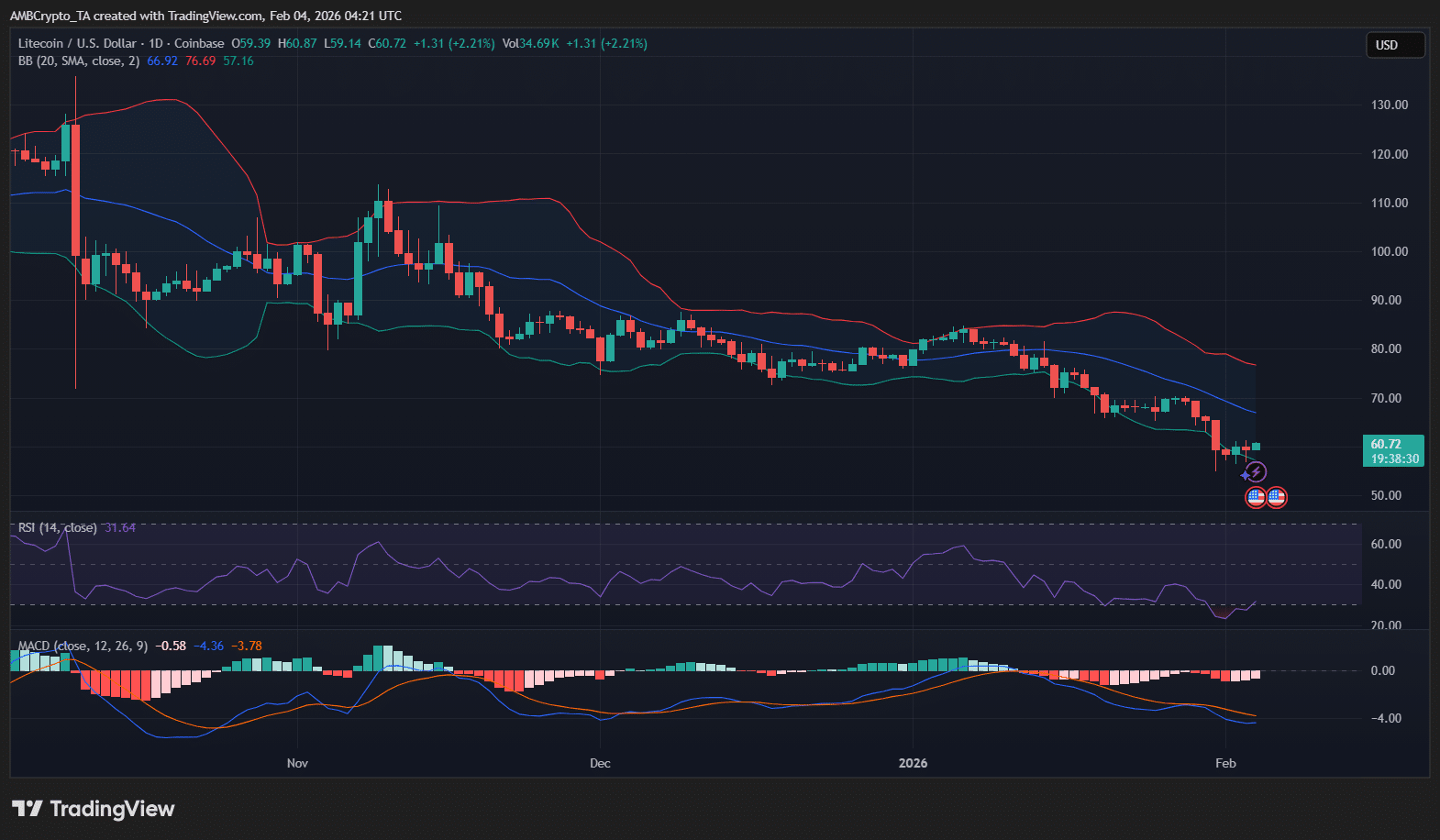
Litecoin has slipped to its lowest level in more than four months, falling nearly 12% over the past week. But price action is only part of the story.

Away from the charts, Litecoin continues to see great support and demand.

LTC slides to multi-month lows

On the daily chart, LTC dropped to its lowest level since October before showing a small bounce. The greater trend is bearish, with prices trading below key MAs and struggling to reclaim lost ground.

Source: TradingView

The RSI showed heavy selling, while the MACD stayed negative – downside momentum has yet to fully fade. Volatility increased, with price repeatedly hitting the lower Bollinger Band.

Institutional adaption is increasing

SBI VC Trade, a crypto exchange backed by Japan’s SBI Holdings, has recently added Litecoin [LTC] to its crypto lending offerings.

Through its Lending Coin program, users in Japan can now lend Litecoin to earn interest, placing it alongside established assets such as Bitcoin [BTC], Ethereum [ETH], and Ripple’s XRP [XRP].

The platform already supports lending for more than 30 cryptocurrencies, and Litecoin’s inclusion is a nice show of confidence.

What’s more?

Source: X

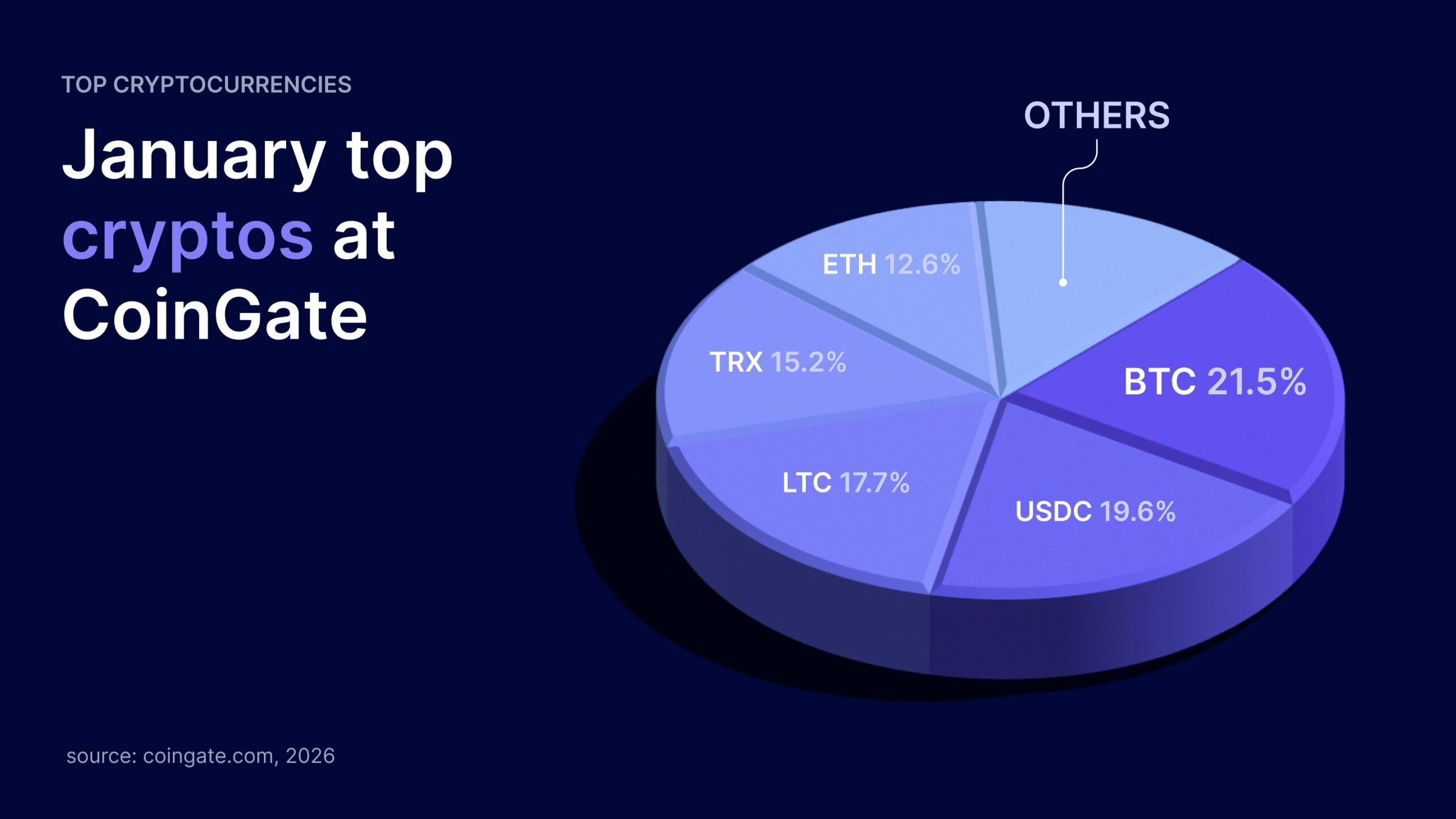
Data from CoinGate showed LTC was the third most used cryptocurrency for payments in January, accounting for 17.7% of transactions. That puts the coin just only behind Bitcoin and USD Coin [USDC].

That share was also higher than in December, back when, it was 16.4%; the number now is a considerable growth.

Source: X

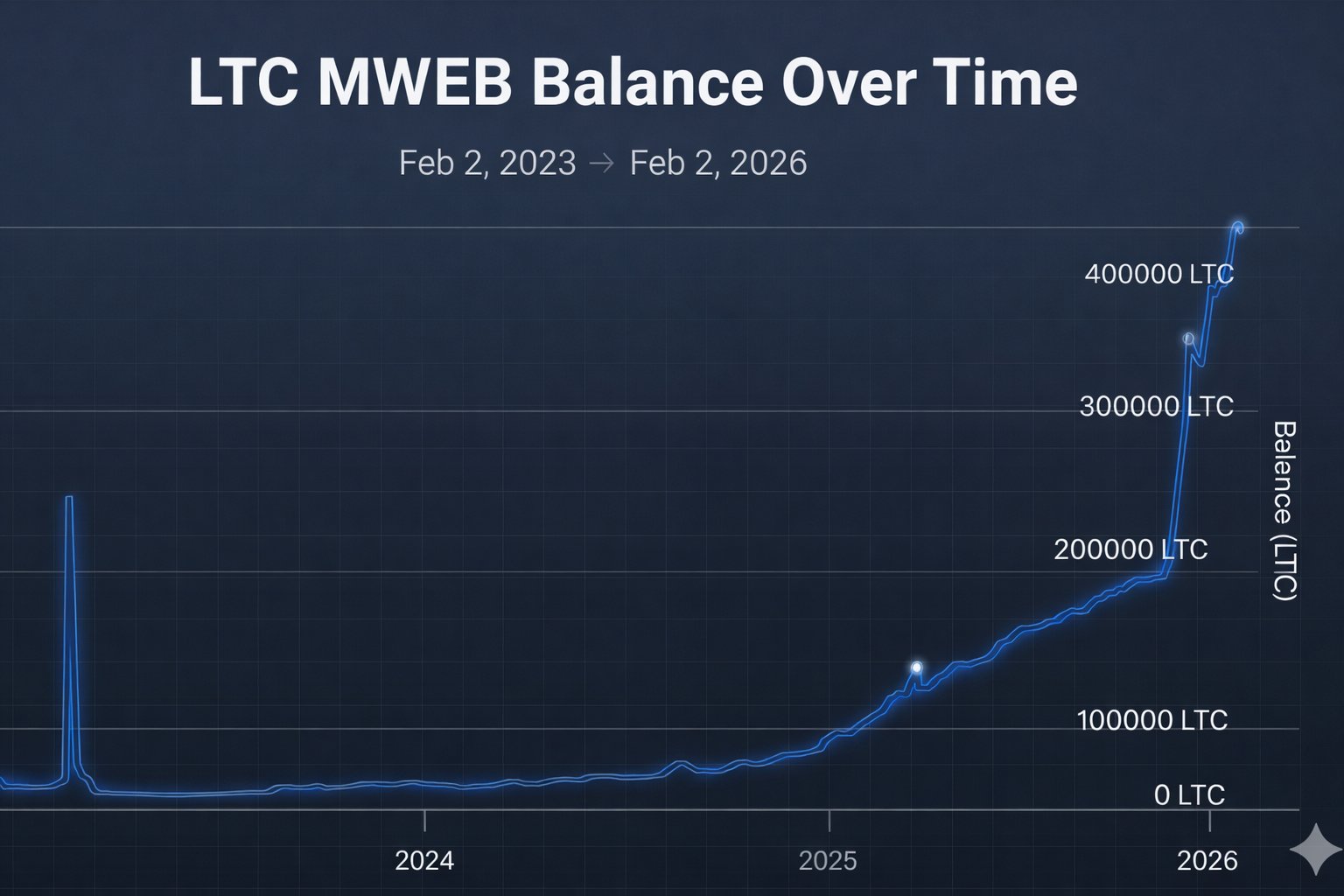
At the same time, activity on Litecoin’s opt-in privacy layer, MWEB, hit a new high. The balance of LTC locked into MWEB climbed massively over the past month, with record peg-ins.

Even with weak market sentiment, Litecoin’s payment utility and network usage remains firmly intact.


Final Thoughts

  • Litecoin’s price is weak, but payment usage and growing MWEB activity prove demand has not disappeared.
  • Institutional support and real-world utility continue to anchor LTC.
Next: Hyperliquid sees $4mln whale accumulation as HYPE rallies – Only to face THIS test!
Share
  • Share
  • Tweet

Perguntas relacionadas

QWhat is the current price trend of Litecoin (LTC) according to the article?

ALitecoin has slipped to its lowest level in more than four months, falling nearly 12% over the past week, with the greater trend being bearish.

QWhich Japanese company's crypto exchange recently added Litecoin to its lending offerings?

ASBI VC Trade, a crypto exchange backed by Japan's SBI Holdings, recently added Litecoin to its crypto lending offerings.

QWhat was Litecoin's ranking in cryptocurrency payments for January according to CoinGate data?

ALitecoin was the third most used cryptocurrency for payments in January, accounting for 17.7% of transactions, just behind Bitcoin and USD Coin.

QWhat aspect of Litecoin's network activity reached a new high despite weak market sentiment?

AActivity on Litecoin's opt-in privacy layer, MWEB, hit a new high with record peg-ins and a massive increase in LTC locked into MWEB over the past month.

QWhat two technical indicators mentioned in the article showed negative signals for LTC's price?

AThe RSI showed heavy selling and the MACD stayed negative, indicating that downside momentum had yet to fully fade.

Leituras Relacionadas

TechFlow Intelligence Bureau: Chip Stocks Lose Trillions in a Single Day, Bitcoin Falls Below $60,000, US-Iran Conflict Escalates

**Daily Tech & Markets Roundup: AI Advances, Market Turmoil, and Geopolitical Tensions** **AI / LLMs**: Anthropic's internal report on AI self-improvement sparked serious discussions about Recursive Self-Improvement (RSI). Meanwhile, debate continues on AI coding tools after Claude was accused of introducing bugs into the rsync codebase. In positive news, DeepSeek V4 Flash impressed in local deployment tests, and GitHub Copilot now supports custom endpoints for local models. A surprising research turn suggests removing chain-of-thought prompting can sometimes improve LLM performance. **Crypto / Web3**: Bitcoin plunged below $60,000, with its RSI hitting levels last seen during the COVID-19 crash, driven by strong U.S. jobs data reviving interest rate hike fears. Discussions highlight Ethereum DeFi's continued lack of a smooth consumer payment layer. **Chips / Hardware**: Chip stocks suffered a massive sell-off, with the Philadelphia Semiconductor Index posting its worst single-day drop in six years, erasing over a trillion dollars in value. Marvell, Micron, AMD, and Intel were among the biggest losers. **Tech Companies**: A leaked Microsoft document revealing goals to make Copilot "addictive" drew criticism. LinkedIn founder Reid Hoffman left Microsoft's board to focus full-time on his AI agent startup, Manus. Google was revealed to be paying SpaceX $920 million monthly for AI training compute. **Markets & Macro**: A blowout U.S. jobs report (172k vs. 80k expected) crushed hopes for near-term rate cuts, sending Treasury yields soaring and triggering a broad market sell-off. CEOs from Kraft, McDonald's, and Whirlpool simultaneously warned U.S. consumers are exhausting their savings. **Geopolitics**: U.S.-Iran tensions escalated with missile/drone interceptions and U.S. strikes on Iranian radar sites, keeping the critical Strait of Hormuz largely closed since late February and posing ongoing oil supply risks. **The Bottom Line**: The strong jobs data acted as a single trigger for correlated sell-offs across equities, crypto, and chips. Underlying the volatility is a stark contradiction between robust employment data and warnings of consumer weakness, alongside geopolitical risks that could reignite inflation, leaving markets to price in a fraught macro outlook with no clear "soft landing" path.

marsbitHá 2h

TechFlow Intelligence Bureau: Chip Stocks Lose Trillions in a Single Day, Bitcoin Falls Below $60,000, US-Iran Conflict Escalates

marsbitHá 2h

It Took Me a Year to See the Bitter Truth About Agent Payments

After a year building infrastructure for the Agent economy, engaging with major players like Stripe, Visa, and Coinbase, the author shares a sobering analysis of the current state of Agent payments. The core finding is a stark lack of genuine, immediate demand across most envisioned use cases. The article breaks down four key market segments: 1. **Agent-to-Merchant (Consumer Shopping):** For most product categories (e.g., clothing, electronics), conversational AI shopping is a step backwards from visual e-commerce interfaces. While agents excel at understanding needs, they can't replace side-by-side product comparison. Real merchant interest is defensive "Agent Engine Optimization," not driven by current customer demand. Potential exists for high-frequency, low-decision purchases (like food delivery) or navigating complex store UIs, but these require massive B2C distribution channels dominated by giants like Amazon. 2. **Agent-to-API (Developer Services):** Developers already have subscriptions and billing relationships for APIs (compute, data). Prepaid balances solve micro-payment issues for low transaction volumes. A deeper structural problem is that major SaaS vendors' business models rely on enterprise contracts, resisting granular pay-per-call pricing. While protocols like MPP and x402 serve the long tail of niche services, this market is small and developers are historically low-willingness-to-pay. 3. **Agent-to-Agent:** This remains largely theoretical with minimal transaction volume. While it represents a long-term bet on a fundamentally new transaction infrastructure (sub-second, micro-penny to million-dollar, multi-party settlements), it does not constitute a present market. 4. **Agent-to-Finance:** This is the only category with existing, paying demand. Integrating AI into financial workflows (trading, portfolio management) is a natural evolution and enables new capabilities like autonomous rebalancing. However, competition favors established, regulated institutions. The "real problem" is not moving money between agents, but the broader challenge of **coordination**—orchestrating work between agents and humans, verifying outcomes, and settling results. Payment is just one component of settlement, which is itself part of coordination. Companies that solve the coordination layer will subsume payment, not the other way around. While well-funded incumbents build defensively for a long-term future, startups must find where the market is today—which, for the author's team, lies outside these four categories in an area of real, growing, and underserved activity.

marsbitHá 3h

It Took Me a Year to See the Bitter Truth About Agent Payments

marsbitHá 3h

It Took Me a Year to See the Hard Truth About Agent Payments

**Title: It Took Me a Year to See the Hard Truth About Agent Payments** Over the past year, I've worked on infrastructure for the Agent economy, engaging with major players like Stripe, Visa, Coinbase, and numerous startups. The findings reveal a stark reality: genuine, widespread demand for Agent-based payments does not yet exist. **Key Observations:** * **Agent-to-Merchant (Shopping):** The user experience for AI shopping often falls short, especially for visual product discovery. While AI excels at understanding needs, conversational interfaces can't yet replace browsing and comparing multiple products visually. Current merchant interest is largely defensive ("Agent Engine Optimization") for a future that hasn't arrived. High-frequency, low-friction purchases (like food delivery) are potential fits, but lack open APIs and face high AI inference costs. Simpler, more affordable, or cross-language interactions for complex UIs are a niche opportunity but require massive consumer distribution to scale. * **Agent-to-API (Developer Tools):** Developer payment needs for APIs (computing, data, models) are already met through subscriptions and prepaid credits. The core challenge is not payment friction but supplier economics: most large SaaS providers prefer enterprise contracts over micropayments for API calls. Protocols like MPP and x402 suit the long-tail of smaller services but cater to a developer market historically reluctant to pay for these tools. Major infrastructure needs at the top of the stack are already being addressed. * **Agent-to-Agent (Machine Commerce):** This is a long-term vision with almost no current transaction volume. While a future with high-speed, high-frequency, multi-party machine-to-machine transactions would require novel infrastructure, it remains theoretical. The market is not here yet. * **Agent-to-Finance:** This is the only category with clear, present demand. Financial professionals and DeFi users already pay for tools, and AI augmentation is a natural evolution. Autonomous AI agents can enable entirely new financial strategies. However, competition is fierce from established, regulated incumbents who can more easily layer AI onto their existing products. **The Core Insight:** Companies, especially giants with long time horizons, are building defensively for a potential future of mass machine commerce. For them, early investment is a low-cost hedge. For startups, the current market reality is different. The primary challenge isn't just moving money between agents (payments). The larger, unsolved problem is **orchestration** – coordinating work between agents and humans, verifying outcomes, and then settling. Payment is just a part of settlement, which is just a part of orchestration. Companies that solve the orchestration problem will subsume payments, not the other way around. After a year of building, we see the real, growing, and underserved market opportunity lies in this broader domain of orchestration.

链捕手Há 3h

It Took Me a Year to See the Hard Truth About Agent Payments

链捕手Há 3h

Trading

Spot
Futuros

Artigos em Destaque

Como comprar LTC

Bem-vindo à HTX.com!Tornámos a compra de Litecoin (LTC) simples e conveniente.Segue o nosso guia passo a passo para iniciar a tua jornada no mundo das criptos.Passo 1: cria a tua conta HTXUtiliza o teu e-mail ou número de telefone para te inscreveres numa conta gratuita na HTX.Desfruta de um processo de inscrição sem complicações e desbloqueia todas as funcionalidades.Obter a minha contaPasso 2: vai para Comprar Cripto e escolhe o teu método de pagamentoCartão de crédito/débito: usa o teu visa ou mastercard para comprar Litecoin (LTC) instantaneamente.Saldo: usa os fundos da tua conta HTX para transacionar sem problemas.Terceiros: adicionamos métodos de pagamento populares, como Google Pay e Apple Pay, para aumentar a conveniência.P2P: transaciona diretamente com outros utilizadores na HTX.Mercado de balcão (OTC): oferecemos serviços personalizados e taxas de câmbio competitivas para os traders.Passo 3: armazena teu Litecoin (LTC)Depois de comprar o teu Litecoin (LTC), armazena-o na tua conta HTX.Alternativamente, podes enviá-lo para outro lugar através de transferência blockchain ou usá-lo para transacionar outras criptomoedas.Passo 4: transaciona Litecoin (LTC)Transaciona facilmente Litecoin (LTC) no mercado à vista da HTX.Acede simplesmente à tua conta, seleciona o teu par de trading, executa as tuas transações e monitoriza em tempo real.Oferecemos uma experiência de fácil utilização tanto para principiantes como para traders experientes.

1.1k Visualizações TotaisPublicado em {updateTime}Atualizado em 2026.06.02

Como comprar LTC

Discussões

Bem-vindo à Comunidade HTX. Aqui, pode manter-se informado sobre os mais recentes desenvolvimentos da plataforma e obter acesso a análises profissionais de mercado. As opiniões dos utilizadores sobre o preço de LTC (LTC) são apresentadas abaixo.

活动图片












