On October 12, Cleveland Fed President Beth Hammack stated in a speech that current monetary policy still needs to remain restrictive, and interest rates may need to rise further to bring inflation back to 2% in a timely manner.
She mentioned that when communicating with businesses, what she sees is strong demand, businesses still have pricing power, and inflationary pressures are not solely from energy. In the same week, the 10-year US Treasury yield traded between 5.2% and 5.3%, touching above 5.35% intraday—its highest level since 2002.
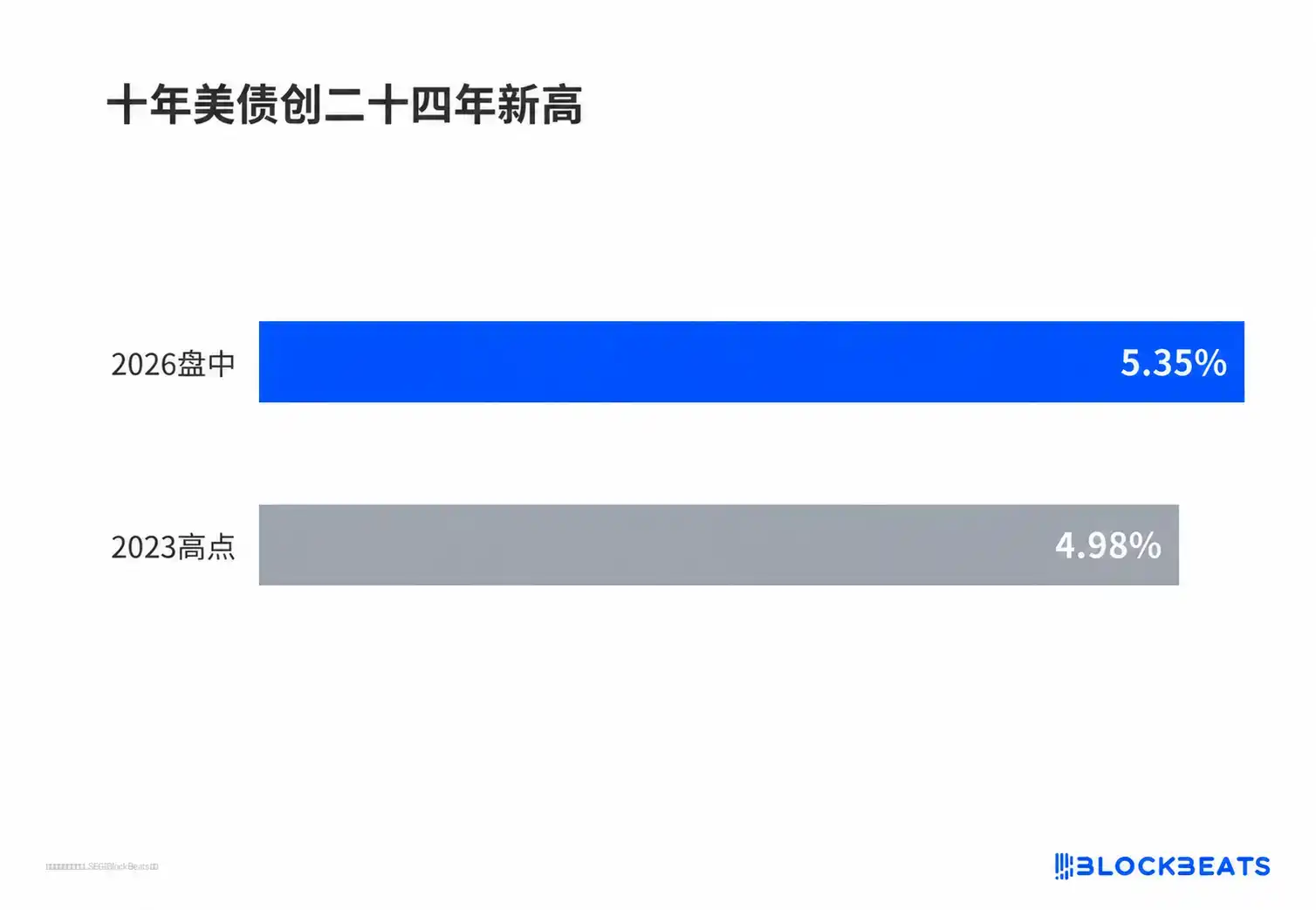
10-Year Treasury Hits 24-Year High
On one side, the long end has already tightened financial conditions for the central bank; on the other, policymakers believe it's still far from enough. The divergence lies in the fact that the short end and the long end have decoupled: expectations for the short end are declining, while the long end is rising.
The Long End Is Rising as the Wholesale Price of Funds
For investors, the 10-year US Treasury yield is the pricing benchmark for global assets. Mortgages, corporate bonds, and stock discount rates are all referenced against it. Its rise means the wholesale cost of borrowing for the entire economy becomes more expensive.
This time, it's not the short end moving. The 2-year yield is around 4.8%, and the federal funds target rate range is 3.75% to 4%. The 10-year yield is about 130 basis points higher than the policy rate.
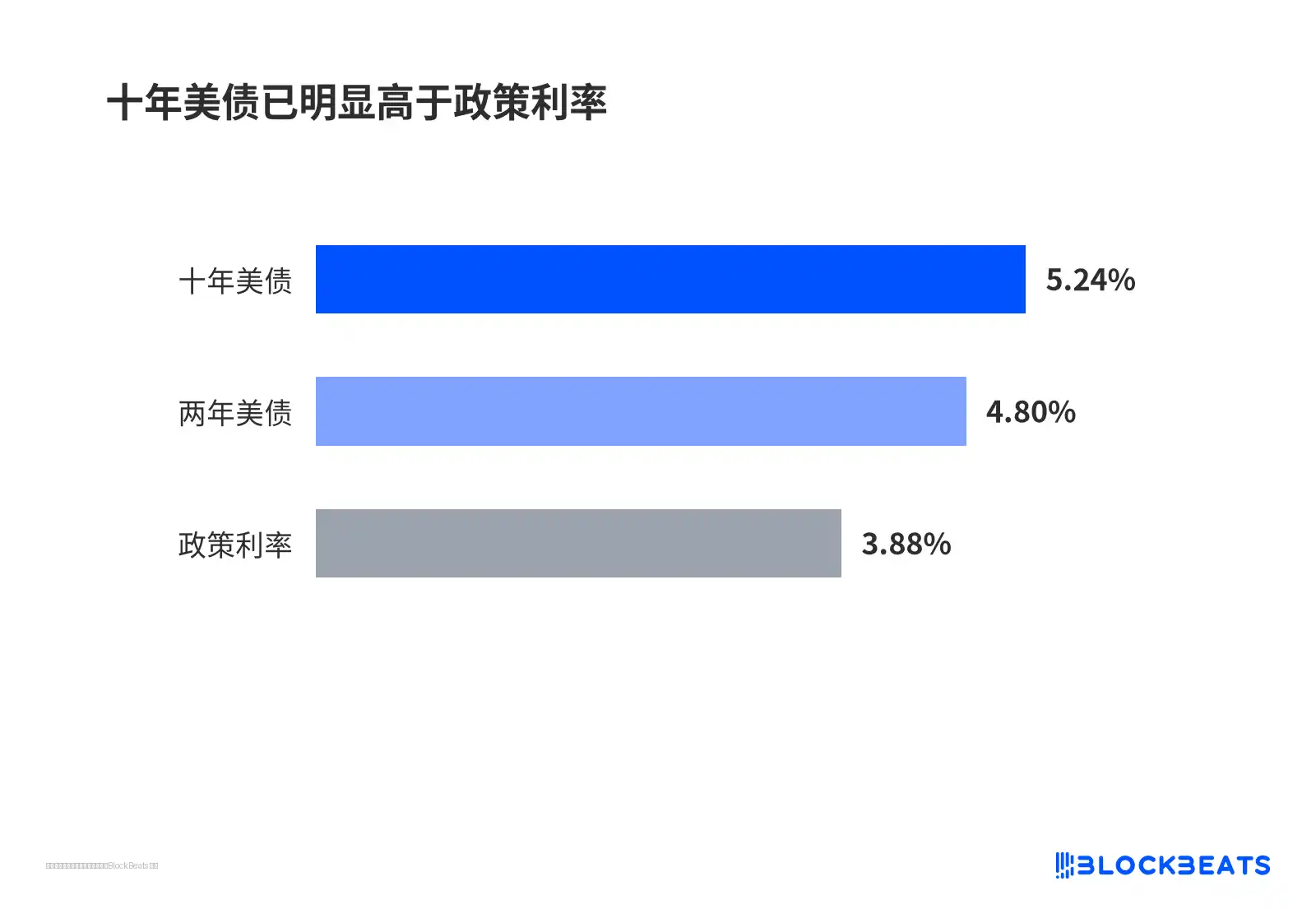
The 10-Year Treasury Is Significantly Higher Than the Policy Rate
The market is pricing not the next few meetings, but the cost of funds over the next decade and beyond.
At the same time, traders' pricing for future interest rate hikes in major global economies via swaps has clearly retreated since mid-September, and market pricing for the probability of a Fed rate hike in October has also dropped to a relatively low level. Short-end expectations are falling, yet the long end is rising, indicating that the push higher in the long end is not driven by the market's judgment on the policy path.
Term Premium Separates the Long End from the Policy Path
First, an explanation of term premium. Lending money to the government for thirty years involves, besides anticipating the path of future short-term rates, charging an additional compensation for long-term uncertainty. When this compensation becomes more expensive, long-term bond prices fall, even if the central bank stands still. In this cycle, the 30-year term premium has risen to a multi-year high.
One driver is supply. The Treasury continues to issue long-term bonds, and investors demand higher yields to take them on. Another is competition for long-term funds: AI capital expenditures are competing for the same pool of money as Treasuries. Data center financing and corporate bond issuance are pushing up funding costs.
Some institutional investors say this round of selling has forced some hedge funds to cut losses and exit. There are also more aggressive views in the market, suggesting yields could approach 6% next year. The latter is an extreme scenario, not the consensus, but it indicates the market is starting to price in fiscal and long-term uncertainties.
Asset Manager Selling Amplified the Pace in Early October
The accelerated decline in early October was related to passive position reductions by asset management firms. Asset managers often use futures to amplify their long-term bond positions. When yields rise rapidly, the same position loses money faster, forcing them to reduce positions, which in turn pushes yields higher.
This is a trading-level amplifier, not the central bank selling bonds. It explains the speed of the rise in early October, not the starting point of this trend. Whether the trend continues depends on whether the supply of long-term bonds can be steadily absorbed.
Mortgages, Small-Cap Stocks, and Emerging Markets Are Already Paying the Bill
The transmission of long-term rates is already becoming visible. The average rate for a 30-year fixed mortgage has risen to around 7.4%, returning to levels near the highs of late 2023.
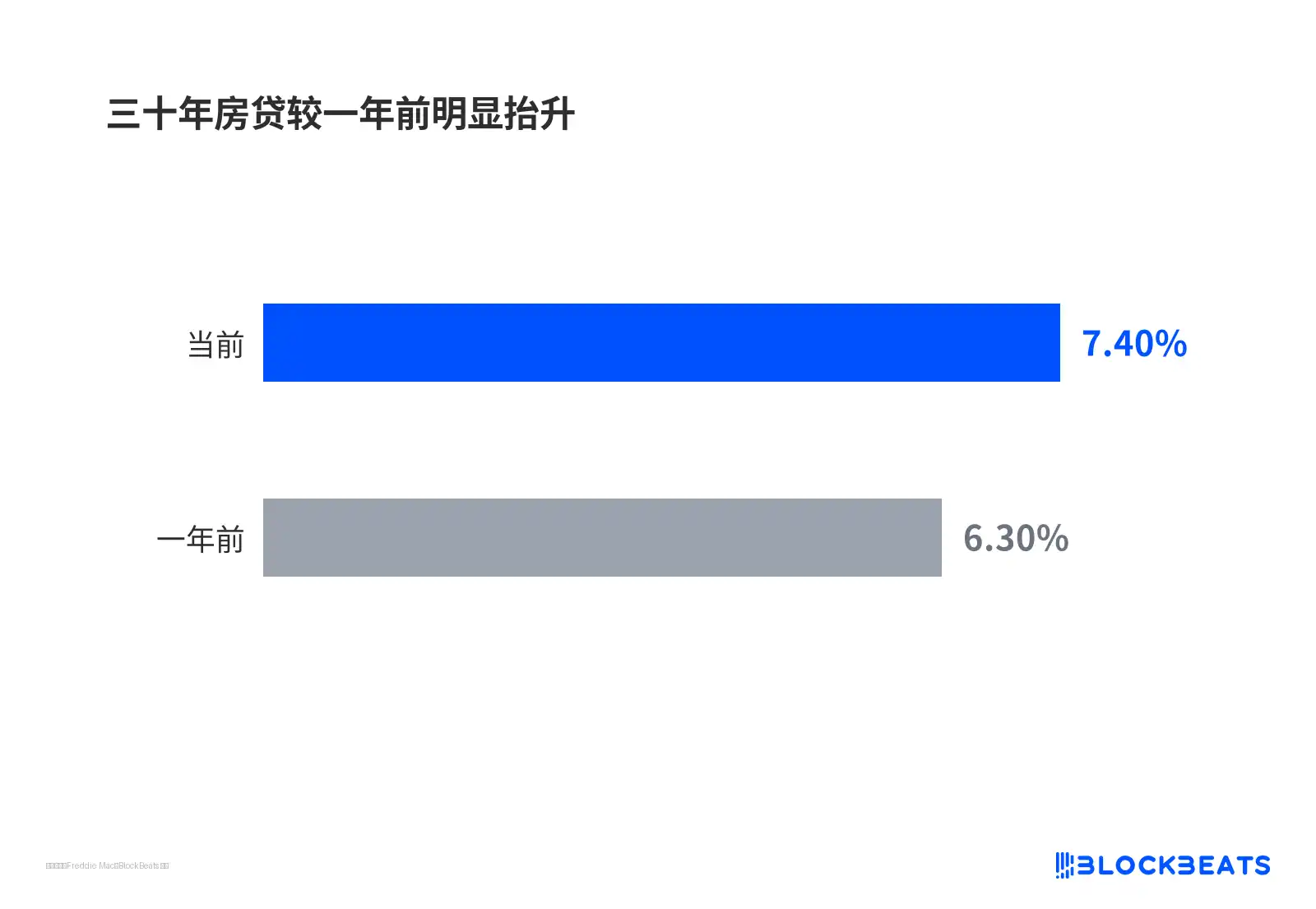
Thirty-Year Mortgage Rates Are Significantly Higher Than a Year Ago
Working backward from the rule that monthly payments should not exceed 30% of income, the income required to buy a median-priced home is already significantly higher than the median household income. Further rises in mortgage rates will only widen this gap.
Small-cap stocks are more sensitive to interest rates. The Russell 2000 has declined for multiple consecutive weeks, with a pullback close to 10% from its August peak. These companies have a higher proportion of short-term and floating-rate debt, and their refinancing costs will rise noticeably as long-term rates increase.
Mortgage-backed securities are also under pressure. Related funds have seen sustained outflows in recent weeks, with September being one of the weaker performing months in recent years. An extreme spillover example appears in frontier markets, where the Ugandan shilling once fell to its weakest level in decades. This is an extreme case of spillover, not a template for a global crisis.
Inflation Data and Long-Term Bond Auctions Determine if 5.3% Is the New Anchor
The CPI data to be released this Wednesday is the next observation point. Market consensus expects headline inflation to rise to 3.6%-3.7% due to energy, with core inflation around 2.4%. This is an expectation, not the result. The FOMC meeting on October 27-28 will provide another clue.
If core inflation continues to moderate and long-term bond auction demand improves, the term premium could be compressed, and the long end could shift into high-level consolidation. If corporate pricing power remains as strong as Hammack observed in her business communications, pricing for short-end rate hikes will be revised upward again, and financial conditions will need to tighten another notch.
Whether the 10-year yield of 5.3% is a temporary peak or the new anchor for pricing over the next two to three years depends on whether the supply of long-term bonds can be steadily absorbed and whether core inflation will reaccelerate. These two variables are more important than the remarks of any single official like Hammack.