Lighter TGE Imminent: Full Overview of Timeline, On-Chain Signals, and Market Pricing

Odaily星球日报Publicado em 2025-12-24Última atualização em 2025-12-24

Resumo

Lighter, a perpetual contract trading platform built on Ethereum L2, is expected to undergo its Token Generation Event (TGE) soon, with market speculation pointing to a window between December 24 and January 1. Key signals include its recent addition to Coinbase's listing roadmap, a Binance perpetual futures pre-market listing, and on-chain movements of 250 million LIT tokens (25% of total supply) suspected to be for airdrop distribution. Data from DeFiLlama shows Lighter leading the Perp DEX sector with $232.3B in trading volume over the past 30 days and a TVL exceeding $1.4B. The project distinguishes itself by leveraging Ethereum's ecosystem rather than building an independent L1, aiming to combine CEX efficiency with DEX security. Pre-market trading on Binance values LIT at around $3.2, implying a fully diluted valuation (FDV) of approximately $3.2B. Market analysts project a range of potential valuations: a bear case of $1.5B FDV ($1.5 per token), a base case of $3B–$4.2B FDV, and a bullish scenario of $7.5B–$12.5B FDV. Users are advised to monitor official announcements closely, as the team is currently reviewing Sybil and wash-trading activities before final airdrop distribution.

Original | Odaily Planet Daily (@OdailyChina)

Author | Asher (@Asher_ 0210)
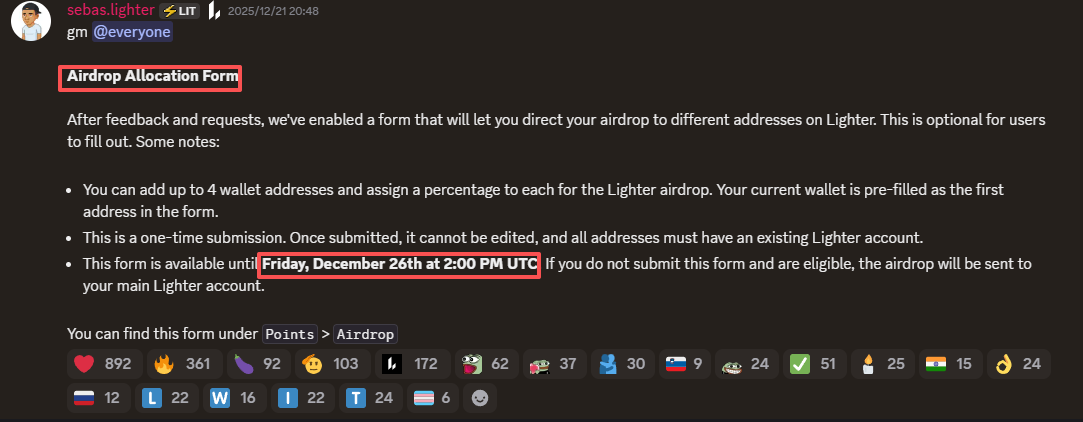
On December 13, Coinbase Markets announced on platform X that Lighter had been added to its listing roadmap; On December 21, Lighter officially announced on Discord, requiring users to complete airdrop address registration by December 26; On December 23, Binance launched Lighter (LIT) perpetual contract pre-market trading. With multiple key milestones landing in quick succession, market expectations for Lighter's imminent Token Generation Event (TGE) have rapidly heated up.
On-chain data further confirms this judgment. On December 20, the Lighter token contract transferred 250 million LIT to a new address (0x98e7769167194A8Cf272B649319676bE84052b5f); This morning, this address has already distributed varying amounts of tokens to 20 addresses, with the highest single transaction being approximately 3.1 million tokens and the lowest about 9,820 tokens. It currently still holds about 230 million LIT. Although the official use of this batch of tokens has not been disclosed, the community widely speculates it may be for airdrop-related distribution.

It is worth noting that 250 million LIT恰好 exactly accounts for 25% of the total token supply,高度 consistent with the community's previous猜测猜测 about "25% allocated for airdrops," further strengthening the market's judgment that Lighter is about to complete its TGE.

Lighter token contract transfers 250 million LIT to a new address

Regarding the timeline expectation, feedback from participants of the previous Lighter Japan AMA suggests the TGE might occur in the window from December 24 to January 1 next year; On the prediction event "When will Lighter conduct its TGE?" on Polymarket, December 29 has the highest probability, currently around 75%.
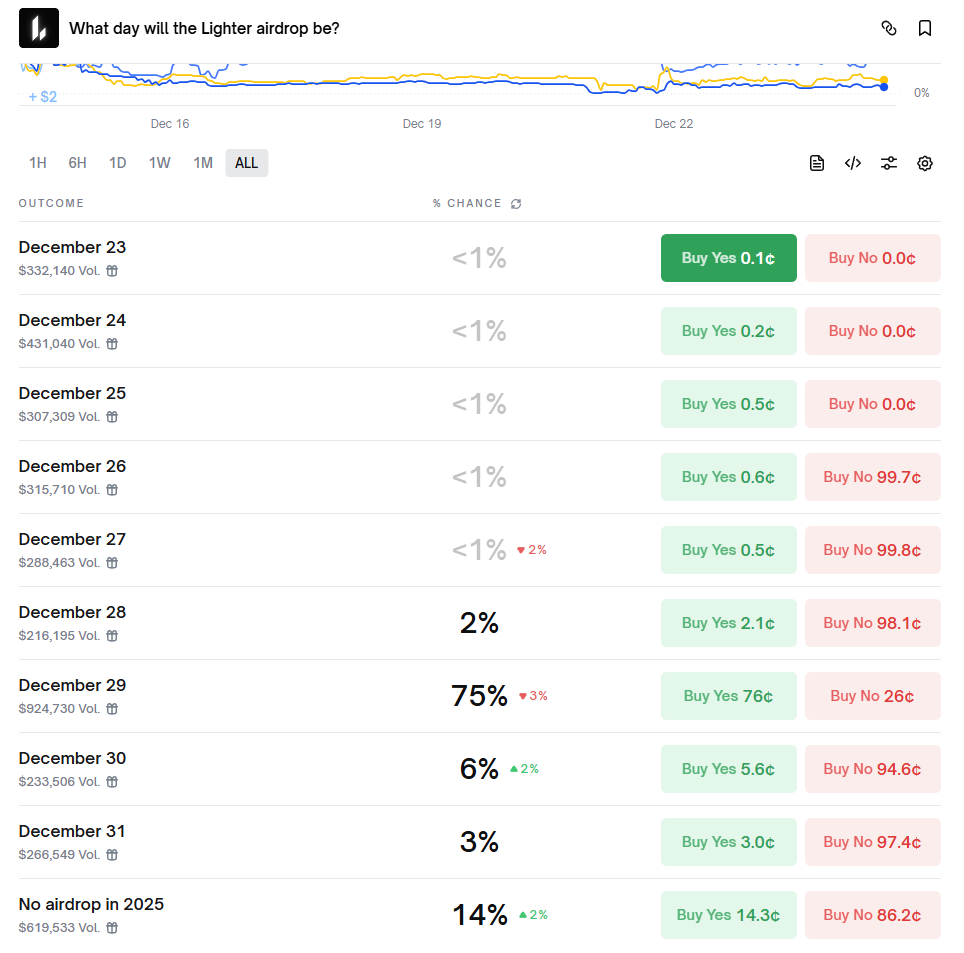
Polymarket prediction event: "On which day will Lighter conduct its TGE?"

Lighter Ranks First in Perp Dex Sector by Perpetual Contract Volume Over Past 30 Days

Lighter is a perpetual contract trading platform built on Ethereum Layer 2 (L2), aiming to combine the speed and liquidity of centralized exchanges (CEX) with the security and transparency of decentralized exchanges (DEX).

According to DeFiLlama data, over the past 30 days, Lighter led the Perp Dex sector with approximately $232.3 billion in perpetual contract trading volume, ahead of Aster ($195.5 billion) and Hyperliquid ($182 billion).

Perp Dex sector perpetual contract trading volume ranking

Furthermore, Lighter's TVL has continued to rise in recent months, currently surpassing $1.4 billion, exceeding Aster's ($1.27 billion).
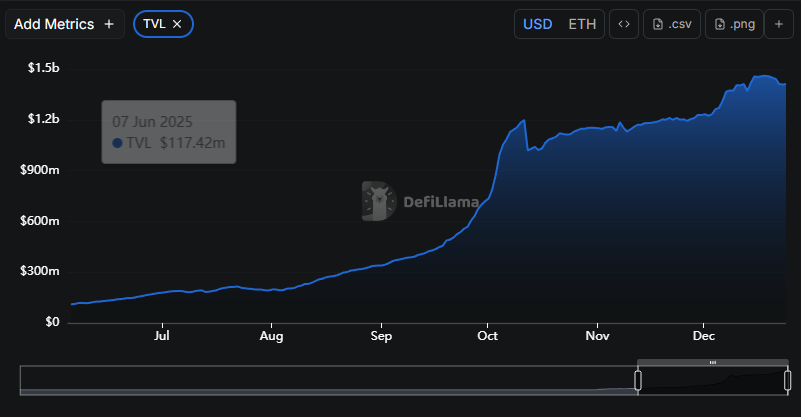
Lighter TVL Data

If Aster's backer is Binance, then Lighter's backer is Ethereum. As Lighter CEO Vladimir Novakovski previously commented on platform X, “Being an L1 is a bug, not a feature.”
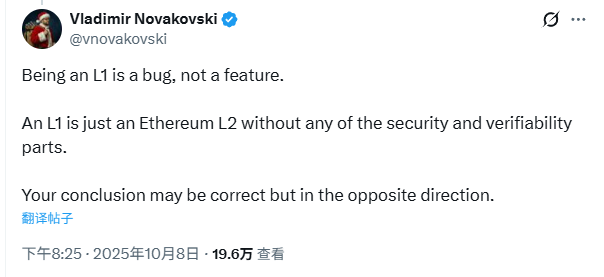
Lighter CEO comments on Lighter's choice of a modular L2 route

Instead of choosing a closed architecture like HyperLiquid's self-built L1, Lighter adopts a core route of "Ethereum-native composability": LLP Tokens can circulate on the mainnet and synergize with DeFi protocols like Aave, thus enjoying a low-cost, low-latency, verifiable execution environment within an open ecosystem. In other words, Lighter's goal is to allow any protocol to reuse its matching engine and capital system. Lighter is not meant to replace Ethereum, but to evolve with Ethereum, becoming the underlying engine for high-performance on-chain finance.

Lighter Valuation and Pre-Market Pricing

Based on Binance's perpetual contract pre-market trading, the LIT price has slowly declined from an initial $3.9 to a current quote of $3.2. At the current price, Lighter's Fully Diluted Valuation (FDV) is approximately $3.2 billion.

If 25% of the total token supply is entirely used for future airdrops, and given a total of 12 million points, then each point corresponds to approximately 20.8 LIT. Estimated at the current pre-market price, each point is worth about $66.

Market Participants' Valuation Range Estimates

Crypto KOL ingalvarez.sol (@ingalvarezsol) predicted Lighter's valuation by combining factors from Polymarket, OTC point prices, and the pre-market LIT token price:

  • $1.5 billion Minimum valuation under pessimistic conditions, corresponding to a token price of ~$1.5;
  • $3–4.2 billion: Bear market benchmark range, corresponding to a token price of ~$3 to $4;
  • $7.5–12.5 billion: Optimistic scenario, corresponding to a token price of ~$7.5 to $12.5;

Another early Lighter user, Chuk (@chuk_xyz), also made predictions based on Lighter's TVL, trading volume, revenue, and other data:

  • Bear Market Range ($1.5B–$4.2B FDV): If the price operates within this range post-TGE, it can be seen as an opportunity zone. The psychological pressure on airdrop holders is lowest, and the risk-reward ratio is clearest.
  • Benchmark Range ($4.2B–$7.5B FDV): If Lighter can stabilize its TVL and maintain a top-tier operational scale, this range can be considered fair value. After the price enters this range, it is suitable to take staged profits to break even while retaining some position.
  • Bull Market Range ($7.5B–$12.5B+ FDV): This range意味着 core catalysts have been fully priced in by the market, including strengthened RWA momentum and consensus formed around the distribution narrative (fintech/broker alignment). This stage is more suitable for continuously reducing positions during the upward trend.

On the Polymarket prediction event "Lighter FDV one day after opening," the probability of exceeding $1 billion FDV is as high as 88%, and the probability of exceeding $2 billion FDV is also 83%.
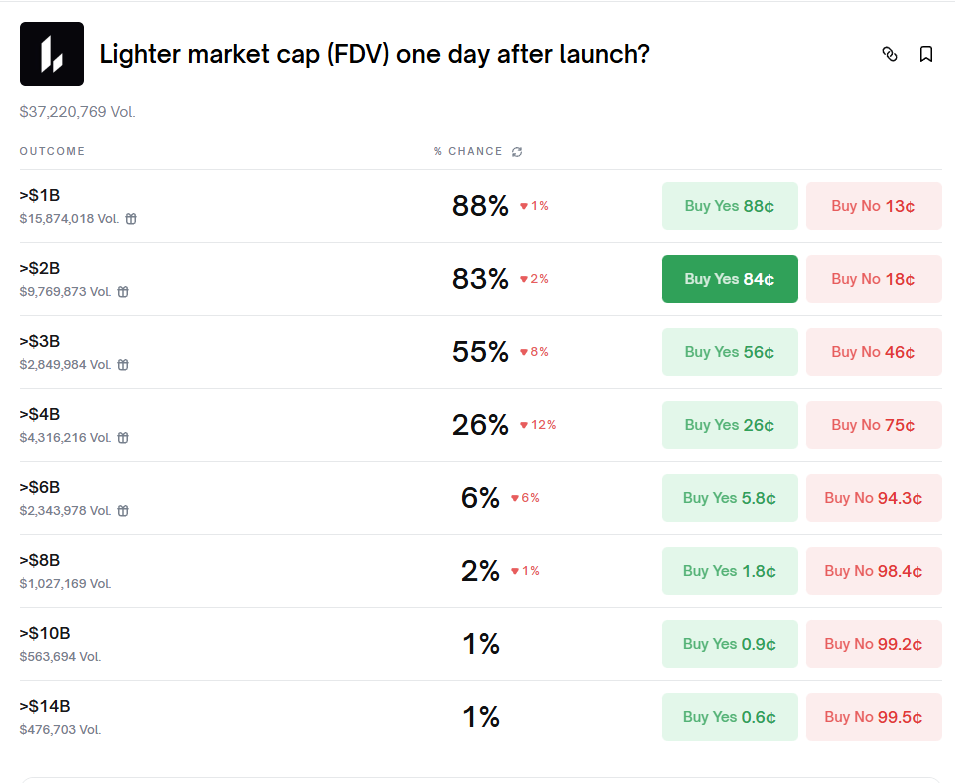
Polymarket event: "Lighter FDV one day after opening"

In summary, the market's minimum expectation for Lighter's opening valuation is an FDV of $1.5 billion, corresponding to a token price of $1.5. Therefore, if the opening price pulls back, $1.5 is an ideal short-term entry price.

Do Not "Celebrate at Halftime," Closely Monitor Official Announcements

Early participants in Lighter interactions must not "celebrate at halftime"; points cannot be considered profit until they are converted into actual LIT tokens. According to the latest announcement from Lighter on their official Discord, "We have entered the final stage of the second season points event. Data analysis is currently underway to remove points obtained by sybil addresses, self-trading, and wash trading. All slashed points (including portions already removed) will be redistributed to the community."

Latest announcement from Lighter on official Discord


Perguntas relacionadas

QWhat is the expected TGE (Token Generation Event) date for Lighter based on market predictions?

ABased on Polymarket predictions, the highest probability (around 75%) is for the TGE to occur on December 29th. Other community feedback suggests a window between December 24th and January 1st.

QWhat is the significance of the 250 million LIT tokens transferred to a new address on December 20th?

AThe transfer of 250 million LIT tokens, which is 25% of the total supply, is widely speculated by the community to be for airdrop distribution, aligning with previous rumors about the airdrop allocation.

QHow does Lighter's trading volume rank in the Perp DEX sector over the past 30 days?

AAccording to DeFiLlama data, Lighter ranked first in the Perp DEX sector for perpetual contract trading volume over the past 30 days, with approximately $232.3 billion, ahead of Aster and Hyperliquid.

QWhat is the current pre-market price of LIT on Binance and what is the corresponding Fully Diluted Valuation (FDV)?

AThe pre-market price of LIT on Binance is currently around $3.2, which corresponds to a Fully Diluted Valuation (FDV) of approximately $3.2 billion.

QWhat is the core architectural philosophy behind Lighter, as stated by its CEO?

ALighter's CEO, Vladimir Novakovski, stated that 'Being an L1 is a bug, not a feature.' Lighter is built as a modular Layer 2 on Ethereum, aiming to combine CEX-like speed and liquidity with DEX-like security and transparency, and to integrate natively with the Ethereum ecosystem.

Leituras Relacionadas

Agent Race Ends, Super Workbench Takes Over

The era of fragmented AI agents is ending. Over the past month, China's tech giants—Tencent, Alibaba, and ByteDance—have simultaneously shifted strategy: instead of launching new, standalone AI agents, they are consolidating their various agent projects into unified "super workbenches." Tencent integrated its QClaw teams into WorkBuddy, a strategic product hailed as a potential third flagship after QQ and WeChat. Alibaba is merging its QoderWork, Wukong, and MuleRun agents into a new "Qianwen Office" platform under DingTalk's leadership. ByteDance rebranded its TRAE SOLO coding agent to TRAE Work, signaling a broader focus on workflow collaboration. This convergence marks a pivotal industry consensus. The initial exploration phase, where companies rapidly built numerous overlapping agents for different scenarios, proved costly and inefficient. With open-source tools eroding technical barriers, competition has shifted from agent creation to resource consolidation and cost control. Historically, platform wars are won not by creating more products, but by simplifying them—as seen with browsers unifying web access and super-apps consolidating services. Now, the "super workbench" aims to become the unified AI entry point for work. This reflects a deeper market realization: the primary audience for AI is no longer just programmers (a market in the tens of millions) but all knowledge workers (a market of billions). The real opportunity lies in augmenting everyday tasks—managing emails, documents, data, and meetings—across the entire workday. The core battleground is becoming control over the primary AI entry point that employees use daily. Tencent's WorkBuddy leverages WeChat and Tencent Docs; Alibaba's Qianwen Office taps into DingTalk's organizational data; ByteDance's TRAE Work integrates with Feishu's workflows. Whoever owns this "super workbench" gains strategic control over orchestrating enterprise data and APIs. This shift is redefining enterprise software. Traditional SaaS applications, valued for their user interfaces, will recede into the background. Their core functionalities will be exposed as standardized "Skills" or APIs for the super workbench's agents to invoke. Software value will shift from selling user seats to charging based on API calls and outcomes delivered. The evolution of agents is moving through clear stages: first as novel standalone products, then as consolidated primary work entry points, and finally as pervasive, invisible capabilities embedded into the digital fabric. The recent moves by major tech firms signal the transition from the first stage into the second, accelerating toward the third. In the end, the most successful agent technology may become invisible—like electricity or the HTTP protocol—a fundamental, unnamed infrastructure powering work itself.

marsbitHá 3m

Agent Race Ends, Super Workbench Takes Over

marsbitHá 3m

Michael Saylor: 110 Reasons to Oppose BIP-110

Michael Saylor presents 110 arguments against Bitcoin Improvement Proposal (BIP) 110, a soft fork aimed at restricting certain non-monetary data storage uses (like inscriptions) on the Bitcoin blockchain. He acknowledges the proponents' valid concerns—such as node costs, fee pressure, and preserving Bitcoin's monetary focus—but fundamentally disagrees with the proposed solution. Saylor argues that BIP 110 represents a dangerous precedent of using consensus rules to enforce value judgments on transaction validity, moving away from Bitcoin's core principles of neutrality and permissionless innovation. His key objections are organized into eleven categories: 1) It violates neutrality and hard consensus by banning currently valid transactions. 2) It fails to meet the high burden of proof required for a consensus change, lacking concrete data on the alleged crisis. 3) Its seven bundled technical restrictions are overly broad, targeting generic script functionalities and blocking future upgrade paths. 4) It sacrifices compatibility and future optionality by closing off designed upgrade hooks. 5) Its temporary rules add significant complexity (grandfathering, expiry states) without sufficient justification. 6) The economic and security impacts, particularly on miner revenue and fee markets, are uncertain and unmodeled. 7) Superior, market-based tools (fee markets, relay/mining policies) already exist to manage blockchain load. 8) It stifles innovation by creating a chilling effect for developers. 9) Its modified activation mechanism (55% threshold, forced signaling) is aggressive and risks network splits. 10) The precedent it sets—using consensus to suppress disliked but legal uses—is more dangerous than the problem it aims to solve. 11) A better path exists: improving measurements, refining resource-based policies, and allowing market forces to work. Saylor concludes that Bitcoin's strength lies in its neutral rules, open markets, and hard consensus. Changing these foundational elements to target specific use cases is an unnecessary and risky "iatrogenic" intervention. He advocates for guarding Bitcoin's neutrality rather than acting as its redeemer.

marsbitHá 18m

Michael Saylor: 110 Reasons to Oppose BIP-110

marsbitHá 18m

Trading

Spot
活动图片

