Lighter TGE Imminent: A Complete Overview of the Timeline, On-Chain Signals, and Market Pricing

marsbitPublicado em 2025-12-24Última atualização em 2025-12-24

Resumo

An article titled "Lighter is about to TGE: A Complete Overview of the Timeline, On-Chain Signals, and Market Pricing" discusses the imminent Token Generation Event (TGE) for the Lighter (LIT) project. Key developments include its addition to Coinbase's listing roadmap, a deadline for airdrop address registration, and the launch of pre-launch perpetual contracts on Binance. On-chain data shows the transfer of 250 million LIT (25% of total supply) to a new address, strongly hinting at an upcoming airdrop. Market predictions on Polymarket suggest the TGE is most likely to occur around December 29th. Lighter is a perpetual contract trading platform built on Ethereum L2, leading its sector with $232.3B in trading volume over the past 30 days and a TVL exceeding $1.4B. Its core philosophy is to combine CEX speed with DEX security, opting for a modular L2 approach integrated with Ethereum rather than building an independent L1. Pre-launch trading on Binance values LIT at approximately $3.2, giving Lighter a Fully Diluted Valuation (FDV) of around $3.2 billion. Analyst predictions for the FDV post-TGE range from a bear case of $1.5B ($1.5 per token) to a bull case of $12.5B ($12.5 per token). The article concludes by cautioning users that airdrop rewards are not final until distributed, as the team is currently analyzing data to remove points earned by sybil addresses and wash trading.

Author | Asher(@Asher_ 0210)
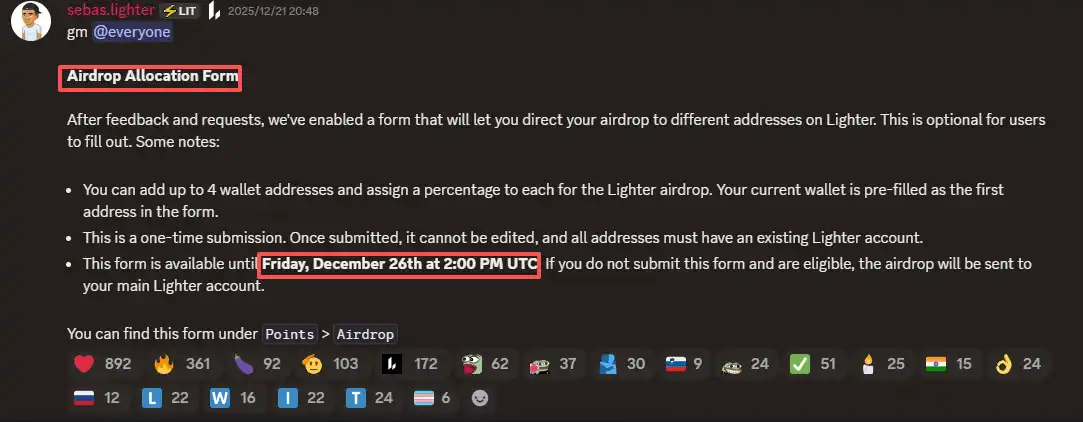
On December 13, Coinbase Markets announced on platform X that Lighter had been added to its listing roadmap; on December 21, Lighter officially announced on Discord that users must complete airdrop address registration by December 26; on December 23, Binance launched pre-market perpetual contract trading for Lighter (LIT). With multiple key milestones landing in quick succession, market expectations for Lighter's imminent Token Generation Event (TGE) have rapidly heated up.
On-chain data further confirms this judgment. On December 20, the Lighter token contract transferred 250 million LIT to a new address (0x98e7769167194A8Cf272B649319676bE84052b5f); this morning, this address has already distributed varying amounts of tokens to 20 addresses, with the single highest transfer being approximately 3.1 million LIT and the lowest about 9,820 LIT. It currently still holds about 230 million LIT. Although the official use for this batch of tokens has not been disclosed, the community widely speculates it is likely for airdrop-related distribution.

It is worth noting that 250 million LIT恰好 accounts for exactly 25% of the total token supply,高度一致 with previous community speculation about "25% allocated for the airdrop," further strengthening the判断 that Lighter is about to complete its TGE.

Lighter token contract transfers 250 million LIT to a new address

Regarding the timing expectation, feedback from participants in Lighter's recent Japanese AMA suggests the TGE might occur in the window from December 24 to January 1 next year; on Polymarket's prediction event for "When will Lighter conduct its TGE?", December 29 currently has the highest probability, around 75%.
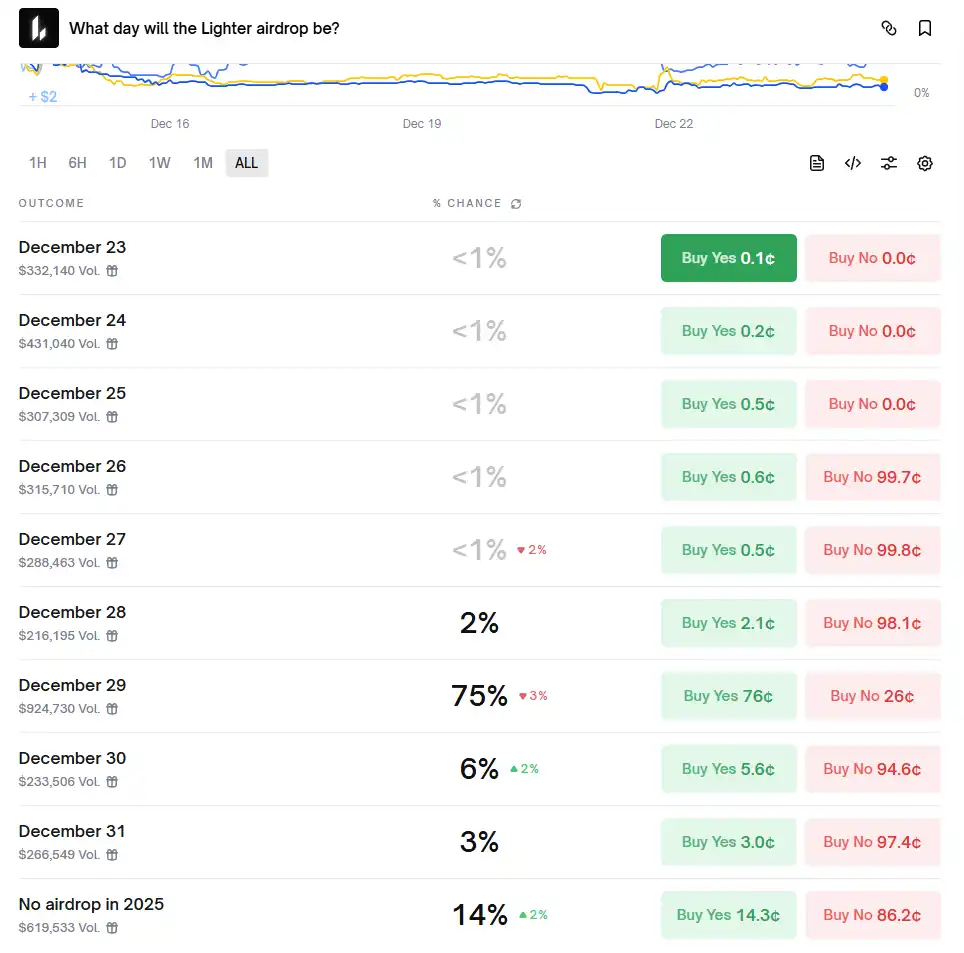
Polymarket prediction event: "On which day will Lighter conduct its TGE?"

Lighter Ranks First in Perp Dex Sector for Perpetual Contract Volume Over Past 30 Days

Lighter is a perpetual contract trading platform built on Ethereum Layer 2 (L2), aiming to combine the speed and liquidity of centralized exchanges (CEX) with the security and transparency of decentralized exchanges (DEX).

According to DeFiLlama data, over the past 30 days, Lighter led the Perp Dex sector with approximately $232.3 billion in perpetual contract trading volume, ahead of Aster ($195.5 billion) and Hyperliquid ($182 billion).

Perp Dex sector perpetual contract trading volume ranking

Furthermore, Lighter's TVL has continued to rise in recent months, currently exceeding $1.4 billion, surpassing Aster ($1.27 billion).
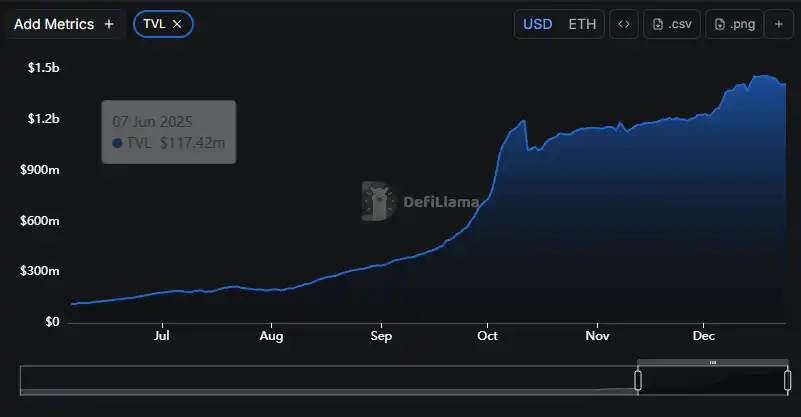
Lighter TVL Data

If Aster's backing is Binance, then Lighter's backing is Ethereum. As Lighter CEO Vladimir Novakovski previously stated in a comment on platform X, “Being an L1 is a bug, not a feature.”
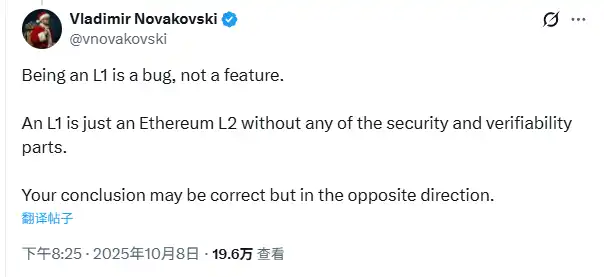
Lighter CEO comments on Lighter's choice of a modular L2 path

Instead of opting for a closed architecture like HyperLiquid's self-built L1, Lighter focuses on an "Ethereum-native composability" core路线: LLP Tokens can circulate on the mainnet and synergize with DeFi protocols like Aave, thus enjoying a low-cost, low-latency, verifiable execution environment within an open ecosystem. In other words, Lighter's goal is to allow any protocol to reuse its matching engine and capital system. Lighter is not meant to replace Ethereum, but to evolve with Ethereum, becoming the underlying engine for high-performance on-chain finance.

Lighter Valuation and Pre-Market Pricing

Based on Binance's pre-market perpetual contract trading, the LIT price has slowly declined from an initial $3.9 to currently around $3.2. At the current price, Lighter's Fully Diluted Valuation (FDV) is approximately $3.2 billion.

If 25% of the total token supply is entirely used for future airdrops, and given a total of 12 million points, then each point corresponds to approximately 20.8 LIT. Estimated at the current pre-market price, each point is worth about $66.

Market Participants' Valuation Range Estimates

Crypto KOL ingalvarez.sol (@ingalvarezsol) predicted Lighter's valuation based on factors including Polymarket, OTC point prices, and the pre-market LIT token price:

  • $1.5 billion: Minimum valuation under pessimistic conditions, corresponding to a token price of ~$1.5;
  • $3–4.2 billion: Bear market baseline range, corresponding to a token price of ~$3 to $4;
  • $7.5–12.5 billion: Optimistic scenario, corresponding to a token price of ~$7.5 to $12.5;

Another early Lighter user, Chuk (@chuk_xyz), also made predictions based on Lighter's TVL, trading volume, revenue, and other data:

  • Bear Market Range ($1.5B – $4.2B FDV): If the price trades in this range post-TGE, it can be seen as an opportunity zone. The psychological pressure on airdrop holders is lowest, and the risk-reward ratio is clearest;
  • Baseline Range ($4.2B – $7.5B FDV): If Lighter can stabilize its TVL and maintain a top-tier operational scale, this range can be considered fair value. After the price enters this range, it's suitable to take staged profits to recoup costs while retaining some position;
  • Bull Market Range ($7.5B – $12.5B+ FDV): This range意味着 core catalysts have been fully priced in by the market, including strengthened RWA momentum and the formation of consensus around the distribution narrative (fintech / broker alignment). This stage is more suitable for continuously reducing positions during the upward trend.

On Polymarket's prediction event for "Lighter FDV one day after opening," the probability of exceeding $1 billion FDV is as high as 88%, and the probability of exceeding $2 billion FDV is also 83%.
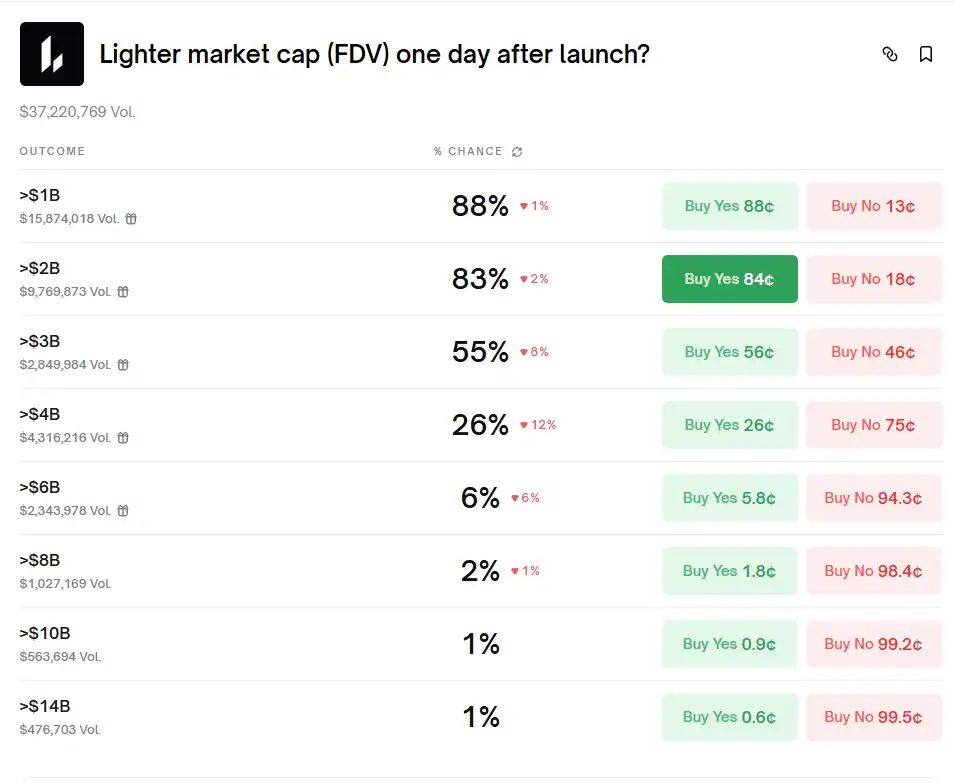
Polymarket event: "Lighter FDV one day after opening"

In summary, the market's minimum expectation for Lighter's opening valuation is around $1.5 billion FDV, corresponding to a token price of $1.5. Therefore, if the opening price experiences a pullback, $1.5 would be an ideal short-term entry price.

Do Not "Open the Champagne at Halftime" – Closely Monitor Official Announcements

Early users who participated in Lighter interactions must not "open the champagne at halftime"; points cannot be considered profit until they are converted into actual LIT tokens. According to the latest announcement from Lighter on their official Discord, "We have entered the final stage of the second season points event. Data analysis is currently underway to remove points obtained by sybil addresses, self-trading, and wash trading. All slashed points (including portions already removed) will be redistributed to the community."

Latest announcement from Lighter on official Discord


Criptomoedas em alta

Perguntas relacionadas

QWhat are the key events that indicate Lighter is approaching its TGE?

AKey events include Coinbase Markets adding Lighter to its listing roadmap on December 13, Lighter's official announcement on Discord for airdrop address registration by December 26, and Binance launching LIT perpetual futures pre-market trading on December 23.

QWhat on-chain activity suggests an airdrop is imminent for Lighter?

AOn December 20, the Lighter token contract transferred 250 million LIT (25% of total supply) to a new address, which then distributed tokens to 20 addresses. This aligns with community speculation of a 25% airdrop allocation.

QWhat is the predicted TGE date range for Lighter based on market signals?

ABased on feedback from a Japanese AMA, the TGE is expected between December 24 and January 1. Polymarket predictions show the highest probability (around 75%) for December 29.

QHow does Lighter's trading volume and TVL compare to competitors in the Perp Dex sector?

AOver the past 30 days, Lighter led the Perp Dex sector with approximately $232.3 billion in perpetual trading volume, ahead of Aster ($195.5B) and Hyperliquid ($182B). Its TVL also surpassed $1.4 billion, exceeding Aster's $1.27 billion.

QWhat are the market's valuation expectations for Lighter at TGE?

AMarket expectations range from a bear case FDV of $1.5 billion ($1.5 per token) to a base case of $3-4.2 billion ($3-4.2 per token) and an optimistic case of $7.5-12.5 billion ($7.5-12.5 per token). Polymarket predicts over $1 billion FDV with 88% probability.

Leituras Relacionadas

As Consensus Accelerates, What Are Young Investors Betting On?

Title: As Consensus Forms Faster, What Are Young Investors Betting On? In the rapid evolution of tech investment, a new generation of young investors is navigating a landscape where AI, robotics, commercial aerospace, and quantum computing are advancing simultaneously. Traditional investment logic based on financial models is giving way to a need for deep technical understanding and the ability to act before industry consensus forms. An analysis of trends from the "WAIC FUTURE TECH" list of young investment leaders reveals key shifts in focus. The first major trend is the movement of AI from the digital screen into the physical world. Investment is shifting from large language models and chatbots towards embodied AI, robotics, AI hardware, and edge computing. While demonstrations generate excitement, the real challenge lies in achieving scalable, reliable, and cost-effective delivery in complex real-world environments like factories and logistics. Success depends not just on algorithms but on the integration of sensors, actuators, and control systems. Second, the competitive focus for large models is moving beyond raw capability toward building an "intelligence flywheel." The goal is to create self-reinforcing systems where user interaction generates data, improving the model, which in turn enhances the user experience and attracts more engagement. Companies that successfully embed AI into workflows to create these closed-loop systems can build lasting value that isn't easily erased by the next model upgrade. Third, facing a potential bottleneck in high-quality human-generated data, investors are looking at new underlying technologies. Reinforcement learning and self-play, as demonstrated by AlphaGo Zero, offer paths for AI to generate its own experience. Scientific foundation models, which aim to build general AI capabilities for fields like life sciences and materials discovery, represent a non-consensus direction that could unlock new frontiers of knowledge and data. Finally, in deep-tech areas like quantum computing, commercial aerospace, and space-based infrastructure, patient capital is essential. These fields have long, uncertain development and validation cycles involving complex engineering, supply chains, and regulations. Investment here requires a long-term view, focusing on foundational team capabilities and the eventual emergence of market demand, even if commercial returns are distant. Collectively, these trends illustrate how young investors are adapting to a new era. They are learning to make earlier, technically-informed judgments, balance hype with real-world viability, and provide the patient capital needed to build the deep-tech foundations of the future.

marsbitHá 23m

As Consensus Accelerates, What Are Young Investors Betting On?

marsbitHá 23m

Can Japan Buy Growth with AI? Will the Bond Market Believe It?

Japan's cabinet has introduced the 2026 Basic Policy on Economic and Fiscal Management and Reform, shifting its primary fiscal target. The new framework moves away from the traditional annual primary balance goal and instead prioritizes a stable reduction of the debt-to-GDP ratio. This change is tied to a strategy of increased "responsible proactive fiscal" spending, aiming to boost long-term growth through investments in strategic sectors like AI, semiconductors, energy, and robotics. The government estimates total public and private investment in 62 key technologies could exceed 370 trillion yen by 2040. The market reaction has been mixed and cautious. While equity markets may respond to policy signals, bond markets are focused on fiscal credibility. Concerns center on whether the weakening of the clear primary balance anchor could lead to looser fiscal discipline. If investors doubt that these strategic investments will generate sufficient productivity gains, tax revenue, and nominal growth to outpace rising interest costs, they may demand higher yields on Japanese Government Bonds (JGBs). Recent volatility in the yen and JGB yields, with the 10-year yield briefly reaching 2.9%, reflects this skepticism. The success of this new framework hinges on two factors: whether Japan can achieve a nominal growth rate consistently higher than its long-term interest rates, and whether future budgets demonstrate disciplined control over bond issuance. The government's narrative is that strategic investment is essential to break Japan's cycle of low growth, aging, and labor shortages. However, the bond market will continuously assess the credibility of this plan, pricing the risk that it may represent fiscal expansion rather than a viable growth strategy.

marsbitHá 1h

Can Japan Buy Growth with AI? Will the Bond Market Believe It?

marsbitHá 1h

Misjudged A-Shares: Resilience, Expectations, and Confidence

China's A-share market recently faced selling pressure, especially in tech sectors, initially triggered by a global tech sell-off that began in South Korea. However, the article argues this is a case of "mistaken injury" and highlights the market's underlying resilience. This resilience stems from three main pillars: **1) Tech Sector Fundamentals:** Unlike Korea's market dominated by a few memory chip stocks, China's tech sector is diversified across computing, communications, electronics, and semiconductors, supported by dual narratives of global AI supply chains and domestic substitution. Core areas like optical modules and fiber optics continue to show strong earnings growth. **2) "National Team" Support:** State-backed institutions and large corporations have made significant market purchases and announced buybacks, providing liquidity and signaling confidence. This is seen as a stabilizing policy signal, often associated with market bottoms. **3) Broader Market Pillars:** Other major sectors are showing endogenous recovery momentum. Consumer stocks benefit from stabilizing CPI and signs of sector recovery (e.g., liquor price hikes). Cyclical sectors like aluminum have high earnings, potential price increases due to tight supply, and low valuations. The financial sector offers stable dividends and low valuations. The conclusion is that the sell-off was driven by external contagion, not a collapse in fundamentals. With strong policy support and recovering momentum across key sectors, the A-share market possesses the toughness to regain stability.

marsbitHá 1h

Misjudged A-Shares: Resilience, Expectations, and Confidence

marsbitHá 1h

Trading

Spot

Artigos em Destaque

Como comprar O

Bem-vindo à HTX.com!Tornámos a compra de O1 exchange (O) simples e conveniente.Segue o nosso guia passo a passo para iniciar a tua jornada no mundo das criptos.Passo 1: cria a tua conta HTXUtiliza o teu e-mail ou número de telefone para te inscreveres numa conta gratuita na HTX.Desfruta de um processo de inscrição sem complicações e desbloqueia todas as funcionalidades.Obter a minha contaPasso 2: vai para Comprar Cripto e escolhe o teu método de pagamentoCartão de crédito/débito: usa o teu visa ou mastercard para comprar O1 exchange (O) instantaneamente.Saldo: usa os fundos da tua conta HTX para transacionar sem problemas.Terceiros: adicionamos métodos de pagamento populares, como Google Pay e Apple Pay, para aumentar a conveniência.P2P: transaciona diretamente com outros utilizadores na HTX.Mercado de balcão (OTC): oferecemos serviços personalizados e taxas de câmbio competitivas para os traders.Passo 3: armazena teu O1 exchange (O)Depois de comprar o teu O1 exchange (O), armazena-o na tua conta HTX.Alternativamente, podes enviá-lo para outro lugar através de transferência blockchain ou usá-lo para transacionar outras criptomoedas.Passo 4: transaciona O1 exchange (O)Transaciona facilmente O1 exchange (O) no mercado à vista da HTX.Acede simplesmente à tua conta, seleciona o teu par de trading, executa as tuas transações e monitoriza em tempo real.Oferecemos uma experiência de fácil utilização tanto para principiantes como para traders experientes.

167 Visualizações TotaisPublicado em {updateTime}Atualizado em 2026.06.29

Como comprar O

Como comprar PROS

Bem-vindo à HTX.com!Tornámos a compra de Pharos (PROS) simples e conveniente.Segue o nosso guia passo a passo para iniciar a tua jornada no mundo das criptos.Passo 1: cria a tua conta HTXUtiliza o teu e-mail ou número de telefone para te inscreveres numa conta gratuita na HTX.Desfruta de um processo de inscrição sem complicações e desbloqueia todas as funcionalidades.Obter a minha contaPasso 2: vai para Comprar Cripto e escolhe o teu método de pagamentoCartão de crédito/débito: usa o teu visa ou mastercard para comprar Pharos (PROS) instantaneamente.Saldo: usa os fundos da tua conta HTX para transacionar sem problemas.Terceiros: adicionamos métodos de pagamento populares, como Google Pay e Apple Pay, para aumentar a conveniência.P2P: transaciona diretamente com outros utilizadores na HTX.Mercado de balcão (OTC): oferecemos serviços personalizados e taxas de câmbio competitivas para os traders.Passo 3: armazena teu Pharos (PROS)Depois de comprar o teu Pharos (PROS), armazena-o na tua conta HTX.Alternativamente, podes enviá-lo para outro lugar através de transferência blockchain ou usá-lo para transacionar outras criptomoedas.Passo 4: transaciona Pharos (PROS)Transaciona facilmente Pharos (PROS) no mercado à vista da HTX.Acede simplesmente à tua conta, seleciona o teu par de trading, executa as tuas transações e monitoriza em tempo real.Oferecemos uma experiência de fácil utilização tanto para principiantes como para traders experientes.

160 Visualizações TotaisPublicado em {updateTime}Atualizado em 2026.06.29

Como comprar PROS

O que é VERONA

I. Introdução ao Projeto VERONA é uma blockchain construída para todos, em todo o lado, através da abstração da cadeia. Utilizando a sua camada de Abstração Generalizada, a VERONA distingue-se por integrar funcionalidades complexas de blockchain, como contas, assinaturas e interoperabilidade, diretamente ao nível do protocolo. Esta abordagem permite a interação com aplicações de blockchain sem a necessidade de compreender as tecnologias subjacentes.1) Informação Básica Nome: VERONA (VERONA)III. Links Relacionados Link do site oficial: https://xion.burnt.com/ Whitepaper: https://xion.burnt.com/whitepaper.pdf Exploradores: https://explorer.burnt.com/ Mídias Sociais: https://x.com/burnt_xion Nota: A introdução ao projeto provém dos materiais publicados ou fornecidos pela equipa oficial do projeto, que é apenas para referência e não constitui aconselhamento de investimento. A HTX não se responsabiliza por quaisquer perdas diretas ou indiretas resultantes.

778 Visualizações TotaisPublicado em {updateTime}Atualizado em 2026.06.22

O que é VERONA

Discussões

Bem-vindo à Comunidade HTX. Aqui, pode manter-se informado sobre os mais recentes desenvolvimentos da plataforma e obter acesso a análises profissionais de mercado. As opiniões dos utilizadores sobre o preço de A (A) são apresentadas abaixo.

活动图片













