Lighter jumps 11% as buybacks tighten supply: Is a breakout toward $1 next?

ambcryptoPublicado em 2026-04-02Última atualização em 2026-04-02

Resumo

LIT (Lighter) surged 11.31% to $0.8818 as cumulative buybacks reached 9.55 million tokens, reducing circulating supply by nearly 4%. This consistent token removal, including over 606K LIT bought back recently, has tightened supply and supported price stability. The rebound from the $0.80 support level indicates weakening bearish momentum, with potential to challenge the $1.00 resistance. Open Interest rose 33.62% to $143 million, reflecting increased leveraged participation and trader confidence. Positive funding rates show longs are dominant, reinforcing structural recovery. Improved technicals and sustained demand suggest a breakout toward $1 is likely.

Lighter has surged 11.31% to $0.8818 as cumulative buybacks reached 9.55 million LIT, rising from 7.48 million earlier in March.

This steady accumulation reflects consistent demand from the protocol, which continues removing tokens from circulation. As a result, nearly 4% of supply now sits absorbed, reducing immediate sell-side availability.

Recent purchases, including over 606K LIT within a week, have reinforced this pattern of sustained accumulation. Lower average buyback prices between $0.80 and $0.95 further increased efficiency, allowing more tokens to exit the market per dollar spent.

This tightening supply condition is now aligned with LIT’s recovery, suggesting structural support continues strengthening beneath current levels.

LIT rebounds as channel weakens

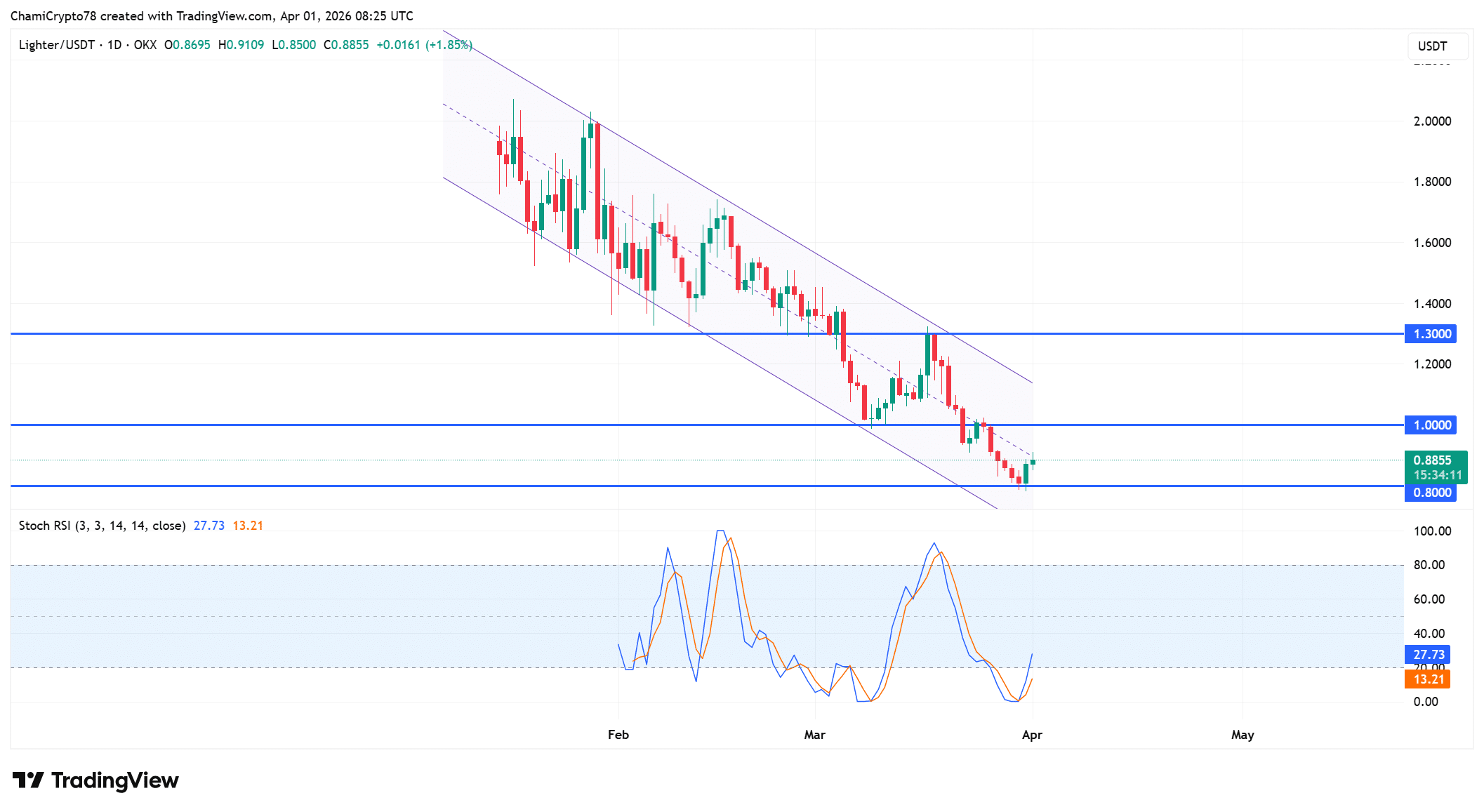
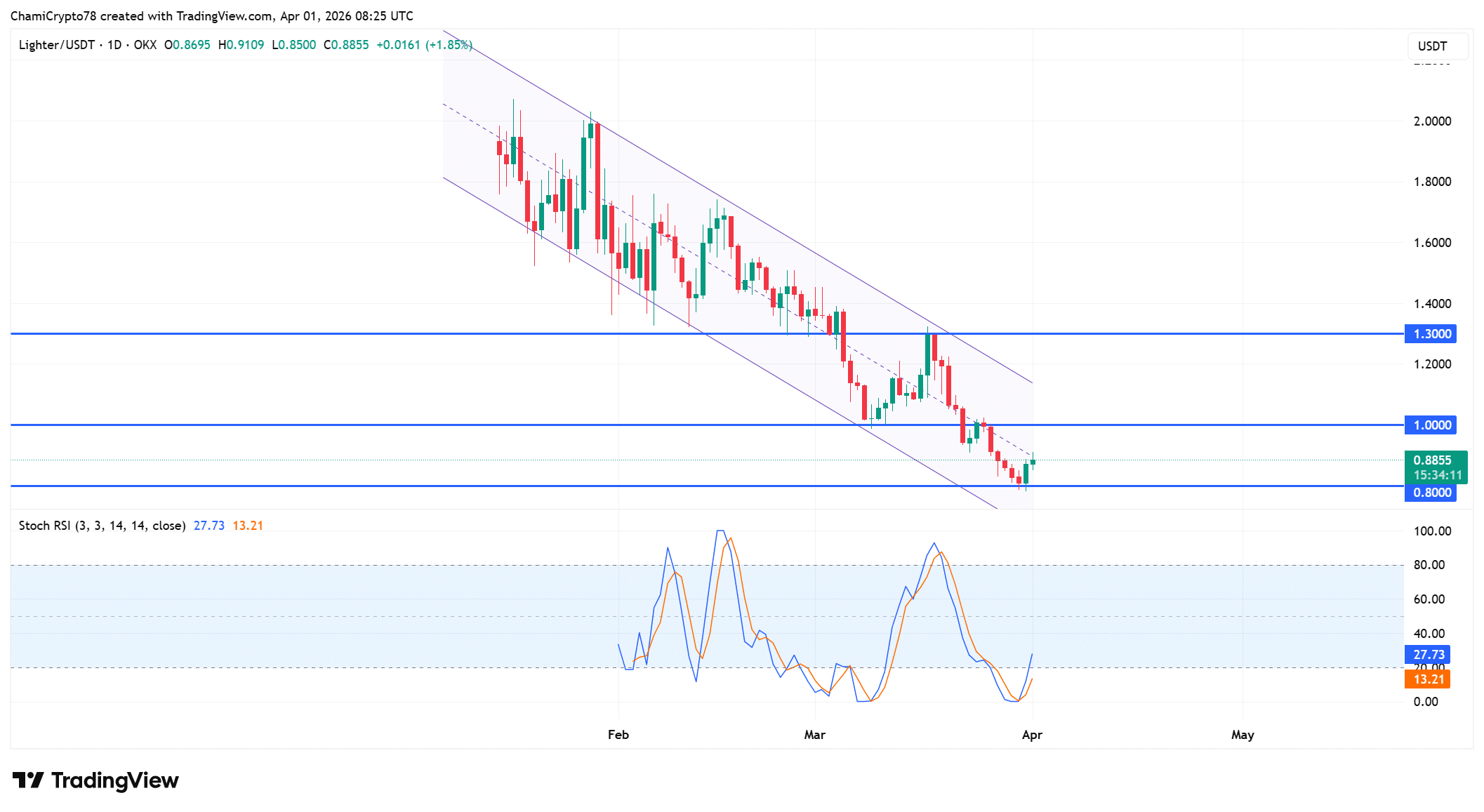
Lighter has rebounded from the $0.80 support zone after respecting the lower boundary of its descending channel. This reaction follows a series of lower lows, which had defined the broader downtrend since February.

However, recent candles showed reduced downside extension, indicating that bearish pressure was weakening near demand. At press time, LIT traded around $0.88 while attempting to reclaim short-term structure inside the channel.

The breakdown pace has slowed, which reflects a shift in seller control. If this recovery continues, price would likely challenge the $1.00 resistance, which aligns with previous consolidation zones.

Above that, $1.30 remains the next key level where prior rejection occurred. Stoch RSI has rebounded from deeply oversold conditions, with readings now at 27.73 and 13.21.

This shift follows a prolonged period of suppressed momentum, where price consistently printed lower lows. The indicator now shows a clear upward turn, reflecting renewed buying activity entering the market.
Source: TradingView

Open Interest expands with participation

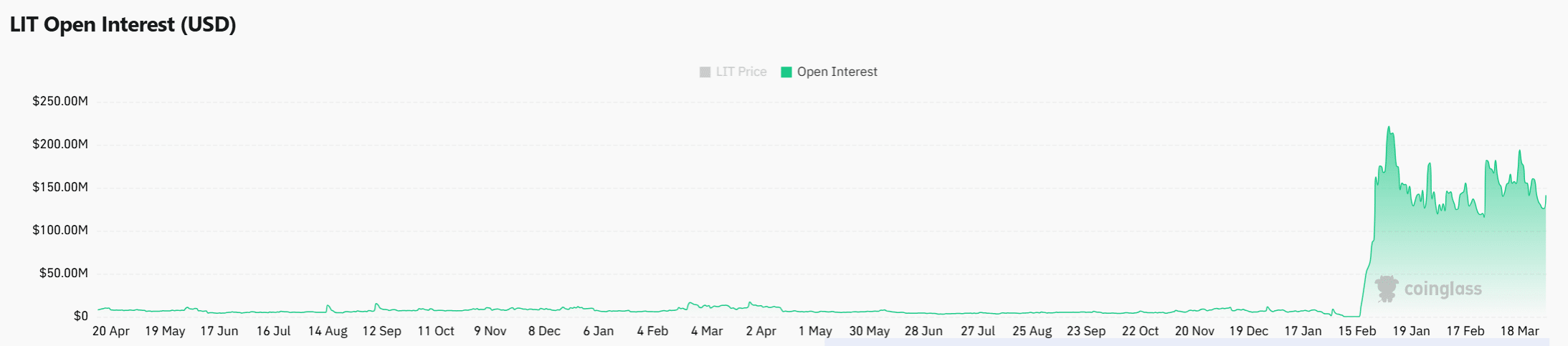
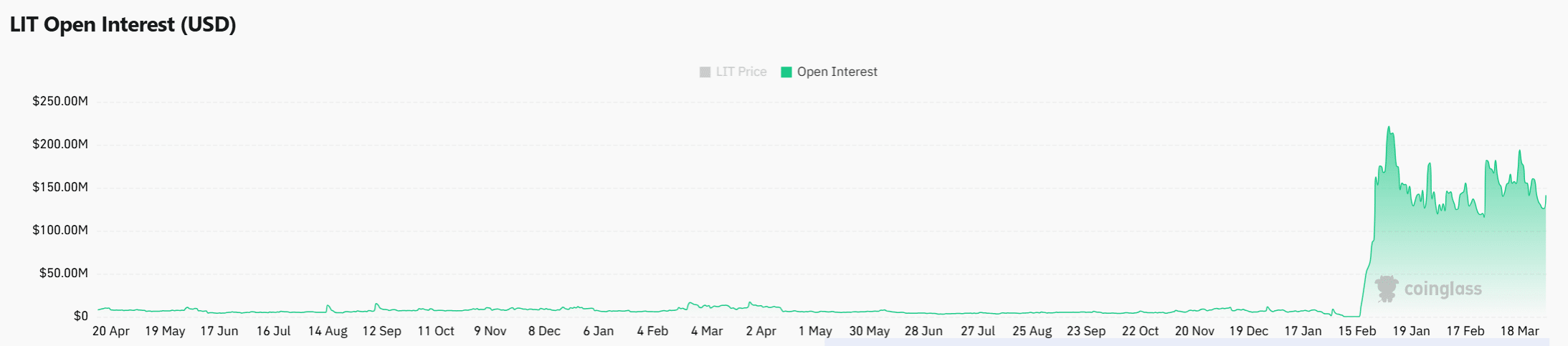
Open interest has surged 33.62% to $143 million, signaling a sharp increase in leveraged participation. This rise occurs alongside price recovery, which indicates that new positions are entering rather than closing out.

Traders now show growing interest in LIT, as capital flows into derivatives markets at a faster pace. This expansion reflects stronger engagement and rising conviction among participants.
Source: CoinGlass

Unlike declining Open Interest scenarios, which often signal uncertainty, this increase supports ongoing activity around current levels.

Funding stays positive as longs dominate

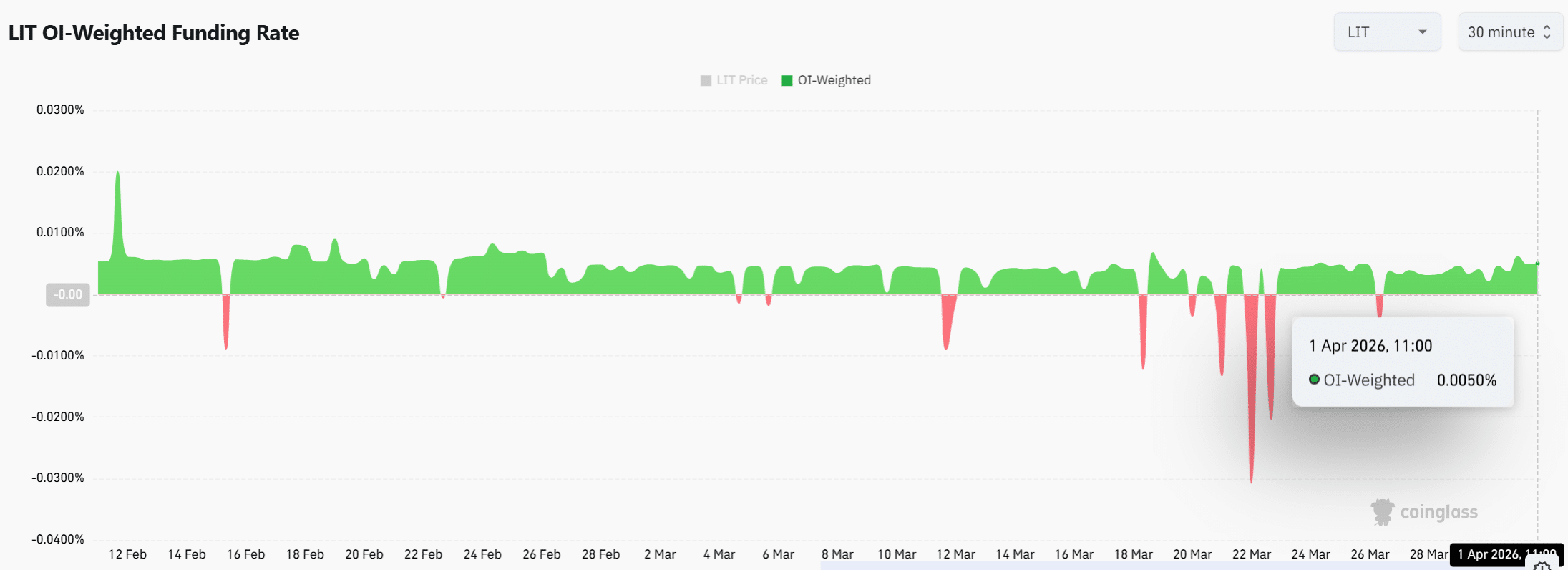
OI-Weighted Funding Rates sat at 0.0050% at the time of writing, maintaining positive positioning across derivatives markets. This sustained level indicated that long traders continued paying premiums to hold positions, reflecting confidence in upward price direction.

Earlier negative spikes had revealed aggressive short pressure, which often preceded liquidation events. However, current conditions show that sentiment has stabilized, with longs maintaining control.

This shift suggests that bearish conviction has weakened after repeated failures to push price lower. As funding remains positive, it reinforces the broader structure where buyers gradually regain dominance across leveraged markets.
Source: CoinGlass

LIT now shows strengthening structure as buybacks tighten supply while participation expands across derivatives markets. Price has stabilized above $0.80 and continues pushing higher with improving conditions.

This alignment suggests recovery remains supported, positioning LIT to challenge the $1.00 resistance zone.


Final Summary

  • Sustained buybacks continue tightening supply, which supports price stability.
  • Rising participation alongside improving structure suggests that buyers are regaining control, which could drive continuation toward higher resistance zones.


Perguntas relacionadas

QWhat is the main reason for LIT's 11.31% price surge to $0.8818?

AThe main reason is cumulative buybacks reaching 9.55 million LIT, which has tightened the token's circulating supply and reduced immediate sell-side availability.

QHow much of LIT's total supply has been absorbed by the buyback program?

ANearly 4% of LIT's total supply has been absorbed by the buyback program.

QWhat key resistance level is LIT positioned to challenge if its recovery continues?

AIf the recovery continues, LIT is positioned to challenge the $1.00 resistance level, with $1.30 being the next key level beyond that.

QWhat does the 33.62% increase in Open Interest to $143 million indicate?

AThe 33.62% surge in Open Interest indicates a sharp increase in leveraged participation and new positions entering the market, reflecting stronger trader engagement and rising conviction.

QWhat does the positive OI-Weighted Funding Rate of 0.0050% signify for market sentiment?

AThe positive funding rate signifies that long traders are paying premiums to hold their positions, reflecting confidence in an upward price direction and indicating that buyers are regaining dominance.

Leituras Relacionadas

Google and Amazon Simultaneously Invest Heavily in a Competitor: The Most Absurd Business Logic of the AI Era Is Becoming Reality

In a span of four days, Amazon announced an additional $25 billion investment, and Google pledged up to $40 billion—both direct competitors pouring over $65 billion into the same AI startup, Anthropic. Rather than a typical venture capital move, this signals the latest escalation in the cloud wars. The core of the deal is not equity but compute pre-orders: Anthropic must spend the majority of these funds on AWS and Google Cloud services and chips, effectively locking in massive future compute consumption. This reflects a shift in cloud market dynamics—enterprises now choose cloud providers based on which hosts the best AI models, not just price or stability. With OpenAI deeply tied to Microsoft, Anthropic’s Claude has become the only viable strategic asset for Google and Amazon to remain competitive. Anthropic’s annualized revenue has surged to $30 billion, and it is expanding into verticals like biotech, positioning itself as a cross-industry AI infrastructure layer. However, this funding comes with constraints: Anthropic’s independence is challenged as it balances two rival investors, its safety-first narrative faces pressure from regulatory scrutiny, and its path to IPO introduces new financial pressures. Globally, this accelerates a "tri-polar" closed-loop structure in AI infrastructure, with Microsoft-OpenAI, Google-Anthropic, and Amazon-Anthropic forming exclusive model-cloud alliances. In contrast, China’s landscape differs—investments like Alibaba and Tencent backing open-source model firm DeepSeek reflect a more decoupled approach, though closed-source models from major cloud providers still dominate. The $65 billion bet is ultimately about securing a seat at the table in an AI-defined future—where missing the model layer means losing the cloud war.

marsbitHá 1h

Google and Amazon Simultaneously Invest Heavily in a Competitor: The Most Absurd Business Logic of the AI Era Is Becoming Reality

marsbitHá 1h

Computing Power Constrained, Why Did DeepSeek-V4 Open Source?

DeepSeek-V4 has been released as a preview open-source model, featuring 1 million tokens of context length as a baseline capability—previously a premium feature locked behind enterprise paywalls by major overseas AI firms. The official announcement, however, openly acknowledges computational constraints, particularly limited service throughput for the high-end DeepSeek-V4-Pro version due to restricted high-end computing power. Rather than competing on pure scale, DeepSeek adopts a pragmatic approach that balances algorithmic innovation with hardware realities in China’s AI ecosystem. The V4-Pro model uses a highly sparse architecture with 1.6T total parameters but only activates 49B during inference. It performs strongly in agentic coding, knowledge-intensive tasks, and STEM reasoning, competing closely with top-tier closed models like Gemini Pro 3.1 and Claude Opus 4.6 in certain scenarios. A key strategic product is the Flash edition, with 284B total parameters but only 13B activated—making it cost-effective and accessible for mid- and low-tier hardware, including domestic AI chips from Huawei (Ascend), Cambricon, and Hygon. This design supports broader adoption across developers and SMEs while stimulating China's domestic semiconductor ecosystem. Despite facing talent outflow and intense competition in user traffic—with rivals like Doubao and Qianwen leading in monthly active users—DeepSeek has maintained technical momentum. The release also comes amid reports of a new funding round targeting a valuation exceeding $10 billion, potentially setting a new record in China’s LLM sector. Ultimately, DeepSeek-V4 represents a shift toward open yet realistic infrastructure development in the constrained compute landscape of Chinese AI, emphasizing engineering efficiency and domestic hardware compatibility over pure model scale.

marsbitHá 2h

Computing Power Constrained, Why Did DeepSeek-V4 Open Source?

marsbitHá 2h

Trading

Spot
Futuros
活动图片