Lighter jumps 11% as buybacks tighten supply: Is a breakout toward $1 next?

ambcryptoPublicado em 2026-04-02Última atualização em 2026-04-02

Resumo

LIT (Lighter) surged 11.31% to $0.8818 as cumulative buybacks reached 9.55 million tokens, reducing circulating supply by nearly 4%. This consistent token removal, including over 606K LIT bought back recently, has tightened supply and supported price stability. The rebound from the $0.80 support level indicates weakening bearish momentum, with potential to challenge the $1.00 resistance. Open Interest rose 33.62% to $143 million, reflecting increased leveraged participation and trader confidence. Positive funding rates show longs are dominant, reinforcing structural recovery. Improved technicals and sustained demand suggest a breakout toward $1 is likely.

Lighter has surged 11.31% to $0.8818 as cumulative buybacks reached 9.55 million LIT, rising from 7.48 million earlier in March.

This steady accumulation reflects consistent demand from the protocol, which continues removing tokens from circulation. As a result, nearly 4% of supply now sits absorbed, reducing immediate sell-side availability.

Recent purchases, including over 606K LIT within a week, have reinforced this pattern of sustained accumulation. Lower average buyback prices between $0.80 and $0.95 further increased efficiency, allowing more tokens to exit the market per dollar spent.

This tightening supply condition is now aligned with LIT’s recovery, suggesting structural support continues strengthening beneath current levels.

LIT rebounds as channel weakens

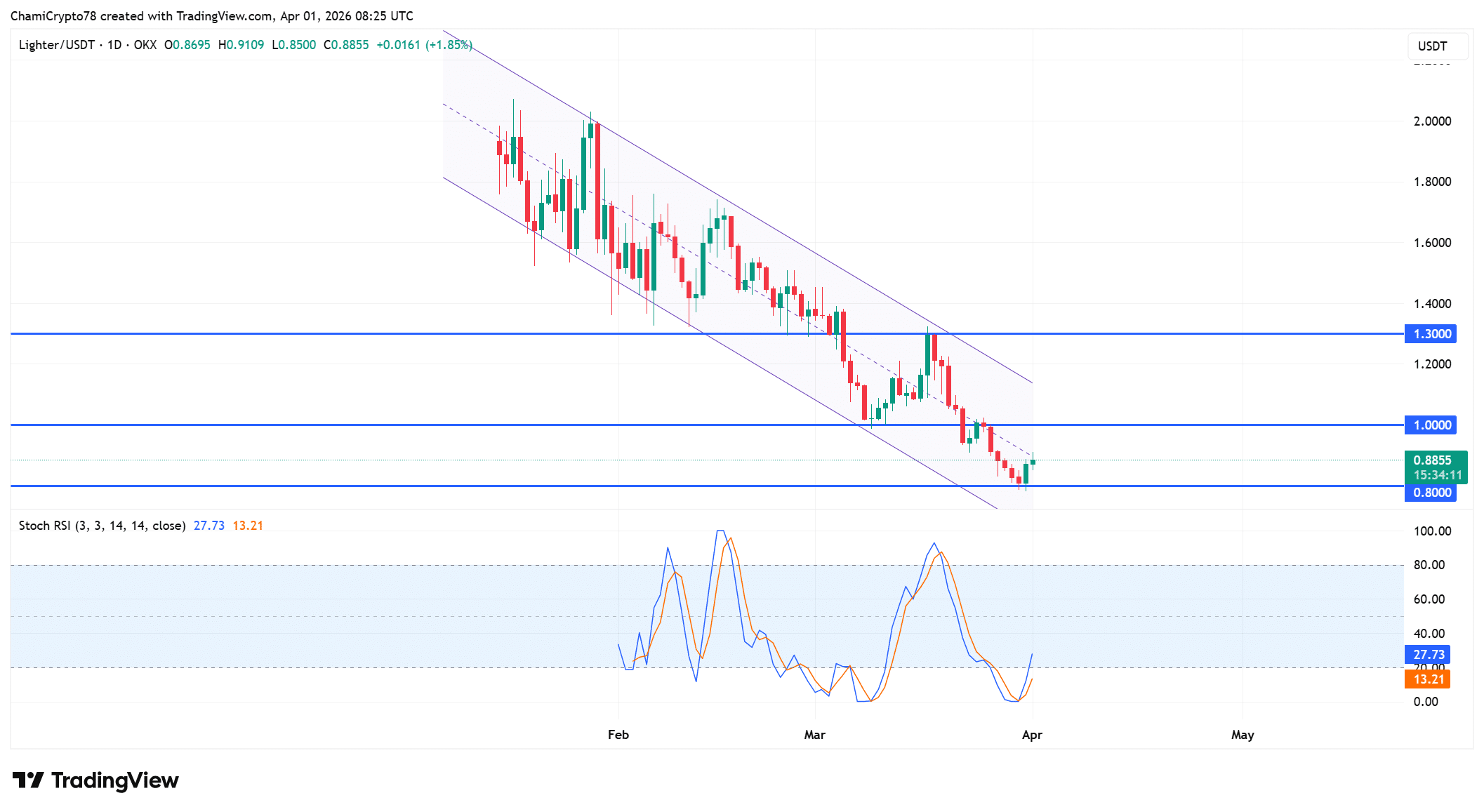
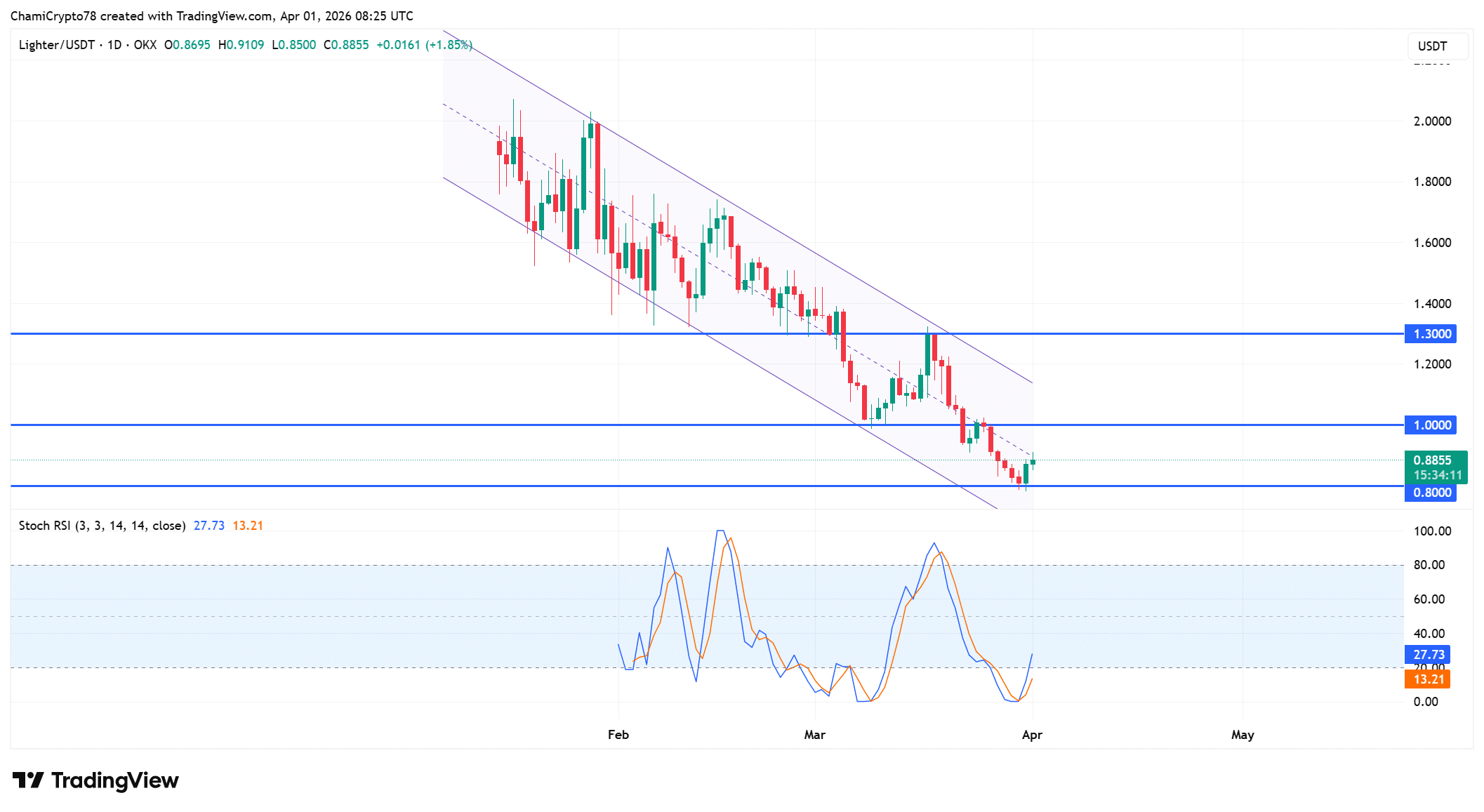
Lighter has rebounded from the $0.80 support zone after respecting the lower boundary of its descending channel. This reaction follows a series of lower lows, which had defined the broader downtrend since February.

However, recent candles showed reduced downside extension, indicating that bearish pressure was weakening near demand. At press time, LIT traded around $0.88 while attempting to reclaim short-term structure inside the channel.

The breakdown pace has slowed, which reflects a shift in seller control. If this recovery continues, price would likely challenge the $1.00 resistance, which aligns with previous consolidation zones.

Above that, $1.30 remains the next key level where prior rejection occurred. Stoch RSI has rebounded from deeply oversold conditions, with readings now at 27.73 and 13.21.

This shift follows a prolonged period of suppressed momentum, where price consistently printed lower lows. The indicator now shows a clear upward turn, reflecting renewed buying activity entering the market.
Source: TradingView

Open Interest expands with participation

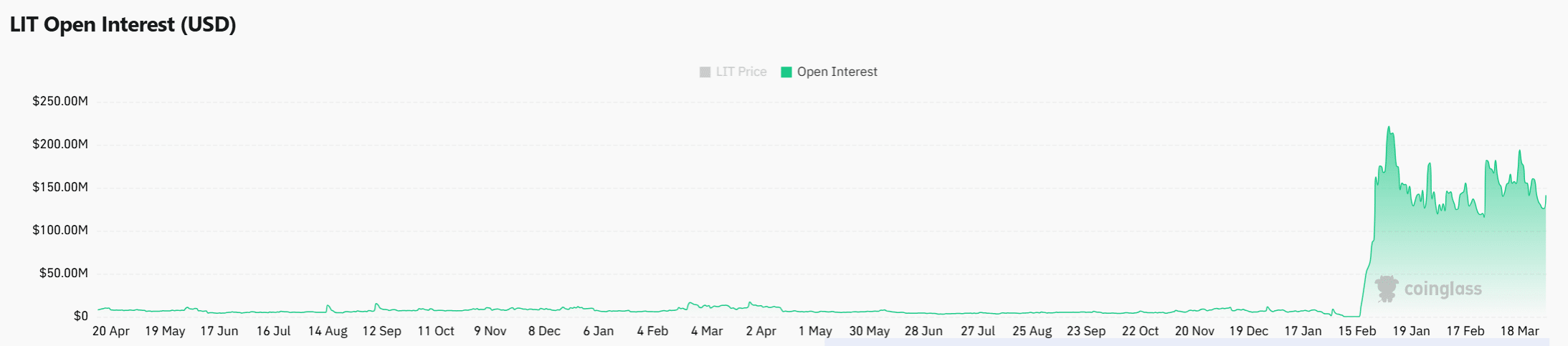
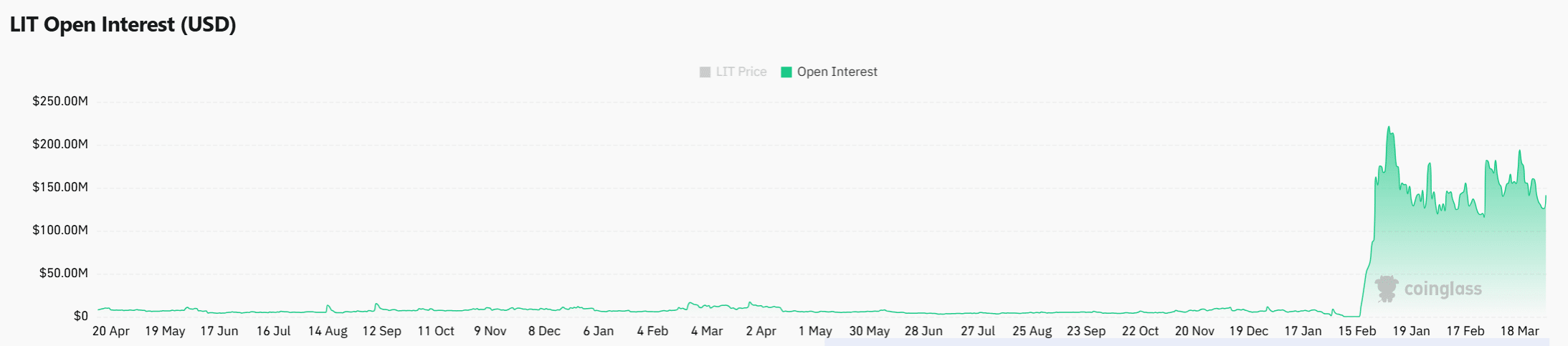
Open interest has surged 33.62% to $143 million, signaling a sharp increase in leveraged participation. This rise occurs alongside price recovery, which indicates that new positions are entering rather than closing out.

Traders now show growing interest in LIT, as capital flows into derivatives markets at a faster pace. This expansion reflects stronger engagement and rising conviction among participants.
Source: CoinGlass

Unlike declining Open Interest scenarios, which often signal uncertainty, this increase supports ongoing activity around current levels.

Funding stays positive as longs dominate

OI-Weighted Funding Rates sat at 0.0050% at the time of writing, maintaining positive positioning across derivatives markets. This sustained level indicated that long traders continued paying premiums to hold positions, reflecting confidence in upward price direction.

Earlier negative spikes had revealed aggressive short pressure, which often preceded liquidation events. However, current conditions show that sentiment has stabilized, with longs maintaining control.

This shift suggests that bearish conviction has weakened after repeated failures to push price lower. As funding remains positive, it reinforces the broader structure where buyers gradually regain dominance across leveraged markets.
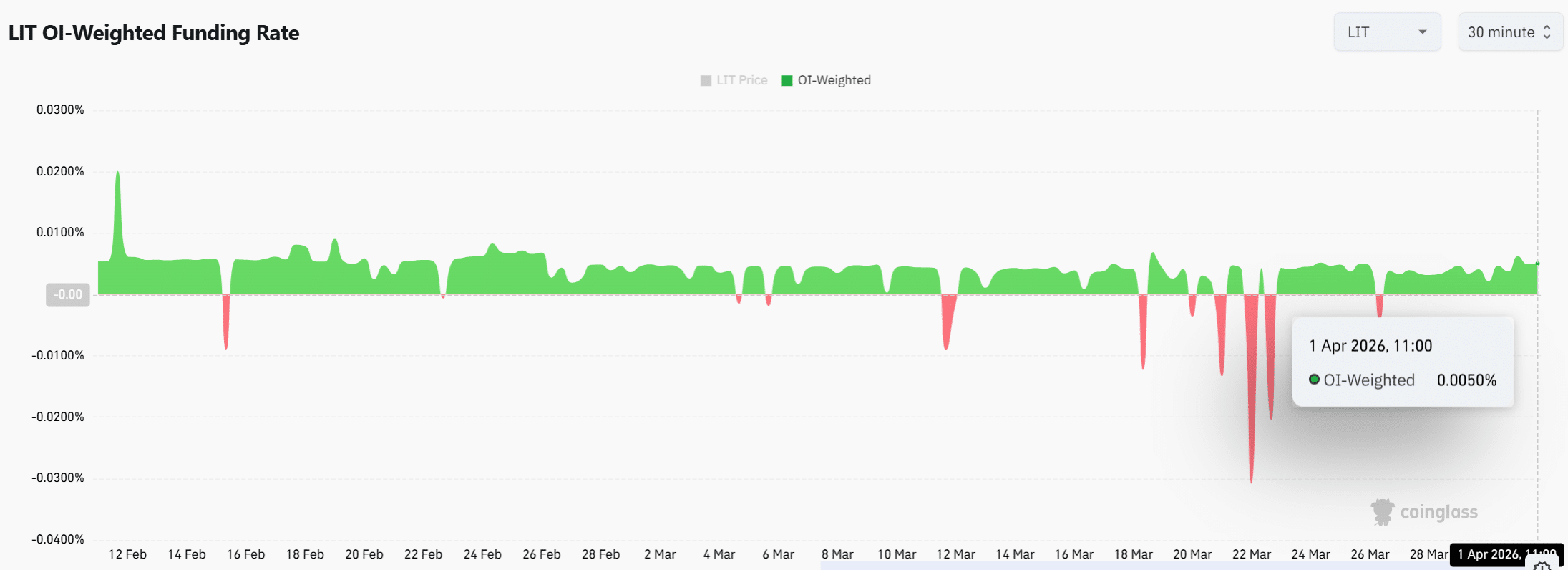
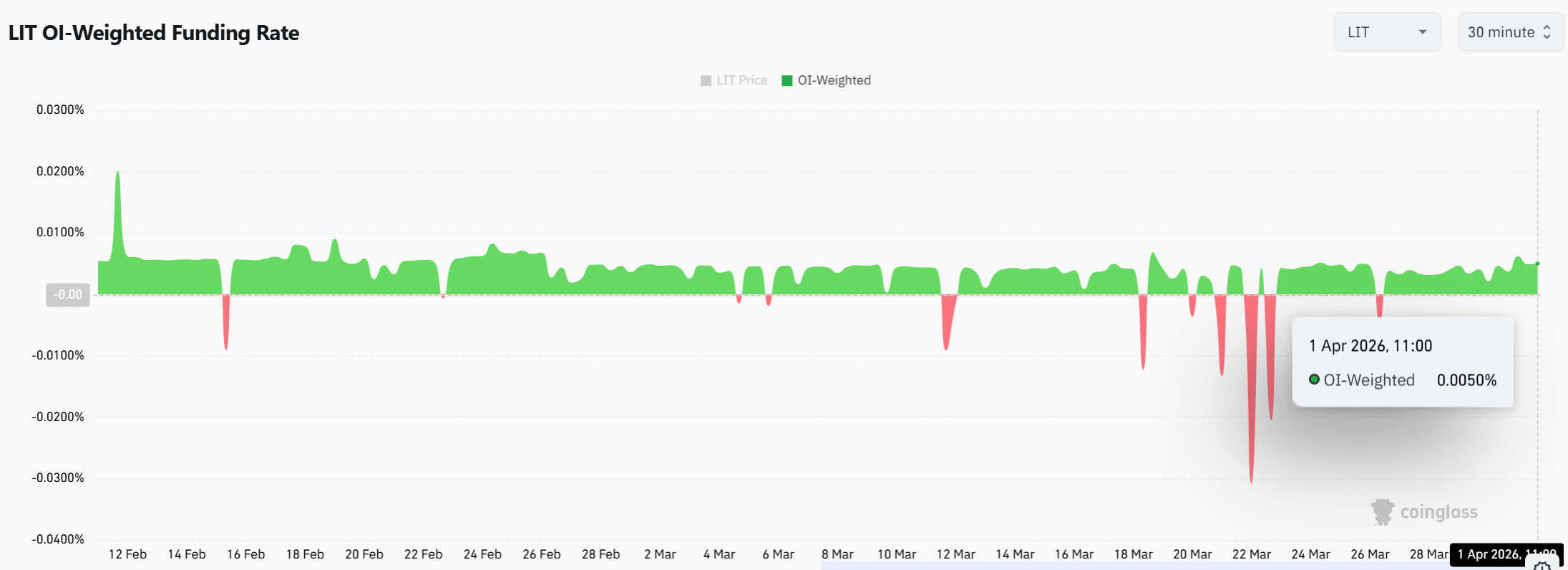
Source: CoinGlass

LIT now shows strengthening structure as buybacks tighten supply while participation expands across derivatives markets. Price has stabilized above $0.80 and continues pushing higher with improving conditions.

This alignment suggests recovery remains supported, positioning LIT to challenge the $1.00 resistance zone.


Final Summary

  • Sustained buybacks continue tightening supply, which supports price stability.
  • Rising participation alongside improving structure suggests that buyers are regaining control, which could drive continuation toward higher resistance zones.


Perguntas relacionadas

QWhat is the main reason for LIT's 11.31% price surge to $0.8818?

AThe main reason is cumulative buybacks reaching 9.55 million LIT, which has tightened the token's circulating supply and reduced immediate sell-side availability.

QHow much of LIT's total supply has been absorbed by the buyback program?

ANearly 4% of LIT's total supply has been absorbed by the buyback program.

QWhat key resistance level is LIT positioned to challenge if its recovery continues?

AIf the recovery continues, LIT is positioned to challenge the $1.00 resistance level, with $1.30 being the next key level beyond that.

QWhat does the 33.62% increase in Open Interest to $143 million indicate?

AThe 33.62% surge in Open Interest indicates a sharp increase in leveraged participation and new positions entering the market, reflecting stronger trader engagement and rising conviction.

QWhat does the positive OI-Weighted Funding Rate of 0.0050% signify for market sentiment?

AThe positive funding rate signifies that long traders are paying premiums to hold their positions, reflecting confidence in an upward price direction and indicating that buyers are regaining dominance.

Leituras Relacionadas

The Verdict in Choi Tae-won's Divorce Case: Revealing the Inheritance Undercurrent Behind SK Hynix's Trillion-Won Empire

SK Group Chairman Chey Tae-won's high-profile divorce case, involving a record 1.38 trillion won settlement, has drawn attention to the succession plans for Korea's second-largest conglomerate, especially its crown jewel, SK hynix. Unlike traditional chaebol scripts centered on the eldest son, Chey's three children from his marriage to former President Roh Tae-woo's daughter, Roh Soh-yeong, are carving distinct, non-traditional paths. Eldest daughter Chey Yun-jung (b. 1989) is seen as the most evident successor. With a scientific and consulting background, she holds executive roles at SK bioscience and SK Inc.'s growth support department, focusing on future strategy and biopharma. Her marriage is to an AI infrastructure entrepreneur, not a traditional business alliance. Second daughter Chey Min-jung (b. 1991) took a unique route, voluntarily serving as a South Korean naval officer, including an anti-piracy deployment. She later worked on policy and strategy for SK hynix in Washington D.C. before co-founding an AI-driven healthcare startup. She married a former U.S. Marine Corps officer, connecting her to U.S. defense and policy circles—networks crucial for a global semiconductor giant. The only son, Chey In-geun (b. 1995), who studied physics like his father, worked briefly at SK E&S before joining McKinsey. Despite fitting the traditional "heir" profile as the eldest son, he remains silent and holds no public position or shares in SK, suggesting the old succession playbook is obsolete. As SK hynix's valuation soars, becoming a geopolitical asset in the AI era, the heirs' legitimacy is no longer automatic. They must prove themselves in fields like AI biotech, global policy, and strategic consulting. Their marriages also reflect new elite networks in tech and defense, not old political alliances. Their inheritance is the complex challenge of navigating a globalized, tech-driven world, not just a corporate throne.

marsbitHá 4h

The Verdict in Choi Tae-won's Divorce Case: Revealing the Inheritance Undercurrent Behind SK Hynix's Trillion-Won Empire

marsbitHá 4h

From OpenSea to OpenRouter: Is Alex Atallah Repeating His 'Exit at the Peak' Playbook?

From OpenSea to OpenRouter: Is Alex Atallah Repeating His "Exit at the Peak" Playbook? According to the Wall Street Journal, payments giant Stripe is in talks to acquire the AI model aggregation platform OpenRouter in a potential deal valuing the company near $100 billion. This would mark founder Alex Atallah's second creation of a company reaching a $100 billion valuation, following his co-founding of NFT marketplace OpenSea. OpenRouter, founded just over three years ago, has grown rapidly by acting as a unified gateway for developers to access over 400 AI models. It currently has about 10 million users and processes over 200 trillion tokens monthly. While the platform's annualized revenue is around $50 million, its valuation has skyrocketed from $1.3 billion in March 2026. The potential acquisition by Stripe, a company OpenRouter's founder once likened it to, represents a major expansion into AI infrastructure for the payments leader. This move echoes Atallah's previous timing with OpenSea, where he departed before the NFT market's significant downturn. For OpenRouter, selling now may be strategic. Despite its scale, its business model—charging a 5-5.5% fee on AI inference calls—faces pressure from competition, open-source models, and potential price wars among model providers, limiting its profitability narrative for an IPO. A key asset for potential acquirers like Stripe is OpenRouter's vast repository of real-world AI usage data, which offers unique insights into model performance and developer preferences that are difficult to replicate. Whether this potential deal signifies a new valuation benchmark for AI infrastructure or another market peak signal remains to be seen.

链捕手Há 4h

From OpenSea to OpenRouter: Is Alex Atallah Repeating His 'Exit at the Peak' Playbook?

链捕手Há 4h

Trading

Spot
活动图片




