As of writing this article at 8:40 AM Eastern Time on July 27, the tip of the blockchain was at block 959,842. Approximately 1,790 blocks remain until block 961,632 — the point at which nodes running BIP-110 software will begin rejecting blocks that do not signal support for version bit 4. Given Bitcoin's average block time of 10 minutes, this height is expected to be reached around August 9, 2026.
BIP-110, officially titled "Reduced Data Temporary Softfork," proposes limiting the size of specific data fields used in Bitcoin transactions. These rules primarily target Ordinals-style inscriptions, excessively large OP_RETURN payloads, and similar high-data-volume use cases, without affecting regular Bitcoin financial transfers, Taproot key path spends, and standard Lightning channel operations.
If activated, the restrictions would come into effect starting from block 965,664 and would automatically expire after 52,416 blocks, or approximately one year.
Support is Growing, But Not Fast Enough
The signaling charts from the past month have looked different than they might seem at first glance.
A few weeks ago, BIP-110 signaling was barely registering, fluctuating below 1% at times. Since then, the support level has climbed to around 3%. In percentage terms, this is a significant increase, but activation in the Bitcoin network depends on who is signaling, not just how many blocks contain the bit.

Ocean continues to account for the majority of signaling activity. The rest of the hash power comes almost entirely from independent miners and small operators. Among the miners currently signaling support for BIP-110 are Roughnecks, SoV, BIP110 Generic, Barefoot Mining, 234 Alberta, 888, Peer to Peer Money, Black Jade Advisors, Sazmining, Crestmont Fabrics, Datum Miner, SpammersGFY, Moonwalk, PyBLOCK-Datum, Just For Krypto, and JAMIN.
Meanwhile, four pools — Foundry, Antpool, ViaBTC, and F2pool, which collectively account for the majority of the network's hash rate — have largely maintained their stance. Unless one of these major operators changes course, the gradual increase in share from smaller participants is unlikely to significantly shift the activation landscape.
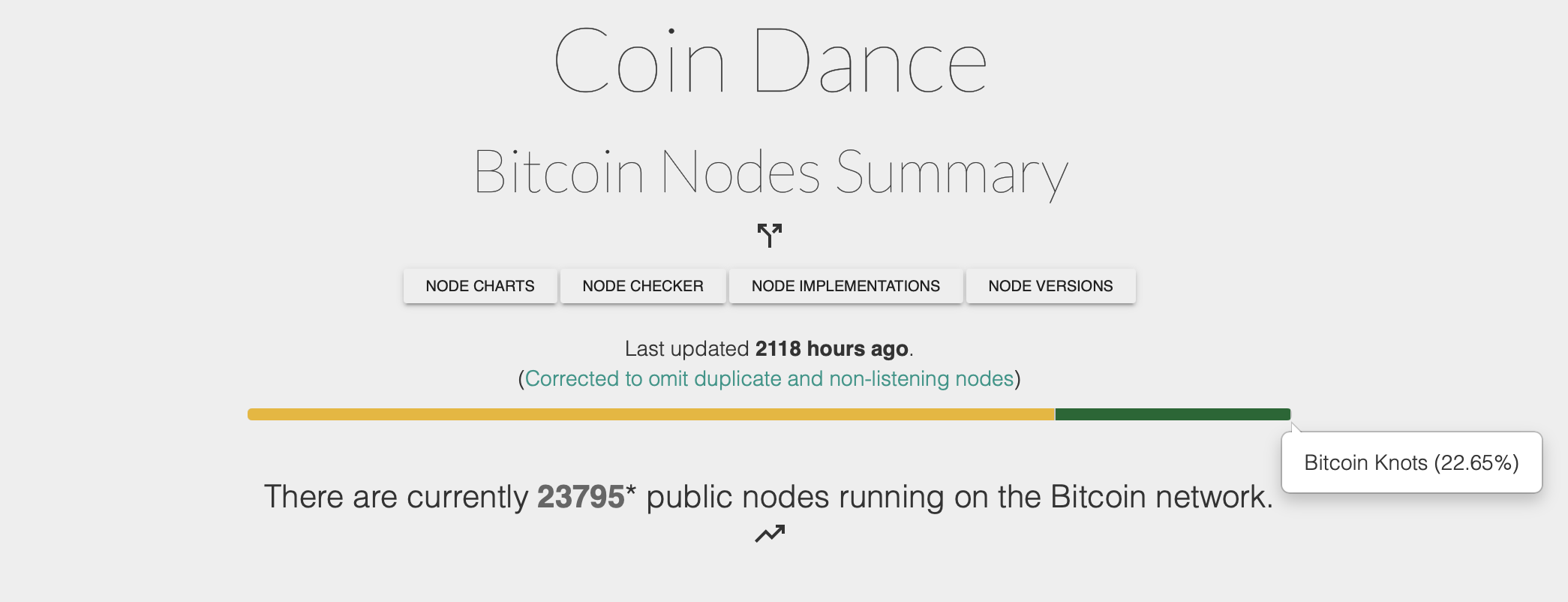
The software ecosystem reflects a similar divide. The only implementation providing enforcement for the proposal is a fork of Bitcoin Knots. Available nodes running this software currently make up about 22%, resulting in enforcement being concentrated within a relatively small fraction of the network compared to Bitcoin Core nodes.
Foundry Holds the Deciding Vote
Among the large mining pools, Foundry has taken an interesting approach.
Around July 17, 2026, the company asked its clients to vote on whether the pool should begin signaling for BIP-110. Instead of making an internal decision, Foundry directly linked the vote outcome to its clients' hash rate, as indicated in an email sent to pool participants.
"The voting period for the Foundry USA PoolTM will remain open until the close of the signaling window preceding block 961,632," the Foundry USA pool wrote on its BIP-110 resource page.
The weight of a vote depends on each client's average hash rate. Clients who do not respond are automatically counted as a "No" vote, and by default, Foundry continues signaling against the proposal. Only if "Yes" votes exceed 51% of the participants' weighted hash rate will the pool switch all its blocks to signal support.
This decision is highly significant, as Foundry accounts for approximately 23% to 33% of Bitcoin's global hash rate, depending on the measurement period. If a pool of this size were to change its stance overnight, the voting charts would shift immediately.
To date, there are no signs that such a shift has occurred.
Foundry has also refrained from publicly endorsing either side. Instead, its client resource page provides links to the BIP specification, the original discussion on bitcoin-dev, criticism from Jameson Lopp, as well as comments from Adam Back, Michael Saylor, Luke Dashjr, and others, allowing clients to evaluate the proposal on their own.
What Happens If the Window Opens Without Broad Support?
The mechanism will become much more significant after block 961,632 appears.
If current signaling levels persist, nodes enforcing BIP-110 will reject blocks mined by the majority of the network because they lack the required version bit. Instead, these nodes will follow the relatively few signaling blocks.
Legacy nodes will behave differently. They will continue accepting both signaling and non-signaling blocks, following the chain with the greatest accumulated proof-of-work, as Bitcoin has always done. Several independent observers have created dedicated monitoring sites that track activation parameters, with some even modeling how this process could unfold under various scenarios.
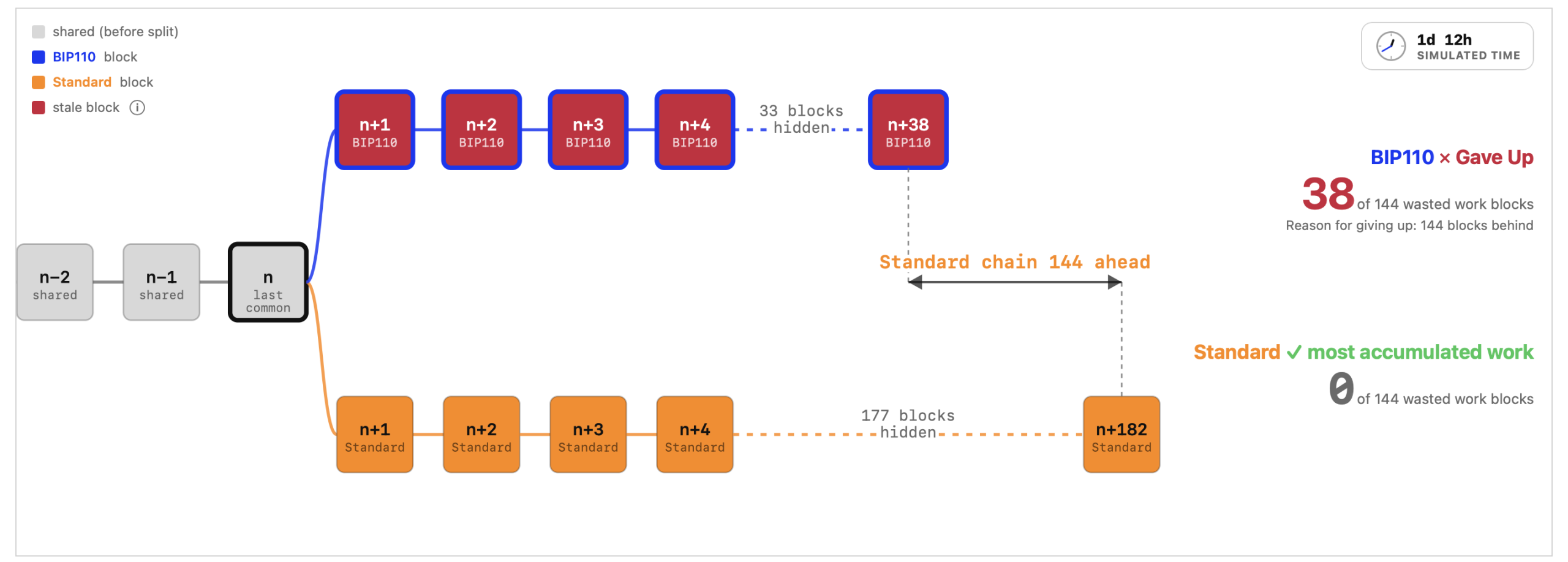
This creates the potential for two competing chains, but not two equally viable ones. The chain recognized by Bitcoin Core and mined by the vast majority of the hash rate will continue producing blocks at the normal pace. The minority chain, consisting solely of signaling miners, will progress much more slowly until it reaches the next difficulty adjustment of 2,016 blocks.
This potential outcome explains why much of the discussion has shifted from inscriptions to the activation process itself.
A Different Activation Strategy
BIP-110 follows an implementation path distinct from Bitcoin's last two major soft forks.
The proposal was launched on December 1, 2025, using a modified BIP-9 process. For early activation, it required that 1,109 out of 2,016 blocks (or 55%) signal support during one difficulty period. If this threshold is never reached, the proposal moves to a mandatory lock-in at block 963,648, with activation occurring one difficulty period later — at block 965,664.
Between these milestones lies the mandatory signaling window.
From block 961,632 to block 963,647, nodes enforcing BIP-110 reject every block that does not set version bit 4, regardless of which proof-of-work chain supports it. This approach differs from both SegWit and Taproot, where non-upgraded nodes continued accepting the chain with the greatest proof-of-work throughout the activation period.
The closest historical analogue is the 2017 User-Activated Soft Fork (UASF) BIP-148, which also attempted to pressure miners through mandatory signaling requirements. That confrontation ultimately concluded without a prolonged chain split, as sufficient hash rate shifted to the new chain before the deadline. The BIP-148 UASF ultimately served more as a pressure tactic than an actual activation.
Whether BIP-110 follows the same path depends largely on whether one or more large pools change their stance before August 9.
Why Proponents Want These Changes
BIP-110 was authored by Dathon Ohm. Earlier versions circulated under the designation BIP-444 before being accepted into the BIP repository.
Proponents of BIP-110 argue that inscriptions, BRC-20-style tokens, and increasingly large OP_RETURN data raise the cost of running a full node, distort Bitcoin's fee market, and divert network resources from Bitcoin's original purpose as a payment and settlement system.
"Removing rules is a hard fork," BIP-110 advocate and Bitcoin Knots developer Luke Dashjr explained on X in early July. "This applies to scheduled rules like halving the subsidy, and, yes, even BIP-110. Rejecting BIP-110 is a contentious hard fork attempt."
Dashjr added:
"And unlike soft forks, hard forks require consensus to succeed. There is no consensus to reject BIP-110."
Opponents generally agree that spam exists but disagree on whether BIP-110's activation mechanism is the appropriate solution. "OP_RETURN block space usage has not meaningfully increased since Bitcoin Core v30 was released. Large-sized OP_RETURNs may have grown slightly, but they still constitute less than 0.1% of block space," Alex Thorn, Head of Research at Galaxy Digital, wrote on X.
Thorn continued:
"BIP-110 is an extremely radical and dangerous response, given the negligible impact of these [transactions] that are targeted for removal."
The Final Days Could Still Change Everything
The next two weeks will likely hinge on three factors.
First, whether one of the largest mining pools begins signaling its support. Second, whether major exchanges provide public clarification on which chain they will recognize if competing chains emerge after block 961,632. Third, what miners actually do once the mandatory window opens, as the support percentage observed ahead of the deadline reflects only part of the picture.
The trend favors BIP-110: support has grown from below 1% to around 3% as the deadline approaches. Nevertheless, the proposal remains far from demonstrating widespread miner support. Unless one of Bitcoin's largest pools changes course in the coming days, the mandatory signaling window is poised to open with support still concentrated among a relatively small portion of the network.
end-content