Lens and Farcaster "Change Hands": Can the Second Venture of On-Chain Social Break Through?

比推Publicado em 2026-01-23Última atualização em 2026-01-23

Resumo

Two leading decentralized social protocols, Lens and Farcaster, have both undergone significant leadership changes this week. Lens, originally developed under Avara (Aave’s parent company), has transitioned to Mask Network, which aims to usher in a “product-centric” era for the protocol. Shortly after, Farcaster’s co-founder announced that infrastructure provider Neynar is acquiring Farcaster’s apps, protocol, and tech stack, with a renewed “developer-first” focus. While both Mask and Neynar possess deep expertise in their respective protocols, the broader challenge remains: achieving mass adoption and sustainable user engagement. Ethereum co-founder Vitalik Buterin commented on the shift, emphasizing the need for social tools that serve long-term user interests rather than short-term engagement. He advocates for decentralized social networks built on shared data layers with diverse clients and cultures. The success of these platforms hinges on creating overlapping “public squares” that foster innovation, community, and user agency. The new stewards now face the task of turning decentralized social ideals into engaging, daily-use realities—moving from theoretical potential to practical, culturally-rich ecosystems.

Source: Bankless

Author: William M. Peaster

Compilation and arrangement: BitpushNews


The landscape of Web3 consumer applications is undergoing dramatic changes.

Over the past few years, the two flagship on-chain social projects—Farcaster and Lens—both experienced a change in "leadership" this week.

A New Chapter for Lens

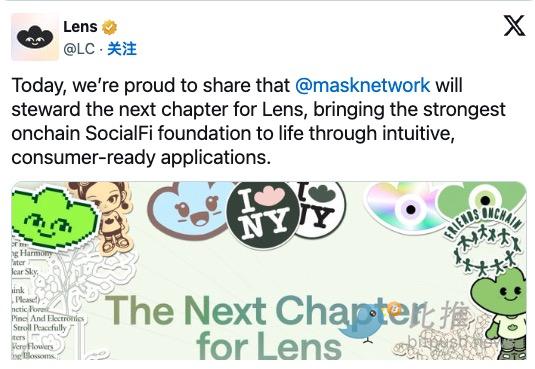
Avara (the parent company of Aave and Lens) just announced the transfer of the Lens protocol's management rights to Mask Network. The Mask team, with its rich experience, has previously developed on-chain social applications like Firefly and Orb. Avara will now focus entirely on DeFi business, while Mask's goal is to usher in a "product-centric" new era for Lens.
Farcaster Follows Suit

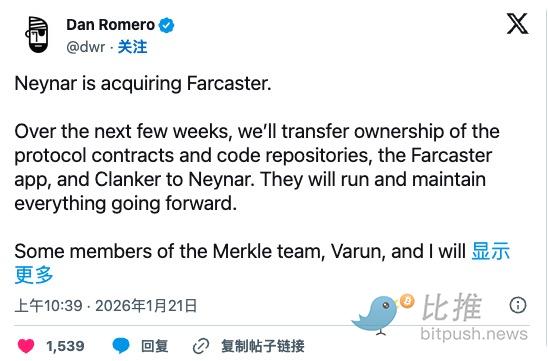
Just a day after the Lens news broke, Farcaster co-founder Dan Romero announced that Neynar, an infrastructure provider for Farcaster, is acquiring Farcaster's applications, protocol, and the Clanker tech stack. The original startup leadership team of Farcaster will not be joining the new company, but Neynar stated they are committed to reshaping the project into a "developer-first" social network.
Weighing the Pros and Cons

Mask knows Lens inside and out, and Neynar understands every detail of Farcaster. These two teams are undoubtedly among the top developers and thinkers in the on-chain social space. In the long run, Lens and Farcaster seem to be in the most capable hands.

However, the road ahead is far from smooth.

So far, on-chain social projects have struggled to become mass social networks with "gravitational mass." If this goal had been achieved, today's change of hands wouldn't have happened. Clearly, there are still some elements missing in the underlying structure, making some degree of "reboot" inevitable. Whether these changes can break through the bottlenecks and achieve lasting user retention remains to be seen.

Regarding the news of Lens's change of hands, Ethereum founder Vitalik Buterin (V God) shared his perspective. He wrote:

"What we need are social tools that serve the long-term interests of users, not just extract short-term engagement. [...] Decentralization is the way to achieve this: through a shared data layer, anyone can build their own client on top of it."

"But crypto social projects have tended to go the wrong way in the past. [...] Mixing 'money' and 'social' isn't inherently wrong: Substack has proven it's possible to build an economic system that supports high-quality content. But Substack's core is about subscribing to creators, not creating price bubbles around them."

"Decentralized social should be run by people who deeply believe in the essence of 'social' and are primarily driven by solving social problems. [...] I'm excited about Lens's development next year because I think the new team taking over is genuinely interested in 'social' itself."

"I encourage everyone to invest more time this year in Lens, Farcaster, and the broader decentralized social world. We need to move beyond the state where everyone is constantly tweeting in a global 'information war zone' and enter a reopened frontier where better, more novel forms of interaction become possible."

The Bigger Picture

For Lens and Farcaster, the key to this game lies in cultivating multiple overlapping "public squares"—connected by shared data but differentiated by different clients and cultures.

This diversity can foster innovation, innovation leads to more social interaction, social interaction attracts more users, which in turn drives more innovation, creating a virtuous cycle. Getting this "flywheel" spinning remains the core challenge.

Mask and Neynar seem ready to take on this task, and I am optimistic about their performance in their new roles. If you want to support their second launch and heed Vitalik's call, a great starting point is to try the Firefly application developed by Mask. It allows you to access platforms like X (Twitter), Farcaster, and Lens simultaneously without manually republishing content.

Looking Ahead

Crypto social is not dead. However, for the leaders of this new phase to successfully open a second chapter, they need to reflect on what worked and what didn't in the first chapter and iterate continuously based on that.

Overall, we have moved from the "what if" stage to the "what now" stage. In this sense, what Mask and Neynar have taken over is not just protocols, but also a mission: to transform decentralization from an abstract ideal into something many people are truly willing to spend time immersed in.

This is no easy task. But if these teams can continue to nurture lasting communities with unique cultures while empowering users with more agency in new ways, they have a chance to go far. Now, let's wait and see if they can truly realize this vision.


Twitter:https://twitter.com/BitpushNewsCN

Bitpush TG Discussion Group:https://t.me/BitPushCommunity

Bitpush TG Subscription: https://t.me/bitpush

Original link:https://www.bitpush.news/articles/7605336

Perguntas relacionadas

QWhat major changes occurred in the management of Lens and Farcaster this week?

AAvara, the parent company of Aave and Lens, transferred the governance of the Lens protocol to Mask Network. Simultaneously, Farcaster's infrastructure provider Neynar acquired Farcaster's applications, protocol, and the Clanker tech stack, with the original founding team stepping down.

QAccording to Vitalik Buterin, what is the core problem with past crypto social projects?

AVitalik Buterin stated that past crypto social projects often went wrong by mixing 'money' and 'social' in a way that created price bubbles around creators, rather than focusing on building an economic system that supports high-quality content, similar to Substack's subscription model.

QWhat is the key challenge for Lens and Farcaster in their new phase of development?

AThe core challenge is to get the 'flywheel' effect spinning: cultivating multiple overlapping 'public squares' connected by shared data but differentiated by different clients and cultures, which can drive innovation, more social interaction, user growth, and further innovation.

QWhich application is recommended as a good starting point to support the new initiatives of Mask and Neynar?

AMask's Firefly application is recommended, as it allows users to access platforms like X (Twitter), Farcaster, and Lens simultaneously without manually reposting content.

QWhat overall shift in phase does the article describe for crypto social projects?

AThe article describes a shift from the 'what if' phase to the 'what now' phase, where the new leaders must reflect on what worked and what didn't in the first chapter, iterate continuously, and transform decentralization from an abstract ideal into something people genuinely want to immerse their time in.

Leituras Relacionadas

Unlocking $100 Million in Liquidity? Pump.fun's New Policy Tests the 5-Minute Pump Technique

Pump.fun, a popular meme coin launchpad, has introduced a new standard mechanism called BOOST. It aims to address a significant capital efficiency issue: when a newly launched token graduates from its initial bonding curve to a liquidity pool (LP), roughly 20% of its liquidity becomes permanently locked as "dead liquidity," estimated to waste over $100 million annually. Instead of locking these funds permanently, BOOST repurposes them. Upon a token's migration, approximately 20% of the settlement funds (e.g., 17.6 SOL or ~$2516 USDC) are used to buy back the token on the open market over a 5-minute period via a Time-Weighted Average Price (TWAP) mechanism. All purchased tokens are immediately burned. This creates a brief, systematic buy pressure immediately after migration, potentially generating a short-term price surge ("pump") while permanently reducing the token's circulating supply. The goal is to enhance the immediate post-launch trading experience, potentially increasing trader retention and sustainable protocol revenue, which funds ongoing token buybacks. However, concerns exist that this artificial 5-minute boost could lower the barrier for launching low-quality tokens and lead to steeper price crashes once the buy pressure stops, if followed by large sell-offs. The feature automatically applies to tokens migrating after July 21, 2024, but not to previously migrated tokens or those launched via the Mayhem AI Agent lab.

marsbitHá 6m

Unlocking $100 Million in Liquidity? Pump.fun's New Policy Tests the 5-Minute Pump Technique

marsbitHá 6m

Podcast Notes | Conversation with GSR Asset Management Head: To Determine if This Crypto Rally is Real, Just Watch the Lending Rates on Aave

Podcast Summary: Dialogue with GSR's Head of Asset Management: To Determine if This Crypto Rally is Real, Just Check Lending Rates on Aave Andy Baehr, Managing Director of Asset Management at GSR, discusses the current crypto market, characterizing it as stuck in a state of "ambivalence" with short-lived, unsustainable rallies. He outlines a simple framework: the market moves between "ambivalence" and "conviction" (sustained upward momentum). Currently, every rally resembles a single-stage rocket booster that quickly fizzles out. Baehr identifies three key signals to watch: 1) DeFi lending rates, 2) the potential passage of the CLARITY Act, and 3) the market forming a consensus on the "Fed hawkish peak." He emphasizes that the most immediate indicator for the sustainability of the recent CPI-triggered rally is the USDC borrowing rate on Aave, currently around 3.75%—close to U.S. Treasury yields. The absence of a credit spread indicates low leverage demand and a lack of market energy. He explains that a healthy, sustained rally requires layered buying pressure. Last year's rally progressed from an ETH short squeeze to crypto-native trader influx and finally to ETF inflows. Currently, this structure is missing. Other potential structural buyers like Digital Asset Treasury (DAT) companies are absent, and ETF flows have proven transient. Baehr notes that while small-cap crypto tokens outperformed large caps in Q2—a potential sign of capitation in major assets—capital is also flowing to more exciting opportunities like AI stocks and tech IPOs, leaving crypto sidelined. Regarding DeFi, he highlights that platforms like Aave provide a clear, real-time signal of leverage demand through their supply/demand-driven interest rates. A significant, sustained rate increase would signal genuine market conviction. He also observes the quiet emergence of fixed-income-like products and vaults in DeFi. On regulation, the probability of the CLARITY Act passing before the August 7th deadline has dropped linearly from 75% to below 40% on Polymarket. Baehr suggests its passage would be treated as a bullish surprise, a potent driver for price movement. However, political hurdles, including ethical clause debates and disclosures about the First Family's crypto profits, remain significant obstacles. Ultimately, the market awaits clarity on the Fed's terminal rate under Chair Warsh. Until the "Fed Solstice"—the point where the market collectively understands the peak of hawkish policy—sustained conviction will be difficult to achieve.

marsbitHá 37m

Podcast Notes | Conversation with GSR Asset Management Head: To Determine if This Crypto Rally is Real, Just Watch the Lending Rates on Aave

marsbitHá 37m

Trading

Spot
活动图片





