Ledger’s early implant warnings deserved more action, Karpelès says

cointelegraphPublished on 2026-10-17Last updated on 2026-10-17

Abstract

Former Mt. Gox CEO Mark Karpelès says Ledger received multiple reports of malicious hardware implants months before its latest security crisis, but issued no public warning. Security researcher Joe Grand alerted Ledger on March 4, 2026, about an implant in a Nano X bought via Lazada Thailand in August 2025; Ledger acknowledged and investigated internally but did not proactively warn customers. Karpelès said at least two people had contacted Ledger about tampered devices since December 2025. Ledger's crisis surfaced October 9, when losses were linked to wallets sold through Southeast Asian reseller CryptoBilis; Ledger confirmed one device had an unauthorized implant. The tampered device's Lazada seller, "LedgerXXX," was not an authorized Thai reseller. OneKey's sales head Archie noted marketplaces host many independent sellers, making authorized stores hard to identify; OneKey removed reseller listings pending stricter checks. Grand also alerted Trezor in August 2026 about tampered wallets from unauthorized TikTok and Facebook sellers. Trezor said counterfeit devices occasionally appear via unauthorized sellers and treats such reports as early warnings, while its no-compromise claim applies only to authorized resellers.

French hardware wallet maker Ledger received multiple reports of malicious hardware implants months before its latest security crisis, according to Mark Karpelès, former CEO of the collapsed Bitcoin exchange Mt. Gox.

Karpelès told Cointelegraph he was aware of at least two people who contacted Ledger about tampered devices dating back to December 2025. Karpelès said he hasn’t encountered any public warning Ledger issued in response.

Joe Grand, a security researcher, told Cointelegraph he alerted Ledger on March 4, 2026, about a malicious implant in a Nano X purchased through online marketplace Lazada Thailand in August 2025.

Grand said Ledger acknowledged his findings and said it was investigating internally, but he criticized the company for not proactively warning customers about the threat.
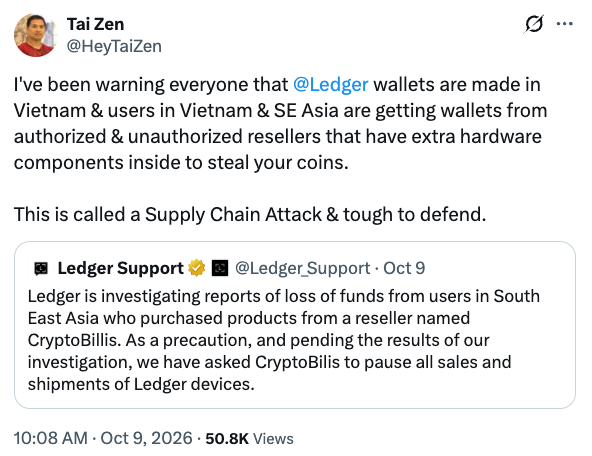
Vietnamese crypto educator Tai Zen contacted Ledger about a suspected hardware wallet implant in December 2025, according to Mark Karpelès. Source: Tai Zen

Ledger’s ongoing security crisis surfaced Oct. 9, when crypto losses were reported involving wallets sold through CryptoBilis, a reseller authorized in Southeast Asia. Ledger has confirmed that one affected device contained an unauthorized implant.

Ledger declined to comment when asked about its handling of Grand’s disclosure, and referred Cointelegraph to its public statements on X.

“Maybe Ledger not responding to a single event of an implant found on a Ledger purchased from a shady dealer is normal,” Karpelès said. He added:

However the increasing number of reports they must have received, and the increasing quality/technology used should have alerted them enough to act, and at least remind customers to be careful.”

Marketplace listings expose reseller verification gaps

In a presentation shared with Cointelegraph, Grand identified the seller of the tampered Ledger as “LedgerXXX” on Lazada. At the time of writing, LedgerXXX is not listed as an authorized reseller in Thailand, though Lazada’s Ledger storefront is.

Cointelegraph sought clarification from both Grand and Ledger on the seller’s identity and authorization status when the device was purchased.

OneKey’s head of sales, Archie, told Cointelegraph that marketplaces such as Lazada host numerous independent sellers, making it difficult for customers to distinguish authorized stores from other listings.
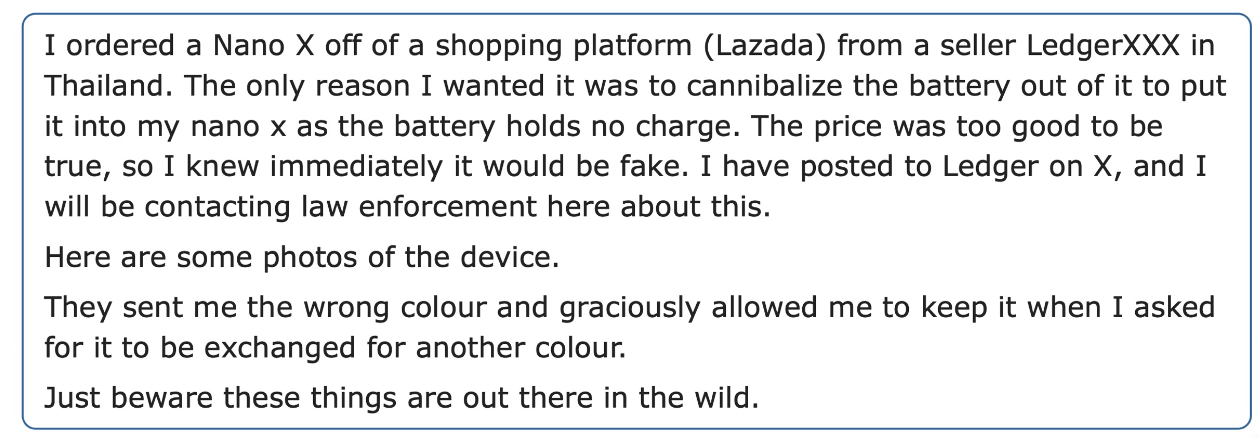
Source: Grand Idea Studio (Joe Grand)

Following the recent incidents, OneKey removed its reseller listings pending stricter checks, saying manufacturers must take responsibility for protecting customers rather than relying solely on buyers to identify trustworthy sellers.

Unauthorized wallet sales still raise security concerns

Grand’s findings were not limited to Ledger. In August 2026, he also alerted Trezor about tampered Trezor One and Model T wallets purchased from unauthorized sellers on TikTok and Facebook.

Trezor told Cointelegraph that counterfeit wallets occasionally appear through unauthorized sellers, as it had warned in 2022 about modified devices sold on Russian marketplaces. The company said that its recent claim of no evidence of compromised devices applied only to new wallets sold through authorized resellers.

Related: Trezor reduces resellers as a ‘preventative step’ amid Ledger tampering reports

Still, Trezor said it treats reports involving unauthorized sellers as early warnings and uses researchers’ findings to improve security checks.

“What changes the picture is a new technique, or a first case coming through an authorised channel,” Trezor said. “Either one means the problem has moved closer to ordinary buyers, and that’s when we’d move fastest, including warning customers directly.”

Magazine: Scammer Loses $4.8M Stored On Tampered Ledgers: Asia Express

Related Questions

QWhat did Mark Karpelès claim about Ledger's early implant warnings?

AKarpelès claimed Ledger received multiple reports of malicious hardware implants months before its latest security crisis, including at least two people contacting Ledger about tampered devices as far back as December 2025, and that he had not seen any public warning issued by Ledger in response.

QWho alerted Ledger about a malicious implant in a Nano X, and when?

ASecurity researcher Joe Grand alerted Ledger on March 4, 2026, about a malicious implant in a Nano X purchased through Lazada Thailand in August 2025.

QHow did Ledger respond to Joe Grand's disclosure according to the article?

ALedger acknowledged Grand's findings and said it was investigating internally, but Grand criticized the company for not proactively warning customers about the threat. Ledger declined to comment on its handling of Grand's disclosure and referred Cointelegraph to its public statements on X.

QWhat concerns about marketplace reseller verification gaps are highlighted in the article?

AThe article highlights that marketplaces like Lazada host numerous independent sellers, making it difficult for customers to distinguish authorized stores from other listings. Grand identified the seller of the tampered Ledger as 'LedgerXXX' on Lazada, which was not listed as an authorized reseller in Thailand at the time of writing.

QWhat did Trezor say about tampered devices from unauthorized sellers and how it handles such reports?

ATrezor said counterfeit wallets occasionally appear through unauthorized sellers, as it warned in 2022 about modified devices sold on Russian marketplaces, and that its recent claim of no evidence of compromised devices applied only to new wallets sold through authorized resellers. It also said it treats reports involving unauthorized sellers as early warnings and uses researchers' findings to improve security checks.

Related Reads

How Various Assets Have Performed So Far This Year: Bitcoin at -22% Return, Dead Last

As of November 13, 2026, Bitcoin has posted a -22.0% year-to-date return, ranking last among major asset classes. In contrast, the Philadelphia Semiconductor Index gained 43.2% despite a sharp pullback from its mid-year peak of 106.6%, while the S&P 500 and Nasdaq Composite held steady gains of roughly 8% to 10%. Even the CSI 300 (-13.3%) and gold GLD (-10.3%) outperformed Bitcoin. The article argues the key difference lies in the presence of real buying support. Semiconductors are backed by massive capital expenditure and order backlogs from major tech companies, giving them an earnings floor even after steep corrections. Bitcoin, by contrast, lacks such support. After spot ETFs helped Wall Street finish building core positions in 2024–2025, 2026 brought neither broad macro liquidity nor a new narrative capable of drawing fresh capital. ETF inflows slowed from a flood to a seasonal trickle. Without sustained new buyers, Bitcoin's high beta works only to the downside: in a stock-picking, zero-sum market it becomes the asset everyone wants to sell into strength. The article further notes that Bitcoin's positioning is losing focus. It has failed to act as either a "digital gold" hedge or a high-beta proxy for tech stocks. It lagged the Nasdaq and S&P 500 during the tech rally, and fell harder than gold when global assets contracted in November. The conclusion: Wall Street treats Bitcoin not as a safe haven but as a highly liquid, 24/7 liquidation tool—the first asset sold when institutions need to meet margin calls or lock in yearly profits. Crypto has been admitted to the table, but often as the one picked to pay the bill.

marsbit28m ago

How Various Assets Have Performed So Far This Year: Bitcoin at -22% Return, Dead Last

marsbit28m ago

From QR Codes to Physical Goods: How Consumer RWA Verifies Products and Rights

A single QR code can be printed on two bottles and scanned twice to open the same page, so verifying a physical item requires confirming the binding between the bottle in hand and its listed number. Consumer RWA verification has two parts: whether the goods or services are real, and whether the rights recorded in the digital credential are valid. For rights provenance, take a co-branded gift box: authorization documents define the term and scope in which a brand may use the co-branded mark, production and warehousing records show whether the box was stocked by batch, and rights registration states what holders can redeem and who delivers it. Linking all three lets consumers check authorization scope, supply, and their own eligibility. Identifiers, events, and evidence must work together. High-value items can use unique serial numbers, uniform-spec goods can use batch numbers, and courses or events can use session numbers. Events such as warehousing, sampling, outbound shipment, receipt, and redemption should be tied to the corresponding object, with operation time and responsible party retained. Test reports correspond to submitted samples; linking results to specific goods also requires checking the sample, batch, and inbound/outbound records. Ordinary batch goods can combine serialized QR codes with abnormal-scan records, while high-value items may add tamper-evident labels or independent authentication. Trusted records must also reflect current status. If a coffee batch has 500 bags at warehousing, 10 used for sampling, and 100 reserved for other channels, then absent other changes, 390 bags remain available for new rights. The warehousing record shows historical quantity; current redeemable quantity must be updated based on actual occupancy. A query page should at minimum state the goods or service, evidence source, last update time, and whether the credential is currently usable.

marsbit1h ago

From QR Codes to Physical Goods: How Consumer RWA Verifies Products and Rights

marsbit1h ago

10 Years Is Too Slow: Gu Quanquan's Team Challenges Dario, Compressing Cancer Cure to 4 Years

A UCLA professor, Quanquan Gu, has founded Geodesic Intelligence, a 15-person startup that after only five months has released NovaAtom-Lite, an all-atom structure prediction model that outperforms DeepMind's Isomorphic Labs flagship IsoDDE on FoldBench, the toughest biomolecular benchmark. The model predicts the 3D coordinates of every heavy atom in protein, DNA, RNA, and ligand complexes with near-experimental precision. NovaAtom-Lite posted top scores on two core pharma tests: antibody-antigen binding (79.07% success, 31 points above AlphaFold 3 and 3.5 above IsoDDE, with 2.2x AlphaFold 3's accuracy at high-precision thresholds) and protein-ligand binding (top 1 on both RMSD and contact metrics). On the Runs N' Poses benchmark, which separates memorization from genuine physics understanding, NovaAtom-Lite's lead grows on the most novel, out-of-distribution ligands (47.6% vs AlphaFold 3's 24%), showing it learns transferable physical rules rather than memorizing structures. The model also supports test-time scaling—raising sampling from 1 to 100 seeds lifts antibody success from 74.3% to 83.1%—and condition constraints, where a single contact-pair hint boosts success to 91.28% and full pocket hints lift hard-case ligand accuracy by nearly 16 points. It solved two nightmare cases: a wildly flexible 22-residue MERS nanobody loop (0.56 Å error, all 25 samples correct) and the KRAS G13D hidden switch-II pocket (0.98 Å ligand RMSD vs OpenDDE's 17.74 Å). Gu previously led ByteDance's SeedFold, the first model to beat AlphaFold 3 on FoldBench, forcing Isomorphic Labs to respond with IsoDDE. A stronger NovaAtom-Pro is coming. Days after launch, a16z cited NovaAtom-Lite in a report arguing pharma is entering its "GPT-3 moment," naming Geodesic as the sole company highlighted in its industry map. Geodesic's closed loop spans structure prediction, scientific reasoning, and wet-lab validation—aiming to compress drug discovery from a decade to four years.

marsbit1h ago

10 Years Is Too Slow: Gu Quanquan's Team Challenges Dario, Compressing Cancer Cure to 4 Years

marsbit1h ago

Trading

Spot
活动图片