LayerZero Breaks Silence On $290 Million KelpDAO Crypto Exploit

bitcoinistPublicado em 2026-04-20Última atualização em 2026-04-20

Resumo

LayerZero has addressed the $290 million exploit affecting KelpDAO's rsETH, asserting it was not a protocol failure but a result of KelpDAO's decision to use a single-DVN (Decentralized Verifier Network) configuration. The company claims the attack was isolated to this specific setup and confirms no contagion risk to other assets or applications. Preliminary analysis suggests the attack was executed by a sophisticated state actor, likely North Korea's Lazarus Group. The method involved poisoning RPC infrastructure used by the LayerZero Labs DVN, swapping binaries on compromised nodes, and using DDoS attacks to force traffic to the malicious infrastructure. However, LayerZero states its least-privilege principles prevented a direct compromise. The exploit was only possible due to KelpDAO's 1-of-1 verifier setup, which contradicts LayerZero's recommended multi-DVN redundancy model. A properly configured system with multiple independent DVNs would have prevented the attack. LayerZero has deprecated affected nodes, restored its DVN, and will no longer support 1/1 configurations. Aave has frozen rsETH and WETH reserves on its platforms as a precaution while confirming rsETH on Ethereum mainnet remains fully backed.

KelpDAO’s $290 million rsETH exploit has moved into a new phase, with LayerZero and Aave now publicly outlining how the incident unfolded, why the damage appears contained, and what it could mean for crypto cross-chain security standards going forward.

The central claim from LayerZero is that the exploit was not a failure of the protocol itself, but the result of KelpDAO’s decision to run rsETH with a single-DVN configuration. That matters because the latest statements shift the market narrative away from generalized contagion risk across LayerZero-integrated assets and toward a narrower question: how much risk was concentrated in one application’s security design.

LayerZero Links KelpDAO Crypto Exploit To RPC Attack

In an incident statement from April 20, LayerZero said the April 18 attack targeted KelpDAO’s rsETH setup and was “isolated entirely to KelpDAO’s rsETH configuration as a direct consequence of their single-DVN setup.” The company added that it had conducted “a comprehensive review of active integrations” and could confirm “with confidence that there is zero contagion to any other asset or application.”

LayerZero framed the episode as a state-linked crypto infrastructure attack rather than a protocol exploit. According to the statement, “preliminary indicators suggest attribution to a highly-sophisticated state actor, likely DPRK’s Lazarus Group, more specifically TraderTraitor.”

It said the attack did not compromise the protocol, key management, or the DVN instances directly. Instead, the attacker allegedly poisoned downstream RPC infrastructure used by the LayerZero Labs DVN, swapped binaries on compromised op-geth nodes, and then used DDoS pressure on uncompromised RPCs to force failover toward the poisoned infrastructure.

That sequence is central to LayerZero’s argument. “Because of our least-privilege principles, they were unable to compromise the actual DVN instances,” the company wrote. “However, they used this pivot point to execute an RPC-spoofing attack.

Their malicious node used a custom payload designed explicitly to forge a message to the DVN with minimal warnings.” LayerZero said the manipulated node presented false data only to the DVN while returning truthful responses to other IPs, including its own monitoring infrastructure, in what it described as a deliberately stealthy effort to avoid detection.

Even so, LayerZero argues the exploit should have been stopped at the application layer had rsETH not relied on a 1-of-1 verifier setup. “The affected application was rsETH, issued by KelpDAO,” the statement said. “Their OApp configuration at the time of this incident relied on a 1-of-1 DVN setup, with LayerZero Labs as the sole verifier — a configuration that directly contradicts the multi-DVN redundancy model that LayerZero has consistently recommended to all integration partners.”

It added that “a properly hardened configuration would have required consensus across multiple independent DVNs, rendering this attack ineffective even in the event of any single DVN being compromised.”

The company said its DVN is live again, that affected RPC nodes have been deprecated and replaced, and that it will no longer sign or attest messages for applications using a 1/1 configuration. It also said it is working with law enforcement and industry partners, including Seal911, to track funds.

Aave said in an X update on late The protocol said its analysis shows “rsETH on Ethereum mainnet is fully backed,” but added that “out of an abundance of caution, rsETH remains frozen across Aave V3 and V4 and exposure to the incident is capped.” WETH reserves also remain frozen across the affected markets on Ethereum, Arbitrum, Base, Mantle, and Linea while the team continues to validate information and assess possible resolutions.

At press time, the total crypto market cap stood at $2.5 trillion.
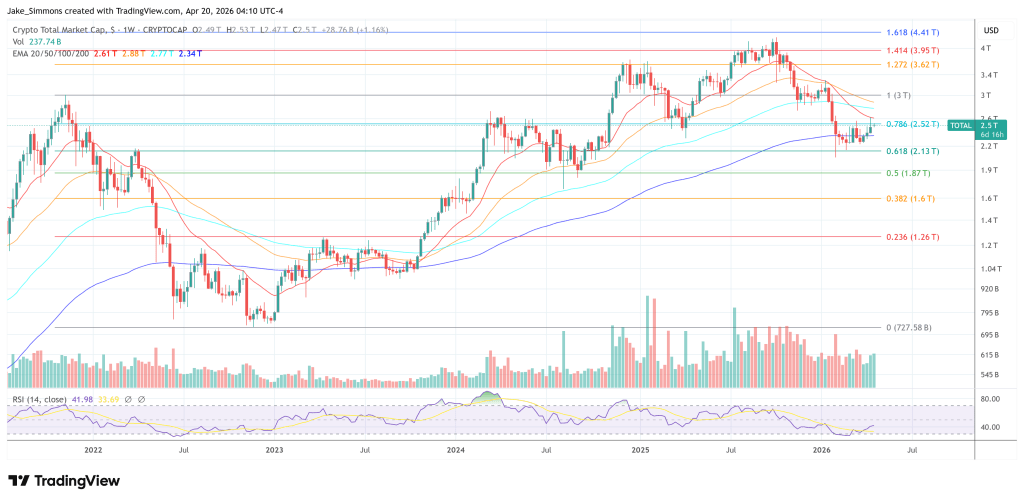
Total crypto market cap must overcome the 0.786 Fib, 1-week chart | Source: TOTAL on TradingView.com

Perguntas relacionadas

QWhat was the main reason for the $290 million KelpDAO crypto exploit according to LayerZero?

ALayerZero stated that the exploit was not a failure of its protocol but was the result of KelpDAO's decision to run its rsETH with a single-DVN (Decentralized Verifier Network) configuration, which contradicted LayerZero's recommended multi-DVN redundancy model.

QWhich sophisticated state actor is LayerZero preliminarily attributing the attack to?

ALayerZero's preliminary indicators suggest the attack is attributed to a highly-sophisticated state actor, likely the Lazarus Group from the Democratic People's Republic of Korea (DPRK), and more specifically, the subgroup known as TraderTraitor.

QHow did the attacker execute the RPC-spoofing attack without compromising the DVN instances directly?

AThe attacker poisoned downstream RPC infrastructure used by the LayerZero Labs DVN, swapped binaries on compromised op-geth nodes, and then used DDoS pressure on uncompromised RPCs to force failover toward the poisoned infrastructure, allowing them to forge a message to the DVN.

QWhat action has LayerZero taken regarding applications using a 1-of-1 DVN configuration after the incident?

ALayerZero announced that it will no longer sign or attest messages for any applications using a 1-of-1 DVN configuration, reinforcing its stance that a multi-DVN setup is necessary for security.

QWhat is the current status of rsETH on Aave V3 and V4 markets following the exploit?

AAave has stated that, out of an abundance of caution, rsETH remains frozen across its Aave V3 and V4 markets, and exposure to the incident is capped, although their analysis shows that rsETH on Ethereum mainnet is fully backed.

Leituras Relacionadas

The Verdict in Choi Tae-won's Divorce Case: Revealing the Inheritance Undercurrent Behind SK Hynix's Trillion-Won Empire

SK Group Chairman Chey Tae-won's high-profile divorce case, involving a record 1.38 trillion won settlement, has drawn attention to the succession plans for Korea's second-largest conglomerate, especially its crown jewel, SK hynix. Unlike traditional chaebol scripts centered on the eldest son, Chey's three children from his marriage to former President Roh Tae-woo's daughter, Roh Soh-yeong, are carving distinct, non-traditional paths. Eldest daughter Chey Yun-jung (b. 1989) is seen as the most evident successor. With a scientific and consulting background, she holds executive roles at SK bioscience and SK Inc.'s growth support department, focusing on future strategy and biopharma. Her marriage is to an AI infrastructure entrepreneur, not a traditional business alliance. Second daughter Chey Min-jung (b. 1991) took a unique route, voluntarily serving as a South Korean naval officer, including an anti-piracy deployment. She later worked on policy and strategy for SK hynix in Washington D.C. before co-founding an AI-driven healthcare startup. She married a former U.S. Marine Corps officer, connecting her to U.S. defense and policy circles—networks crucial for a global semiconductor giant. The only son, Chey In-geun (b. 1995), who studied physics like his father, worked briefly at SK E&S before joining McKinsey. Despite fitting the traditional "heir" profile as the eldest son, he remains silent and holds no public position or shares in SK, suggesting the old succession playbook is obsolete. As SK hynix's valuation soars, becoming a geopolitical asset in the AI era, the heirs' legitimacy is no longer automatic. They must prove themselves in fields like AI biotech, global policy, and strategic consulting. Their marriages also reflect new elite networks in tech and defense, not old political alliances. Their inheritance is the complex challenge of navigating a globalized, tech-driven world, not just a corporate throne.

marsbitHá 22h

The Verdict in Choi Tae-won's Divorce Case: Revealing the Inheritance Undercurrent Behind SK Hynix's Trillion-Won Empire

marsbitHá 22h

From OpenSea to OpenRouter: Is Alex Atallah Repeating His 'Exit at the Peak' Playbook?

From OpenSea to OpenRouter: Is Alex Atallah Repeating His "Exit at the Peak" Playbook? According to the Wall Street Journal, payments giant Stripe is in talks to acquire the AI model aggregation platform OpenRouter in a potential deal valuing the company near $100 billion. This would mark founder Alex Atallah's second creation of a company reaching a $100 billion valuation, following his co-founding of NFT marketplace OpenSea. OpenRouter, founded just over three years ago, has grown rapidly by acting as a unified gateway for developers to access over 400 AI models. It currently has about 10 million users and processes over 200 trillion tokens monthly. While the platform's annualized revenue is around $50 million, its valuation has skyrocketed from $1.3 billion in March 2026. The potential acquisition by Stripe, a company OpenRouter's founder once likened it to, represents a major expansion into AI infrastructure for the payments leader. This move echoes Atallah's previous timing with OpenSea, where he departed before the NFT market's significant downturn. For OpenRouter, selling now may be strategic. Despite its scale, its business model—charging a 5-5.5% fee on AI inference calls—faces pressure from competition, open-source models, and potential price wars among model providers, limiting its profitability narrative for an IPO. A key asset for potential acquirers like Stripe is OpenRouter's vast repository of real-world AI usage data, which offers unique insights into model performance and developer preferences that are difficult to replicate. Whether this potential deal signifies a new valuation benchmark for AI infrastructure or another market peak signal remains to be seen.

链捕手Há 22h

From OpenSea to OpenRouter: Is Alex Atallah Repeating His 'Exit at the Peak' Playbook?

链捕手Há 22h

Trading

Spot
活动图片





