Law Firm Behind FTX Legal Work Now Facing $525M Suit

bitcoinistPublicado em 2026-05-15Última atualização em 2026-05-15

Resumo

A federal lawsuit seeks $525 million from Silicon Valley law firm Fenwick & West for its alleged central role in facilitating FTX's fraud. A bankruptcy examiner found the firm "deeply intertwined" in FTX's wrongdoing, creating shell companies like North Dimension to funnel over $3 billion, drafting backdated agreements, and implementing FTX's auto-delete messaging policy on Signal. The suit, filed by 20 international victims, claims Fenwick's involvement lent FTX false legitimacy, preventing investors from withdrawing savings. It cites former FTX engineer Nishad Singh, who testified he directly told Fenwick attorneys about misuse of customer funds, after which the firm allegedly advised on concealment. The complaint includes claims of malpractice and fraud, targeting both the firm and two individual partners. This follows the recent rejection of Sam Bankman-Fried's bid for a new trial.

A court-appointed bankruptcy examiner found that Fenwick & West was “deeply intertwined in nearly every aspect of FTX Group’s wrongdoing” — and now that finding sits at the heart of a $525 million federal lawsuit filed against the Silicon Valley law firm.

Shell Companies And Deleted Messages

Twenty victims of the FTX collapse, coming from five countries, filed the complaint Wednesday in the US District Court for the District of Columbia.

They say they lost their life savings when the exchange went under in November 2022, and that Fenwick’s involvement gave FTX a false sense of legitimacy that kept them from pulling their money out in time. Six individual defendants are named alongside the firm.

The examiner’s conclusions came after a review of more than 200,000 documents in the federal bankruptcy proceedings.

According to the lawsuit, the examiner found that Fenwick created corporate structures for both FTX and its sister trading firm Alameda Research, formed shell entities to hide money movements, and drafted backdated agreements to cover up illicit transfers.
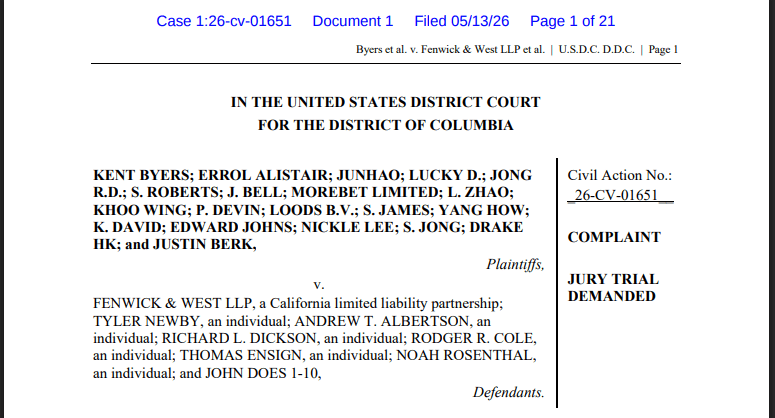
Source: Court Listener

Two specific acts are described in detail. Reports indicate Fenwick attorneys set up North Dimension Inc., a Delaware shell company that posed as an electronics retailer while allegedly funneling over $3 billion in stolen customer funds.

The firm also reportedly put in place FTX’s auto-delete messaging policy on the Signal app — the same system federal prosecutors say helped the fraud go undetected.

A Witness From Inside FTX

Nishad Singh, FTX’s former Director of Engineering, adds another layer to the case. Singh pleaded guilty to fraud charges and testified against Sam Bankman-Fried at his criminal trial.

According to the lawsuit, Singh told Fenwick attorneys directly that customer funds were being misused. Rather than walking away, the firm allegedly advised on how to conceal it.

BTCUSD now trading at $79,806. Chart: TradingView

After FTX filed for bankruptcy, Fenwick quietly scrubbed all references to the exchange from its website. The firm also retained defense lawyers from Gibson Dunn before any civil lawsuit had been filed against it.

Damages And Individual Defendants

The plaintiffs are bringing seven claims, including malpractice, fraud, and gross negligence. They are seeking compensatory damages above $525 million, a return of all legal fees Fenwick collected from FTX, and punitive damages against two named partners — Tyler Newby and Daniel Friedberg — for what the complaint calls deliberate and reckless individual professional conduct.

Meanwhile, Bankman-Fried’s own legal efforts have stalled. A federal judge last month rejected his bid for a new trial, dismissing his claims of new evidence as baseless.

Judge Lewis Kaplan, who sentenced Bankman-Fried to 25 years in prison in 2024, said his arguments were “wildly conspiratorial and entirely contradicted by the record.”

Featured image from WealthBuilders, chart from TradingView

Perguntas relacionadas

QAccording to the lawsuit, what specific actions did the court-appointed bankruptcy examiner find Fenwick & West to be involved in with FTX?

AThe examiner found that Fenwick & West was 'deeply intertwined in nearly every aspect of FTX Group’s wrongdoing,' including creating corporate structures for FTX and Alameda Research, forming shell entities to hide money movements, and drafting backdated agreements to cover up illicit transfers.

QWho is named as a key witness from inside FTX in the lawsuit against Fenwick & West, and what is the significance of his testimony?

ANishad Singh, FTX's former Director of Engineering, is named. He pleaded guilty to fraud and testified that he directly told Fenwick attorneys customer funds were being misused. The lawsuit alleges the firm then advised on how to conceal it rather than withdrawing.

QWhat are the plaintiffs in the lawsuit seeking from Fenwick & West and the named individual partners?

AThe plaintiffs are seeking compensatory damages above $525 million, a return of all legal fees Fenwick collected from FTX, and punitive damages against two named partners, Tyler Newby and Daniel Friedberg, for alleged deliberate and reckless professional conduct.

QWhat were two specific acts allegedly performed by Fenwick attorneys detailed in the complaint?

AFirst, they set up the Delaware shell company North Dimension Inc., which allegedly funneled over $3 billion in stolen customer funds while posing as an electronics retailer. Second, they reportedly implemented FTX’s auto-delete messaging policy on Signal, which helped conceal the fraud.

QWhat recent development is mentioned regarding Sam Bankman-Fried's legal situation?

AA federal judge, Lewis Kaplan, last month rejected Sam Bankman-Fried's bid for a new trial, dismissing his claims of new evidence as 'wildly conspiratorial and entirely contradicted by the record.' Judge Kaplan had sentenced him to 25 years in prison in 2024.

Leituras Relacionadas

Fei-Fei Li's Team Clarifies the Concept of 'World Models', Sora Merely a Renderer

"World Models" has become a widely used yet confusing term in AI. To address this, a team led by Fei-Fei Li and World Labs proposed a functional taxonomy based on the Partially Observable Markov Decision Process framework. This taxonomy categorizes systems called "world models" into three distinct projections: Renderers, Simulators, and Planners. Renderers, like OpenAI's Sora and other video generation models, focus on producing photorealistic visual outputs for human perception. They prioritize visual fidelity over physical accuracy. Simulators, such as NVIDIA Omniverse, aim to compute precise future environmental states for computational tasks like engineering analysis or digital twins. Planners, like Vision-Language-Action models, take in observations and goals to output executable actions for robots or agents. The article clarifies that most current "world models," including Sora, are primarily Renderers. They generate convincing visuals but lack the core ability to simulate state transitions based on actions, a key requirement for a true world model in classic reinforcement learning definitions. This conceptual confusion has practical implications, leading to potential misalignment in technology selection, investment, and public understanding of AI capabilities. Clear categorization is crucial. It helps enterprises avoid costly mistakes (e.g., using a renderer for robot training), allows investors to accurately assess markets, and enables researchers to build comparable benchmarks. While future systems may integrate these functions, recognizing current boundaries is essential for honest assessment and progress.

marsbitHá 43m

Fei-Fei Li's Team Clarifies the Concept of 'World Models', Sora Merely a Renderer

marsbitHá 43m

Bloomberg Uncovered: How Do China's Wealthy Circumvent the Annual $50,000 Limit to Transfer Assets?

**Summary: How Wealthy Chinese Circumvent $50,000 Annual Foreign Exchange Limits** Despite China's strict capital controls, including an annual $50,000 per person foreign exchange quota, an estimated $150 billion in funds still leaves the country annually via various gray and underground channels. This report outlines the evolution of China's "capital wall" and the methods used to bypass it. **The Evolving Capital Controls:** * **Foundation (1994):** The system of "current account convertibility with strict capital account controls" was established. * **Quota Set (2007):** The $50,000 individual annual forex purchase limit was formalized. * **Crackdown Begins (2015-2017):** Following market volatility, enforcement tightened. Banks were required to scrutinize transactions, and channels like using UnionPay cards for Hong Kong insurance premiums or buying overseas property were blocked. * **Digital & Legal Upgrades (2024-2026):** Enhanced algorithms now flag suspicious patterns (e.g., "smurfing"). The Common Reporting Standard (CRS) provides Chinese tax authorities with data on citizens' offshore accounts. Unlicensed cross-border brokers have been targeted. **Five Primary Methods for Moving Capital:** 1. **Underground Banking / "Hawala" (Duiqiao):** The largest-scale method. No money crosses borders. Clients pay RMB to a domestic account; an overseas associate deposits equivalent foreign currency into the client's offshore account. Risks include high fees, account freezes, and legal penalties. 2. **"Smurfing" or "Ant Moving":** Using multiple individuals' $50,000 quotas to pool funds for one offshore recipient. Increasingly detected by anti-money laundering algorithms. 3. **Trade Invoice Manipulation:** Businesses over-invoice imports or under-invoice exports via offshore shell companies, creating a pretext to transfer excess funds abroad under the guise of trade. 4. **Channel Migration:** After a crackdown on internet brokers, funds flow toward more compliant but costly channels like major banks' cross-border wealth management services or Qualified Domestic Institutional Investor (QDII) quotas. 5. **Structural Arrangements:** High-net-worth individuals use complex, high-cost legal structures involving offshore trusts, insurance, and investment migration programs to transfer asset ownership. **Regulatory Response: Focusing on People, Not Just Money** The current strategy extends oversight from enterprises to **individual residents**. Tools like CRS allow retroactive visibility into offshore assets. Cryptocurrencies, once seen as a potential loophole, are now actively monitored and prosecuted as an illegal channel. The underlying driver remains: with significant wealth concentrated among millions of affluent households seeking diversification amid domestic economic shifts, the incentive to move assets offshore persists despite regulatory barriers.

marsbitHá 1h

Bloomberg Uncovered: How Do China's Wealthy Circumvent the Annual $50,000 Limit to Transfer Assets?

marsbitHá 1h

Trading

Spot
Futuros
活动图片





