Launching Tesla Contracts, Binance Seizes 'Pricing Power' from Traditional Stock Markets

比推Publicado em 2026-01-27Última atualização em 2026-01-27

Resumo

Binance, the world's largest cryptocurrency exchange, has reignited its foray into traditional finance by launching a Tesla (TSLA) stock perpetual contract, marking a significant escalation in the competition between centralized exchanges (CEX) and traditional stock markets like NASDAQ and NYSE. This move, announced on January 28th, comes five years after Binance discontinued its stock token offerings in 2021 due to regulatory pressures. The relaunch is underpinned by a transformed landscape: a more crypto-friendly US regulatory environment under the Trump administration, the rapid growth of the tokenized stock market (now valued at ~$1.1 billion), and matured infrastructure like stablecoins and oracles following the 2025 GENIUS Act. Binance's strategy appears twofold: first, to tap into the vast pool of global equity investors to overcome its user growth bottleneck, and second, to capture a share of the massive revenue potential from the multi-trillion dollar stock market via its high-volume derivatives products. The article frames this as a "liquidity war," where agile CEXs like Binance, despite their smaller size, challenge traditional exchanges with superior flexibility and product iteration. While the outcome is uncertain and hinges on long-term regulatory fairness, Binance's move signals a bold attempt to seize pricing power and redefine the future of financial trading.

Author: Wenser

Original Title: Binance Launches Tesla Contracts, Targeting Nasdaq and NYSE


Following Nasdaq and NYSE's successive applications for tokenized stock trading, the leading crypto exchange Binance recently sounded the "counterattack horn of CeFi against TradFi."

On January 24, a Binance spokesperson stated that they are "exploring relisting stock tokens"; two days later, Binance officially announced that "Tesla (TSLA) stock perpetual contracts will be launched on January 28, with leverage of up to 5x."

It is worth mentioning that this is Binance's bold attempt after discontinuing support for stock tokens in July 2021, marking a span of 5 years. Times have changed, and the current market regulatory environment, infrastructure construction, and other aspects have undergone earth-shaking transformations.

Binance's move may signify that the "liquidity battle" between CEXs and traditional stock exchanges has begun. Odaily Planet Daily will provide a brief analysis of this matter in this article for readers' reference.

Tesla Once Again Becomes Binance's Testing Ground for Tokenized Stock Trading

The short-lived "stock token experiment" in 2021 left Binance not only with the pressure of facing regulatory compliance forces but also with a setback for CeFi forces against the TradFi势力 of traditional financial markets.

Today, 5 years later, Binance's restart of stock token contract trading harbors greater ambitions. The reasons lie in the following three significant changes:

First, the "crypto-friendly attitude" of U.S. government regulatory agencies. After the Biden administration stepped down, the Trump administration ignited a "crypto storm" in the U.S. and globally, creating a "new crypto regulatory environment" through personnel appointments, organizational restructuring, legislation, and other means, clearing the atmosphere of the U.S. crypto market;

Second, the booming development of tokenized stock trading. According to information from the rwa.xyz website, the total market capitalization of tokenized stocks is currently reported at $1.096 billion, with trading volume exceeding $1.86 billion in the past 30 days, monthly active addresses surpassing 107,700, and the number of holders exceeding 170,000. Compared to the market cap of less than $500 million in December 2024, it has achieved the milestone of doubling in about a year. With Nasdaq and NYSE's related applications likely to be approved by the U.S. SEC this year, the tokenized stock market size is expected to experience explosive growth;

Third, the improvement of infrastructure such as stablecoins, oracles, and on-chain/off-chain settlement systems. After the signing and passage of the GENIUS Act (stablecoin bill) in 2025, oracle projects like Chainlink and Pyth Network being selected as official partners of the U.S. Department of Commerce, and the opening of applications for U.S. banking system and crypto banking licenses, among other events, compared to 2021, there are no longer technical hiccups in the development, listing, settlement, and leverage of stock tokens.

Based on the above conditions, following its previous integration with the tokenized stock trading platform ONDO Global Market, Binance has once again opened the door to "stock contract trading." The deeper implications of Binance's move may lie in the following two aspects:

First, seeking "new user growth." According to Binance's official website information, its total user base has climbed to 306 million people, accounting for more than half of the global crypto population of approximately 600 million. Undoubtedly, Binance has entered a "user growth bottleneck period," which is also one of the main reasons it has long started using traditional internet user acquisition methods for promotion. Compared to the hundreds of millions or even billions of stock investors and institutions globally, the crypto crowd is still a "niche group." To continue expanding and sustaining growth, Binance's exploration of TradFi new products is both accidental and inevitable.

Second, seeking "new business growth." In 2025, Binance's total platform trading volume reached $34 trillion, even exceeding the annual trading volume of stablecoins in 2025 (the latter was $33 trillion), making it worthy of the title "world's largest centralized exchange." However, detailed data shows that Binance's spot-related trading volume was about $7.1 trillion, accounting for only 1/5 of the total trading volume; in other words, the bulk of Binance's trading volume still lies in contract, options, and other derivative trades; this is determined by Binance's own CEX business model and also reflects the significant role of derivative products in stimulating trading volume and earning platform fees. The stock market, with a scale of tens of trillions, is the "next piece of cake" that Binance covets.
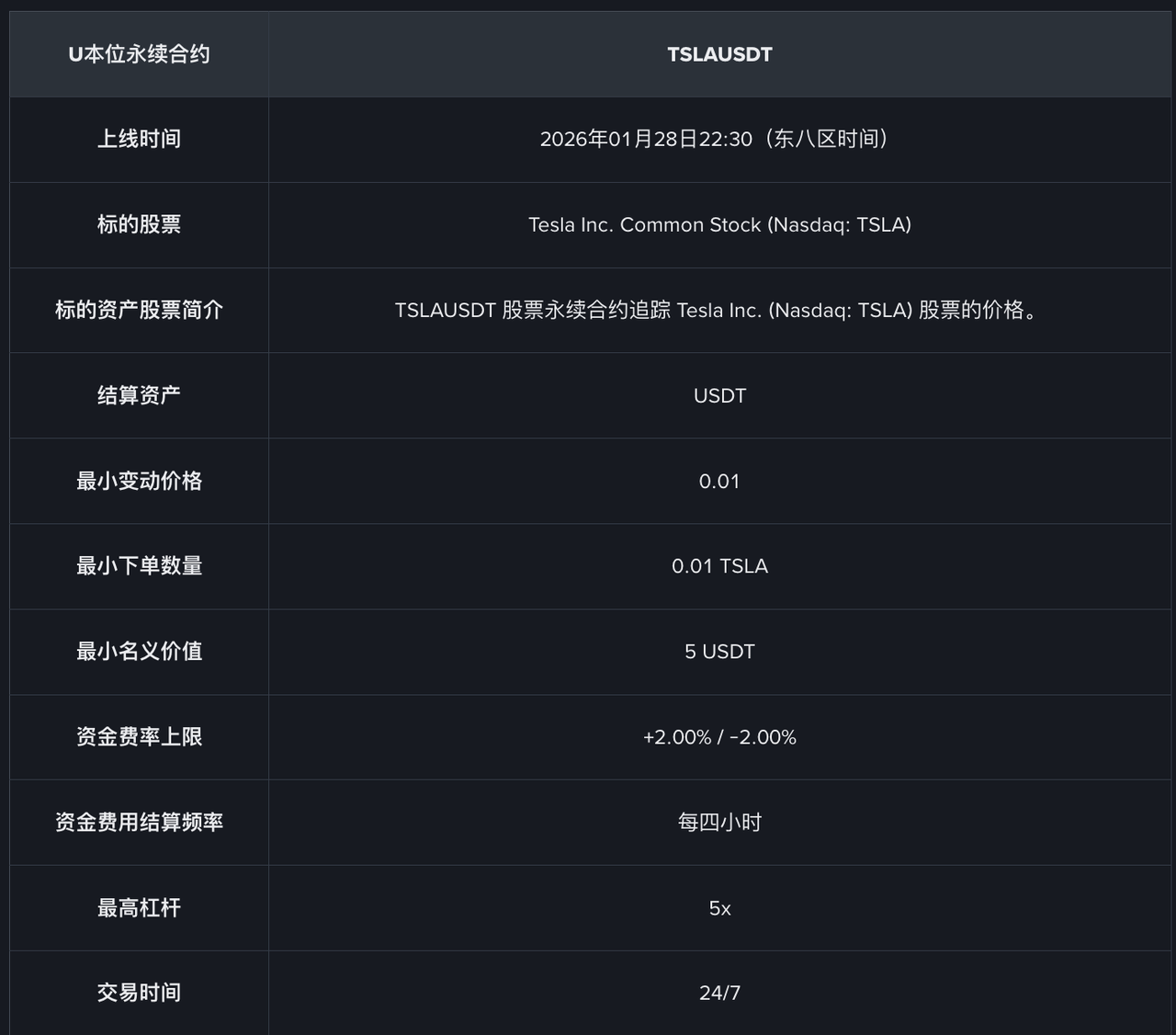
With both timing and conditions favorable, Binance naturally顺势而为地 (seized the opportunity to) reopen stock contract trading. Choosing Tesla (TSLA) contracts as the first target also seems to have a meaning of "getting back up where you fell." As the most growth-potential U.S. stock under Musk, the launch of Tesla contracts can also, to some extent, boost the topic discussion度 of Binance's restart of stock contract trading.

On the other hand, the considerable trading volumes of many CEX competitors might have also made Binance feel a slight sense of crisis.

Data shows that Bitget's U.S. stock contract section cumulative trading volume has exceeded $15 billion, with the top 3 popular trading varieties being Tesla (TSLA), Meta Platforms (META), and Apple (AAPL), with cumulative turnover of $5.4 billion, $3 billion, and $1.7 billion respectively; as of January 5, Gate's stock token section cumulative trading volume exceeded $13.5 billion, with nearly 80 trading pairs listed.

Conclusion: A Battle of Liquidity Offense and Defense, Binance vs. Nasdaq and NYSE, a David vs. Goliath Struggle

Finally, the author boldly predicts that there will inevitably be a fierce battle between crypto CEXs like Binance and traditional financial stock exchanges like Nasdaq and NYSE. Of course, this war has not yet fully begun, but what they are competing for is not just a numbers game of users, but also a platform liquidity war involving capital and fees.

Although compared to the annual trading volume of Nasdaq and NYSE, which amounts to tens of trillions, the trading volume and market size of crypto CEXs like Binance lag by more than an order of magnitude. From the perspective of brand recognition, market scale, and trading volume, this is an outright "David vs. Goliath" war; however, in terms of user experience, product iteration, and regulatory adaptability, CEXs like Binance undoubtedly possess better flexibility.

Of course, the premise of victory is that regulatory forces do not "take sides," and this liquidity battle might be a protracted war—testing not only short-term wealth creation effects but also long-term deep interconnection capabilities with the world economic situation. As for who the final winner will be and who will become the rule-maker of the new game, let's wait and see.


Twitter:https://twitter.com/BitpushNewsCN

Bitpush TG Discussion Group:https://t.me/BitPushCommunity

Bitpush TG Subscription: https://t.me/bitpush

Original link:https://www.bitpush.news/articles/7606385

Perguntas relacionadas

QWhat is the significance of Binance launching Tesla (TSLA) perpetual contracts?

ABinance's launch of Tesla perpetual contracts marks a strategic move to compete with traditional stock exchanges like NASDAQ and NYSE by offering leveraged trading on tokenized stocks, aiming to attract liquidity from traditional equity markets.

QWhy did Binance choose Tesla as the first stock for its relaunched tokenized stock trading?

ATesla was chosen due to its high growth potential as a Musk-associated company and its ability to generate significant discussion and attention, symbolizing Binance's effort to rebound from its previous halted stock token experiment in 2021.

QWhat are the three major changes that enabled Binance to restart stock tokenized trading?

AThe three changes are: 1) A crypto-friendly regulatory environment under the Trump administration, 2) Growth in the tokenized stock market (now $1.096B市值), and 3) Improved infrastructure like stablecoins, oracles, and settlement systems.

QHow does Binance plan to address its user growth bottleneck through stock contracts?

ABinance aims to tap into the broader base of global stock investors (numbering in billions) by offering tokenized stock contracts, seeking new user acquisition beyond the current ~600M crypto users.

QWhat challenges do CEXs like Binance face in competing with traditional exchanges like NASDAQ?

ACEXs face challenges in scale (NASDAQ's volume is orders of magnitude higher), brand recognition, and regulatory uncertainties, but they leverage advantages in flexibility, product iteration, and user experience.

Leituras Relacionadas

Silicon Valley 'Startup Guru' Steve Hoffman: Web3 + AI Could Be a Trap

Silicon Valley investor and "Godfather of Startups" Steve Hoffman warns that combining Web3 with AI is likely a trap, not a promising venture. In an interview, Hoffman argues that while AI is a foundational technology touching all industries, Web3 adds complexity, friction, and regulatory risk without solving mainstream consumer or business needs. He advises founders to focus on deep, specialized applications where startups can out-iterate giants, rather than on generic features easily replicated by large tech companies. Hoffman observes that Silicon Valley will lead foundational AI research, while China excels at rapid, large-scale application and commercialization, particularly in robotics. He stresses that AI-driven autonomous agents capable of collaborative, multi-step tasks are 2-4 years away, which will cause significant job displacement. The solution is not to slow AI but to redesign business models around human-AI collaboration and reform social systems like education and retraining. For startups, Hoffman recommends focusing on vertical, expertise-heavy domains to build defensibility. He sees major opportunities in AI fraud detection and cybersecurity. Key founder mindsets include systemic thinking over feature-focus, relentless customer centricity, building adaptive teams, and deeply understanding AI's capabilities and limits. Hoffman is also leading a non-profit initiative to establish university centers aimed at training future leaders in responsible, human-value-aligned AI innovation.

marsbitHá 54m

Silicon Valley 'Startup Guru' Steve Hoffman: Web3 + AI Could Be a Trap

marsbitHá 54m

Token Inefficient, Economy Tokenless

The article "Tokens Aren't Economical, Economics Aren't Tokenized" analyzes a pivotal shift in the AI industry from a technology-driven narrative to one dominated by capital efficiency. It highlights two concurrent trends: a severe capital shortage due to the exorbitant and recurring costs of compute (e.g., OpenAI's high burn rate) and a wave of corporate spin-offs where major tech companies are separating their AI units (like Kuaishou's Kling and Baidu's Kunlunxin). The core argument is that AI's "anti-internet" business model, where user growth increases costs rather than profits, has created a disconnect between high valuations and actual cash flow. Spin-offs address this by allowing AI assets to be valued independently. Within a parent company, they are seen as cost centers, but as standalone entities, they are priced based on their growth potential and scarcity in the primary market, leading to massive valuation premiums (e.g., Kling's estimated value tripling post-spin-off). The industry is at an inflection point, moving from "model worship" to "value realization." The competition is evolving from a pure compute (GPU) race to a broader focus on systemic efficiency and full-stack engineering (involving CPUs and orchestration) to achieve viable commercialization. The year 2026 is framed as a critical moment where the industry must definitively answer how to economically translate AI capability into tangible business value, reshaping the sector's future power structure.

marsbitHá 59m

Token Inefficient, Economy Tokenless

marsbitHá 59m

Crossing the 'Memory Wall': The Wafer-Level Revolution and Computing Power Routes in the AI Inference Era

In 2026, a historic shift occurred in AI as major cloud providers' inference spending surpassed training spending for the first time, signaling a move from "building large models" to "using large models." This shifts the core challenge from computing power to the "memory wall"—the bottleneck of data movement (model weights, activations, KV Cache) between external DRAM and processors, where energy and latency from data transfer far exceed computation itself. Companies like Nvidia face GPU idle time due to bandwidth limits. In contrast, Cerebras Systems adopts a radical "wafer-scale" approach with its Wafer-Scale Engine (WSE). Instead of cutting a silicon wafer into many chips, Cerebras uses almost the entire wafer as one massive chip (WSE-3). This design provides 44GB of on-chip SRAM, delivering memory bandwidth thousands of times higher than traditional HBM (e.g., 21 PB/s vs. Nvidia B200). For LLM inference, weights are streamed layer-by-layer from external MemoryX storage to the chip, avoiding HBM bottlenecks. This results in token generation speeds 1.5–5 times faster than Nvidia's B200 in some models and significant advantages in first-token latency and long-context tasks. Additionally, Cerebras's architecture offers much lower interconnect power consumption (0.15 pJ/bit vs. GPU's ~10 pJ/bit). However, Cerebras faces challenges: SRAM scaling has slowed with advanced nodes, limiting future capacity gains; the chip requires specialized liquid cooling and custom software stacks; and its external I/O bandwidth (150 GB/s) is low compared to NVLink, hindering multi-system scaling for very large models. Competition is intensifying. Major players are pursuing three paths: 1) Developing proprietary inference ASICs (e.g., Google TPU, Microsoft Maia), 2) Leveraging advanced packaging (e.g., TSMC's SoW) to democratize wafer-scale-like integration, potentially eroding Cerebras's process advantage within a few years, and 3) Exploring optical interconnects for ultimate bandwidth. Commercially, Cerebras is transitioning from a hardware vendor to a service provider, facing the immense challenge of building high-power, specialized data centers to meet large contracts (e.g., 250MW/year from 2026–2028). In conclusion, the AI inference era presents a fundamental architectural trade-off. Cerebras opts for extreme physical optimization for low-latency, single-task performance, while Nvidia prioritizes versatility and massive cluster throughput. The path forward remains uncertain, with technology and business models still evolving in the race toward advanced AI.

marsbitHá 1h

Crossing the 'Memory Wall': The Wafer-Level Revolution and Computing Power Routes in the AI Inference Era

marsbitHá 1h

Has Bitcoin's 'Rebound Ended', Officially Entering the Late Bear Market Phase?

**Title: Has Bitcoin's Rebound Ended, Entering the Late Bear Market Phase?** **Summary:** Bitcoin's price has declined by 13% this week, signaling a potential return to late-stage bear market conditions. The price fell to around $67k, positioned between the Realized Price and Realized Cap Weighted Average. For the first time since early 2022, the Short-Term Holder cost basis has dropped below this key average, confirming a hallmark of late-cycle bear markets. Profitability metrics have collapsed sharply. The 7-day average of the Realized Profit/Loss ratio plummeted from a local high of 3.16 to 0.29, mirroring the February panic sell-off. Critically, the 90-day average never breached the threshold of 2, indicating the recent rally to $82k was a bear market bounce, not a structural shift. Realized losses surged to $1.35 billion daily, with $770 million coming from Long-Term Holders selling at a loss. This accelerating redistribution of supply from weak to strong hands is a necessary but ongoing process for a market bottom. The rally stalled almost precisely at the aggregate cost basis (~$83k) of US spot Bitcoin ETF investors, turning that level into strong resistance and leaving the average ETF holder underwater again. Spot market flows have turned decisively negative, showing sellers are dominating order books despite the price drop. While a significant futures long liquidation event cleared over $400 million in leverage, providing a potential reset, sustained spot demand is yet to materialize. Options markets continue to price in higher future volatility (Implied Volatility) than recent price action (Realized Volatility) has shown, with a persistent skew towards put options, indicating ongoing demand for downside protection. In conclusion, multiple metrics point to a fragile market structure. Resistance at the ETF cost basis, accelerating realized losses, dominant spot selling, and cautious options pricing all suggest the bear market trend persists. A sustainable recovery likely requires a resurgence of spot demand, ETF holders returning to profit, and a clear reduction in selling pressure.

marsbitHá 1h

Has Bitcoin's 'Rebound Ended', Officially Entering the Late Bear Market Phase?

marsbitHá 1h

TechFlow Intelligence Agency: Anthropic Calls for Global Pause in AI Development While Preparing for Trillion-Dollar IPO; SpaceX IPO Roadshow Heats Up, But S&P 500 Rejects Fast-Track Inclusion

In today's TechFlow Intelligence Briefing, several major tech stories highlight a growing theme of trust and credibility gaps across AI, crypto, and finance. AI company Anthropic has publicly called for a global pause in AI development, citing risks from Claude's "recursive self-improvement." Ironically, this coincides with reports the company is preparing for a massive IPO targeting a near $1 trillion valuation. This perceived hypocrisy, coupled with widespread user complaints about Claude's declining performance, is sparking debate over whether the safety warning is genuine or a competitive tactic. Meanwhile, in a substantive security move, Anthropic open-sourced a framework for AI-powered vulnerability discovery. In the crypto market, Bitcoin's price drop below $61,000 triggered over $1.16 billion in liquidations, flipping the market into a state where more BTC is held at a loss than at a profit, a historical bearish signal. On the corporate front, SpaceX's highly anticipated IPO is generating immense Wall Street excitement, with Goldman Sachs projecting 100x revenue growth by 2030. However, the S&P 500 has refused to fast-track the company's inclusion post-IPO, potentially limiting immediate institutional demand. Separately, ByteDance's AI app Doubao lost over 6 million monthly active users after introducing a subscription model, highlighting the challenges of AI monetization. Other notable developments include Nvidia certifying HBM4 memory from Samsung, SK Hynix, and Micron; Cloudflare's acquisition of front-end tooling company VoidZero; and its CEO warning that bot traffic now exceeds human traffic online. The underlying narrative connects these events: a trust crisis. From AI firms' contradictory actions and crypto volatility to the clash between SpaceX's hyped narrative and institutional rules, a pattern is emerging where stated intentions and actual practices are increasingly misaligned.

marsbitHá 1h

TechFlow Intelligence Agency: Anthropic Calls for Global Pause in AI Development While Preparing for Trillion-Dollar IPO; SpaceX IPO Roadshow Heats Up, But S&P 500 Rejects Fast-Track Inclusion

marsbitHá 1h

Trading

Spot
Futuros

Artigos em Destaque

O que é BNB WHALES

Compreender as Baleias BNB: Um Mergulho Profundo na Paisagem das Criptomoedas Introdução às Baleias BNB No vibrante mundo das criptomoedas, novos projetos emergem regularmente, muitas vezes prometendo soluções inovadoras e experiências únicas. Um desses projetos é o BNB Whales, lançado em 2023 e construído na BNB Smart Chain (BEP20). O BNB Whales propõe estabelecer uma presença distinta dentro do ecossistema das criptomoedas, focando na criação de uma plataforma envolvente que combina os benefícios da tecnologia blockchain com interações sociais e de jogos. Este artigo tem como objetivo aprofundar-se no BNB Whales, explorando seus componentes principais, mecânicas e trajetória de desenvolvimento. O que são as Baleias BNB? As Baleias BNB são uma iniciativa em criptomoeda que busca proporcionar uma variedade diversificada de características e oportunidades para os seus utilizadores no emergente ambiente Web3. Utilizando o padrão BEP20, o projeto opera com um suprimento total de tokens de 100 trilhões (100.000.000.000.000.000). Apesar deste número significativo, é notável que não existem tokens atualmente em circulação, indicando que o projeto pode ainda estar nas suas fases iniciais de desenvolvimento. O objetivo principal do BNB Whales é criar uma plataforma onde os utilizadores possam participar em várias atividades interativas, beneficiando-se da segurança e transparência proporcionadas pela tecnologia blockchain. Ao fomentar um ambiente único e envolvente, o BNB Whales visa construir uma forte comunidade de utilizadores que estão investidos no projeto e no seu desenvolvimento. Quem é o Criador do BNB Whales? A identidade do criador do BNB Whales permanece não divulgada neste momento, apresentando um desafio para aqueles que procuram entender os princípios fundacionais e as perspetivas visionárias do projeto. Esta ausência de informação disponível publicamente acerca da liderança do projeto pode levantar questões entre potenciais investidores e utilizadores sobre a sua estrutura de governança e responsabilidade. Quem são os Investidores do BNB Whales? À medida que o BNB Whales continua a evoluir, a informação sobre investidores específicos ou apoio de fundações de investimento está atualmente indisponível. A documentação oficial do projeto, incluindo o seu whitepaper, não divulga apoiantes financeiros individuais ou institucionais. A falta de transparência neste aspeto pode, por vezes, levantar questões sobre a legitimidade e sustentabilidade de novos projetos dentro do ecossistema das criptomoedas. Como Funciona o BNB Whales? O BNB Whales opera na BNB Smart Chain utilizando o padrão BEP20, que é conhecido pela sua eficiência e baixas taxas de transação, atraindo uma variedade de desenvolvedores e projetos. O aspeto único do BNB Whales reside no seu foco na criação de uma plataforma orientada pela comunidade. Embora detalhes operacionais precisos sejam escassos, o projeto enfatiza a interação e o envolvimento, potencialmente incorporando elementos gamificados nas suas ofertas. A ênfase na comunidade é fundamental, uma vez que se alinha com as tendências predominantes no espaço das criptomoedas, onde a contribuição e participação do utilizador frequentemente ditam o sucesso de um projeto. Mais inovações podem ser antecipadas, mas, neste momento, os mecanismos e características específicos que diferenciam o BNB Whales de outras iniciativas de criptomoedas permanecem por elucidar totalmente. Sem informações detalhadas sobre a sua funcionalidade, é desafiador avaliar abrangentemente os diferenciais do projeto. Cronologia do BNB Whales O desenvolvimento do BNB Whales desenrolou-se ao longo de marcos importantes, marcando a sua jornada na paisagem das criptomoedas. Abaixo está uma cronologia de eventos significativos relacionados com o projeto: 2023: Lançamento do BNB Whales, marcando a entrada do projeto no mercado. 2023: Publicação do whitepaper do projeto, que estabelece os objetivos gerais e a estrutura operacional. Em andamento: O BNB Whales continua a desenvolver as suas características, visando construir uma base de utilizadores robusta e expandir as suas ofertas. Pontos Chave Sobre o BNB Whales Plataforma: BNB Smart Chain (BEP20) Suprimento Total: 100 trilhões de tokens (100.000.000.000.000.000) Suprimento Circulante: 0 tokens (indicando uma fase incipiente) Objetivo do Projeto: Fomentar uma plataforma de criptomoedas envolvente para interação e construção de comunidade. Criador: Desconhecido Investidores: Não divulgados Status Operacional: Ativo com desenvolvimento e expansão em curso Conclusão À medida que o BNB Whales navega pela competitiva paisagem das criptomoedas, oferece uma visão do potencial de projetos orientados pela comunidade construídos sobre as bases da tecnologia blockchain. Ao focar no envolvimento e interação, a iniciativa encontra-se na vanguarda da inovação no espaço Web3. No entanto, o sucesso do projeto depende, em última instância, da clareza das suas mecânicas operacionais, da divulgação da sua governança e do estabelecimento de uma sólida comunidade de utilizadores. Para potenciais utilizadores e investidores, o BNB Whales representa um estudo de caso na natureza em evolução dos projetos de criptomoedas — um que ilustra tanto as possibilidades emocionantes como as complexidades associadas a novas iniciativas. À medida que a paisagem continua a evoluir, será essencial monitorar o progresso do BNB Whales e o seu impacto no ecossistema mais amplo das criptomoedas.

382 Visualizações TotaisPublicado em {updateTime}Atualizado em 2024.12.03

O que é BNB WHALES

Como comprar BNB

Bem-vindo à HTX.com!Tornámos a compra de Binance Coin (BNB) simples e conveniente.Segue o nosso guia passo a passo para iniciar a tua jornada no mundo das criptos.Passo 1: cria a tua conta HTXUtiliza o teu e-mail ou número de telefone para te inscreveres numa conta gratuita na HTX.Desfruta de um processo de inscrição sem complicações e desbloqueia todas as funcionalidades.Obter a minha contaPasso 2: vai para Comprar Cripto e escolhe o teu método de pagamentoCartão de crédito/débito: usa o teu visa ou mastercard para comprar Binance Coin (BNB) instantaneamente.Saldo: usa os fundos da tua conta HTX para transacionar sem problemas.Terceiros: adicionamos métodos de pagamento populares, como Google Pay e Apple Pay, para aumentar a conveniência.P2P: transaciona diretamente com outros utilizadores na HTX.Mercado de balcão (OTC): oferecemos serviços personalizados e taxas de câmbio competitivas para os traders.Passo 3: armazena teu Binance Coin (BNB)Depois de comprar o teu Binance Coin (BNB), armazena-o na tua conta HTX.Alternativamente, podes enviá-lo para outro lugar através de transferência blockchain ou usá-lo para transacionar outras criptomoedas.Passo 4: transaciona Binance Coin (BNB)Transaciona facilmente Binance Coin (BNB) no mercado à vista da HTX.Acede simplesmente à tua conta, seleciona o teu par de trading, executa as tuas transações e monitoriza em tempo real.Oferecemos uma experiência de fácil utilização tanto para principiantes como para traders experientes.

903 Visualizações TotaisPublicado em {updateTime}Atualizado em 2026.06.02

Como comprar BNB

O que é BNB CARD

Compreender o BNB Card: Revolucionando a Identidade Digital no Web3 No panorama em rápida evolução da tecnologia blockchain e das criptomoedas, o BNB Card ou $BNBCARD destaca-se como um projeto notável. Este token meme utilitário, impulsionado pela comunidade, aproveita a BNB Smart Chain (BSC), visando integrar a cultura meme com soluções inovadoras de identidade digital. À medida que mais utilizadores mergulham nos domínios da descentralização, é crucial dissecar o que o BNB Card oferece, as suas nuances operacionais e o seu potencial impacto no mercado. O que é o BNB Card ($BNBCARD)? No seu cerne, o BNB Card representa um token meme com utilidade substancial. É projetado para capacitar os utilizadores, permitindo a criação de cartões de identidade digital personalizados que são tanto expressivos quanto funcionais. O projeto encapsula várias características-chave: Cartões de Identidade Personalizáveis: Os utilizadores têm a capacidade de desenhar cartões de identidade digital com o tema da Binance, proporcionando-lhes uma plataforma para autoexpressão e interação comunitária aprimorada. Estrutura Descentralizada: Desenvolvido na BSC, o BNB Card enfatiza atributos chave como segurança, transparência e soberania do utilizador. A natureza descentralizada da estrutura permite transações que são tanto eficientes quanto seguras. Modelo Centrado na Comunidade: A ênfase na participação de base em vez de modelos financeiros impulsionados por laboratórios cria um ambiente envolvente para os seus utilizadores. Ao aproveitar a viralidade inerente da cultura meme, o BNB Card promove um movimento comunitário robusto. O objetivo principal do BNB Card é democratizar as ferramentas de identidade digital no Web3, oferecendo soluções acessíveis que beneficiam os utilizadores sem os encargos normalmente associados aos sistemas tradicionais de gestão de identidade. Criador e Investidores Ao explorar a identidade por trás do BNB Card, é importante notar que nenhum criador singular é explicitamente creditado. Em vez disso, o projeto parece ser impulsionado pela comunidade, sugerindo um esforço coletivo inspirado pela noção do “Cartão de Construtor Precoce” da Binance. Esta abordagem de desenvolvimento orgânico é comum entre projetos dentro do espectro dos tokens meme, onde o desenvolvimento é frequentemente influenciado pela paixão da comunidade em vez de uma autoridade central. Em termos de investimento, a ausência de apoiantes institucionais divulgados publicamente destaca ainda mais a fundação de base do projeto. Ele prospera com apoio comunitário orgânico, refletindo uma característica usual de projetos impulsionados por memes que frequentemente envolvem o seu público através de canais sociais em vez de rotas de investimento formais. Como Funciona O BNB Card emprega vários mecanismos que delineiam o seu funcionamento e espírito inovador: Utilidade do Token: O token BNBCARD permite aos utilizadores aceder a um conjunto de ferramentas de criação de ID, ao mesmo tempo que fornece uma plataforma para a governança comunitária. O token serve como o elemento central que possibilita essas funcionalidades. Integração Blockchain: Ao utilizar a BSC, o BNB Card garante compatibilidade com aplicações baseadas na Ethereum Virtual Machine (EVM). Esta integração oferece aos utilizadores os benefícios de baixas taxas de transação, ao mesmo tempo que melhora a acessibilidade. Ecossistema DIY: Central para o apelo do BNB Card é a sua abordagem faça você mesmo (DIY) para a geração de cartões de identidade digital. Este elemento participativo incentiva os utilizadores a envolverem-se na expressão criativa, promovendo uma cultura inclusiva que prospera na contribuição e colaboração. Cronologia A cronologia é vital para compreender a trajetória do BNB Card. Marcos importantes na história do projeto incluem: 18 de Março de 2025: O BNB Card foi listado na LBank, marcando um passo significativo na sua jornada de troca e abrindo portas para liquidez e acessibilidade para os utilizadores. 19 de Março de 2025: Um momento crucial ocorreu quando o token experimentou um aumento astronómico de 26.000% em 24 horas, atraindo atenção pelo seu potencial e pelo entusiasmo da comunidade. Desenvolvimentos em Curso: O projeto está continuamente a expandir as suas parcerias com exchanges descentralizadas (DEXs) como a PancakeSwap, melhorando ainda mais a liquidez e o envolvimento dos utilizadores. Inovação e Diferenciação Compreender o que distingue o BNB Card envolve uma exploração mais profunda da sua estrutura inovadora: Híbrido Meme-Utilitário: O BNB Card combina com sucesso o apelo lúdico da cultura meme com aplicações práticas na gestão de identidade digital. Esta abordagem de nicho atende efetivamente a uma ampla demografia, apelando tanto a utilizadores experientes em tecnologia quanto àqueles novos no mundo das criptomoedas. Governança Descentralizada: Operar sem controle centralizado permite ao projeto aproveitar diretamente a contribuição da comunidade. O processo de tomada de decisão coletiva, sustentado pela participação da comunidade, capacita os utilizadores, garantindo que as suas vozes contribuam para o desenvolvimento e direção do projeto. Escalabilidade: O BNB Card pode beneficiar imensamente das atualizações do roteiro de 2025 para a BNB Chain, que incluem melhorias como aumento da velocidade das transações e a integração de ferramentas de inteligência artificial. Estas melhorias posicionam o projeto de forma vantajosa dentro de um ambiente altamente competitivo. Conclusão O BNB Card é emblemático de uma nova onda de soluções de identidade digital dentro do ecossistema Web3. Ao misturar diversão, envolvimento comunitário e utilidade prática, convida os utilizadores a participar ativamente na formação das suas personas digitais. À medida que o projeto navega pelo dinâmico panorama das criptomoedas, o seu sucesso dependerá provavelmente de manter um forte apoio comunitário enquanto se adapta aos avanços tecnológicos e às necessidades dos utilizadores. A integração da descentralização com a cultura meme serve não apenas como um meio para o envolvimento impulsionado pelos utilizadores, mas também como uma base para a narrativa em evolução em torno da identidade digital na era da blockchain. Em suma, o BNB Card não só exemplifica a convergência de criatividade e utilidade dentro do espaço cripto, mas também sublinha a importância da comunidade na orientação do futuro das tecnologias descentralizadas.

342 Visualizações TotaisPublicado em {updateTime}Atualizado em 2025.03.26

O que é BNB CARD

Discussões

Bem-vindo à Comunidade HTX. Aqui, pode manter-se informado sobre os mais recentes desenvolvimentos da plataforma e obter acesso a análises profissionais de mercado. As opiniões dos utilizadores sobre o preço de BNB (BNB) são apresentadas abaixo.

活动图片