L2's 'Card Swipe' Era: When the Scaling Narrative Ends, Payments Become the Lifeline

marsbitPublicado em 2026-01-22Última atualização em 2026-01-22

Resumo

The article discusses the growing "payment card" trend among Layer-2 (L2) networks as a strategy to survive a severe user activity and transaction crisis. It begins with Solana's criticism of Starknet's low usage (allegedly only 8 daily active users and 10 transactions) despite its high valuation, highlighting a broader issue of low traffic across many L2s, as evidenced by data from L2BEAT and DefiLlama. Key examples include Zero Network, which stopped producing blocks for weeks with minimal impact, and networks like Linea, Starknet, Scroll, and ZKsync exhibiting very low Transactions Per Second (TPS). With Base and Arbitrum dominating 80% of the Total Value Locked (TVL), other L2s face a significant valuation-to-usage disparity. Facing a lack of killer dApps, L2s are turning to cryptocurrency payment cards to generate consistent on-chain activity. Unlike custodial cards from exchanges (which use chains like Tron or Solana for batch settlement), L2s are leveraging non-custodial cards that require on-chain settlement for each transaction. Examples include: - **Scroll**: Partnered with Etherfi for gasless transactions and cashback subsidies. - **Gnosis**: Its Gnosis Pay card converts user assets to stablecoins for euro payments. - **Linea**: Used as a primary settlement layer for the MetaMask card. This shift provides a high-frequency, sustainable use case, driving transaction volume. Even Polygon is pivoting to payments, citing significant non-USD stablecoin transfer volume...

Original Author: Eric, Foresight News

Recently, Solana made a joke about Starknet, mocking an L2 with only 8 daily active users and 10 transactions per day that still has a $15 billion FDV.
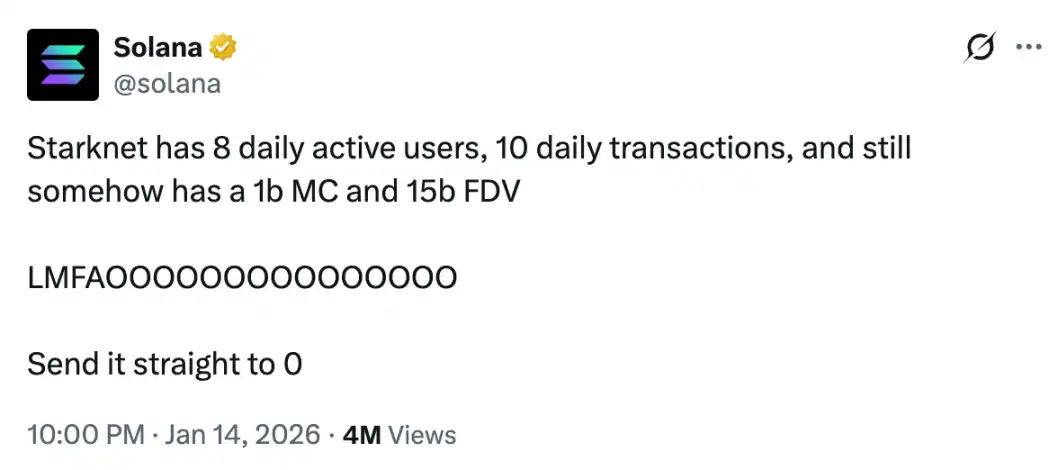
Although, in hindsight, this salt-in-the-wound joke was meant to attract attention and introduce the news of Starknet's token STRK launching on Solana via NEAR Intents. But Solana's criticism is not without reason; the L2s that have sprung up like mushrooms in the past two years are indeed facing a traffic crisis.

The most convincing recent example is on January 8th, when Zero Network, an L2 network incubated by Web3 wallet company Zerion, was exposed to have stopped producing blocks for over 3 weeks, but it seemed to have no impact. The official reaction was even more subtle; Zero Network stopped producing blocks on December 19, 2025, but the official statement on fixing the issue only came on December 23. The last original content posted by Zero Network's official Twitter was in May of the same year.

Despite this, the claim of only 8 users executing 10 transactions per day is an exaggeration. According to data from L2BEAT, Starknet's TPS yesterday was 2.64, meaning there were over 200,000 transactions on the network in a day. But this number is still extremely low; even the Ethereum mainnet's daily transaction volume is 10 times that of Starknet.
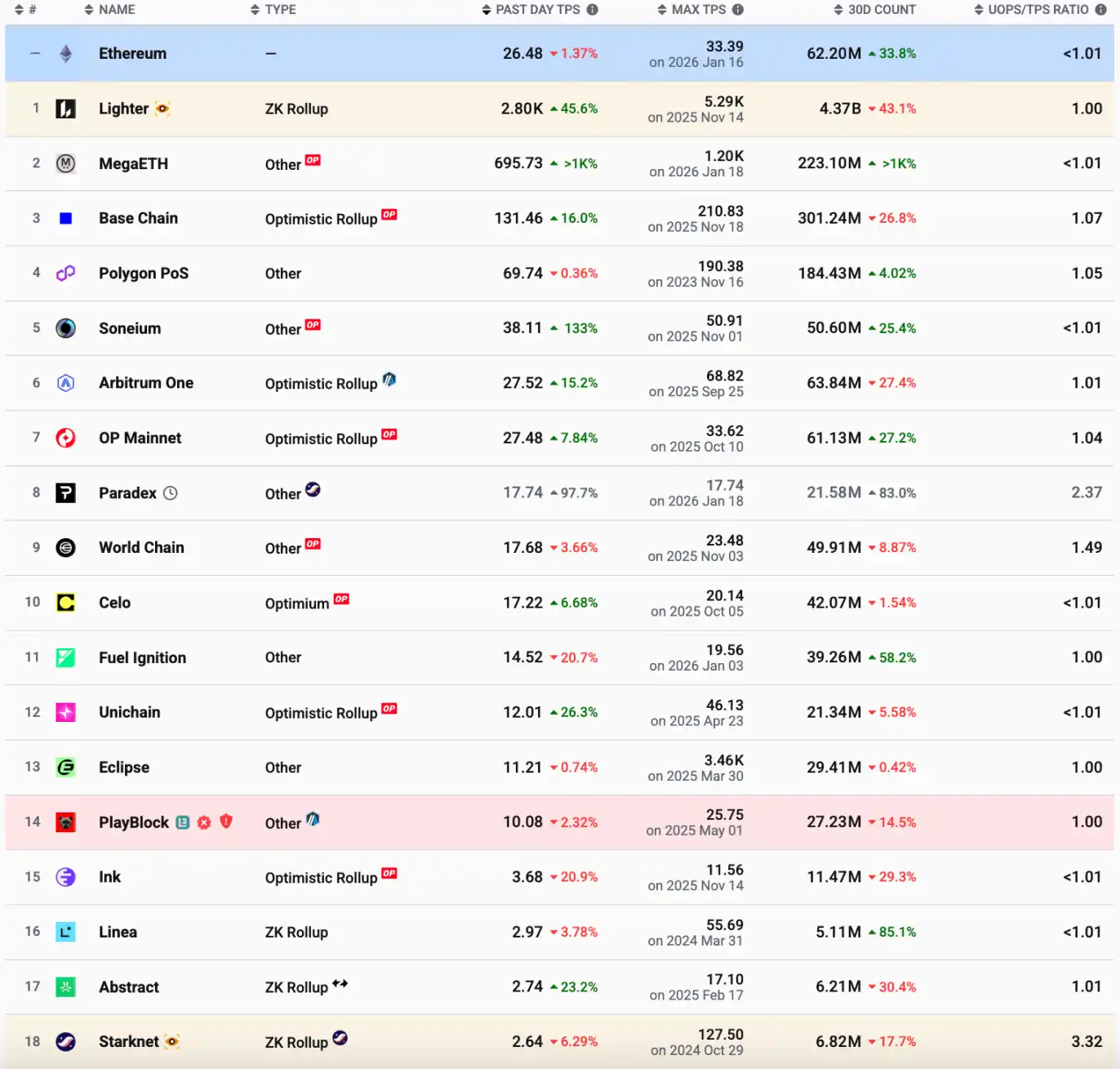
Data shows that among general-purpose L2s, aside from Base and Polygon, even Arbitrum and OP Mainnet's TPS are not significantly higher than Ethereum's. Linea and Starknet have a TPS of less than 3. The parts not shown in the screenshot include Scroll with a TPS slightly over 1, and ZKsync, Blast, etc., with less than 1.
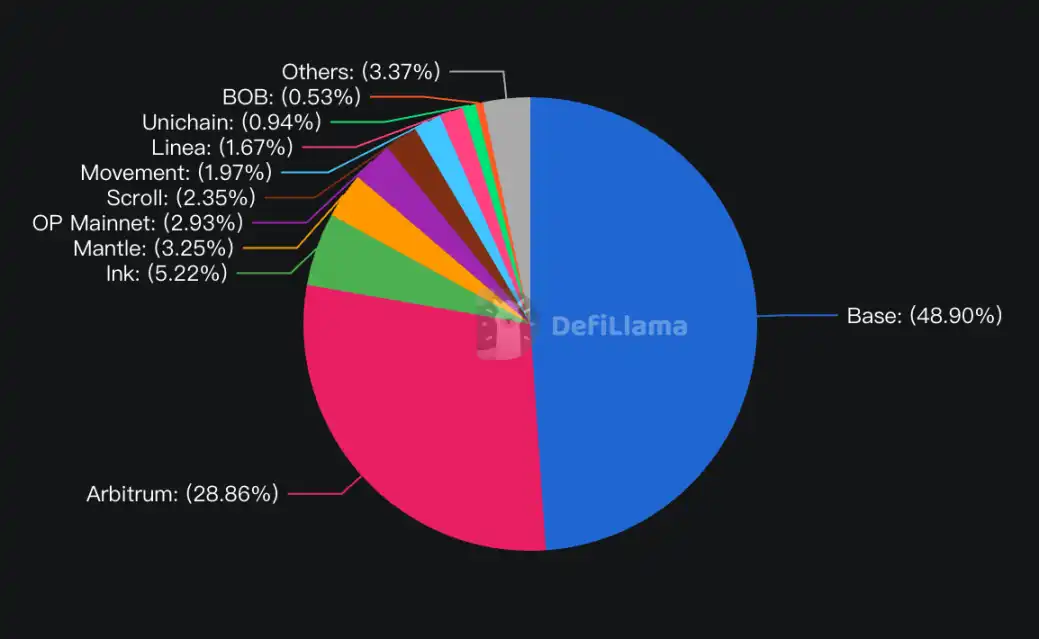
Looking at the TVL data from DefiLlama, Base and Arbitrum together account for nearly 80% of all L2 TVL. The remaining L2s, not in the "Others" category, had a combined valuation conservatively estimated at nearly $10 billion during their private funding rounds, but their combined TVL is less than $2 billion.
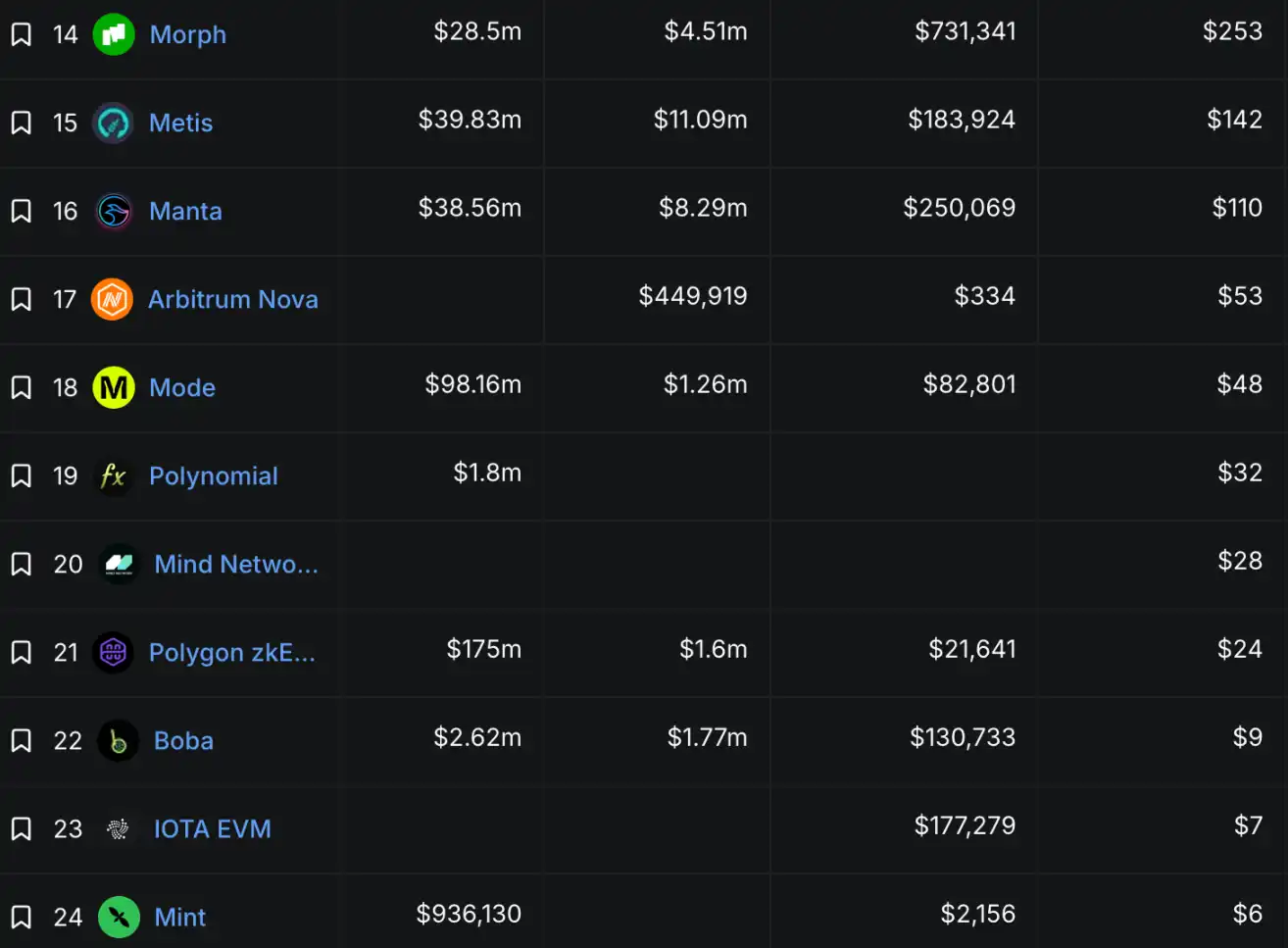
In terms of protocol revenue, only the top 7 protocols had revenues above $1,000 in the past 24 hours. Daily protocol revenues in the three-digit or even two-digit range might not even compare to the interest some large holders earn daily from placing assets in exchange wealth management.

This data very直观地展示了 (intuitively shows) the current predicament of L2s: against the backdrop of a lack of application narratives, hoping for a killer app that doesn't operate as an appchain and willingly runs on a general-purpose L2 has become a pipe dream. On the question of finding an application scenario that can provide stable transaction data, L2s have found the same answer: cryptocurrency cards.

Pavel Paramonov, founder of cryptocurrency research institution Hazeflow, once criticized that cryptocurrency cards are essentially not "cryptocurrency payments" but still fiat payments, not truly promoting cryptocurrency adoption. But he also mentioned that many projects or public chains launching crypto cards are doing so out of necessity, with the goal merely being to keep users within their ecosystem.

Many cryptocurrency cards launched by exchanges currently are a form of "custodial" card. User assets are held in exchange or institutional custody accounts, and upon consumption, settlement is handled by the exchange, off-ramp companies, and the card issuer. The settlement chains for such cards are usually Tron, Solana, or even the slightly higher-cost Ethereum. On one hand, the存量 (存量 - inventory/supply) of stablecoin assets on these chains is sufficient; on the other hand, some cards reduce costs through batch settlement rather than per-transaction settlement. For institutions, liquidity and stability might be more important than the low cost of L2s.

The crypto cards that L2s are eyeing are various forms of "non-custodial cards." Before using such a card for payment, assets reside in the user's own wallet, and each payment is settled individually, which can effectively increase on-chain activity. Typical examples include Scroll (Etherfi card settlement layer), Gnosis, and Linea (MetaMask card settlement layer).

In September 2024, Etherfi announced that its payment card would use Scroll as the settlement layer. Scroll can help Etherfi achieve "gasless transactions" and provide a higher cashback percentage subsidized by the SCR token. Besides the traditional method of directly spending assets on Scroll, the Etherfi card has a special mechanism: users can borrow fiat currency using yield-bearing assets on Scroll as collateral for payments. Supported assets include eETH, weETH, wETH, eBTC, etc.

Gnosis, as a sidechain that has long lacked presence, has successfully made a comeback with its payment card. Its card, Gnosis Pay, primarily operates in Europe. Users can connect non-custodial wallets like MetaMask and Gnosis Safe in the Gnosis Pay App. During spending, Gnosis Pay converts the user's wallet's supported assets (certain Euro, Pound, and Dollar stablecoins) into EURe, a Euro stablecoin issued by Monerium, which is then converted 1:1 into Euros for payment.

The crypto card issued by MetaMask uses ConsenSys's L2 Linea as the primary settlement network, additionally supporting Solana and Base. Users need to deposit supported payment assets (various USD or Euro stablecoins) into their MetaMask wallet before spending. During payment, user assets are transferred to the off-ramp service provider, converted into fiat currency, and then paid to the merchant.
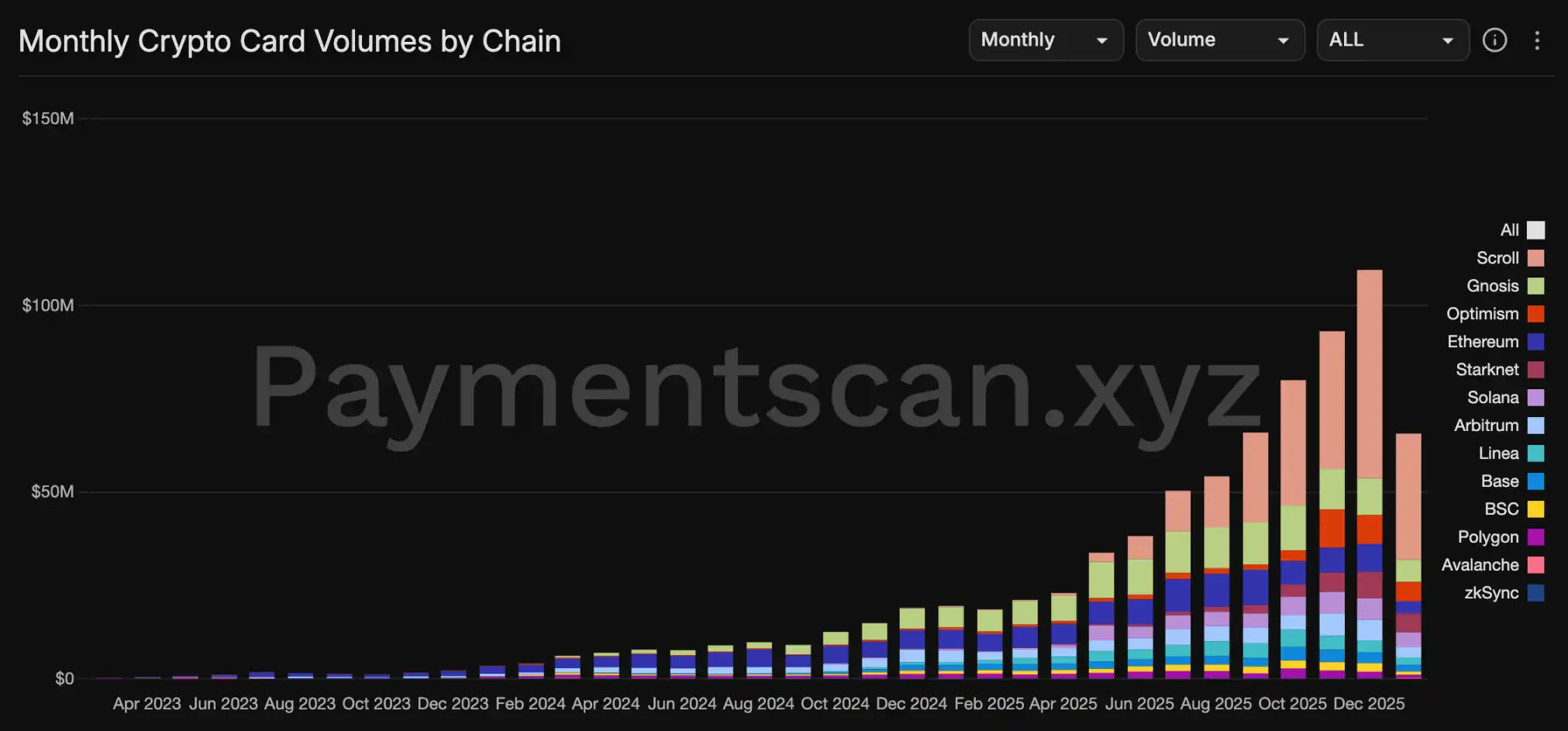
Due to the per-transaction settlement nature of non-custodial cards, each user消费 (消费 - consumption/spending) corresponds to a contract call to verify the remaining asset balance and the on-chain asset transfer. Thus, L2s can rely on payments, an absolutely high-frequency and sustainable scenario, to ensure a certain level of on-chain activity. According to Paymentscan data, Scroll, through its partnership with Etherfi and SCR subsidies, has captured a significant market share in card payments. However, this data is not entirely accurate, as many card payments might not involve on-chain transfers but are settled internally by institutions. Regardless, it's an indisputable fact that L2s have found a practical application scenario through payments.

It's not just emerging L2s that are anxious; Polygon, which cannot be strictly classified as an L2, also recently shifted its strategic focus to payments. By the end of 2025, the transfer volume of non-USD stablecoins on Polygon exceeded $11.1 billion, with the new stablecoin XSGD reaching $2.24 billion in trading volume and the Australian Dollar stablecoin AUDF reaching $2.46 billion. Additionally, Polygon has become one of the main chains used for Stripe's stablecoin payments; its announcement on January 13th to acquire cryptocurrency payment infrastructure Coinme and blockchain development platform Sequence for a consideration of $250 million更是将 (更是将 - further writes) "all in on payments" plainly on its face.

After experiencing the bombardment of various concepts, L2s have come to recognize reality. While they still await novel applications, the urgent task at hand is to utilize their low-cost, high-efficiency characteristics and survive first through payments.


Criptomoedas em alta

Perguntas relacionadas

QWhat is the main issue facing Layer 2 (L2) networks according to the article?

AThe main issue facing L2 networks is a severe lack of user activity and transaction volume, leading to a 'traffic crisis' where many L2s have extremely low TPS and TVL, making it difficult to sustain themselves without finding practical, high-frequency use cases.

QWhat specific example does the article use to illustrate the inactivity of some L2 networks?

AThe article cites Zero Network, an L2 incubated by Web3 wallet company Zerion, which stopped producing blocks for over three weeks without any noticeable impact, and whose official Twitter account had not posted original content since May of the same year.

QWhat solution have many L2 networks turned to generate consistent on-chain activity?

AMany L2 networks have turned to cryptocurrency payment cards, specifically non-custodial cards, as a solution. Each payment with these cards requires an on-chain settlement, creating a high-frequency and sustainable source of transactions.

QWhich L2 networks are mentioned as having partnered with specific crypto cards to increase transactions?

AThe article mentions Scroll (partnering with Etherfi card), Gnosis (with its Gnosis Pay card), and Linea (used as a settlement layer for the MetaMask card) as examples of L2s leveraging payment cards to boost on-chain activity.

QWhy does the article state that Polygon is also shifting its strategic focus?

APolygon is shifting its strategic focus to payment solutions because it has seen significant transaction volume from non-USD stablecoins and has made major acquisitions, such as buying cryptocurrency payment infrastructure company Coinme and blockchain development platform Sequence, effectively going 'all in on payments'.

Leituras Relacionadas

Dan Koe: The Counterintuitive Truth—You Don't Need to Remember Everything You Read

Dan Koe: The Counterintuitive Truth — You Don't Need to Remember Everything You Read The central idea is that deliberately trying to remember information is often misguided. True learning isn't about memorizing facts but about having important knowledge surface naturally when needed through use. Most forgetting is normal, not a failure. The article reframes learning using a control theory framework—a four-step feedback loop: having a clear Goal, accurately Sensing your current state, Comparing the gap, and Acting to close it. Most learning stalls because people only do step 2 (blind input) without a goal to create the necessary "error signal" for focused action. The most effective method is to start with output, not input. Begin a meaningful personal project first, and learn only what's necessary to complete it. This project-driven, "just-in-time" learning ensures knowledge is contextual and retained. The concept of a "Second Brain" often fails because it becomes a digital graveyard—over-collected and under-utilized. The goal should be building a "Second Subconscious"—a dynamic system that proactively surfaces relevant ideas during creation, not a static storage vault. Tools like Obsidian+Claude or Eden can help by automating organization and enabling semantic search, but their value depends on linking knowledge to active projects. Ultimately, what matters is not what you store, but what you filter and internalize. Focus on ideas that shape your worldview, use projects as filters, and transform collected material through writing and sharing. AI should be used to reduce friction in research and editing, not to formulate your core views. In conclusion, remembering is a byproduct, not the goal. Knowledge that sticks comes from pursuing personal goals, applying it in real projects, and digesting it through creation. The tools are merely aids; the crucial step is to start doing meaningful work and let the necessary knowledge find you.

marsbitHá 50m

Dan Koe: The Counterintuitive Truth—You Don't Need to Remember Everything You Read

marsbitHá 50m

A New Era: The Fundamental Transformation of China's Entrepreneurs

A profound generational shift is underway among Chinese entrepreneurs. The wealth and influence once dominated by real estate and internet giants is now being claimed by a new wave of founders driving breakthroughs in AI, semiconductors, and robotics. This change is vividly reflected in 2026's wealth rankings. Figures like Zhang Yiming (ByteDance), Liang Wenfeng (DeepSeek), Chen Tianshi (Cambricon), and Wang Xingxing (Unitree Robotics) are ascending. Their wealth stems not from traditional business models but from market expectations for future technological competitiveness, with AI, chips, and smart hardware becoming the primary engines of wealth creation. Their common trait is a foundational focus on technology, often starting from the laboratory rather than a business plan. Examples include Chen Tianshi's decade-long push in AI chips, Liang Wenfeng's core algorithmic innovations at DeepSeek with a compact team, and Zhu Yiming's "no salary until profitable" 9-year journey to build Changxin Memory into a global DRAM player. This transition marks a fundamental shift in China's economic imperative: from commercial expansion and learning to indigenous innovation and deep industrial capability. While the previous generation built the foundational market and infrastructure, this new cohort is tasked with achieving global leadership in core technologies, moving China from "keeping pace" to pioneering original, breakthrough innovations that are industrialized at scale. The baton is being passed to those competing on the world stage through technological originality.

marsbitHá 50m

A New Era: The Fundamental Transformation of China's Entrepreneurs

marsbitHá 50m

Once-Popular Web3 Enters Wave of Layoffs

The once-hot Web3 industry is experiencing a severe wave of layoffs. While many companies attribute job cuts to AI-driven restructuring, the primary reason is often financial pressure. The Web3 sector, at the intersection of tech and finance, has been hit particularly hard. Employees at major cryptocurrency exchanges report sudden, impersonal layoffs—often with system access revoked overnight—and minimal or no severance. Common tactics include setting impossible performance targets or terminating employees for minor policy violations. The working atmosphere has become toxic, marked by intense monitoring, excessive meetings, and management obsessed with control and internal politics rather than product innovation. The industry's core business model is collapsing. Exchange revenue from trading fees and listing charges has plummeted due to a decline in quality projects and retail investor exodus. Events like the massive forced liquidation on October 10th further shattered confidence. Competition from on-chain derivatives platforms and prediction markets is intensifying the downturn. As layoffs continue, displaced workers struggle to find new opportunities. Many transition to the AI sector, but face significant bias from traditional finance and even some AI firms, which view crypto industry experience with suspicion. The current downturn appears more structural than cyclical, driven by unsustainable practices, internal strife, and a failure to innovate, raising questions about the industry's future trajectory.

marsbitHá 1h

Once-Popular Web3 Enters Wave of Layoffs

marsbitHá 1h

Trading

Spot

Artigos em Destaque

Como comprar ERA

Bem-vindo à HTX.com!Tornámos a compra de Caldera (ERA) simples e conveniente.Segue o nosso guia passo a passo para iniciar a tua jornada no mundo das criptos.Passo 1: cria a tua conta HTXUtiliza o teu e-mail ou número de telefone para te inscreveres numa conta gratuita na HTX.Desfruta de um processo de inscrição sem complicações e desbloqueia todas as funcionalidades.Obter a minha contaPasso 2: vai para Comprar Cripto e escolhe o teu método de pagamentoCartão de crédito/débito: usa o teu visa ou mastercard para comprar Caldera (ERA) instantaneamente.Saldo: usa os fundos da tua conta HTX para transacionar sem problemas.Terceiros: adicionamos métodos de pagamento populares, como Google Pay e Apple Pay, para aumentar a conveniência.P2P: transaciona diretamente com outros utilizadores na HTX.Mercado de balcão (OTC): oferecemos serviços personalizados e taxas de câmbio competitivas para os traders.Passo 3: armazena teu Caldera (ERA)Depois de comprar o teu Caldera (ERA), armazena-o na tua conta HTX.Alternativamente, podes enviá-lo para outro lugar através de transferência blockchain ou usá-lo para transacionar outras criptomoedas.Passo 4: transaciona Caldera (ERA)Transaciona facilmente Caldera (ERA) no mercado à vista da HTX.Acede simplesmente à tua conta, seleciona o teu par de trading, executa as tuas transações e monitoriza em tempo real.Oferecemos uma experiência de fácil utilização tanto para principiantes como para traders experientes.

552 Visualizações TotaisPublicado em {updateTime}Atualizado em 2026.06.02

Como comprar ERA

Discussões

Bem-vindo à Comunidade HTX. Aqui, pode manter-se informado sobre os mais recentes desenvolvimentos da plataforma e obter acesso a análises profissionais de mercado. As opiniões dos utilizadores sobre o preço de ERA (ERA) são apresentadas abaixo.

活动图片