L1 is Dead, Long Live Appchain

marsbitPublicado em 2026-04-20Última atualização em 2026-04-20

Resumo

"L1 is Dead, Appchain Rises" critiques the failure of current Layer-1 (L1) blockchain models, arguing their tokens are trending toward zero. The author identifies key flaws: linear token emissions that incentivize selling rather than value creation, weak value propositions like "gas token" and "governance" narratives, mismanagement by bloated "foundations" or "labs" that drain value through excessive spending and token sales, and poor industry leadership focused on short-term narratives and overhyped trends like RaaS and high TPS. The solution proposed is a fundamental shift. New L1 token models are needed, moving away from the "low float, high FDV" paradigm that disadvantages retail investors. Fundraising should be sufficient only for launch, not excessive. Token unlocks should be tied to real milestones like CEX listings or DeFi integration. The ultimate goal should be for L1 tokens to become widely used mediums of exchange, not just fuel for networks. Value is increasingly moving to the application layer, with successful apps building their own chains (appchains). The author concludes that L1s must build sustainable value by creating useful applications and services, fostering strong holder communities, and achieving self-sustainability without relying on continuous token emissions.

Author:iwillpat

Compiled by: Jiahuan, ChainCatcher

Since the era of "Rollup as a Service" (RaaS) began, the outcome was already predetermined. This is the precursor to the execution layer entering a death spiral and commoditization.

What I mean is, general-purpose L1 tokens will continue to trend towards zero, and likely no exceptions. I will try to explain why, and what I would do differently if I were an L1 operator.

The main drivers of L1 failure are as follows: linear token releases, failed value propositions, poor governance, and industry "leadership".

I will briefly elaborate on these points—these are just personal views, not definitive conclusions.

Linear staking releases in their current form have some benefits, namely distribution through liquid staking ("My 7% APY!"), but they fail in several key aspects.

Delegated Proof of Stake (DPoS) makes it easy for armchair "decentralization fundamentalists" to participate in network security, but it does not properly incentivize insiders, users, and developers. At best, it incentivizes people to hold tokens, doing nothing to create any real value.

The most classic argument I've heard about PoS is: large validators have an economic incentive not to dump on you. But that hasn't stopped them from selling every possible allocation and block reward.

This leads to my next point: they sell because L1 tokens have no long-term value proposition.

Tissue Paper Thin

The "gas token" and "governance" narratives are tired and unconvincing—like two-ply Bounty paper towels that disintegrate when wet. The value of a network token depends on what you can buy with it.

So the goal of all blockchain teams should be to push their token as a currency as widely as possible. In the pursuit of higher TPS and lower block times, the industry's vision of "peer-to-peer electronic cash" seems to have been lost.

Let's be brutally honest: throughput, TVL, and low latency give the token no value. Liquidity and usage rate do.

This next point is the most substantial and painful: blockchain "Labs". (And various foundations.)

Selling at unlock, large-discount OTC deals, eye-watering operational expenses, incentive programs to attract hot money, hiring "KOLs"... we can all name a few.

Ultimately, every dollar spent by Labs is a tax on token holders. Unless that Labs generates revenue through some service, first-party wallet, or application, it is surviving by selling tokens.

This in itself is not bad—they provide valuable services through engineering resources, explorers, and APIs. But if Labs does not bring net new buy pressure to the token, and expenses are climbing unsustainably, it is slowly bleeding to death.

One of the primary goals of Labs should be to build the network into a permissionless, self-sustaining system that passes the "hands-off test". Eventually, business development should be community-driven, and the network should have its own spiritual "CTO".

This doesn't require 400 employees; 30-40 excellent people are enough, plus those developing first-party apps and services.

Finally—after this I'll share my "solution"—cryptocurrency has been led astray by many large capital allocators and advisors.

Putting aside FTX, Celsius, and Luna, we have been force-fed by the industry's biggest players: short-term narratives, excessive leverage, "maximal extractable value", like stuffing a pathetic, bloated retail turkey.
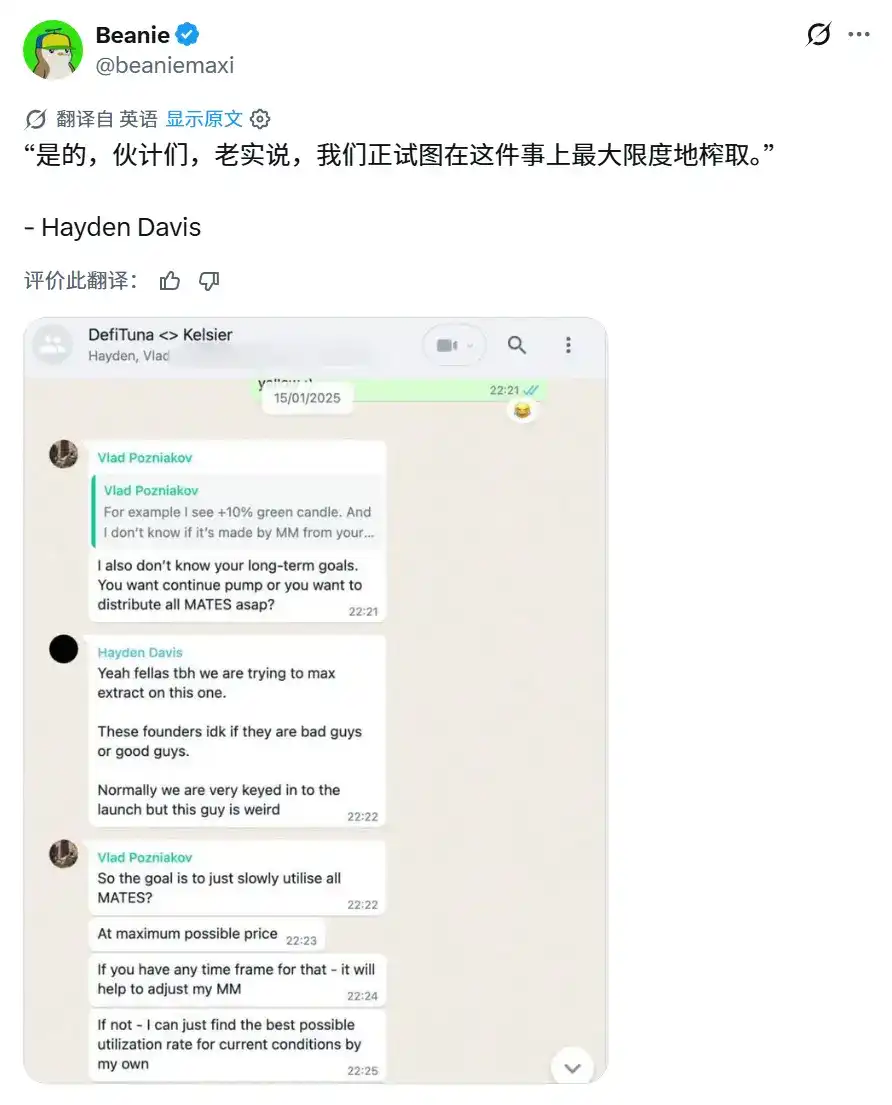
Promoting TPS over smart contract security, investing in the 10th general-purpose blockchain, raising funds at outrageous valuations, raising far more capital than needed, claiming security advantages that simply don't exist... these are all classic symptoms of severe crypto brain rot.

Placing bold bets on the direction of the industry is one thing—privacy coins, MoveVM, tokenized IP, decentralized social.

But burning money into another idiotic hype cycle or short-term cash grab is another matter entirely: RaaS, data availability, any L1 that tokens at a product with a multi-unicorn valuation before having a product, infrastructure solutions for crypto problems that don't exist or generate revenue...

(Full disclosure: I don't claim to be an investment genius, but I can do basic math. Buy pressure must exceed sell pressure.)

Where to Next?

Next, I will briefly talk about where the industry should go.

We need new L1 token models and a completely different way for crypto VCs to play. The current "low float, high FDV" paradigm works when valuations are lower and there is incremental capital flowing in.

But retail is no longer willing to pay for seed-round valuations that are 1000x at TGE, nor withstand the selling pressure from massive unlocks and insider staking rewards 12 months later.

L1s simply don't need hundreds of millions to launch a mainnet—unless I'm missing something. Raise enough to build the platform and go to market, then raise more later; everyone will be better off.

Token unlocks should be tied to milestones like CEX liquidity, payments, and DeFi lending, and on-chain governance should be given higher priority. Foundations should maintain at least some transparency regarding their balance sheets, expenses, and investments.

Retail doesn't want to pay for network security (i.e., validator rewards). Eventually, the network should be able to sustain itself without any staking rewards.

Maybe staking rewards shouldn't have existed from the start, and network or Labs revenue should go directly to validators. Then, see how hard validators would work.

Less and less value is flowing to the base layer, and we shouldn't be investing so much in their development. Gas fees on all chains are trending towards zero, successful applications are migrating to their own chains, and cross-chain bridging has never been easier.

So you can draw this conclusion: it's better to build an application (or appchain) first and then vertically integrate—Hyperliquid, Pump, etc. have done this.

I'm not saying to stop investing in general-purpose blockchains, but I do believe the core function of a network token should ultimately be a truly useful medium of exchange—permissionless L1s should be liquidity hubs for DeFi and testing grounds for new applications.

These are not new ideas. I think many L1 teams have realized: to survive, they need to build their own applications and services. The treadmill of foundations surviving by selling tokens is slowing down.

If you work in these teams on something that doesn't generate revenue, you might want to start thinking about what value you can create.

Interestingly, mass adoption by retail or institutions seems far less important than building a strong holder community and keeping them happy. When in doubt, ask the community.

Even if their advice is terrible, at least ask them who their favorite and least favorite person on your team is.

I hesitated for weeks about posting this. This is not a well-structured thought piece; it's more like a bunch of shower thoughts.

My point is: all L1s are making the same serious mistakes, differing only in luck and timing. The best-performing projects survive, usually due to stronger leadership and faster delivery, but the question of a sustainable value proposition remains unanswered.

We can continue down this long and painful path of value extraction, watching BTC maxis and sats stackers continue to outperform; or, we admit the problems with the current L1 model and start building for a slightly fairer outcome.


Perguntas relacionadas

QWhat are the main reasons the author believes that general L1 tokens will trend towards zero?

AThe author cites four main reasons: linear token releases, failed value propositions, poor governance, and flawed industry leadership that prioritizes short-term gains over sustainable development.

QAccording to the author, why do large validators in Proof-of-Stake systems continue to sell their tokens despite economic incentives not to?

AThey sell because L1 tokens lack a long-term value proposition; the 'gas token' and 'governance' narratives are weak, and token value ultimately depends on what it can be used to purchase.

QWhat criticism does the author level against blockchain 'Labs' and Foundations?

AThe author criticizes them for acting as a tax on token holders by selling tokens to fund high operational expenses, over-hiring, and unsustainable spending without generating net new buy pressure for the token.

QWhat does the author propose as a better model for launching and funding L1s?

AThe author suggests that L1s do not need hundreds of millions to launch, token unlocks should be tied to milestones like CEX listings and DeFi adoption, and governance should be more community-driven with greater transparency from foundations.

QWhat is the author's view on the future direction of the industry, and what does 'Appchain' represent in the title?

AThe author believes value is moving away from base layers (L1s) and that the future lies in application-specific blockchains (Appchains), where successful applications migrate to their own chains, enabling vertical integration and a more sustainable model.

Leituras Relacionadas

How Many Tokens Away Is Yang Zhilin from the 'Moon Chasing the Light'?

The article explores the intense competition between two leading Chinese AI companies, DeepSeek and Kimi (Moon Dark Side), and the mounting pressure on Yang Zhilin, the founder of Kimi. While DeepSeek re-emerged after 15 months of silence with its powerful V4 model—boasting 1.6 trillion parameters and low-cost, long-context capabilities—Kimi has been focusing on long-context processing and multi-agent systems with its K2.6 model. Yang faces a threefold challenge: technological rivalry, commercialization pressure, and investor expectations. Despite Kimi’s high valuation (reaching $18 billion), its revenue heavily relies on a single product with low paid conversion rates, while DeepSeek’s strategic silence and open-source influence have strengthened its market position and valuation prospects, now targeting over $20 billion. Both companies reflect broader trends in China’s AI ecosystem: Kimi aims for global influence through open-source contributions and agent-based advancements, while DeepSeek prioritizes foundational innovation and hardware independence, notably shifting to Huawei’s chips. Their competition is seen as vital for China’s AI progress, with the gap between top Chinese and U.S. models narrowing to just 2.7% on the Elo rating scale. Ultimately, the article argues that this rivalry, though anxiety-inducing for leaders like Zhilin, is essential for driving innovation and solidifying China’s role in the global AI landscape.

marsbitHá 4h

How Many Tokens Away Is Yang Zhilin from the 'Moon Chasing the Light'?

marsbitHá 4h

TechFlow Intelligence Bureau: ChatGPT Helps Amateur Mathematician Crack 60-Year-Old Problem, CFTC Sues New York Regulator Over Coinbase and Gemini

An amateur mathematician, with the assistance of ChatGPT, has solved a combinatorial mathematics puzzle originally proposed by Hungarian mathematician Paul Erdős in the 1960s. This marks another milestone in AI-aided mathematical research, demonstrating the evolving capabilities of large language models in formal reasoning. In other AI developments, OpenAI introduced a new privacy filter tool for enterprise API usage, automatically screening sensitive data. Meanwhile, the Qwen3.6-27B model achieved 100 tokens per second on a single RTX 5090 GPU using quantization, significantly lowering the cost barrier for local AI deployment. In crypto and Web3, the U.S. CFTC sued New York’s financial regulator, challenging its oversight of Coinbase and Gemini—a first-of-its-kind federal-state regulatory clash. Following a vulnerability, KelpDAO and major DeFi protocols established a recovery fund. Tether froze $344 million in assets linked to Iran’s central bank upon U.S. Treasury request, highlighting the centralized control risks in stablecoins. Separately, Litecoin underwent a 3-hour chain reorganization to undo a privacy-layer exploit. In the U.S., former President Trump invoked the Defense Production Act to address power grid bottlenecks affecting AI data centers and dismissed the entire National Science Board, raising concerns over research independence. A retail trader gained 250% on a $600k Intel options bet amid AI-related speculation. Xiaomi announced its first performance electric vehicle, targeting rivals like Tesla. Meanwhile, iPhone users reported devices automatically reinstalling a hidden app daily, suspected to be MDM-related. A Chinese securities report noted that A-share institutional crowding has reached its second-longest streak since 2007, signaling high valuations and potential style rotation. The day’s developments reflect a dual narrative: AI is enabling unprecedented individual breakthroughs, while centralized power structures—whether governmental or corporate—are becoming more assertive, underscoring that decentralization is as much a political-economic challenge as a technical one.

marsbitHá 4h

TechFlow Intelligence Bureau: ChatGPT Helps Amateur Mathematician Crack 60-Year-Old Problem, CFTC Sues New York Regulator Over Coinbase and Gemini

marsbitHá 4h

Trading

Spot
Futuros

Artigos em Destaque

Como comprar ERA

Bem-vindo à HTX.com!Tornámos a compra de Caldera (ERA) simples e conveniente.Segue o nosso guia passo a passo para iniciar a tua jornada no mundo das criptos.Passo 1: cria a tua conta HTXUtiliza o teu e-mail ou número de telefone para te inscreveres numa conta gratuita na HTX.Desfruta de um processo de inscrição sem complicações e desbloqueia todas as funcionalidades.Obter a minha contaPasso 2: vai para Comprar Cripto e escolhe o teu método de pagamentoCartão de crédito/débito: usa o teu visa ou mastercard para comprar Caldera (ERA) instantaneamente.Saldo: usa os fundos da tua conta HTX para transacionar sem problemas.Terceiros: adicionamos métodos de pagamento populares, como Google Pay e Apple Pay, para aumentar a conveniência.P2P: transaciona diretamente com outros utilizadores na HTX.Mercado de balcão (OTC): oferecemos serviços personalizados e taxas de câmbio competitivas para os traders.Passo 3: armazena teu Caldera (ERA)Depois de comprar o teu Caldera (ERA), armazena-o na tua conta HTX.Alternativamente, podes enviá-lo para outro lugar através de transferência blockchain ou usá-lo para transacionar outras criptomoedas.Passo 4: transaciona Caldera (ERA)Transaciona facilmente Caldera (ERA) no mercado à vista da HTX.Acede simplesmente à tua conta, seleciona o teu par de trading, executa as tuas transações e monitoriza em tempo real.Oferecemos uma experiência de fácil utilização tanto para principiantes como para traders experientes.

388 Visualizações TotaisPublicado em {updateTime}Atualizado em 2025.07.17

Como comprar ERA

Discussões

Bem-vindo à Comunidade HTX. Aqui, pode manter-se informado sobre os mais recentes desenvolvimentos da plataforma e obter acesso a análises profissionais de mercado. As opiniões dos utilizadores sobre o preço de ERA (ERA) são apresentadas abaixo.

活动图片