Kyle Criticizes Hyperliquid Four Days After Leaving, Arthur Hayes Responds with a $100,000 Bet

marsbitPublicado em 2026-02-09Última atualização em 2026-02-09

Resumo

In the midst of a market downturn, Hyperliquid ($HYPE) has nearly doubled in value since January, drawing both praise and criticism. Kyle Samani, the recently departed co-founder of Multicoin Capital, publicly criticized the project, calling it representative of crypto's classic problems: founders "fleeing their home country," facilitating crime, being closed-source, and permissioned. Arthur Hayes, BitMEX co-founder, responded not by addressing the criticisms but by proposing a $100,000 bet: that HYPE would outperform any large-cap crypto of Kyle’s choosing from February 10th to July 31st. Kyle did not accept the wager, aligning with his earlier, since-deleted tweet expressing that crypto is "not as interesting as many thought." The article dissects Kyle's critiques, noting that Hyperliquid's operational structure (offshore entity, U.S. user ban) is standard industry practice. It suggests his harsh tone may stem from a personal desire to distance himself from the industry post-departure, contrasting with his former firm, Multicoin, which was revealed to have built a significant $46 million position in HYPE around the time of his exit. The exchange highlights a classic crypto divide: those who have left the "table" often critique from an ethical standpoint ("should"), while those still invested argue primarily with price action ("will it pump"). The discussion quickly devolved into personal attacks about wealth and portfolio performance, underscoring how deeply entrenched f...

Author: David, Shenchao TechFlow

There aren't many projects worth mentioning in this downturn, but Hyperliquid is one of them.

$HYPE has nearly doubled from its January low. No matter how you view this project, the market is voting. But Kyle Samani, the former co-founder of Multicoin, voted against it.

On February 8th, Blockworks Research published a report stating that Hyperliquid's silver contracts have begun competing head-to-head with traditional futures exchanges like CME in terms of spreads and execution.

Many in the circle shared it, seeing it as a sign that on-chain finance is finally starting to bite into traditional finance's turf.

But Kyle poured cold water on it.
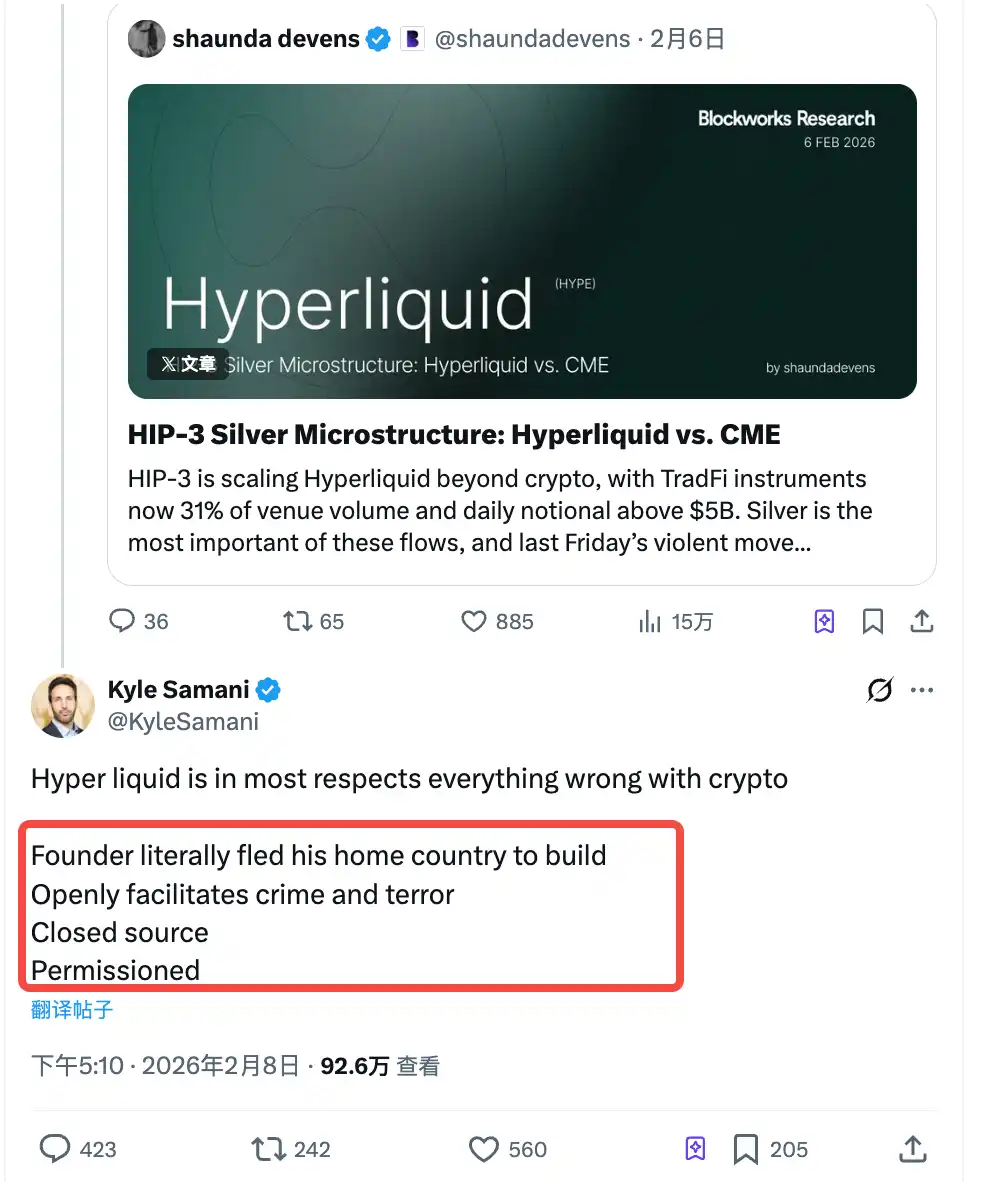
He believes that Hyperliquid represents almost all the classic problems of the crypto industry:

  • The founders fled their home country to build this project
  • The platform openly facilitates crime and terrorist activities
  • The code is closed-source
  • The product operates with permissions, not fully open

In the past, this kind of statement would have been a common project attack on Crypto Twitter.

But don't forget, just four days ago, Kyle announced his departure from Multicoin Capital (Reference reading: Kyle Left the Crypto Industry, I'm a Bit Sad), and before the departure announcement, he posted a since-deleted tweet:

"Crypto isn't as fun as many people (including myself) once thought."

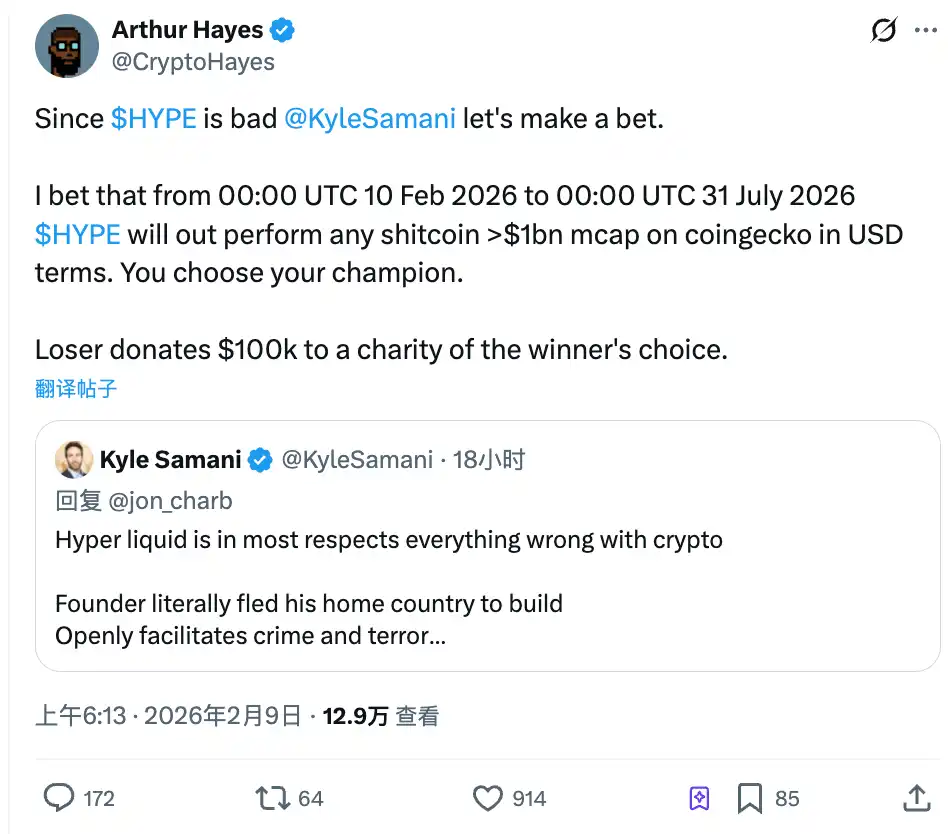
Old acquaintance Arthur Hayes clearly disagreed with this assessment, and he directly expressed his confidence in HYPE after Kyle's comments:

"Since you think HYPE is so bad, let's make a bet. From February 10th to July 31st, HYPE outperforms any coin with a market cap over $1 billion that you choose. The loser donates $100,000 to the winner's chosen charity. You pick the coin, I'm only betting HYPE wins."
Criticism, Leaving the Table

As of publication, Kyle has not accepted Arthur's bet and likely won't.

Someone who just said "crypto isn't as fun anymore" is unlikely to sit back down at the table to compare whose coin pumps more.

But Kyle's accusations against Hyperliquid are worth discussing.

For example, "the founders fled their home country." Hyperliquid founder Jeff Yan grew up in Palo Alto, California, graduated from Harvard, and previously worked as a quant at the high-frequency trading firm Hudson River Trading.

The team is based in Singapore, the company is registered in the Cayman Islands, and the platform blocks US users.

This structure is used by everyone from Binance to dYdX. Having been in this industry for nearly a decade, Kyle must know this is standard practice for offshore compliance.

Calling it "fleeing his homeland" seems a bit deliberate for someone who grew up in Palo Alto.

The points about being closed-source, permissioned, and facilitating crime aren't without merit, but in the past, Kyle might not have publicly stated such criticism. When he was at Multicoin, his job was to find, invest in, and promote projects; these gray areas were an unspoken cost everyone in the industry understood.

The change is that Kyle is no longer in that position.

What one sees after leaving the table is different from what one sees while sitting at it.

Pumping, No Need for Words

On the other hand, note that Arthur Hayes did not refute any of Kyle's accusations. He didn't defend Hyperliquid's closed-source nature, nor did he explain why Jeff Yan moved to Singapore.

His response was simply a price bet.

This is familiar crypto logic: pumping equals a good product. Choosing to respond with price is because, for those still working in this industry full-time, price is the only language that matters.

You say Hyperliquid has moral flaws, he says HYPE will outperform any large-cap altcoin in five months.

These two statements seem to be about the same thing but are actually on completely different planes.

Kyle is talking about "should or shouldn't," Hayes is talking about "will it pump or not."

This kind of talking past each other happens every cycle in the crypto space. Every time the market reaches its mid-to-late stages or a bear market, a group of people stands up and says the industry has problems, and those still at the table always respond with the same phrase:

Then look at the price.

Token price is the most convenient weapon for players still in the game because, as long as it's rising, all criticism can be temporarily set aside.

The problem is, Kyle might not be entirely an insider anymore. For a fund's co-founder to publicly express disillusionment with the entire industry just before formally resigning isn't quite appropriate in any circle.

The post was deleted, but the sentiment remains.

His current criticism of Hyperliquid, with its tone of leaving no room for doubt, seems less like criticizing a project and more like cutting ties with certain aspects of his past eight years.

However, while he personally can cut ties, Multicoin itself is still in the game.
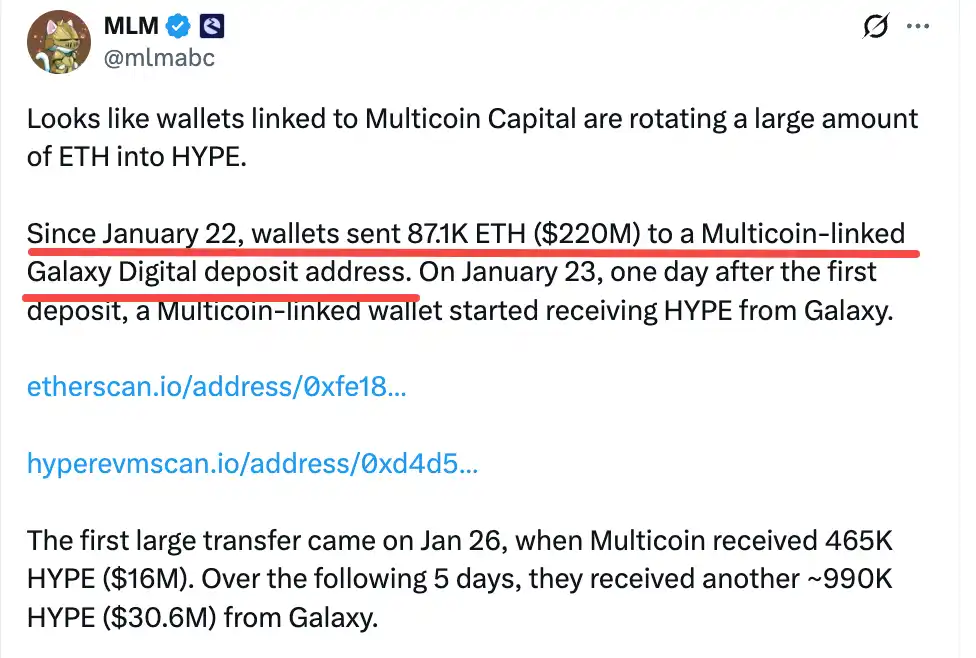
Starting November 22nd of this year, on-chain analysts discovered that a wallet疑似 associated with Multicoin deposited approximately 87,000 ETH to Galaxy Digital, and began buying HYPE in 17 transactions the next day, totaling about $46 million.

This means that around the time Kyle was leaving Multicoin, his former fund was making large investments in the project he just harshly criticized.

17 separate purchase transactions most likely mean someone within Multicoin made a judgment call and took action.

Kyle thinks Hyperliquid represents all the problems of the crypto industry, but at least someone at Multicoin thinks it's worth voting for with real money. Holding it is an attitude in itself.

Kyle left, but his old employer's money might have sat down. And it sat down at the very table Kyle despises the most.

Beyond the Arthur and Kyle showdown, the reactions in the comments are also interesting.

A Hyperliquid community user named Max dug up an old post he made in September 2024. The background of that post was that people were questioning Multicoin's operations in the circle. Max criticized Kyle back then, roughly saying:

"You're always trying to use LPs' money to chase the beta returns of your heavily invested assets, while also helping to pump your own investment portfolio."

A year and a half later, with Kyle now criticizing Hyperliquid, Max believes the套路 hasn't really changed:

Kyle is still the same Kyle, always criticizing others through the lens of his own portfolio. Defending Solana back then, sour on Hyperliquid now—the root lies in Multicoin's ecosystem interests and competitive anxiety.

Kyle couldn't help himself and directly replied with a characteristically crypto "wealth flex":The money I've directly invested in crypto is at least 10 times the total sum of your entire life.
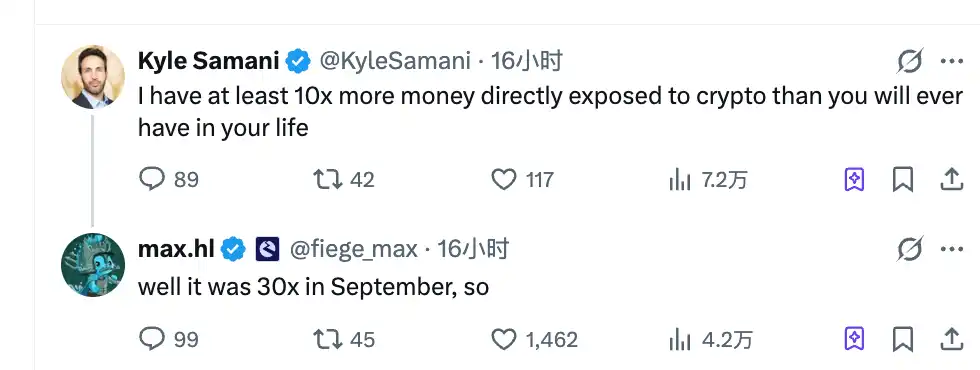
And Max's follow-up jab hit the mark perfectly,In September last year, your assets might have been 30 times mine...

From September 2025 to February 2026, the market experienced several fluctuations. Multicoin, which Kyle previously represented, clearly saw its crypto assets shrink significantly; meanwhile, Hyperliquid has remained relatively resilient.

Position never exists separately from portfolio.

When a project begins to threaten the traffic and valuation of an existing ecosystem, criticism is quickly labeled as "conflict of interest"; conversely, defenders retaliate with "you're just jealous."

In this wave, Kyle wanted to attack Hyperliquid from the high ground of morality and decentralization purity, but was easily pulled back into the jungle law of "whoever makes money is right" by his opponent.

In the end, rational discussion is drowned out by tribal狂欢, leaving only screenshots and memes.

Every cycle is like this. Some people sit down, some people stand up. Those sitting down talk about price, those standing up talk about morality.

But whether one sees the problems first and then becomes disillusioned with the industry, or becomes disillusioned first and then sees the problems, the order is actually unclear.

Regardless of whether HYPE rises or falls five months from now, Kyle probably won't care. He's already looking at other things.


Perguntas relacionadas

QWhat were Kyle Samani's main criticisms of Hyperliquid?

AKyle Samani criticized Hyperliquid on several fronts: its founders 'fled their home country' to build the project, the platform publicly facilitates crime and terrorist activities, its code is closed-source, and the product operates with permissions and is not fully open.

QHow did Arthur Hayes respond to Kyle Samani's criticism of Hyperliquid?

AArthur Hayes did not address the specific criticisms. Instead, he proposed a $100,000 bet, wagering that the HYPE token would outperform any cryptocurrency with a market cap over $1 billion that Kyle chose from February 10th to July 31st, with the loser donating to the winner's chosen charity.

QWhat was the context of Kyle Samani's comments, given his recent professional move?

AKyle Samani had just announced his departure from Multicoin Capital four days prior. Before the official announcement, he posted (and then deleted) a tweet stating, 'Crypto is not as interesting as many people (including myself) once thought it was,' indicating a sense of disillusionment with the industry.

QWhat does the article suggest is the fundamental difference in perspective between Kyle Samani and those still 'at the table' like Arthur Hayes?

AThe article suggests Kyle is arguing from a perspective of 'should' or 'should not'—focusing on moral and ideological flaws in the project and industry. In contrast, those like Hayes are arguing from a perspective of 'will it go up'—where price performance is the only meaningful metric, and all criticisms can be sidelined if the asset appreciates.

QWhat ironic detail does the article reveal about Multicoin Capital's actions regarding Hyperliquid?

ADespite Kyle's public criticism, the article reveals that around November 22nd of the previous year, a wallet linked to Multicoin Capital deposited a large amount of ETH and then made 17 separate purchases of HYPE tokens totaling approximately $46 million, indicating his former firm had taken a significant bullish position in the project he was attacking.

Leituras Relacionadas

Near Returns to the AI Stage: Transformation into a Public Chain Due to 'Payroll Difficulties,' Agent and Privacy Emerge as New Growth Narratives

NEAR Returns to AI Origins: From Payroll Struggles to Blockchain, Now Focusing on AI Agents and Privacy NEAR Protocol's journey began not with grand blockchain ambitions, but from a practical hurdle: its AI startup founders, including Transformer paper co-author Illia Polosukhin, couldn't efficiently pay international developers in 2017. This led them to pivot and build a high-performance, scalable blockchain. After years navigating various crypto narratives like sharding and cross-chain interoperability, NEAR is now leveraging its AI roots to re-enter the AI arena. A key driver is its "NEAR Intents" layer, which abstracts complex cross-chain transactions. Users simply state their goal (e.g., swap BTC for ETH), and a solver network finds the optimal route. This system has processed over $20B in cross-chain volume, generating significant fee revenue. A major growth area is private transactions via "Confidential Intents/Swaps," which hide trade details until settlement to protect against MEV and front-running. Remarkably, private swaps recently accounted for over 40% of NEAR's transaction volume, highlighting strong demand but also potential regulatory scrutiny. With its AI-founder pedigree, NEAR is positioning itself at the intersection of blockchain, AI agents, and privacy, aiming to become infrastructure for the emerging agent economy while navigating the challenges of its rapid adoption.

marsbitHá 1h

Near Returns to the AI Stage: Transformation into a Public Chain Due to 'Payroll Difficulties,' Agent and Privacy Emerge as New Growth Narratives

marsbitHá 1h

From Ethereum to AI's 'CROPS': What Exactly is This Set of 'Slow Variables' That Vitalik Repeatedly Emphasizes?

In recent discussions, Vitalik Buterin has frequently emphasized the concept of "CROPS," a framework defining core values for Ethereum's development. CROPS stands for Censorship Resistance, Capture Resistance, Open Source, Privacy, and Security. Initially outlined in the Ethereum Foundation's "EF Mandate," it represents a commitment to user sovereignty, ensuring that the network resists external control, remains open, protects privacy, and prioritizes security. The relevance of CROPS extends beyond Ethereum's foundational principles, becoming crucial in the context of AI integration. As AI agents begin handling wallet operations and automated transactions, the risk increases that users may cede control over their digital assets, privacy, and intentions to centralized AI service providers. A "CROPS AI" would therefore emphasize local execution where possible, privacy-preserving remote model calls (e.g., using zero-knowledge proofs), and transparent, verifiable processes to maintain user agency. Vitalik highlights a significant convergence between "CROPS Ethereum access layer" and "CROPS AI." Both address the same fundamental challenge: how users can access powerful services—be it blockchain data via RPCs or AI models—without exposing sensitive information or relinquishing ultimate control. This intersection points toward a future digital entry point that is more private, secure, and user-controlled. Ultimately, CROPS is not merely an abstract ideal but a practical guidepost. It steers development—from protocol resilience and wallet design to AI agent safety—towards a future where users retain self-sovereignty even as digital systems grow more complex and powerful. In an era of accelerating AI adoption, these "slow variables" of censorship resistance, openness, privacy, and security may define Ethereum's enduring value.

marsbitHá 1h

From Ethereum to AI's 'CROPS': What Exactly is This Set of 'Slow Variables' That Vitalik Repeatedly Emphasizes?

marsbitHá 1h

Silicon Valley 'Startup Guru' Steve Hoffman: Web3 + AI Could Be a Trap

Silicon Valley investor and "Godfather of Startups" Steve Hoffman warns that combining Web3 with AI is likely a trap, not a promising venture. In an interview, Hoffman argues that while AI is a foundational technology touching all industries, Web3 adds complexity, friction, and regulatory risk without solving mainstream consumer or business needs. He advises founders to focus on deep, specialized applications where startups can out-iterate giants, rather than on generic features easily replicated by large tech companies. Hoffman observes that Silicon Valley will lead foundational AI research, while China excels at rapid, large-scale application and commercialization, particularly in robotics. He stresses that AI-driven autonomous agents capable of collaborative, multi-step tasks are 2-4 years away, which will cause significant job displacement. The solution is not to slow AI but to redesign business models around human-AI collaboration and reform social systems like education and retraining. For startups, Hoffman recommends focusing on vertical, expertise-heavy domains to build defensibility. He sees major opportunities in AI fraud detection and cybersecurity. Key founder mindsets include systemic thinking over feature-focus, relentless customer centricity, building adaptive teams, and deeply understanding AI's capabilities and limits. Hoffman is also leading a non-profit initiative to establish university centers aimed at training future leaders in responsible, human-value-aligned AI innovation.

marsbitHá 2h

Silicon Valley 'Startup Guru' Steve Hoffman: Web3 + AI Could Be a Trap

marsbitHá 2h

Token Inefficient, Economy Tokenless

The article "Tokens Aren't Economical, Economics Aren't Tokenized" analyzes a pivotal shift in the AI industry from a technology-driven narrative to one dominated by capital efficiency. It highlights two concurrent trends: a severe capital shortage due to the exorbitant and recurring costs of compute (e.g., OpenAI's high burn rate) and a wave of corporate spin-offs where major tech companies are separating their AI units (like Kuaishou's Kling and Baidu's Kunlunxin). The core argument is that AI's "anti-internet" business model, where user growth increases costs rather than profits, has created a disconnect between high valuations and actual cash flow. Spin-offs address this by allowing AI assets to be valued independently. Within a parent company, they are seen as cost centers, but as standalone entities, they are priced based on their growth potential and scarcity in the primary market, leading to massive valuation premiums (e.g., Kling's estimated value tripling post-spin-off). The industry is at an inflection point, moving from "model worship" to "value realization." The competition is evolving from a pure compute (GPU) race to a broader focus on systemic efficiency and full-stack engineering (involving CPUs and orchestration) to achieve viable commercialization. The year 2026 is framed as a critical moment where the industry must definitively answer how to economically translate AI capability into tangible business value, reshaping the sector's future power structure.

marsbitHá 2h

Token Inefficient, Economy Tokenless

marsbitHá 2h

Trading

Spot
Futuros
活动图片

