KuCoin Consensus Hong Kong 2026 Participation Benefits LiquidChain and the L3 Narrative

bitcoinistPublicado em 2026-02-09Última atualização em 2026-02-09

Resumo

The pivot of crypto's center of gravity to Asia is accelerating, highlighted by events like Consensus Hong Kong 2026 and participation from major players like KuCoin. A key challenge in Asian markets is fragmented liquidity across major chains like Bitcoin, Ethereum, and Solana, leading to inefficiencies and risks with wrapped assets. LiquidChain ($LIQUID) emerges as a Layer 3 (L3) solution designed to unify these liquidity pools into a single execution layer, eliminating reliance on bridges and wrapped tokens. It offers a "deploy-once" model for developers to access users across all three chains seamlessly. The project’s presale has raised over $532K, with tokens priced at $0.0136, attracting early capital focused on infrastructure and interoperability. The $LIQUID token serves as transaction fuel and offers staking rewards, positioning it as a potential key player in the cross-chain narrative leading up to 2026.

The pivot of crypto’s center of gravity from West to East isn’t just a forecast anymore; it’s an active migration. With Consensus, the industry’s premier gathering, planting its flag in Hong Kong for 2025 and setting the stage for future iterations, the narrative has firmly shifted toward Asian liquidity dominance.

This momentum is further solidified by major players like KuCoin, which recently announced its participation in Consensus Hong Kong 2026. On February 12, Edwin Wong, KuCoin’s Vice President and Head of Risk Control, will join the featured panel ‘Turning Intelligence Into Action’ on the Explorations Stage to discuss how on-chain signals and AI capabilities can be translated into trust-first infrastructure and practical governance.

Hong Kong’s aggressive regulatory clarity has created a vacuum for liquidity hubs. While major exchanges figure out the licensing maze, the underlying trend is the unification of fragmented markets. Traders in the Asian session historically drive massive volume across Bitcoin, Ethereum, and increasingly, Solana. But there’s a catch: the friction of moving capital between these chains remains the industry’s glaring inefficiency.

Context matters. Bitcoin recently tested the $100K psych-level before retracing, while Ethereum struggles to maintain dominance against Solana’s monolithic speed. This ‘chain tribalism’ fractures liquidity, making execution expensive and slow. The winners of the 2026 cycle won’t be the L1s fighting for dominance. It’ll be the L3s that connect them. (It’s somewhat ironic that while users argue over which chain is ‘best,’ smart money is quietly funding the protocols that make the underlying chain irrelevant to the end-user.)

This infrastructure gap is where new interoperability layers enter the chat. As exchanges and institutions look toward the 2026 horizon, they need ‘deploy-once’ architectures. This macroeconomic setup creates a perfect storm for LiquidChain ($LIQUID), a project designed to dissolve the barriers between the industry’s three largest liquidity pools.

LiquidChain Solves the ‘Wrapped Asset’ Risk Plaguing Asian Markets

Fragmentation defines the current market structure. To trade $BTC on Solana, users rely on wrapped assets, derivatives that introduce counterparty risk and bridge vulnerability. LiquidChain flips this dynamic by operating as a Layer 3 (L3) infrastructure that fuses Bitcoin, Ethereum, and Solana liquidity into a single execution environment.

That matters for one big reason: institutional capital, the kind courted at events like Consensus Hong Kong, can’t tolerate bridge exploits. LiquidChain offers verifiable settlement without the complex user flows that currently plague DeFi. By enabling a ‘single-step execution’ model, it allows developers to build apps that access users on all three chains simultaneously.
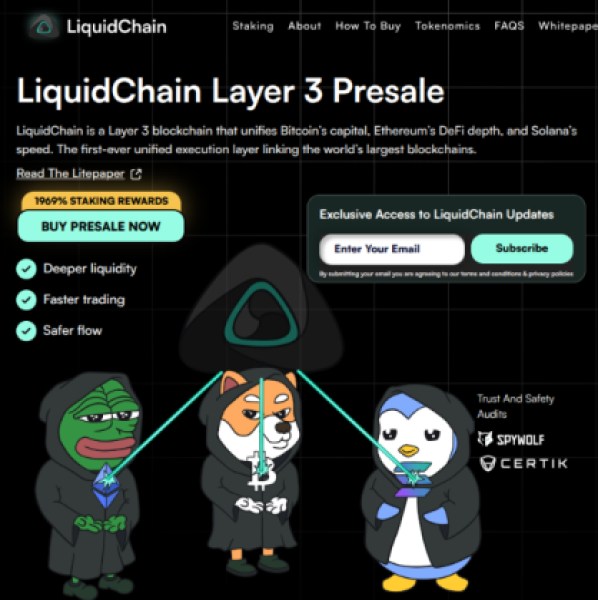
For a developer, the pitch is efficiency: deploy code once on LiquidChain, and instantly access liquidity from the top three ecosystems. No need to maintain fragmented liquidity pools across different networks, a redundancy that currently bleeds capital efficiency. As the dialogue moves toward the 2026 institutional horizon, protocols offering this level of unification are positioning themselves as the ‘TCP/IP’ of the blockchain era, invisible, essential, and highly valued.

CHECK OUT THE UNIFIED LIQUIDITY LAYER

Early Capital Flows into $LIQUID Presale Signal Infrastructure Demand

While headlines fixate on meme coin volatility, capital allocators are rotating into infrastructure plays that solve the interoperability crisis. The LiquidChain presale data reflects this methodical accumulation. It has already raised over $532K, and tokens are priced at $0.0136. Early investors also have access to staking rewards, currently sitting at 1943%.

This sub-million market cap entry point is notable compared to legacy interoperability protocols, which often trade in the billions. The pricing suggests the project is still in a discovery phase, distinct from the retail mania that usually follows major exchange listings.

The utility of the $LIQUID token extends beyond simple governance. It functions as the transaction fuel for the cross-chain VM and is required for liquidity staking. The tokenomics are designed to incentivize bonding assets from $BTC, $ETH, and $SOL into the LiquidChain ecosystem, rewarding users who provide the ‘glue’ for this unified layer. We see it as one of the next crypto to explode, due to its offering.

Investors are eyeing the $0.0136 price point not just for immediate gains, but as a derivative bet on cross-chain volume growth. If the thesis holds, that Asia will demand seamless execution across chains, LiquidChain’s ability to merge these ecosystems places it in a prime position to capture value from every transaction it facilitates.

CHECK OUT THE $LIQUID PRESALE

This article is for informational purposes only and does not constitute financial advice. Cryptocurrency investments, including presales like LiquidChain, carry high risks. Always conduct independent due diligence before participating.


Perguntas relacionadas

QWhat is the significance of KuCoin's participation in Consensus Hong Kong 2026?

AKuCoin's participation, with its Vice President Edwin Wong joining the 'Turning Intelligence Into Action' panel, signifies the exchange's commitment to discussing and shaping the future of trust-first infrastructure and practical governance using on-chain signals and AI, aligning with the event's focus on Asia's growing dominance in the crypto space.

QAccording to the article, what is the primary market inefficiency that LiquidChain aims to solve?

ALiquidChain aims to solve the industry's glaring inefficiency of friction and high cost when moving capital between major blockchains like Bitcoin, Ethereum, and Solana, which fractures liquidity and makes execution expensive and slow.

QHow does LiquidChain function to unify liquidity from Bitcoin, Ethereum, and Solana?

ALiquidChain operates as a Layer 3 (L3) infrastructure that fuses liquidity from Bitcoin, Ethereum, and Solana into a single execution environment, eliminating the need for wrapped assets and their associated counterparty risk by enabling verifiable settlement and a 'single-step execution' model.

QWhat are some key details about the LiquidChain ($LIQUID) presale mentioned in the article?

AThe LiquidChain presale has raised over $532,000, with tokens priced at $0.0136. Early investors have access to staking rewards, currently at 1943% APY, and the project's low market cap entry point is seen as a discovery phase distinct from typical retail mania.

QWhat is the core utility of the $LIQUID token within its ecosystem?

AThe $LIQUID token functions as the transaction fuel for the cross-chain Virtual Machine (VM), is required for liquidity staking, and is used to incentivize users to bond assets from $BTC, $ETH, and $SOL into the LiquidChain ecosystem, rewarding those who provide liquidity for the unified layer.

Leituras Relacionadas

Winter for Crypto IPOs: Consensys and Ledger Withdraw Applications

The crypto IPO window is tightening significantly in 2026, marked by prominent companies delaying or pausing their public listing plans. Following a successful 2025 "harvest year" that saw Circle, Bullish, and Gemini go public amidst a bull market, the tide has turned. Consensys, developer of MetaMask, recently postponed its IPO until at least fall 2026. Hardware wallet leader Ledger also suspended its planned US listing due to unfavorable market conditions, with Kraken having previously delayed its own plans. This shift is driven by a cooling market in 2026, characterized by a significant Bitcoin price correction, declining trading volumes, and reduced investor risk appetite for crypto stocks. The poor post-IPO performance of 2025 listings like Circle and Bullish, which saw major share price declines, has heightened investor caution. This contrasts sharply with the current AI sector, where companies like SpaceX, OpenAI, and Anthropic are commanding massive valuations and investor enthusiasm based on narratives of stable, exponential growth. Crypto companies now face pressure to transition from hype-driven models to demonstrating reliable cash flows and robust compliance. While the paused IPO plans may lead to valuation resets and affect ecosystem liquidity, they also accelerate industry consolidation toward stronger, more compliant infrastructure players. A potential recovery in Bitcoin's price and clearer regulations could reopen the IPO window in the latter half of 2026.

marsbitHá 2h

Winter for Crypto IPOs: Consensys and Ledger Withdraw Applications

marsbitHá 2h

ChatGPT Can Manage Your Money for You. Would You Trust It with Your Bank Account?

OpenAI has launched a personal finance tool for ChatGPT, currently in preview for US-based ChatGPT Pro users. This feature allows users to connect their bank and investment accounts (via Plaid, supporting over 12,000 institutions) directly to ChatGPT. It analyzes transactions, generates visual dashboards, and offers conversational financial advice—such as budgeting or planning for major purchases—based on the user's actual data. This move follows OpenAI's acquisitions of fintech startups Roi and Hiro Finance, signaling a strategic push into vertical "super assistant" applications, similar to its earlier health-focused feature. However, the launch has sparked significant privacy concerns. Critics question the safety of granting such sensitive financial access to an AI, especially amid ongoing lawsuits alleging OpenAI shared user chat data with third parties like Meta and Google. OpenAI emphasizes that ChatGPT only reads data (no transaction capabilities), deletes it within 30 days if disconnected, and offers opt-out options for model training. Yet, trust remains a major hurdle. The trend reflects a broader industry shift: AI companies like Anthropic and Perplexity are also targeting high-value, data-rich domains like finance and health. While technically promising, the tool operates in a regulatory gray area—it provides personalized guidance but disclaims formal financial advice or liability. Ultimately, OpenAI's challenge is convincing users to trust an AI with their most private financial information.

marsbitHá 2h

ChatGPT Can Manage Your Money for You. Would You Trust It with Your Bank Account?

marsbitHá 2h

Trading

Spot
Futuros

Artigos em Destaque

Como comprar L3

Bem-vindo à HTX.com!Tornámos a compra de Layer3 (L3) simples e conveniente.Segue o nosso guia passo a passo para iniciar a tua jornada no mundo das criptos.Passo 1: cria a tua conta HTXUtiliza o teu e-mail ou número de telefone para te inscreveres numa conta gratuita na HTX.Desfruta de um processo de inscrição sem complicações e desbloqueia todas as funcionalidades.Obter a minha contaPasso 2: vai para Comprar Cripto e escolhe o teu método de pagamentoCartão de crédito/débito: usa o teu visa ou mastercard para comprar Layer3 (L3) instantaneamente.Saldo: usa os fundos da tua conta HTX para transacionar sem problemas.Terceiros: adicionamos métodos de pagamento populares, como Google Pay e Apple Pay, para aumentar a conveniência.P2P: transaciona diretamente com outros utilizadores na HTX.Mercado de balcão (OTC): oferecemos serviços personalizados e taxas de câmbio competitivas para os traders.Passo 3: armazena teu Layer3 (L3)Depois de comprar o teu Layer3 (L3), armazena-o na tua conta HTX.Alternativamente, podes enviá-lo para outro lugar através de transferência blockchain ou usá-lo para transacionar outras criptomoedas.Passo 4: transaciona Layer3 (L3)Transaciona facilmente Layer3 (L3) no mercado à vista da HTX.Acede simplesmente à tua conta, seleciona o teu par de trading, executa as tuas transações e monitoriza em tempo real.Oferecemos uma experiência de fácil utilização tanto para principiantes como para traders experientes.

201 Visualizações TotaisPublicado em {updateTime}Atualizado em 2025.03.21

Como comprar L3

Discussões

Bem-vindo à Comunidade HTX. Aqui, pode manter-se informado sobre os mais recentes desenvolvimentos da plataforma e obter acesso a análises profissionais de mercado. As opiniões dos utilizadores sobre o preço de L3 (L3) são apresentadas abaixo.

活动图片












