Krypto News: Coinbase and Crypto.com Launch Prediction Markets

bitcoinistPublicado em 2026-02-04Última atualização em 2026-02-04

Resumo

Major cryptocurrency exchanges Coinbase and Crypto.com have recently launched prediction market platforms, expanding their offerings beyond traditional crypto trading. Coinbase activated its "Coinbase Predict" feature across all 50 U.S. states in partnership with regulated provider Kalshi. This allows users to trade binary event contracts on real-world outcomes in sports, politics, and economics, settled in USD or USDC. The platform operates under CFTC oversight, creating a regulatory distinction from gambling. Simultaneously, Crypto.com introduced its standalone prediction market app, "OG," operated by its CFTC-registered derivatives division. A key differentiator is its planned offering of margined, leveraged positions on prediction contracts, alongside social features and user incentives. The article highlights the growing interest in event-based trading and questions which infrastructure can best support it. It points to Bitcoin Layer-2 solutions, like the project "Bitcoin Hyper," as a potential foundation for building scalable, decentralized prediction markets. The project's ongoing presale, having raised over $31 million, is cited as evidence of significant market interest in expanding Bitcoin's use cases beyond a store of value.

Since the beginning of the year, major crypto exchanges have been diving deep into the prediction and event trading market. In quick succession, both Coinbase and Crypto.com have announced and launched new platform offerings that allow private users to bet on the outcome of real-world events—from sports events to politics and cultural developments. This development is part of a broader trend where established trading platforms are expanding their product portfolios far beyond classic crypto trading.

Coinbase Expands Nationwide Prediction Markets

At the end of January, the US exchange Coinbase activated its prediction market offering across all 50 US states. The feature was introduced in collaboration with the regulated US provider Kalshi and enables customers to trade so-called event contracts directly via the Coinbase app. These are binary markets where the contract settles based on a yes/no outcome of an event, such as "Will Team X win the game?" or "Will US GDP exceed expectations?".

Pricing is determined by supply and demand in the market, not by odds set by the platform.

The full national release follows an earlier, limited availability in select regions. Coinbase itself describes the product as an opportunity to "hedge" on real-world events and convert predictions into tradable market prices, similar to established prediction markets like Polymarket or Kalshi itself. Wagers can be placed in US dollars or via stablecoin balances in USDC, which is already familiar to Coinbase customers.

Regulatorily, the offering is significant in the US as it falls under the supervision of the Commodity Futures Trading Commission (CFTC), which allows for a different classification than classic sports betting or gambling. This regulatory classification is not without controversy: in several states, there have already been disputes over whether prediction markets should instead fall under state gambling laws.

Crypto.com Launches Standalone Platform "OG"

Simultaneously, Crypto.com has launched its own prediction market platform called OG, which initially focuses on the US market and went live just before one of the biggest sporting events of the year. OG is operated by Crypto.com | Derivatives North America (CDNA), a registered CFTC clearing and trading venue, and also offers users the ability to trade event contracts on topics such as sports, politics, finance, and entertainment.

A key distinguishing feature of OG is the planned offering of margin or leveraged positions on prediction contracts, which is intended to set it apart from previous platform formats—an approach that, however, also implies higher risks for users. Additionally, OG integrates social elements such as leaderboards and rewards, including up to $500 for the first million registered users.

The launch as a standalone app rather than an integrated feature signals that Crypto.com views the prediction market as its own growth area that generates strong user interest. According to the company, demand for such contract types has increased significantly in recent months, which favored the decision to spin off a dedicated product.

Are Decentralized Prediction Markets Coming to Bitcoin?

The recent moves by major exchanges into regulated prediction markets highlight how much interest in event-based trading has grown. At the same time, this brings a fundamental question into focus: On which infrastructure can such applications be mapped in a scalable, transparent, and as neutral as possible manner in the long term?

While many of the platforms used today are built on existing smart contract networks, there is a parallel growing interest in solutions that enable these concepts on a Bitcoin basis as well. A prerequisite for this is powerful Layer-2 structures that open up new use cases beyond pure value storage.

Against this backdrop, one project is currently coming more into view that aims to address exactly this gap.

Bitcoin Hyper positions itself as a Layer-2 solution for the Bitcoin ecosystem, with the goal of enabling more complex applications directly at Bitcoin's security level. These explicitly include decentralized prediction markets, which have so far been implemented primarily on Ethereum- or Solana-based networks. The project pursues the approach of combining Bitcoin's liquidity and trust base with a high-performance execution layer to enable applications that were previously considered technically unfeasible.
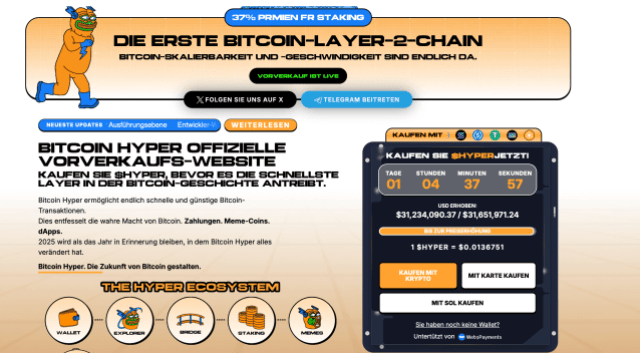
The current market interest is reflected primarily in the ongoing presale. According to project reports, over $31 million has already been raised, indicating unusually high attention in a phase where many investors are acting more selectively. Observers attribute this in part to the overarching narrative: Bitcoin not just as a passive store of value, but as a foundation for new financial and information markets. Prediction markets are considered a particularly sensitive use case, as they require both scalability and security.

Bitcoin Hyper attempts to differentiate itself in this environment through a clear focus on Bitcoin Layer-2 infrastructure. If the adoption of such Layer-2 networks continues to accelerate, applications like decentralized prediction markets on Bitcoin could also become realistic.

The presale is divided into several price tiers, allowing early participants to achieve book gains. Acquisition is done via the project website by connecting a compatible wallet and executing the token swap.

Go to the Bitcoin Hyper Presale

Perguntas relacionadas

QWhat new type of trading platforms have Coinbase and Crypto.com recently launched?

ACoinbase and Crypto.com have launched prediction market platforms, allowing users to trade on the outcome of real-world events such as sports, politics, and cultural developments.

QHow does Coinbase's prediction market, Coinbase Predict, function and what is it regulated under?

ACoinbase Predict functions as a binary market where contracts settle based on a yes/no outcome of an event. It is regulated under the oversight of the U.S. Commodity Futures Trading Commission (CFTC).

QWhat is the name of Crypto.com's new prediction market platform and what is one of its key differentiating features?

ACrypto.com's new platform is called OG. A key differentiating feature is its planned offering of margin or leveraged positions on prediction contracts.

QAccording to the article, which blockchain is being positioned as a potential new base for decentralized prediction markets through Layer-2 solutions?

ABitcoin is being positioned as a potential new base for decentralized prediction markets through Layer-2 solutions like Bitcoin Hyper, which aims to enable more complex applications on Bitcoin's security level.

QHow much funding has the Bitcoin Hyper project reportedly raised in its ongoing presale, according to the article?

AThe Bitcoin Hyper project has reportedly raised more than $31 million in its ongoing presale.

Leituras Relacionadas

Podcast Notes | Conversation with GSR Asset Management Head: To Determine if This Crypto Rally is Real, Just Watch the Lending Rates on Aave

Podcast Summary: Dialogue with GSR's Head of Asset Management: To Determine if This Crypto Rally is Real, Just Check Lending Rates on Aave Andy Baehr, Managing Director of Asset Management at GSR, discusses the current crypto market, characterizing it as stuck in a state of "ambivalence" with short-lived, unsustainable rallies. He outlines a simple framework: the market moves between "ambivalence" and "conviction" (sustained upward momentum). Currently, every rally resembles a single-stage rocket booster that quickly fizzles out. Baehr identifies three key signals to watch: 1) DeFi lending rates, 2) the potential passage of the CLARITY Act, and 3) the market forming a consensus on the "Fed hawkish peak." He emphasizes that the most immediate indicator for the sustainability of the recent CPI-triggered rally is the USDC borrowing rate on Aave, currently around 3.75%—close to U.S. Treasury yields. The absence of a credit spread indicates low leverage demand and a lack of market energy. He explains that a healthy, sustained rally requires layered buying pressure. Last year's rally progressed from an ETH short squeeze to crypto-native trader influx and finally to ETF inflows. Currently, this structure is missing. Other potential structural buyers like Digital Asset Treasury (DAT) companies are absent, and ETF flows have proven transient. Baehr notes that while small-cap crypto tokens outperformed large caps in Q2—a potential sign of capitation in major assets—capital is also flowing to more exciting opportunities like AI stocks and tech IPOs, leaving crypto sidelined. Regarding DeFi, he highlights that platforms like Aave provide a clear, real-time signal of leverage demand through their supply/demand-driven interest rates. A significant, sustained rate increase would signal genuine market conviction. He also observes the quiet emergence of fixed-income-like products and vaults in DeFi. On regulation, the probability of the CLARITY Act passing before the August 7th deadline has dropped linearly from 75% to below 40% on Polymarket. Baehr suggests its passage would be treated as a bullish surprise, a potent driver for price movement. However, political hurdles, including ethical clause debates and disclosures about the First Family's crypto profits, remain significant obstacles. Ultimately, the market awaits clarity on the Fed's terminal rate under Chair Warsh. Until the "Fed Solstice"—the point where the market collectively understands the peak of hawkish policy—sustained conviction will be difficult to achieve.

marsbitHá 18m

Podcast Notes | Conversation with GSR Asset Management Head: To Determine if This Crypto Rally is Real, Just Watch the Lending Rates on Aave

marsbitHá 18m

7 Months After the Collapse of Huiwang, Southeast Asia's Escrow Platforms Undergo a Major Reshuffle

Following the collapse of Huione Pay—dubbed the "Alipay of Southeast Asia"—seven months ago, the region's underground financial guarantee platform sector is undergoing a significant reshuffle. This power vacuum has been swiftly filled by emerging platforms such as XinBi, Tiger/Navigator, JinBei (renamed JinBo), Dali/Tiancheng, and FullyLight. These platforms, operating largely via Telegram and offering services like escrow for illicit transactions, have absorbed the vast user base and markets left behind by Huione. While positioning themselves as "trust intermediaries," their primary clientele consists of networks involved in online scams, money laundering, illegal gambling, and even human trafficking. For instance, the Tiger/Navigator platform explicitly provides "escrow" services for kidnapping-for-ransom operations ("强押车交易"). Data underscores the immense scale: Huione alone processed over $103 billion in cryptocurrency payments and facilitated over $31 billion through its escrow market before its downfall, linking it to Cambodia's notorious Prince Group. Since its collapse, competitors have seen explosive growth. For example, the XinBi platform has accumulated over $1.6 billion in total USDT revenue, while platforms like NewPay, OkPay (under Dali), and FullyLight Wallet collectively processed over $4.8 billion in USDT in a single year. This ecosystem thrives in regions like Cambodia and Myanmar, where regulatory gaps allow these platforms to act as critical financial infrastructure for sprawling cybercrime industries, from scam compounds to online casinos. The article concludes that the moniker "Southeast Asian Alipay" is a misnomer, obscuring the platforms' fundamental role in enabling serious criminal enterprises rather than representing legitimate financial innovation.

Odaily星球日报Há 1h

7 Months After the Collapse of Huiwang, Southeast Asia's Escrow Platforms Undergo a Major Reshuffle

Odaily星球日报Há 1h

Trading

Spot
活动图片





