Kraken is Also Issuing Tokens? A Comprehensive Guide to Ink Season 1 Points Program

Odaily星球日报Publicado em 2026-04-15Última atualização em 2026-04-15

Resumo

Kraken Pro, the professional trading platform of the major cryptocurrency exchange Kraken, has launched the first season of its Ink Points program. Ink is Kraken’s Ethereum Layer 2 blockchain, introduced in October 2024, designed to simplify user onboarding into DeFi by addressing common pain points like complex wallet setups and high gas fees. The article explains the differences between Kraken's three service tiers: the basic Kraken for beginners, the subscription-based Kraken+ offering fee-free tiers, and Kraken Pro for advanced traders with lower fees and professional tools. All versions share the same account and funds. A step-by-step guide is provided for interacting with Kraken Pro: users must register, complete KYC, navigate to the "Promos" section to access Ink Points, deposit funds, and start trading to earn points. Ink Points serve as a loyalty incentive within the Ink Layer 2 ecosystem. Points are earned through trading, staking, and referrals on Kraken Pro, with an affiliate program offering 10% commission on referrals. Points are calculated daily, distributed weekly, and accumulated over four-week seasons. A ranked, tiered competition system is in place, though points currently have no monetary value or tokenization capability. The program is not accessible in all regions.

Original | Odaily Planet Daily (@OdailyChina)

Author | Asher (@Asher_ 0210)
Last night, the Korean cryptocurrency exchange Kraken announced via its Kraken Pro official account that the Ink Season 1 points program is now live.
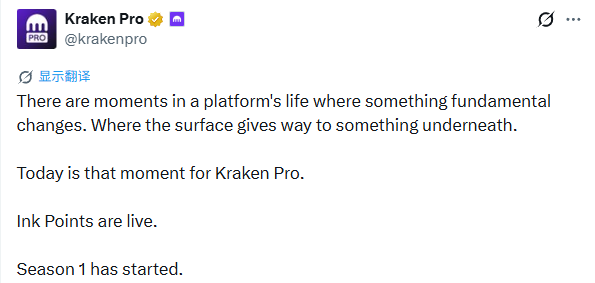
Kraken Pro officially announces the launch of the Ink points program

Kraken officially announced the launch of the Ink chain (an Ethereum Layer 2 designed to simplify user entry into DeFi) in October 2024, aiming to seamlessly bridge Kraken's over 10 million centralized exchange users to the on-chain DeFi ecosystem, addressing the pain points of traditional DeFi (such as complex wallet setup, high gas fees, fragmented liquidity, etc.). Although Ink is not the Kraken exchange itself, but an independent on-chain infrastructure, it is deeply integrated with Kraken's infrastructure (such as Kraken Wallet, zero withdrawal fee support, etc.).

At the end of last year, Kraken's valuation in the primary market once reached $20 billion. However, due to the cooling IPO environment in the crypto industry, its CEO subsequently chose to postpone the planned US listing originally scheduled for 2026. Therefore, it is more likely that Kraken will prioritize promoting the Ink chain to complete its token issuance before going public.

Below, Odaily Planet Daily provides a breakdown of the relationship between Kraken Pro and Kraken, a Kraken Pro interaction tutorial, and the Ink points rules.

Differences Between the 3 Versions of Kraken Exchange

This event takes place on Kraken Pro. Since Kraken currently has three versions, Odaily Planet Daily has compiled the differences between them as follows:

  • Kraken (Basic Version): Focuses on simplicity and ease of use, with a very intuitive interface, suitable for beginners or small-volume users with low trading frequency. Offers a standalone mobile app, low operational barrier, and leans towards a "buy-and-use" experience.
  • Kraken+ (Subscription/Membership Version): Builds upon the basic version with a subscription mechanism where users pay monthly for additional benefits. The core advantage is zero fees on the first $10,000 of trading volume per month, along with some additional perks. Suitable for users with certain trading needs looking to reduce costs.
  • Kraken Pro (Professional Version): Targets experienced traders, offering a standalone app and web interface. Features include more professional candlestick charts, a variety of order types (like limit, stop-loss, etc.), and a lower fee structure. Although it has a separate interface, it shares the same account and funds as the basic version, allowing users to switch between the regular version and Pro at any time.
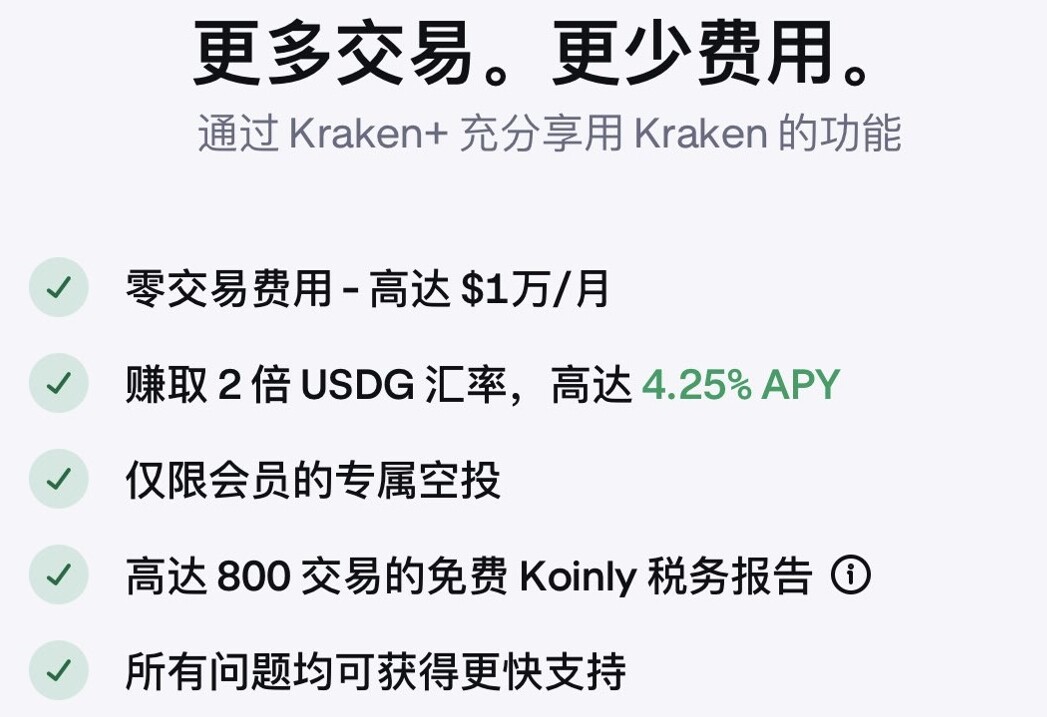
Difference between Kraken and Kraken+

Step-by-Step Guide to Interacting with Kraken Pro

STEP 1. Go to the Kraken Pro website (link: https://pro.kraken.com/) and complete account registration using your email.
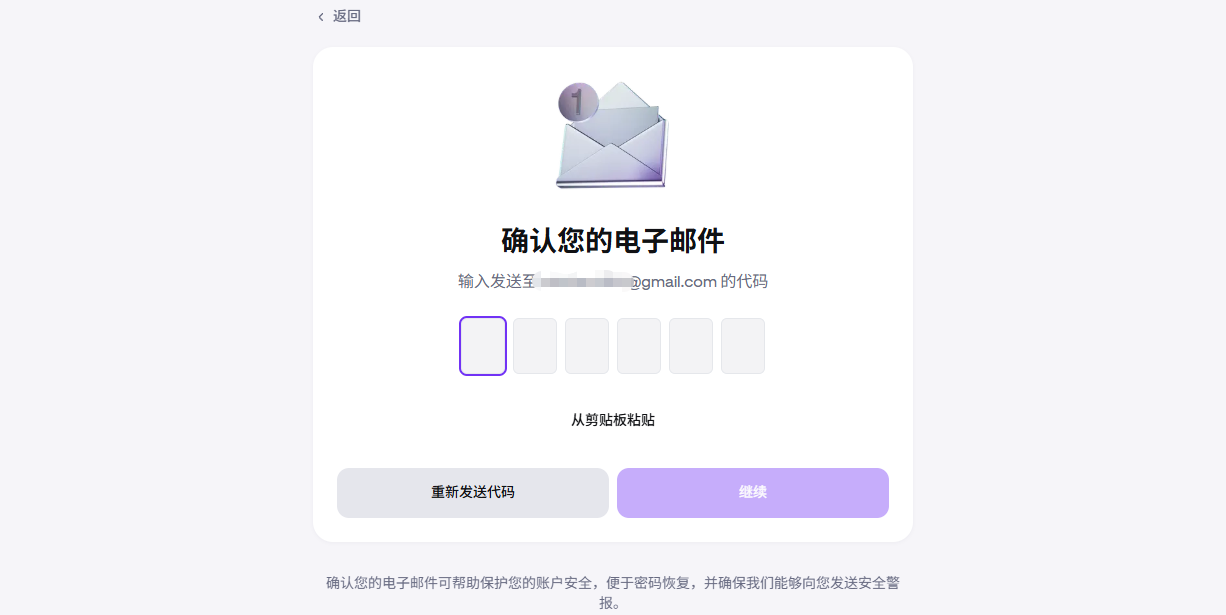
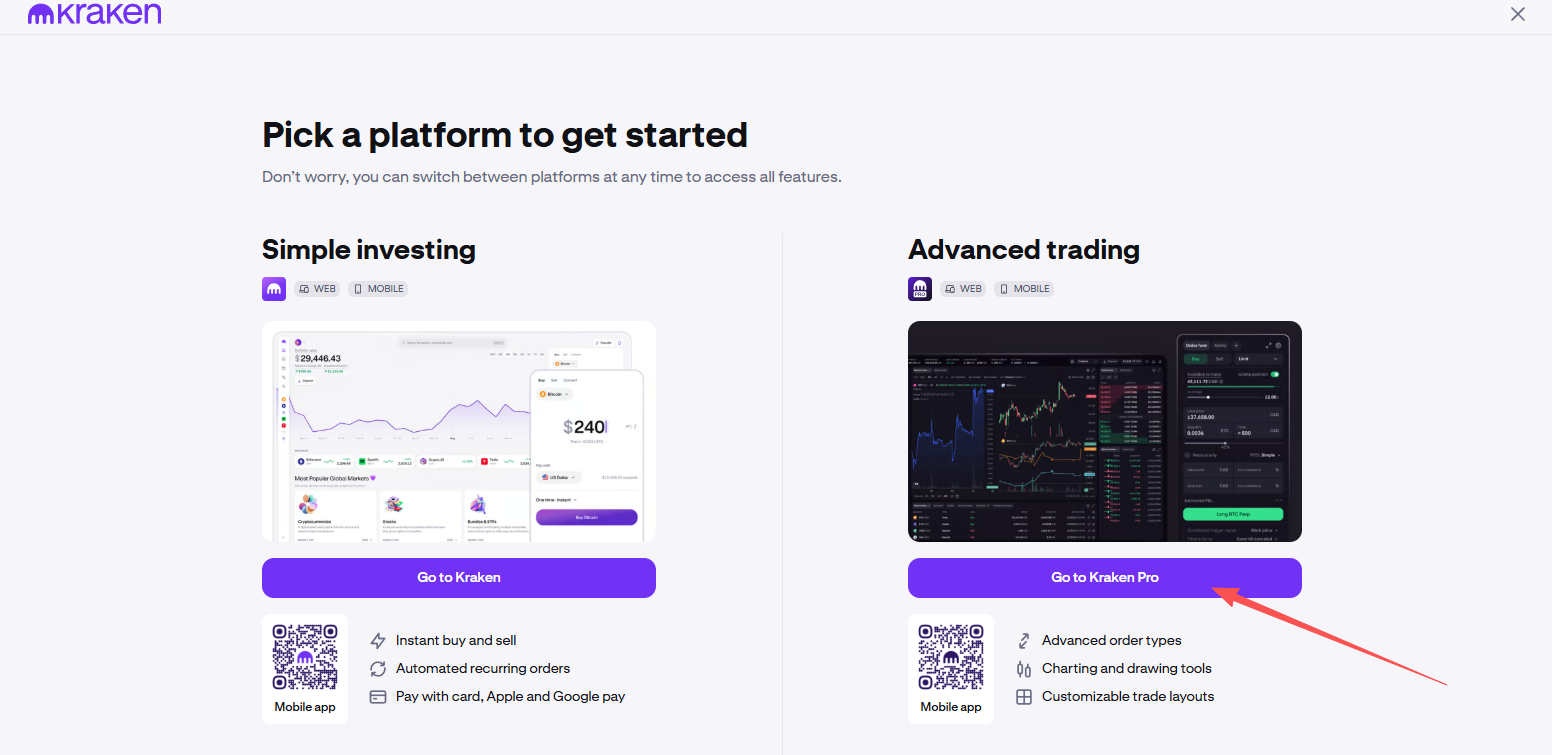
STEP 2. Select the Kraken Pro version. If using a mobile device, simply download the Kraken Pro app from your app store. Additionally, after accessing Kraken Pro, you need to complete KYC verification.
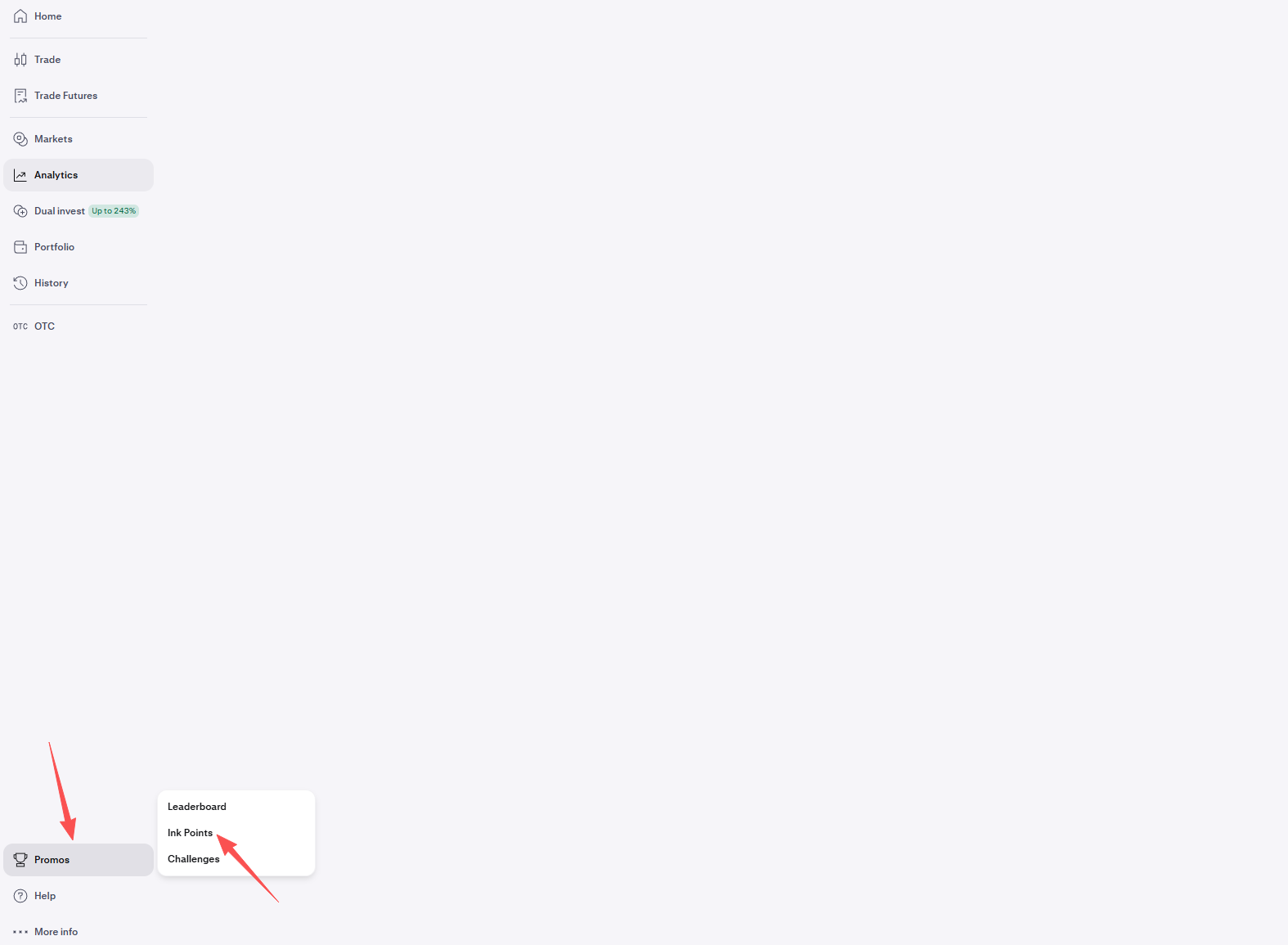
STEP 3. Click on "Promos" at the bottom and select "Ink Points" to enter the points interface.
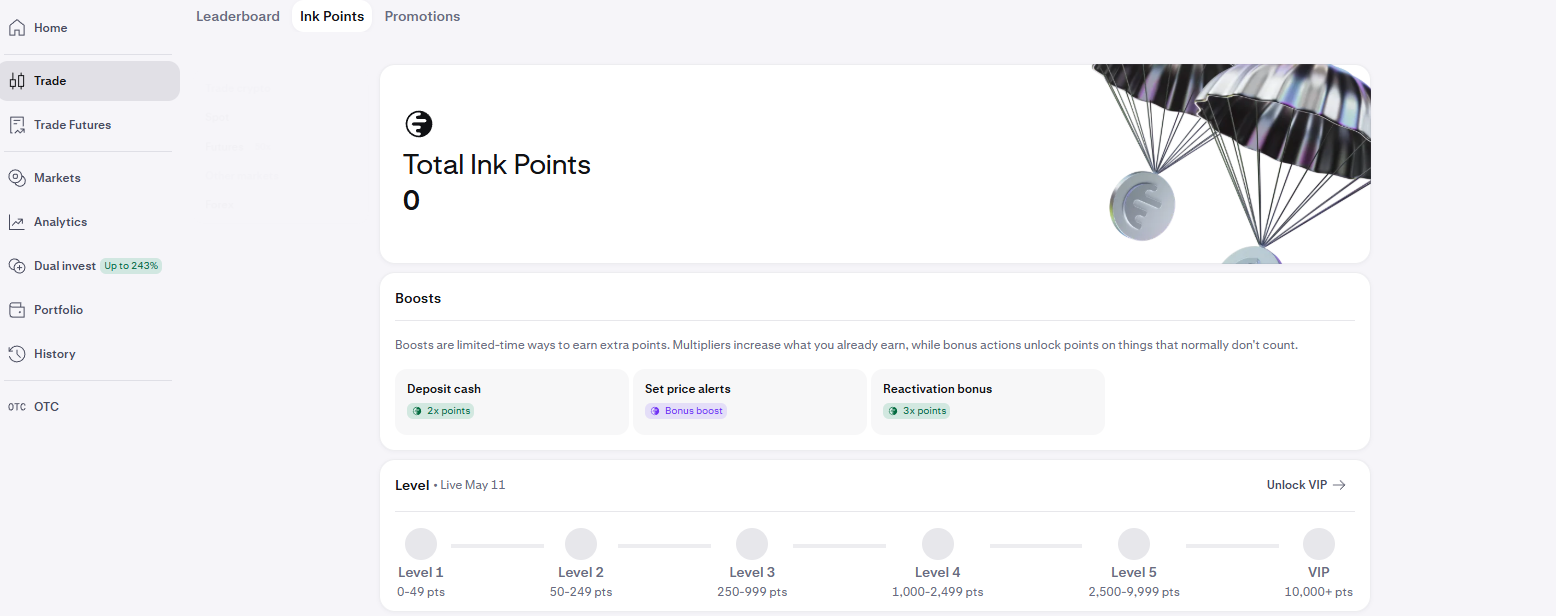
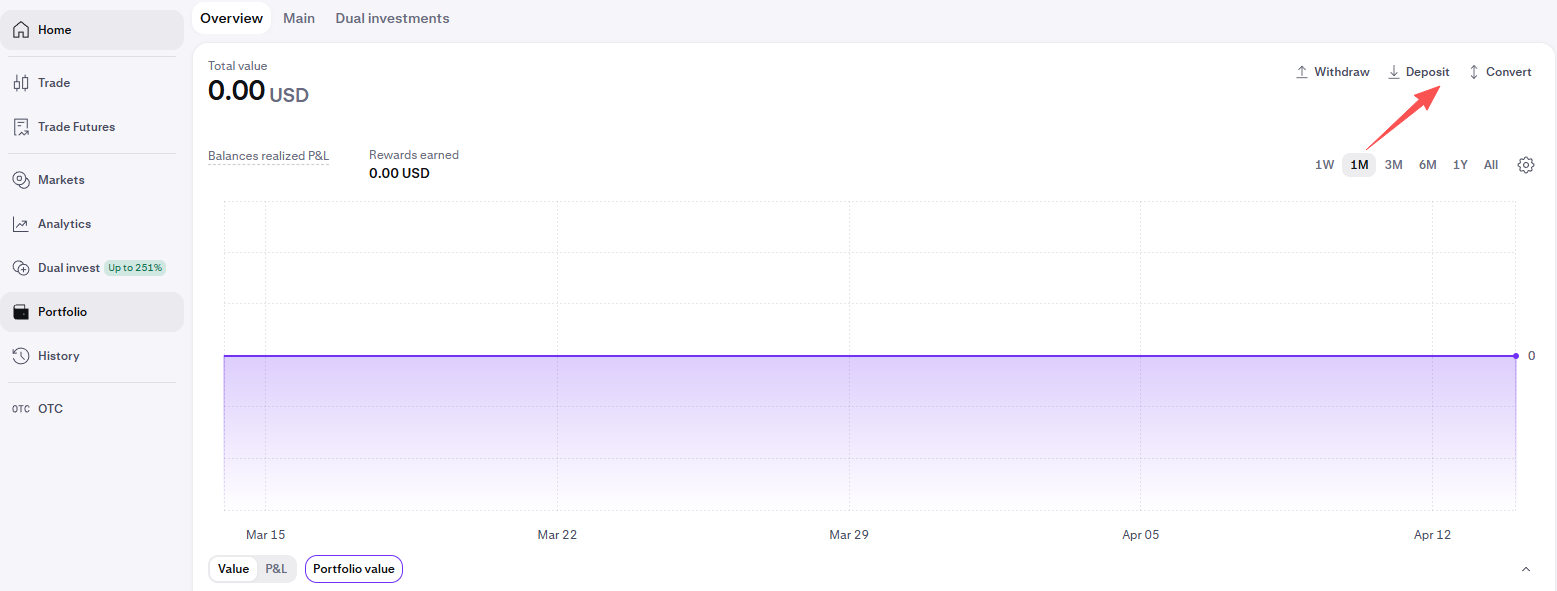
STEP 4. Click on "Portfolio" and then "Deposit" to fund your account, then you can start trading and earning points.
Detailed Explanation of Ink Points Rules

What are Ink Points

  • Ink Points are the points system for the Ink Layer2, connecting real user interactions with incentive mechanisms;
  • The Kraken Pro version will also adopt this points system as a loyalty program.

How to Earn Ink Points

  • Performing actions like trading, staking, and referring new users on Kraken Pro can earn Ink Points;
  • Joining the Kraken Alliance Program can earn a 10% Ink points rebate from referrals;

Additionally, the official encourages genuine user interaction: the earlier you start, the more active you are, and the more Kraken Pro products you use, the more points you will earn.

Ink Points Update Instructions

  • Points Calculation: Points are calculated daily, the system settles automatically every week, and points are distributed every Monday;
  • Season Structure: Every 4 weeks is a season, points for each season are calculated separately, total points are retained for life;
  • Acceleration Mechanism: Point multiplier events will be launched regularly, users should pay attention to official announcements;
  • Leaderboard + Tiers: Rankings are updated weekly, with six tiers based on current points (Tiers 1 to 5 and VIP). The exclusive "Tier System" means you compete only with traders in the same tier. Except for VIP, other tiers currently offer no additional benefits, but plans are to gradually open them up in the future.

Furthermore, the official notes that Ink Points are not tokenizable, not redeemable, have no cash value, and are temporarily unavailable in some regions.


Perguntas relacionadas

QWhat is the Ink Points program announced by Kraken Pro?

AThe Ink Points program is a loyalty and incentive system for Kraken Pro users, designed to reward activities like trading, staking, and referrals. It is part of the Ink Layer2 ecosystem and aims to encourage user engagement.

QWhat are the key differences between Kraken, Kraken+, and Kraken Pro?

AKraken is the basic version for beginners with a simple interface. Kraken+ is a subscription-based version offering benefits like zero fees on the first $10,000 in monthly trading volume. Kraken Pro is the advanced version for experienced traders, featuring professional charts, lower fees, and more order types, while sharing the same account and funds as the basic version.

QHow can users earn Ink Points on Kraken Pro?

AUsers can earn Ink Points by trading, staking, and referring new users on Kraken Pro. Additionally, joining the Kraken Alliance Program allows users to earn a 10% rebate on Ink Points from referred users.

QWhat is the relationship between Ink Chain and Kraken exchange?

AInk Chain is an independent Ethereum Layer2 infrastructure designed to simplify user entry into DeFi, but it is deeply integrated with Kraken's infrastructure, such as Kraken Wallet and zero withdrawal fees. It is not the Kraken exchange itself.

QWhat are the rules for Ink Points distribution and calculation?

AInk Points are calculated daily and distributed automatically every Monday. The program runs in 4-week seasons, with points accumulated per season but lifetime totals retained. There are six user levels (1 to 5 and VIP), and rankings are updated weekly. Points cannot be tokenized, exchanged, or cashed out.

Leituras Relacionadas

Gate Research Institute: The 'Wall Street-ization' Wave of Crypto Financial Products – Competition or Integration?

The article titled "Gate Research Institute: Are Crypto Financial Products Sparking a 'Wall Street' Wave—Competition or Convergence?" explores the evolving relationship between the crypto ecosystem and traditional finance (TradFi). The piece begins by reflecting on Bitcoin's original 2009 vision of decentralization, disintermediation, and moving away from banks. It then contrasts this with the 2024 landscape, where key crypto assets like Bitcoin are increasingly held through Wall Street products like ETFs issued by giants like BlackRock. The article questions whether this signifies that TradFi is systematically taking over the rights to issue, price, custody, and distribute crypto financial assets. The core argument is that this is not a zero-sum takeover but rather a bidirectional convergence where each side addresses the other's weaknesses. Crypto offers 24/7 global markets, programmable settlement, and open access but lacks compliant channels, institutional-grade custody, deep fiat liquidity, and mainstream distribution. TradFi possesses these but is constrained by legacy systems, limited operating hours, and slow settlement. Two primary convergence paths are highlighted: * **Path A (CEX to TradFi):** Exemplified by Gate, which has progressed from offering tokenized stocks and CFDs to providing direct, real stock trading (US, Hong Kong, South Korea) within its platform, using USDT. * **Path B (TradFi to Crypto):** Exemplified by Robinhood, which has integrated crypto trading, acquired exchanges like Bitstamp, and is moving traditional assets like stocks onto the blockchain via tokenization and its own Layer 2. Both paths are ultimately competing to become the next-generation, unified financial account—a "super account" where users can seamlessly trade cryptocurrencies, stocks, ETFs, RWA (Real World Assets), and tokenized treasury products in one interface. The growth of RWA and tokenized treasuries (e.g., BlackRock's BUIDL) is presented as the asset-layer fusion, providing stable, yield-bearing assets on-chain and acting as a bridge between the two worlds. In conclusion, the "Wall Street-ization" of crypto is framed as a mutual transformation. Decentralized ideals persist in the protocol layer, while at the application layer, a more efficient, global, and accessible unified capital market is emerging from this convergence. The future competition lies not between crypto exchanges and stockbrokers, but between platforms vying to offer the most comprehensive asset coverage, liquidity, and user experience within a single account.

marsbitHá 4m

Gate Research Institute: The 'Wall Street-ization' Wave of Crypto Financial Products – Competition or Integration?

marsbitHá 4m

Claude's Major New Feature: Screen Recording + Voice, Distilling Your Skills into AI Tasks in One Click

Claude has introduced a major new feature called "Record a Skill," available for Pro, Max, and Team users. This function, found in the Claude desktop app's CoWork menu, allows users to create reusable AI skills simply by recording their screen and providing voice narration while performing a task. Claude then automatically analyzes the recording and generates a functional Skill. A hands-on test confirmed the feature works seamlessly. Users start recording via the Skills manager, perform their workflow while verbally explaining the steps and logic, and avoid including sensitive information. After recording, Claude processes the content and creates the Skill, which can be saved and later invoked with a slash command (/). This eliminates the need for manual adjustments or writing complex instruction files. The innovation goes beyond mere efficiency. Previously, creating a Skill required writing a detailed SKILL.md file in Markdown—a significant barrier for non-technical users. "Record a Skill" bypasses this by directly capturing both actions and the implicit reasoning shared in the narration. This lowers the barrier to knowledge transfer and automation, addressing a core challenge in corporate knowledge management: the difficulty of getting experts to write and maintain documentation. However, the feature also highlights a shift in the nature of work. A case study from March 2026 showed a freelancer whose five-year client relationship was effectively replaced by a hand-coded Claude Skill automating their content workflow. With the even lower barrier of screen recording, the ability to distill personal expertise into automatable skills accelerates this trend. The "moat" for work is moving from simply knowing how to do a task to mastering tasks that are difficult or impossible to automate.

marsbitHá 8m

Claude's Major New Feature: Screen Recording + Voice, Distilling Your Skills into AI Tasks in One Click

marsbitHá 8m

Feeding AI "Noise" Can Also Boost Scores, This Work Enables Positive Transfer with Noise

Feeding "Noise" to AI Can Improve Performance: A Method Enables Positive Transfer from Noise This work, Semi-Supervised Noise Adaptation (SSNA), introduces a Noise Adaptation Framework (NAF) that challenges traditional transfer learning. Instead of requiring a labeled source domain of real data (e.g., images, text), NAF uses randomly generated Gaussian noise as the source. For a target task with C classes, it constructs C noise clusters by sampling from Gaussian distributions. Although this synthetic noise contains no semantic meaning, NAF trains it to form a discriminative class structure in a shared representation space—clustering same-class noise and separating different classes. The key is aligning this learned structure from the noise domain to the real, sparsely labeled target domain. A small number of target labels are still essential to establish the correspondence between noise clusters and actual classes. The training objective combines: 1) supervised loss on the few labeled target samples, 2) classification loss for the noise to build its structure, and 3) a distribution alignment loss (using Negative Domain Similarity) to minimize the gap between the noise and target domains in the shared space. Experiments show significant gains in few-label settings. With just 4 labels per class, NAF with a ResNet-18 backbone improves accuracy over a standard supervised baseline (ERM) by +12.35% on CIFAR-10, +7.61% on CIFAR-100, +4.38% on DTD-47, and +2.74% on Caltech-101. It also benefits fine-grained datasets and scales to ImageNet-1K (with 100 labels/class) and text classification (AG News). NAF can be integrated into existing semi-supervised methods like FixMatch for further gains. Ablation studies confirm the transferred benefit comes from the discriminative structure of the noise, not randomness itself. Collapsing all noise into a single point causes negative transfer, while increasing separation between noise cluster centers improves performance. The amount of noise per class is less critical once a basic structure forms. In conclusion, this work demonstrates that for positive transfer, the semantic content of source data may not be necessary. What can be effectively transferred is the *organizational structure* of categories within a representation space. This offers a promising alternative for scenarios where real source data is unavailable due to privacy, copyright, or procurement constraints.

marsbitHá 10m

Feeding AI "Noise" Can Also Boost Scores, This Work Enables Positive Transfer with Noise

marsbitHá 10m

Trading

Spot
活动图片