KOSPI Index Halts Trading Due to Eighth Price Limit Up Circuit Breaker Trigger of 2026

cryptonews.ruPublicado em 2026-07-28Última atualização em 2026-07-28

Resumo

The South Korean KOSPI index has triggered a market-wide trading halt for the eighth time in 2026, falling another 8% and losing over 28% in the past month. This latest plunge is driven by a severe sell-off in semiconductor and AI-related stocks. Key contributors include a sharp decline in shares of SK Hynix (down 50% from its June high) and heavyweights like Samsung, which comprises 50% of the index. The drop followed a sector-wide weakness triggered by the IPO of Changxin Memory Technology and falling US chip stocks like Nvidia (-4.4%). Analysts point to massive AI financing deals (like Nvidia's $250B support for OpenAI) raising debt cost concerns and questioning AI scalability viability. The article notes Bitcoin's correlation with AI stocks has weakened, but KOSPI's volatility could redirect some liquidity to crypto markets. Blockchain-based exchanges are exploring KOSPI-linked perpetual futures to allow speculation on further declines or a short squeeze, as traditional altcoin trading in South Korea diminishes amid the index's dramatic swings.

The South Korean KOSPI index experienced its eighth volatility limit halt in 2026, losing an additional 8%. The index is being closely watched for signals to analyze the situation in the artificial intelligence and semiconductor sectors.

The South Korean KOSPI index hit a critical mark for the eighth time this year. The index plunged alongside other markets. The KOSPI's slump this year continued, coinciding with overall market weakness.

The KOSPI index lost 520 billion Korean won, or approximately 360 billion US dollars. Furthermore, some South Korean stocks were used as collateral, which could lead to further potential losses as leverage is unwound. During the market crash on July 9th, some considered this drop the last for KOSPI, but the index continued to decline, falling over 20% in recent weeks.
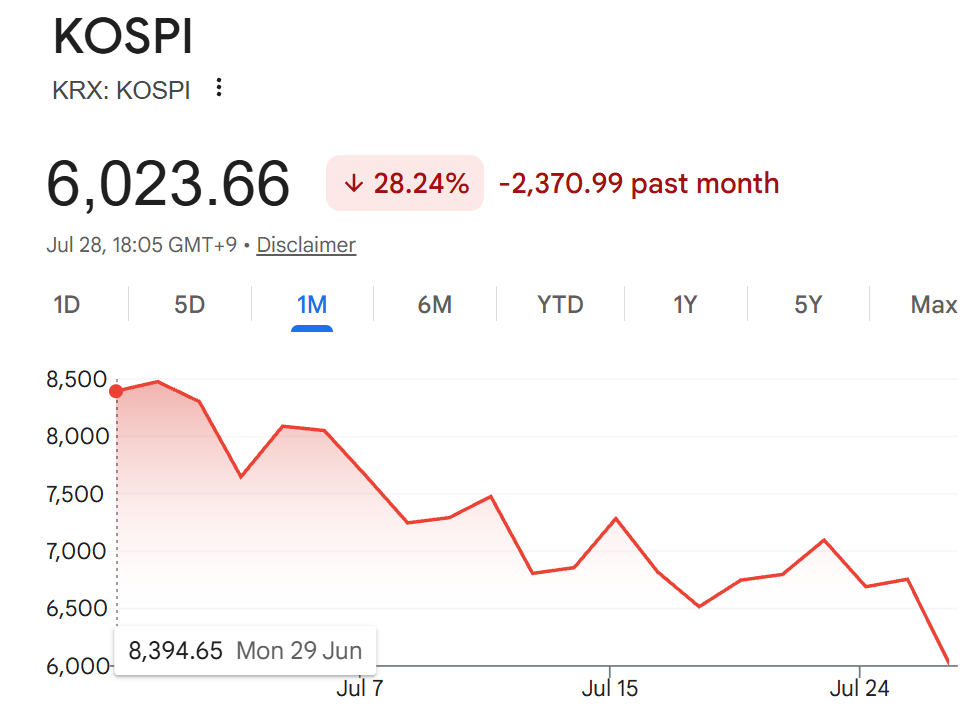
The KOSPI index lost more than 28% of its value over the past month, triggering another automatic trading halt mechanism. | Source: Google Finance

In addition, the SK Hynix index fell 50% from its June high due to weakness in the memory maker stock sector. Shares of many memory makers fell following the IPO of Changxin Memory Technology (CMXT) on Monday.

The South Korean market reacted to the reduction in shares of American chipmakers and a 4.4% drop in Nvidia (Nasdaq: NVDA) stock. Shares of Micron (Nasdaq: MU) and SanDisk (Nasdaq: SNDK) were also among the biggest decliners, falling 5% and 10% respectively.

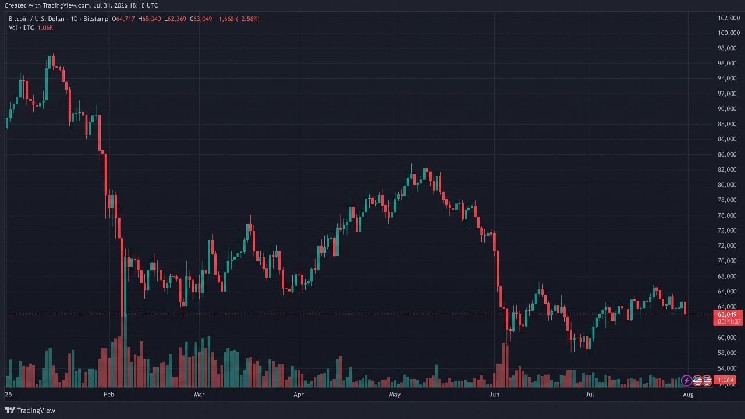
Asian markets followed, with the Nikkei index falling 4%. At the same time, $BTC also broke out of its new price range and fell to $63,000.

Why Did the KOSPI Index Fall?

In 2026, the KOSPI index has exhibited extreme volatility, driven by both retail trading and the influence of semiconductor company stocks. As Cryptopolitan reported, just before the crash, KOSPI showed signs of recovery and closed in positive territory.

However, the recovery in AI and chipmaker stocks proved fragile. The cause of the fall was recent news that Nvidia supported OpenAI, allocating $250 billion to finance a new data center. Nvidia will also allocate $350 billion to purchase OpenAI's own chips, and the market has already priced in the "cyclical financing" of the AI economy.

These financial deals are leading to an increase in borrowing costs, calling into question the viability of AI scaling.

With Samsung accounting for 50% of the KOSPI index, the drop was rapid, leading to liquidations and the triggering of the automatic circuit breaker.

What Does the KOSPI Index Mean for the Cryptocurrency Market?

As of 2026, $BTC has lost its correlation with AI and chip development company stocks and has significantly lagged the trend. The KOSPI index crash may return some liquidity to the cryptocurrency market if the arguments for AI weaken.

The increased volatility of KOSPI is also not a problem for crypto traders. Blockchain-based exchanges have already taken up this challenge. Dextera Labs mentioned the possibility of launching a KOSPI-based perpetual futures market, potentially allowing bets on other dramaticmatic . A futures market for KOSPI could allow traders to speculate on a potential "short squeeze" or further decline.

Trading KOSPI via blockchain would be viable due totron directional movements of the index. Currently, the market is still awaiting the completion of the leverage unwinding process. Now KOSPI is also awaiting signals on whether a liquidity outflow will occur or simply a re-rating of risks in AI and memory company stocks.

Speculation on KOSPI has also crowded out token and altcoin trading, which remained popular among retail traders in South Korea.

end-content
Perguntas relacionadas

QWhat caused the KOSPI index to trigger its eighth trading halt mechanism in 2026?

AThe KOSPI index triggered its eighth trading halt mechanism in 2026 due to a significant market drop, losing an additional 8%. This decline was part of a broader downturn, with the index falling over 28% in the past month. The drop was heavily influenced by weakness in the semiconductor and memory stock sectors, notably following a major correction in related US stocks like Nvidia and domestic giants like Samsung, which constitutes 50% of the KOSPI.

QHow did the performance of major semiconductor stocks contribute to the KOSPI's decline?

AMajor semiconductor stocks significantly contributed to the KOSPI's decline. The SK Hynix index fell 50% from its June high due to weakness in memory stocks. The decline was exacerbated by a negative reaction to falling US chipmaker stocks, including a 4.4% drop in Nvidia and declines in Micron and SanDisk. As Samsung alone makes up 50% of the KOSPI, its sharp fall accelerated the index's drop, leading to liquidations and the trading halt.

QWhat potential impact did the article suggest the KOSPI crash could have on the cryptocurrency market?

AThe article suggested the KOSPI crash could potentially bring some liquidity back to the cryptocurrency market if the investment thesis for Artificial Intelligence (AI) weakens. While Bitcoin had lost its correlation with AI and chip stocks by 2026, a major shift away from these equities could redirect funds. Additionally, the high volatility of KOSPI has spurred discussions about launching blockchain-based perpetual futures markets for the index, which could attract crypto traders to speculate on its movements.

QWhat was the specific trigger mentioned for the market's fragile recovery in AI and chip stocks failing?

AThe specific trigger for the failure of the fragile recovery in AI and chip stocks was news related to Nvidia's massive financial commitment. Nvidia pledged $250 billion to finance a new data center for OpenAI and an additional $350 billion for OpenAI to purchase Nvidia's own chips. The market interpreted this 'circular financing' of the AI economy as unsustainable, raising the cost of borrowed funds and casting doubt on the viability of scaling AI, which led to the sell-off.

QWhat are some of the proposed blockchain-based financial products related to the KOSPI index mentioned in the article?

AThe article mentions proposed blockchain-based financial products related to the KOSPI index, specifically the potential launch of a KOSPI-based perpetual futures market. This would allow traders on decentralized exchanges to speculate on further dramatic moves in the index, such as a potential short squeeze or continued decline. The idea is considered viable due to the KOSPI's strong, often one-directional movements, and it represents an area where crypto trading infrastructure could intersect with traditional market volatility.

Leituras Relacionadas

Russian Miners Refused Exclusion from 'Take and Pay' Scheme

The Russian Ministry of Energy has clarified that cryptocurrency mining companies will not be excluded from the new "take-or-pay" pricing scheme, despite ongoing discussions and complaints. Under this mechanism, set to take effect from January 1, miners will have to pay for nearly all the kilowatts of their maximum declared power capacity, not just for their actual electricity consumption. While the draft document is being adjusted, primarily to exempt utility companies (water and heat suppliers), miners face stricter rules: they are placed in a separate category and will be subject to the scheme regardless of their connection date, with a minimum payable volume set at 90% of their declared capacity (compared to 70% for others). The scheme, targeting industrial consumers with over 670 kW capacity and expected to fully launch by 2027, requires payment based on maximum possible consumption. Utility companies had argued that inclusion would at least double their costs, which would then be passed on to consumers via tariffs. They also criticized the proposed power thresholds as lacking technological or economic justification, claiming they would generate extra revenue for grid operators. Mining companies oppose the plan. Firm "Algorithm" warned in a study that rising energy costs are already making continuous grid-powered mining economically unviable in Russia within 2-3 years, putting the country at a competitive disadvantage against major US companies. In a letter to the Ministry, "Algorithm" requested an exemption, suggesting miners could instead serve as "energy-balancing" organizations—consuming power during off-peak periods and reducing load during peaks. The Ministry's stance indicates this proposal has been rejected.

cryptonews.ruHá 5m

Russian Miners Refused Exclusion from 'Take and Pay' Scheme

cryptonews.ruHá 5m

U.S. Tax Service Details New Cryptocurrency Fraud Scheme

The U.S. Internal Revenue Service (IRS) has warned of a new cryptocurrency fraud scheme. Scammers are sending paper letters impersonating official U.S. Department of the Treasury and IRS correspondence. These letters urge Americans to urgently register on a non-existent platform called the "Digital Asset Compliance Portal." The fraudulent letters contain QR codes linking to a phishing website disguised as the official IRS site. Victims are prompted to disclose their cryptocurrency exchange or wallet provider (examples given include Coinbase, Kraken, and Ledger) and the amount of crypto assets they hold. Jarod Koopman, Chief of the IRS Criminal Investigation Division, stated that criminals are exploiting public trust in government institutions by creating convincing fake websites and official-looking correspondence. According to the investigation, the infrastructure for this scam was set up just days before the mailing campaign began, using a domain registered through a Hong Kong-based registrar. The IRS assured taxpayers that it does not require them to provide wallet information via third-party sites or to click links from suspicious messages. The agency advised Americans to verify the authenticity of any notifications through official channels, such as making a phone call. This alert follows a recent FBI warning about a separate fraudulent scheme targeting cryptocurrency wallet holders on the Tron network.

cryptonews.ruHá 15m

U.S. Tax Service Details New Cryptocurrency Fraud Scheme

cryptonews.ruHá 15m

Trading

Spot
活动图片