KBank Signals Major Crypto Push With Stablecoin Wallet Trademarks as $SUBBD Reshapes Creator Economy

bitcoinistPublicado em 2026-02-03Última atualização em 2026-02-03

Resumo

Thailand's Kasikornbank (KBank) is strengthening its digital asset infrastructure by filing trademarks for digital wallets and stablecoin solutions, signaling a major institutional push into blockchain. This move aims to modernize payments and capture digital capital flows in Southeast Asia. Simultaneously, the $85 billion creator economy is shifting toward decentralization. SUBBD Token ($SUBBD) is highlighted as an AI-powered platform built on Ethereum that reduces fees and gives creators more control. It integrates AI tools for content generation and community management, alongside a staking system offering 20% APY to incentivize holders. The project has raised over $1.4 million in its presale, reflecting strong demand for utility-driven Web3 applications.

Thailand’s second-largest lender, Kasikornbank (KBank), is quietly fortifying its digital asset infrastructure.

The banking giant isn’t just tinkering; trademark filings show they are securing IP rights for digital wallets and stablecoin solutions right before the anticipated IPO of their asset management arm. This isn’t just a technical upgrade; it’s a signal that institutional banking is finally getting serious about integrating blockchain rails.

KBank seems to be prepping for a future where crypto is a daily medium of exchange, not just a speculative toy. By locking down these trademarks now, the bank is effectively hedging against the slow death of legacy SWIFT systems to capture digital capital flows across Southeast Asia.

Why does that matter? Simple: institutional validation usually precedes mass utility. When banks build the wallet infrastructure, they’re essentially rolling out the red carpet for the applications built on top of it.

But while banks focus on the ‘rails’, the actual movement of money, the real innovation is happening at the application layer. Specifically, where AI meets decentralized finance. The $85B content creation industry is undergoing a similar overhaul.

Just as KBank wants to bypass legacy payment friction, new ecosystems are cutting out the restrictive fee structures of Web2 platforms. This shift from centralized control to decentralized utility is bridging the gap between institutional adoption and retail use. That’s why investors are looking closely at AI-powered challengers like SUBBD Token ($SUBBD).

AI-Driven Platforms Decentralize The $85B Creator Economy

While giants like KBank modernize the back end, the front-end user experience is shifting toward creator sovereignty. Frankly, the current model looks predatory. Legacy platforms often extract fees ranging from 20% to 70% of a creator’s earnings while retaining the right to de-platform users on a whim. The inefficiency is glaring: intermediaries are extracting massive value without contributing proportional utility.

SUBBD Token ($SUBBD) tackles this by merging the Ethereum blockchain with advanced AI tools. The goal?

Return control to the creators. By using an ERC-20 token for transactions, the ecosystem cuts out high banking fees and payment processor delays—the very friction points KBank’s stablecoin initiatives aim to solve institutionally.

But SUBBD goes beyond payments. It integrates proprietary AI models for content generation (think AI Voice Cloning and AI Influencer Creation), allowing creators to scale their output without exploding their labor costs.

The addition of an AI Personal Assistant for automated interactions signals a major shift in how influencers manage community engagement. Instead of manual replies, AI tools handle the grunt work, optimizing revenue streams through subscriptions, pay-per-view (PPV), and NFT sales. (For creators, this means transforming a passive audience into an active, token-gated economy.)

Governance rights further distinguish this model. Token holders vote on feature rollouts and community events, ensuring the platform evolves based on user needs rather than shareholder mandates.

LEARN MORE ABOUT $SUBBD WITH OUR ‘WHAT IS SUBBD TOKEN?’ GUIDE.

$SUBBD Presale Momentum Highlights Demand For Yield-Bearing Web3 Utilities

The market’s appetite for utility-driven AI projects is obvious in recent capital inflows. Smart money is watching early-stage valuations closely, hunting for assets that offer both technological innovation and incentives for long-term holding. SUBBD has already secured over $1.4M in its ongoing presale, a figure that suggests robust confidence in the roadmap, even with broader market volatility.

Currently priced at $0.05749, the token offers an entry point that contrasts sharply with the saturated valuations of established AI cryptos. The project’s economic model is built for retention.

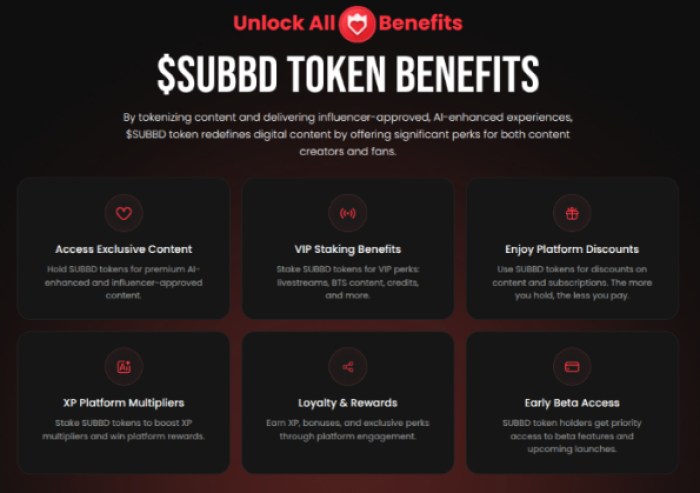
To mitigate the volatility often seen with new utility tokens, SUBBD offers a staking protocol with a fixed 20% APY for the first year. This high-yield structure does double duty: it rewards early adopters for locking liquidity and stabilizes the token’s circulating supply during the critical initial growth phase.
Source: SUBBD Token

But it’s not just about yield. For fans, staking unlocks tiered platform benefits, including access to exclusive livestreams and ‘HoneyHive’ membership. This gamification of finance, where holding a token grants both interest and experiential access, is fast becoming the standard for successful Web3 launches.

As institutional giants like KBank build the stablecoin highways, projects like SUBBD are building the high-speed vehicles that give users a reason to drive on them.

VISIT THE OFFICIAL $SUBBD PRESALE SITE.

This article is not financial advice. Cryptocurrency investments, including presales and AI tokens, carry inherent risks. Always conduct independent research before making investment decisions.


Criptomoedas em alta

Perguntas relacionadas

QWhat is Kasikornbank (KBank) doing to strengthen its position in the digital asset space according to the article?

AKasikornbank (KBank) is fortifying its digital asset infrastructure by filing trademarks for digital wallets and stablecoin solutions, signaling a serious institutional push to integrate blockchain technology and capture digital capital flows in Southeast Asia.

QHow does the SUBBD Token ($SUBBD) aim to benefit content creators?

ASUBBD Token ($SUBBD) aims to return control to creators by using an ERC-20 token to cut out high banking fees and payment processor delays. It also integrates AI tools for content generation and community management, and allows token holders to participate in governance.

QWhat specific AI tools does the SUBBD ecosystem integrate for creators?

AThe SUBBD ecosystem integrates proprietary AI models for AI Voice Cloning and AI Influencer Creation, as well as an AI Personal Assistant for automated interactions to help creators scale their output and manage community engagement.

QWhat financial incentive does SUBBD offer to early token holders?

ASUBBD offers a staking protocol with a fixed 20% APY for the first year to reward early adopters, lock liquidity, and stabilize the token's circulating supply during its initial growth phase.

QHow much funding has SUBBD secured in its ongoing presale, and what does this indicate?

ASUBBD has secured over $1.4 million in its ongoing presale, indicating robust market confidence in its roadmap and demand for utility-driven AI projects despite broader market volatility.

Leituras Relacionadas

Wall Street Morning News: V-shaped Rebound at Month-end, but Nasdaq Suffers Worst July in 12 Years; Funds Accelerate Concentration Towards Cloud Giants

Despite a V-shaped rebound at the end of July, the Nasdaq posted its worst July since 2004, while the S&P 500 had its worst July since 2014. Markets were jolted by geopolitical shifts, as President Trump canceled a planned strike on Iran, leading WTI crude to plunge over 8%. This, alongside OPEC+ announcing a supply increase, reversed crude's sharp July gains. Treasury yields surged, with the 10-year yield rising over 30 basis points in July—its largest July increase since 2005. In a rare move, the US and Japan jointly intervened to weaken the USD/JPY, aiming to prevent potential Japanese sales of US Treasuries. While the tech sector faced deleveraging pressure throughout July, cloud giants staged a massive rally on strong earnings. Microsoft, Amazon, and Google collectively added nearly $1.5 trillion in market value last week. Amazon soared over 15% on accelerating AWS growth, Microsoft extended historic gains, Google fully recovered post-earnings losses, and Meta ended an 11-day losing streak. In contrast, Apple tumbled over 7% on supply chain and guidance concerns, ceding its "world's most valuable company" title to Nvidia. The memory and storage sector corrected sharply. Gold edged up 0.91% in July, with analysts viewing the ~30% pullback from January highs as a potential basing period, supported by long-term central bank demand. Key events to watch this week include earnings from Palantir, AMD, SpaceX (its first post-IPO report), and memory giants like Western Digital. The US July non-farm payrolls report on Friday will be critical for gauging the Fed's policy path. SpaceX also faces a significant lock-up expiration, testing market liquidity.

marsbitHá 37m

Wall Street Morning News: V-shaped Rebound at Month-end, but Nasdaq Suffers Worst July in 12 Years; Funds Accelerate Concentration Towards Cloud Giants

marsbitHá 37m

Rubin Ultra Makes Major Cuts, Even Nvidia Can't Handle Memory Price Hikes?

NVIDIA's Rubin Ultra, the top-tier variant of the newly announced Rubin AI accelerators, has reportedly seen significant specification downgrades, according to an industry report from SemiAnalysis. Initially designed with four compute dies (4-die), the Rubin Ultra is now said to be reduced to a 2-die design. Key changes highlighted in the report include: * **No increase in peak theoretical compute performance**, remaining at 35 PFLOPs like the standard Rubin. * **Severe reduction in memory capacity** to 192GB using 8-Hi HBM stacks, which is less than the standard Rubin's 288GB using 12-Hi stacks. * **Negligible memory bandwidth improvement** of only 1 TB/s. * **Slightly higher chip-level power consumption**. * The **primary upgrade is a massive increase in scale-up interconnect capacity**, supporting connections for up to 576 GPUs via NVLink, compared to 72 for the standard Rubin. The report suggests the redesign is primarily a cost-optimization move driven by the sharp rise in HBM (High-Bandwidth Memory) prices. By reducing the expensive HBM content and shifting investment towards enhanced system-scale networking, NVIDIA aims to maintain the platform's value for large-scale AI training clusters while managing soaring material costs. The news reportedly triggered a sell-off in South Korean memory stocks, with SK Hynix and Samsung shares falling around 8%, as markets grew concerned that NVIDIA—a major HBM buyer—might be reducing its reliance on high-capacity memory, potentially capping future pricing power for memory makers.

Odaily星球日报Há 58m

Rubin Ultra Makes Major Cuts, Even Nvidia Can't Handle Memory Price Hikes?

Odaily星球日报Há 58m

Can Generative Models Finally Be Trained End-to-End? The Core Is a For Loop

This article introduces a novel training paradigm for generative models called Explorative Modeling (XM), which enables true end-to-end training. Traditionally, powerful generative models like autoregressive and diffusion models are not trained end-to-end. They are trained to predict a single small step but require iterative multi-step sampling for inference. This "exposure bias" leads to error accumulation and limits performance. The core challenge XM addresses is "mode blurring." In generative tasks, a single input (e.g., "generate a dog") corresponds to many valid outputs (multiple modes). Standard training objectives like reconstruction loss force the model to average these modes, producing unrealistic, blurry outputs. To avoid this, existing models break generation into many small, almost deterministic steps, sacrificing end-to-end training. XM tackles this by restructuring the training loop itself. Its key insight is to amplify "generative expressivity." For each training input, instead of generating one sample, the model generates K candidate outputs. Only the candidate closest to the real data is used for computing the loss and updating the model via backpropagation. This simple "best-of-K" mechanism is implemented as a short for-loop. By exploring multiple possibilities, the model learns to distribute its guesses across different modes rather than collapsing to their uninformative average. The paper demonstrates that "exploration" acts as a new, powerful scaling axis. Gains from XM increase with model size, data scale, and compute. Experiments show improvements in FID scores for image generation and significant efficiency gains, sometimes outperforming larger models without exploration. When pushed to the limit, XM enables fully single-step, end-to-end generative models. In robotics tasks, an "Explorative Policy" matched the performance of a 100-step Diffusion Policy with a single forward pass, drastically improving inference speed. While the best-of-K concept is not entirely new, the authors' contribution lies in formally understanding it as a direct method to boost generative expressivity without fragmenting the generation process. This work suggests that as models scale, enhancing exploration during training may become crucial for overcoming fundamental performance bottlenecks.

marsbitHá 1h

Can Generative Models Finally Be Trained End-to-End? The Core Is a For Loop

marsbitHá 1h

Trading

Spot

Artigos em Destaque

Como comprar PUSH

Bem-vindo à HTX.com!Tornámos a compra de Push Protocol (PUSH) simples e conveniente.Segue o nosso guia passo a passo para iniciar a tua jornada no mundo das criptos.Passo 1: cria a tua conta HTXUtiliza o teu e-mail ou número de telefone para te inscreveres numa conta gratuita na HTX.Desfruta de um processo de inscrição sem complicações e desbloqueia todas as funcionalidades.Obter a minha contaPasso 2: vai para Comprar Cripto e escolhe o teu método de pagamentoCartão de crédito/débito: usa o teu visa ou mastercard para comprar Push Protocol (PUSH) instantaneamente.Saldo: usa os fundos da tua conta HTX para transacionar sem problemas.Terceiros: adicionamos métodos de pagamento populares, como Google Pay e Apple Pay, para aumentar a conveniência.P2P: transaciona diretamente com outros utilizadores na HTX.Mercado de balcão (OTC): oferecemos serviços personalizados e taxas de câmbio competitivas para os traders.Passo 3: armazena teu Push Protocol (PUSH)Depois de comprar o teu Push Protocol (PUSH), armazena-o na tua conta HTX.Alternativamente, podes enviá-lo para outro lugar através de transferência blockchain ou usá-lo para transacionar outras criptomoedas.Passo 4: transaciona Push Protocol (PUSH)Transaciona facilmente Push Protocol (PUSH) no mercado à vista da HTX.Acede simplesmente à tua conta, seleciona o teu par de trading, executa as tuas transações e monitoriza em tempo real.Oferecemos uma experiência de fácil utilização tanto para principiantes como para traders experientes.

586 Visualizações TotaisPublicado em {updateTime}Atualizado em 2026.06.02

Como comprar PUSH

Discussões

Bem-vindo à Comunidade HTX. Aqui, pode manter-se informado sobre os mais recentes desenvolvimentos da plataforma e obter acesso a análises profissionais de mercado. As opiniões dos utilizadores sobre o preço de PUSH (PUSH) são apresentadas abaixo.

活动图片