Kalshi's Pre-Market Stock Price Surges, Is It Still Time to Buy?

Odaily星球日报Publicado em 2026-01-29Última atualização em 2026-01-29

Resumo

Kalshi, a leading US-regulated prediction market platform, has seen its pre-IPO stock price surge by 21.7% in the past 30 days, significantly outperforming major cryptocurrencies like BTC and ETH. The prediction market sector is experiencing explosive growth, with total trading volume exceeding $50 billion in 2025. Kalshi reported a record $23.8 billion in annual trading volume for 2025, a 12x year-over-year increase, and is projected to reach a monthly trading volume of $9.1 billion in January 2026. Backed by major investors like Paradigm and Sequoia, Kalshi's valuation has soared to $11 billion. Pre-IPO share prices for Kalshi vary across platforms, ranging from $307 on Nasdaq Private Market to $450 on crypto-native platforms, reflecting high market interest. The article analyzes whether investing in Kalshi's pre-IPO market is still worthwhile given its rapid growth and dominant market position.

Original|Odaily Planet Daily(@OdailyChina)

Author|Wenser(@wenser 2010)

The scale, trading volume, and other data of the prediction markets continue to grow rapidly. The pre-IPO markets of leading platforms like Kalshi and Polymarket have also attracted significant market attention and liquidity. According to data from the PreStocks platform, Kalshi's pre-market stock price has surged 21.7% in the past 30 days, far exceeding the gains of mainstream cryptocurrencies like BTC and ETH over the past month.

Before the IPO cake is served, the Pre-IPO sector might be the battleground suitable for more people to participate in early. This article by Odaily Planet Daily will analyze whether the pre-market for prediction market stocks is worth a heavy bet, from the perspectives of the industry sector, platform data, and capital valuation.

Behind the "Prediction Markets Still Have 100x Upside" Judgment: Total Trading Volume Exceeds $50 Billion in 2025

Last August, 1confirmation founder Nick Tomaino boldly claimed that "prediction market trading volume will grow 100 times".

At that time, the "twin titans of prediction markets," Polymarket and Kalshi, had not yet secured funding above the $1 billion mark, their valuations were far from the $10 billion scale, and the overall prediction market trading volume in July was less than $2 billion, nearly halved from the historical high of over $4 billion in October 2024. The judgment of 100x growth space seemed like nonsense.

But soon, in October 2025, Polymarket announced a $2 billion investment from ICE Group, the parent company of the NYSE, skyrocketing its valuation to $9 billion, and later sought a new round of funding at a valuation of $12-15 billion; Kalshi, meanwhile, completed 2 rounds of financing between October and December, with the latest round reaching $1 billion, surging its valuation to $11 billion, led by Paradigm, with participation from Sequoia, a16z, Meritech Capital, IVP, ARK Invest, Anthos Capital, CapitalG, and Y Combinator.

Behind the capital's fervent pursuit is the rapid and vigorous development of the prediction markets.

According to data from our previously published article "2025 Prediction Market Review: Total Trading Volume Exceeds $50 Billion, Dual Giants Command Over 97.5% Market Share":

  1. In September 2025, the combined trading volume of Kalshi and Polymarket reached $1.44 billion;
  2. In October 2025, prediction market trading volume reached $8.7 billion, with Kalshi leading and Polymarket following;
  3. In November 2025, the combined trading volume of Kalshi and Polymarket approached $10 billion, with Kalshi's trading volume reaching $5.8 billion, a 32% increase month-over-month; Polymarket's trading volume reached $3.74 billion, a 23.8% increase month-over-month.
  4. In December 2025, analyst Patrick Scott stated that prediction market trading volume exceeded $13 billion in November 2025, more than three times the trading volume during the peak of the 2024 election.

Thus, in just a few months, the overall monthly trading volume of prediction markets increased about 6-fold. Viewed this way, 100x growth is not out of reach.

After all, 100 times $2 billion is only $200 billion. Compared to the prediction market's total trading volume of over $50 billion in 2025, it only requires a 4x growth. Behind such a迅猛的 (rapid) growth rate is the狂飙突进 (galloping advance) of Kalshi, this US-compliant prediction market platform.

Kalshi Poised to Become the "Leading Stock in Prediction Markets": 2025 Trading Volume Nearly $24 Billion, January Volume Could Reach $9 Billion

The emphasis on Kalshi's "compliant status in the US market" is because, based on its various licenses and compliance preparations, the door to an IPO is easier for Kalshi to open. Furthermore, as a pioneer prediction market platform founded in 2018 (Odaily Planet Daily Note: The platform officially launched in July 2021, slightly later than Polymarket), Kalshi's business growth in recent years has been extremely impressive.

Kalshi's 2025 Report Card: Annual Trading Volume $23.8 Billion, Number of Trades Reached 97 Million

KalshiData previously stated that all metrics of Kalshi achieved record growth in 2025.

  • In terms of notional trading volume, the annual amount reached $23.8 billion, a year-on-year increase of 1108%, approximately 12.1 times. December set a monthly historical high of $6.38 billion, the 4th week of December set a weekly historical high of $1.7 billion, and December 21st set a daily historical high of $381.7 million.
  • In terms of the number of trades, the annual total reached 97 million, a year-on-year increase of 1680%, approximately 17.8 times. December saw 27.67 million trades, the 4th week of December saw 7.6 million trades, and December 21st saw 1.5 million trades, all setting historical highs.

And as time entered 2026, the growth of Kalshi's business data can be described as恐怖 (terrifying/astounding).

Kalshi's Business Surge: January 2026 Notional Trading Volume Expected to Exceed $9 Billion

On December 16, 2025, Kalshi CEO Tarek Mansour stated that with the launch of the Combo feature, the platform's single-day trading volume hit a historical high of $340 million;

On January 12, 2026, the single-day trading volume of prediction markets grew to approximately $702 million, setting a new historical high; among which, Kalshi accounted for approximately $465 million, about two-thirds of the total, while Polymarket and Opinion collectively contributed about $100 million in trading volume.

On January 26, KalshiData stated that as of January 23, Kalshi's monthly notional trading volume was approximately $6.7 billion, with a daily average trading volume of approximately $293 million. If the current pace is maintained, Kalshi's notional trading volume for January is expected to reach approximately $9.1 billion.

It is worth mentioning that last October, the overall prediction market trading volume was $8.7 billion, with Kalshi's market share around 45%-55%; now, the monthly trading volume of just the Kalshi platform exceeds the overall market size at that time. This reflects both the红利期 (dividend period) of the prediction market整体处于时代风口 (being in the trend of the times), and also shows the可怕 (astounding) business growth rate of Kalshi.
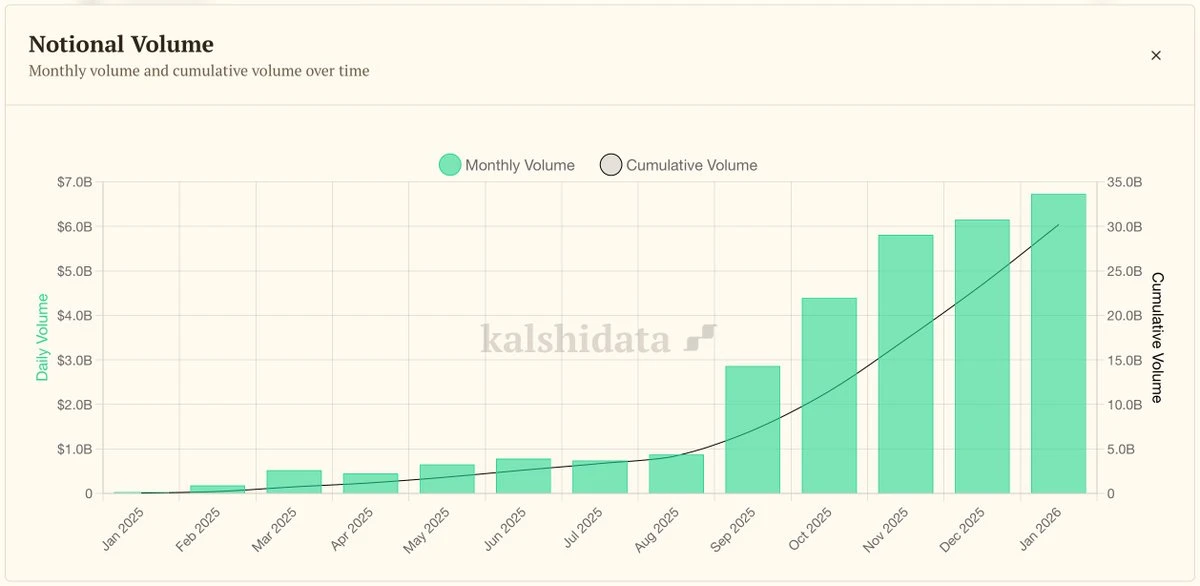
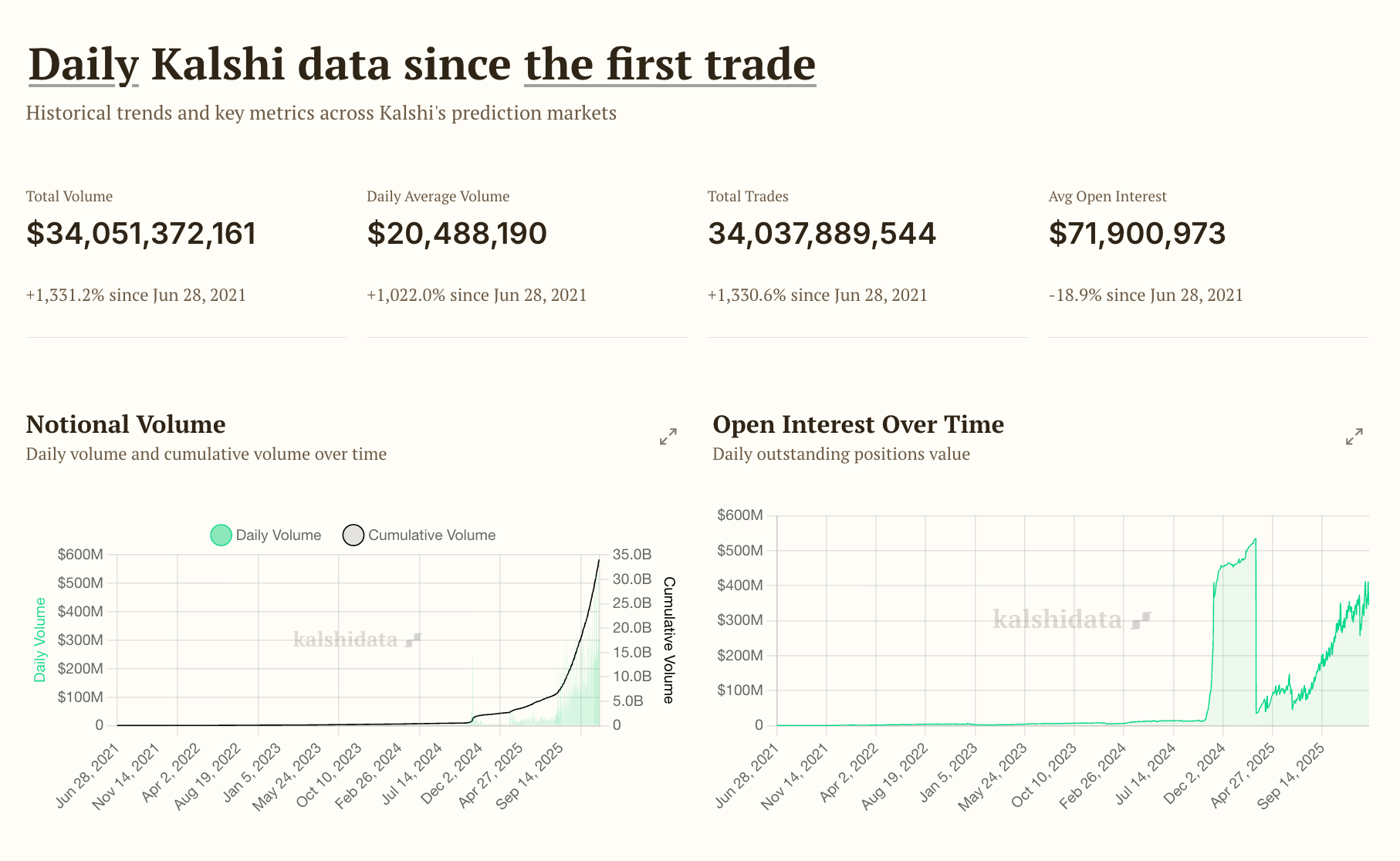
According to data from the KalshiData website, as of January 29, Kalshi's historical total trading volume exceeded $34.05 billion, with a daily average trading volume exceeding $20.48 million; looking at its notional trading volume K-line chart, it has grown almost exponentially since September 2025.
Capital Market Pricing Range: Kalshi Single Share Price is $300-$450

Finally, as the current number one prediction market platform, although Kalshi's specific IPO time and number of shares to be issued are not yet determined,结合 (combined with) its previous financing news and external statements, an IPO is a certainty. Currently, there are many divergences in the pre-market stock pricing between traditional financial markets and cryptocurrency markets:

The pre-market in traditional financial markets prices Kalshi's stock relatively lower——

  • On Nasdaq Private Market, Kalshi's single share is priced around $307;
  • On Hiive, Kalshi's single share is priced around $357.

The pre-market in cryptocurrency markets prices Kalshi's stock relatively higher——

  • On PreStocks, Kalshi's implied market capitalization is approximately $14 billion, with a single share price of approximately $407;
  • On Jarsy, Kalshi's market valuation is $11 billion, with a单独定价 (single price) of $450.

In the next article, Odaily Planet Daily will analyze in detail the price range worth buying for Kalshi's stock pre-market, dissecting the investment opportunities in prediction market stocks from the perspective of the pre-market.


Leituras Relacionadas

Super-Rich Hoarded Record Cash in February, Stock Market Hit New Highs Four Months Later: Who's Getting Fooled?

In February, the total assets in US money market funds reached a record high of approximately $8.25 trillion, a trend highlighted by high-net-worth individuals increasing their cash holdings. Notably, Warren Buffett's Berkshire Hathaway amassed a $381.7 billion cash pile ahead of his 2025 retirement, while other prominent figures like Peter Thiel sold tech stocks, fueling narratives of wealthy investors seeking safety. However, by June, the trend reversed. Money market fund assets fell to around $7.87 trillion, indicating a flow of capital back into equities. Concurrently, the S&P 500 and Nasdaq reached all-time highs, with the S&P 500 surpassing 7600 points. This market surge occurred despite the earlier defensive moves, highlighting a potential opportunity cost for those who retreated to cash. Analysis shows that since early 2022, the S&P 500's total return significantly outpaced that of prime money market funds. The capital shifted from equities appears to have been partly reallocated into alternative investments like real estate, art, and private credit, especially among ultra-high-net-worth individuals. Meanwhile, major investment banks like Goldman Sachs and Morgan Stanley have raised their year-end targets for the S&P 500, citing AI-driven earnings growth, while also cautioning about risks including market concentration and economic fragility beneath the surface rally.

marsbitHá 3m

Super-Rich Hoarded Record Cash in February, Stock Market Hit New Highs Four Months Later: Who's Getting Fooled?

marsbitHá 3m

Robot Vacuums Have Been Competing for 20 Years, So Why Are 90% of Chinese Households Still Hesitant?

The article explores why over 90% of Chinese households are still hesitant to adopt robotic vacuum cleaners despite two decades of industry development, identifying a core "trust gap" as the primary barrier. The central issue is not a lack of need, but user concerns about reliability in dynamic, real-world home environments. Common anxieties include the robot dragging pet waste, colliding with transparent objects, tangling in cords, scattering cat litter, getting stuck on thresholds, missing corners under furniture, and requiring high-maintenance bases that develop odors. The industry's past focus on competing on technical specs (suction power, mopping functions) has not adequately addressed these practical usability and trust problems. The piece then examines DJI's entry into the market with its ROMO 2 model as a potential new approach. Leveraging its expertise in spatial perception and obstacle avoidance from drones, DJI's solution emphasizes "less intervention" through three key principles: less manual re-cleaning, less user rescue missions, and less maintenance. Specific ROMO 2 features highlighted include advanced obstacle recognition (handling transparent objects and small items), adaptive leg mechanisms for climbing thresholds (up to 8.5cm), an extendable arm for reaching under furniture, AI for identifying and appropriately handling different mess types (e.g., avoiding scattering dry debris), and a self-cleaning base designed to minimize user upkeep. The article argues the next phase of competition should shift from a "parameter race" to a "trust race." It draws a parallel to the iPhone's simplification of the smartphone, suggesting that focusing on a reliable, low-hassle user experience—where people feel confident leaving their floors to the machine—is what's needed to finally convince the vast majority of观望ing families. The ultimate test for products like the ROMO 2 will be long-term user adoption, retention, and口碑, not just technical specifications.

marsbitHá 3m

Robot Vacuums Have Been Competing for 20 Years, So Why Are 90% of Chinese Households Still Hesitant?

marsbitHá 3m

The Unclear American Economy: Resilient or Cooling Down?

**U.S. Economic Outlook: Resilient or Cooling Down?** This analysis examines whether the U.S. economy is heading towards a recession. While still growing, the economy shows significant signs of strain. Key data points include Q1 2026 GDP growth of 1.6% and Q1 PCE inflation at 4.5% (annualized), more than double the Fed's target. The labor market remains resilient but is softening, with unemployment at 4.3%. Critical recession indicators present a mixed picture: the yield curve has normalized after a prolonged inversion (historically a late-cycle signal), and the Conference Board's Leading Economic Index has been declining. Current recession probability for 2026 is estimated at 19%, but rises to 41% for 2027, indicating heightened delayed risks. Major pressures are building: a wall of corporate debt refinancing at higher rates, depleted consumer savings, a contracting housing sector, and an energy price shock. The economy exhibits stagflationary characteristics—high inflation alongside slowing growth—which constrains the Federal Reserve's policy options. Historical patterns show recessions are often preceded by Fed tightening and yield curve inversions. If a recession occurs, it is expected to be mild, similar to 2001 rather than 2008. For investors, a defensive portfolio shift toward staples, healthcare, and short-term high-quality bonds may be prudent, while maintaining a long-term, diversified perspective. Key developments to monitor include upcoming GDP, employment, and inflation data, as well as policy signals from the new Fed Chair.

marsbitHá 11m

The Unclear American Economy: Resilient or Cooling Down?

marsbitHá 11m

The Most Advanced Large Models Are Now Subject to Export Controls Like Enriched Uranium

In an unprecedented move mirroring the control of enriched uranium, the US Commerce Department has imposed an export control ban on Anthropic's advanced AI models, Fable 5 and Mythos 5, forcing their global shutdown. This marks the first time a purely digital entity—a set of neural network weights—has been subjected to such hardware-like strategic export restrictions, based not on physical scarcity but on its concentrated "capability density." The article draws a direct parallel to the historical control of nuclear technology, arguing that just as uranium ore becomes a controlled substance only when enriched to a critical threshold, AI capabilities become subject to regulation when compressed into a single, potent, and easily accessible interface. This "enriched AI" is seen as crossing a threshold where its aggregated power poses a potential threat. The author predicts three major consequences over the next decade. First, capability auditing will become institutionalized, with governments setting compliance checklists and thresholds for model power, triggering automatic export controls. Second, jurisdictional boundaries will blur as US export controls extend their reach globally, governing any user of American AI services regardless of location, forcing non-US entities to reconsider their AI supply chain dependencies. Third, a technological bifurcation will occur, splitting the AI landscape into a restricted, high-risk track of advanced US proprietary models and a more reliable track of open-source or locally developed alternatives, where guaranteed access may outweigh raw performance. The core crisis exposed is the lack of a legal property rights framework for AI "intelligence." While companies invest heavily in integrating these models into their production systems, legally they only purchase a service that can be revoked at any time, leaving them with no recourse for their sunk investments. The conclusion warns of a permanently fractured digital world where the most capable models may not be the most usable, and clear, unassailable ownership of technology will become paramount.

marsbitHá 23m

The Most Advanced Large Models Are Now Subject to Export Controls Like Enriched Uranium

marsbitHá 23m

Trading

Spot
Futuros
活动图片



