Kalshi Trading Volume Continues to Break Records, What Is the Reasonable Pre-Market Stock Price?

Odaily星球日报Publicado em 2026-02-11Última atualização em 2026-02-11

Resumo

Amidst a recent market downturn, the prediction market sector has shown remarkable resilience. Kalshi, the largest regulated prediction market platform in the US, reached a record single-month trading volume exceeding $9.5 billion in January, making it the sector leader. This surge has sparked renewed interest in pricing its pre-IPO shares. Significant price discrepancies exist across different pre-IPO trading platforms. On PreStocks, Kalshi shares are priced between $364 and $369. On Jarsy, the price is notably higher at around $504. In contrast, traditional private markets like Nasdaq Private Market and Hiive list shares at approximately $320 and $358, respectively. The analysis suggests a reasonable pre-IPO share price range for Kalshi is between $320 and $423. This is based on its last private funding round valuation of $11 billion and an estimated implied valuation of at least $15 billion, supported by its surging trading volume which now nearly equals the entire prediction market's size from October of the previous year. The article concludes that Jarsy's current price appears high, while PreStocks may present a potential arbitrage opportunity. Furthermore, with 2026 being a major year for global sporting events, Kalshi's annual revenue potential is seen as substantial, potentially exceeding estimates for competitor Polymarket, which could lead to further increases in its pre-IPO valuation.

Original|Odaily Planet Daily(@OdailyChina)

Author|Wenser(@wenser 2010)

During the market downturn, the prediction market has become the most eye-catching track in the crypto market. In early February, when the market plummeted, BTC and ETH once fell by more than 10%, but prediction market trading remained active, with weekly transactions reaching 26.39 million, a record high. At the same time, as the largest compliant prediction market platform in the United States, Kalshi also surged to the top of the track with over $9.5 billion in trading volume in January this year, setting a new historical high for monthly trading volume. Following this, the market has initiated a new round of pricing for Kalshi's pre-market stock price.

The question we are discussing today is—what should the reasonable price range be for the pre-market stock of Kalshi, which is expected to become the "first stock in the prediction market"?

Overview of Current Pricing on Tokenized Stock Trading Platforms: PreStocks, Jarsy

As of the time of writing, there is a significant price difference for Kalshi's pre-market stock on two major tokenized stock trading platforms:

On the PreStocks platform, Kalshi's pre-market stock pricing includes two prices—

One price is the token price under the implied market capitalization (market liquidity pricing level), with a per-share price of approximately $369;

The other price is the marked price under the capital market capitalization (existing financing pricing level), with a per-share price of approximately $364.
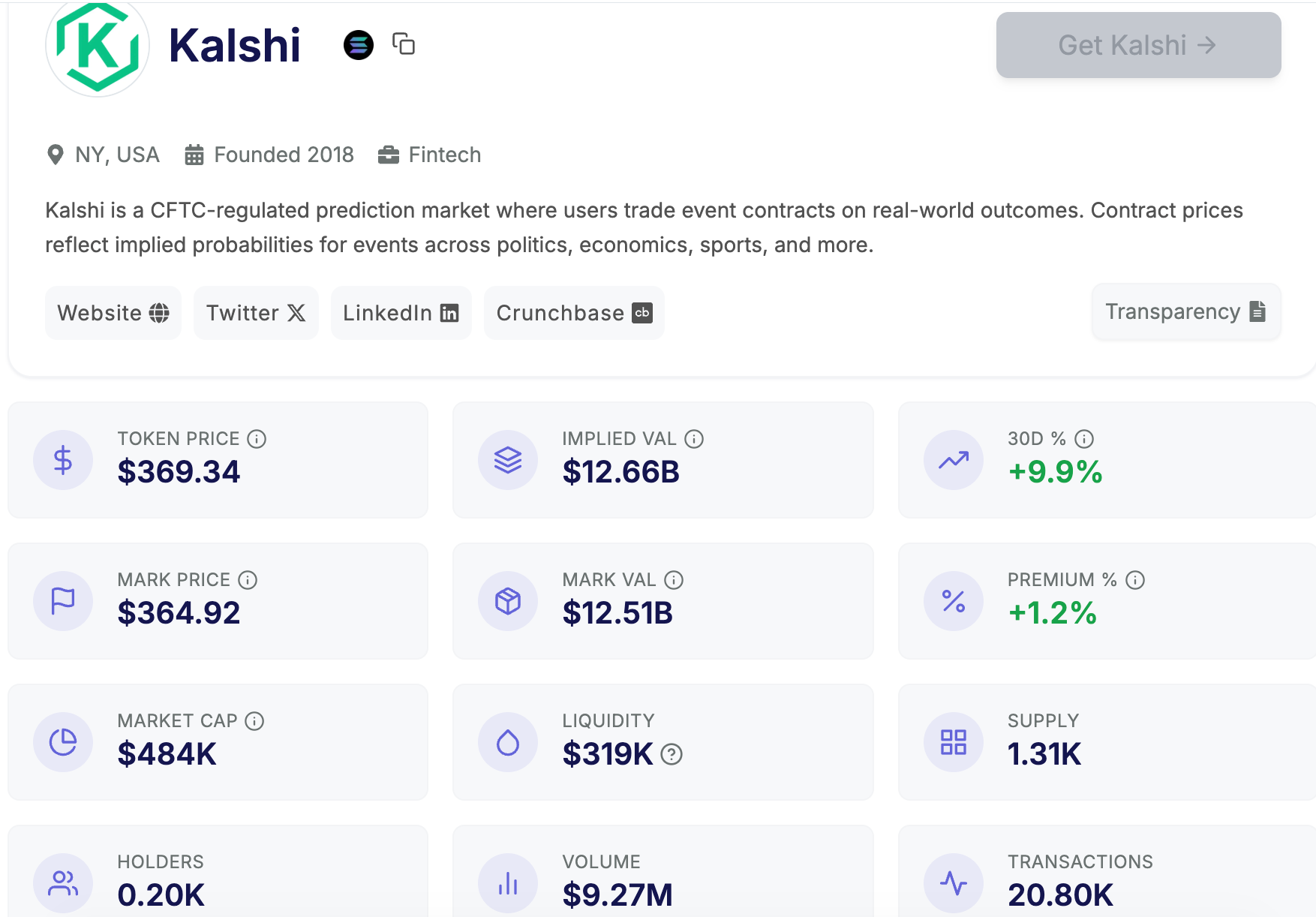
On the Jarsy platform, Kalshi's pre-market per-share price has risen to approximately $504.

It is worth mentioning that compared to the time when we previously wrote the article "Kalshi's Pre-Market Stock Price Soars, Is It Still Worth Buying Now?", the pre-market prices of Kalshi stock on both platforms have experienced varying degrees of increases and decreases. The price situation at that time was as follows:

  • On PreStocks, Kalshi's implied market capitalization was approximately $14 billion, with a per-share price of about $407;
  • On Jarsy, Kalshi's market valuation was $11 billion, with a per-share price of $450.

In other words, the price on the PreStocks platform fell from $407 to approximately $369; the price on the Jarsy platform rose from $450 to approximately $504.

For comparison, the pre-market pricing for Kalshi stock in traditional financial markets has also changed—

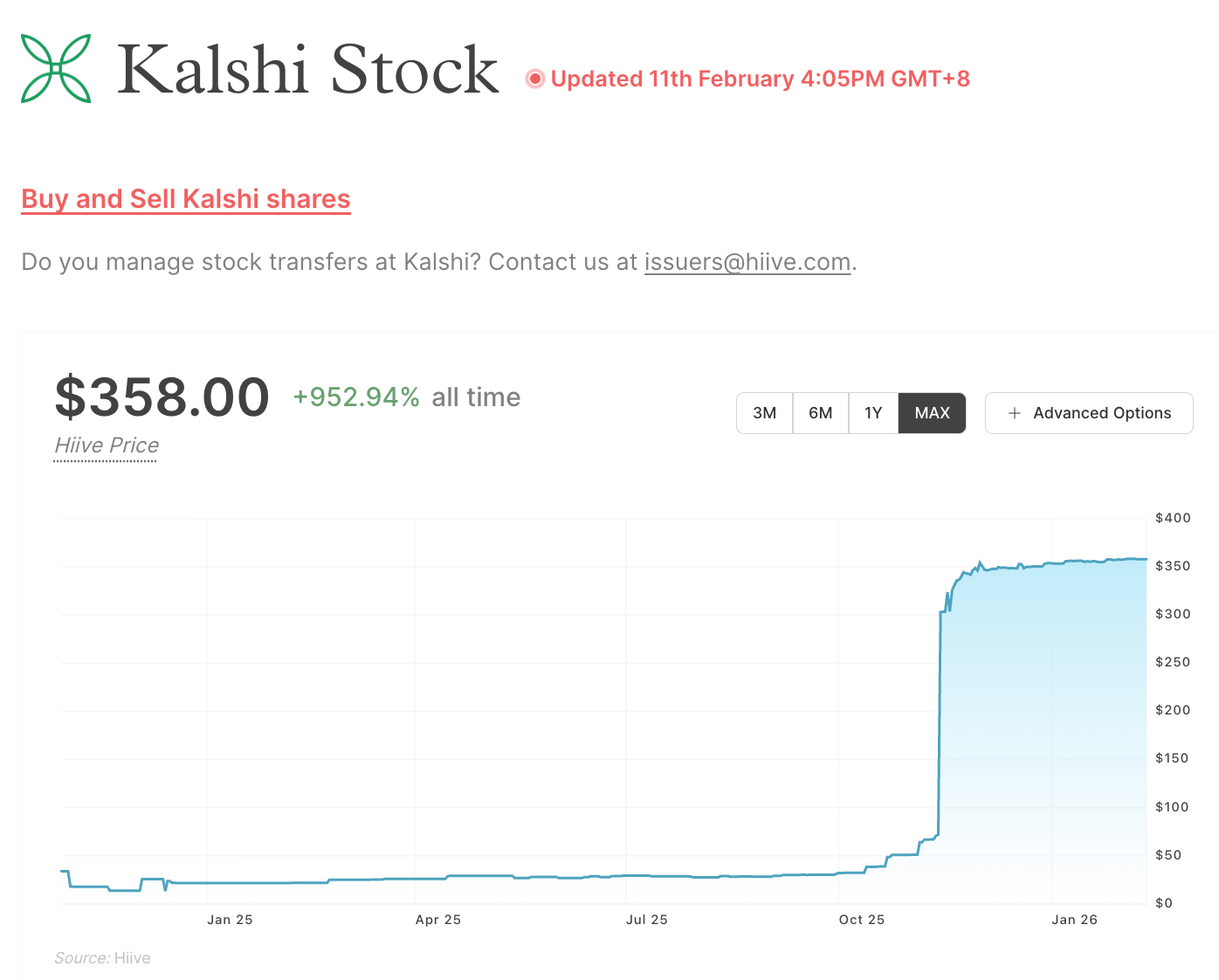
  • On Nasdaq Private Market, Kalshi's per-share price rose from approximately $307 to around $320;
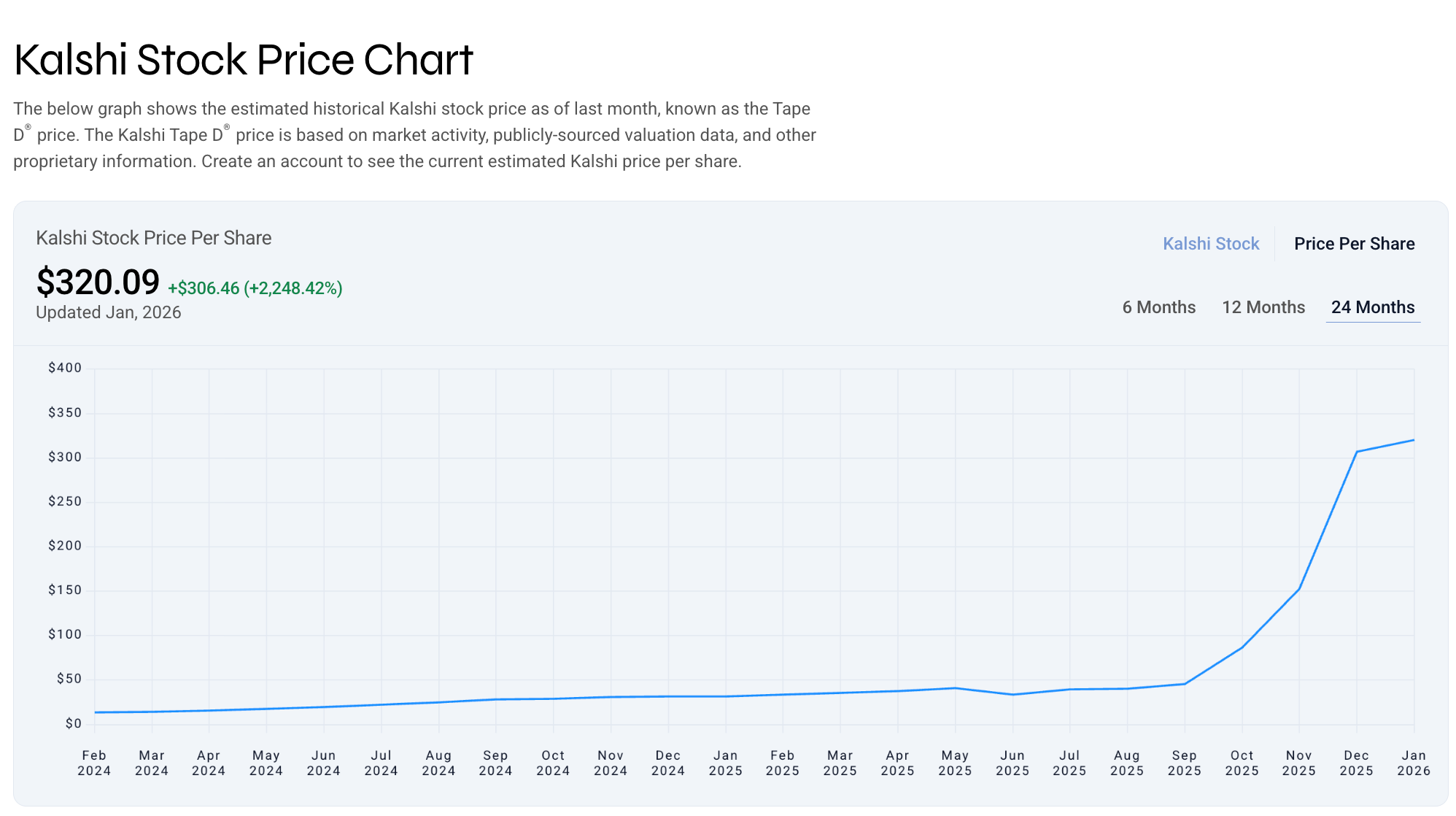
  • On Hiive, Kalshi's per-share price rose by $1 from approximately $357 to around $358.
Reasonable Pre-Market Pricing Range for Kalshi Stock: Approximately $320~$423

Last year, Kalshi completed a $1 billion Series E financing round with a valuation of $11 billion.

Based on the market capitalizations and corresponding stock prices mentioned above, the number of Kalshi shares is approximately between 30.72 million and 34.30 million.

Specifically, the number of shares is calculated as follows—
Based on a $11 billion valuation corresponding to the traditional financial market pre-market prices of $320 and $358, the number of Kalshi shares is approximately 30.72 million to 34.37 million;
Based on the implied market capitalization/token price and capital market capitalization/marked price on the PreStocks platform, the number of Kalshi shares is approximately 34.27 million to 34.30 million;
Based on the pre-market purchase price per share on the Jarsy platform, Kalshi's market capitalization tops out at $18.665 billion, with a per-share price of $604.84, and the number of shares is approximately 30.86 million.

Based on the above information, we can make the following deductions:

First, based on the $11 billion valuation, the reasonable pre-market pricing range for Kalshi stock is approximately $320-$358. In other words, the current pricing on crypto market tokenized stock trading platforms such as PreStocks and Jarsy is relatively high;

Second, Kalshi's trading volume in January reached $9.5 billion, close to the overall prediction market size of approximately $10 billion in October last year; in October last year, its market share was about 50% of the prediction market. From this perspective, Kalshi's current capital market valuation is at least above $15 billion.

Third, based on a $15 billion valuation and combined with data such as the range of the number of Kalshi shares, the pre-market pricing range for Kalshi stock is approximately $436~$488.

Therefore, if the number of Kalshi shares meets expectations, and under the premise of a $15 billion implied market capitalization, conservatively estimated, the reasonable pre-market pricing range for Kalshi stock might be $320~$378 (calculated based on the average of the lowest prices in the pricing range); optimistically estimated, the reasonable pre-market pricing range for Kalshi stock might be $358~$423 (calculated based on the average of the highest prices in the pricing range).

Based on the above data conclusions, the pre-market pricing for Kalshi stock on the Jarsy platform is relatively high, while the PreStocks platform offers some arbitrage opportunities.

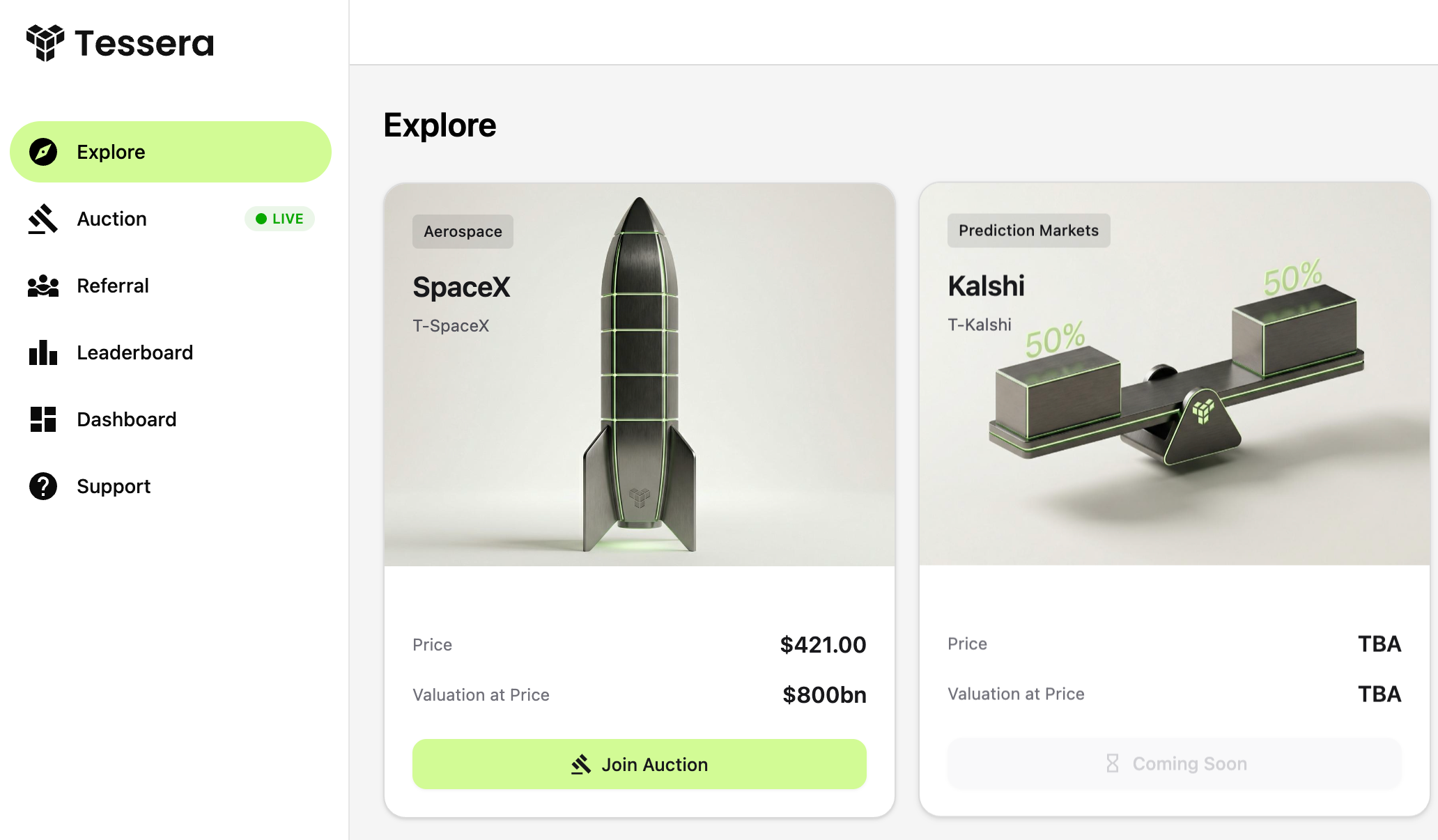
In addition, the latest tokenized stock trading platform, Tessera, plans to open equity public offerings in the future, which readers can also consider as an alternative reference (invitation code can be found here).
Combined with the relevant information mentioned in the previously published article by Odaily Planet Daily, "Data Calculation Shows Polymarket's Annual Revenue Exceeding 100 Million Is Not Difficult, Provided That...":

Based on a static calculation of the trading volume and fee ratio in the "15-minute cryptocurrency rise and fall" market on Polymarket, under the current trading volume level and structure, if Polymarket introduces a similar fee model in all markets, it is expected to bring annual revenue of $418 million to the platform.

As a prediction market platform with larger trading volume and higher fees, and taking advantage of the timing of the major sports year in 2026, Kalshi's annual revenue is expected to exceed this estimated revenue of Polymarket. From this perspective, the capital market may further raise the pre-market pricing of Kalshi stock in the future.


Perguntas relacionadas

QWhat is the current pre-market stock price range for Kalshi on PreStocks and Jarsy platforms?

AOn PreStocks, the pre-market stock price for Kalshi is around $369 (implied market cap) and $364 (capital market cap). On Jarsy, the pre-market price is around $504.

QWhat was the valuation of Kalshi after its Series E funding round last year?

AKalshi completed a $1 billion Series E funding round last year, valuing the company at $11 billion.

QWhat is the estimated reasonable pre-market stock price range for Kalshi based on a $11 billion valuation?

ABased on a $11 billion valuation, the reasonable pre-market stock price range for Kalshi is approximately $320 to $358.

QWhat is the optimistic estimated pre-market stock price range for Kalshi if its implied market cap reaches $15 billion?

AIf Kalshi's implied market cap reaches $15 billion, the optimistic estimated pre-market stock price range is approximately $358 to $423.

QHow does the article suggest Kalshi's future annual revenue might compare to Polymarket's estimated revenue?

AThe article suggests that Kalshi's annual revenue is expected to surpass Polymarket's estimated $418 million, especially with the advantage of the 2026 major sports events year, potentially leading to a higher pre-market stock valuation.

Leituras Relacionadas

Raising Interest Rates Is Not a Tech Killer, EPS Is: A Strategy for Discarding the Weak and Retaining the Strong After the AI Theme's Sharp Decline

**Summary: Rising Interest Rates Are Not the Killer of Tech; EPS Is: The "Keep the Strong, Ditch the Weak" Strategy After the AI Theme Plunge** The author argues that the sharp sell-off in tech and AI-related stocks, triggered by a strong US jobs report that heightened Fed rate hike fears, represents a "pullback to pick up passengers" rather than a "car crash." The true end of a tech bull market is not determined by an extra 25 basis point hike, but by industry overcapacity and the disproval of earnings per share (EPS) expectations. Historical analysis shows that during past rate hike cycles, the Nasdaq-100 often outperformed, provided EPS growth remained strong. The current phase is seen as a shift from a "broad narrative-driven rally" to a "focused verification stage" for AI. The investment strategy should be to "keep the strong, ditch the weak." * **Retain exposure** to high-conviction AI infrastructure leaders with clear order visibility, stable margins, strong cash flow, and upward EPS revisions (e.g., AI servers, advanced packaging, optical modules, key cloud suppliers). * **Reduce exposure** to high-beta, narrative-driven stocks with unclear profit paths (e.g., some quantum computing, space, or speculative chip stocks), especially on rebounds. Valuation concerns should focus on whether earnings can catch up to high multiples, not on high P/E alone. Crowded positioning signals a concentration into quality assets, not necessarily a market top. The upcoming Q2 earnings season will be a key validation point. The core principle is to hold stocks with proven EPS, while using macro events (CPI data, central bank meetings) to manage timing and risk.

marsbitHá 36m

Raising Interest Rates Is Not a Tech Killer, EPS Is: A Strategy for Discarding the Weak and Retaining the Strong After the AI Theme's Sharp Decline

marsbitHá 36m

The Largest IPO in History Ignites Heated Debate: Is SpaceX Worth $1.77 Trillion?

SpaceX's potential IPO is priced at $135 per share, aiming to raise $75 billion and valuing the company at approximately $1.77 trillion, which would make it the largest IPO in history. This valuation has sparked intense debate among investors. Bullish analysts, including major underwriters Goldman Sachs and Morgan Stanley, argue the valuation is justified by SpaceX's long-term potential. They see it not just as a rocket company but as a future leader in space infrastructure, with key growth drivers being Starlink satellite internet, low-cost rocket launches, and future AI-related ventures. They project revenues reaching hundreds of billions to trillions of dollars by 2030-2040. ARK Invest's model suggests a 2030 enterprise value could reach $2.5 trillion. Bearish analysts from independent research firms like Morningstar, PitchBook, and New Constructs contend the IPO price is excessively high, already pricing in unrealistic future growth. Using DCF and sum-of-the-parts models, they estimate fair value between $780 billion and $1.7 trillion, significantly below the IPO target. They highlight risks such as the speculative nature of AI projections, over-dependence on Elon Musk, high growth expectations, and corporate governance concerns. Trefis set a target price of just $79 per share. While both sides acknowledge SpaceX's unique position in commercial space, the core disagreement centers on whether the $135 share price offers a reasonable margin of safety or is overly optimistic. Despite the valuation controversy, reported strong demand for the IPO indicates significant market interest.

marsbitHá 2h

The Largest IPO in History Ignites Heated Debate: Is SpaceX Worth $1.77 Trillion?

marsbitHá 2h

After the Passage of the GENIUS Act and the CLARITY Act, What Is the Correct Architecture for On-Chain Yield?

The article discusses the evolution of on-chain credit, distinguishing three markets: overcollateralized crypto lending, unsecured lending (largely unsuccessful), and asset-backed credit (ABC). ABC, backed by identifiable real-world collateral with legal recourse, is identified as the fastest-growing category and the only one credibly addressing adverse selection—the core problem in credit where the riskiest borrowers self-select. Current growth in on-chain Real World Assets (RWAs), particularly tokenized private credit funds (e.g., Maple Finance, Centrifuge), is substantial but often merely "wraps" existing fund structures, inheriting their risks rather than solving adverse selection at the protocol level. The regulatory landscape is a key driver, with the US GENIUS Act (prohibiting stablecoin issuers from paying yield) and the proposed CLARITY Act (closing loopholes on indirect yield) set to redefine permissible yield-bearing products. This makes vaults (like ERC-4626) the critical architecture—they become the primary compliant vehicle for delivering yield, functioning as issuance, disclosure, distribution, and recovery mechanisms. The author's thesis is that the correct post-GENIUS/CLARITY architecture involves building ABC solutions where credit assessment, structure, and recovery are encoded directly into the smart contract vault layer, moving beyond mere tokenized fund wrappers to solve adverse selection fundamentally and ensure regulatory compliance.

Foresight NewsHá 3h

After the Passage of the GENIUS Act and the CLARITY Act, What Is the Correct Architecture for On-Chain Yield?

Foresight NewsHá 3h

Trading

Spot
Futuros
活动图片




