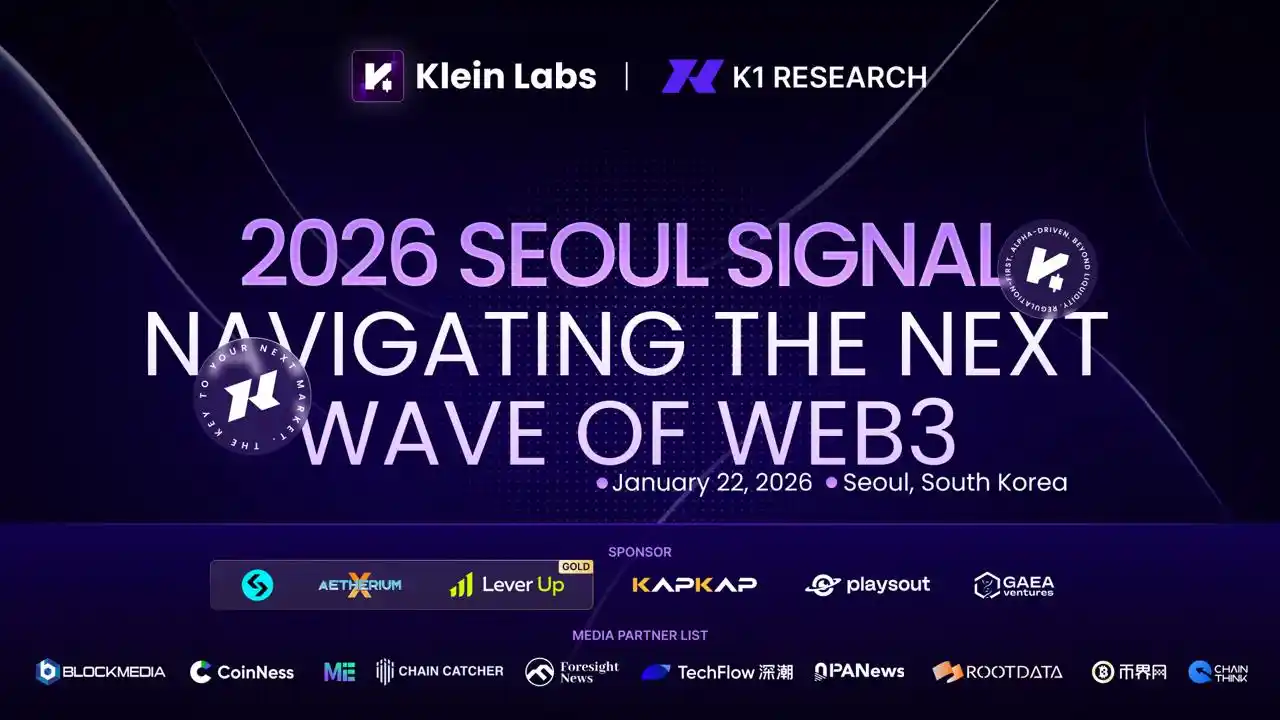
K1 Research and Klein Labs Co-host "2026 Seoul Signal", Foreseeing the Next Wave of Web3

marsbitPublicado em 2026-01-12Última atualização em 2026-01-12

Resumo

K1 Research, an Asia-Pacific market expansion consultancy, and Klein Labs, a strategic market maker and Web3 venture incubator, will co-host "2026 Seoul Signal: Insights into the Next Wave of Web3" on January 22 in Seoul at People the Terrace. Leveraging K1 Research's global network across Seoul, Hong Kong, Singapore, and Dubai, along with Klein Labs' expertise in liquidity design and market structure, the event aims to provide forward-looking strategic insights for the Web3 industry in 2026. It will bring together builders, creators, and traders to discuss survival strategies and long-term growth paths for the upcoming cycle. The forum is supported by three major gold sponsors: - BGB: The official platform token of Bitget Exchange, serving as a core asset within its ecosystem. - LeverUp: A perpetual contracts DEX on Monad, offering up to 1001x leverage and a fee-sharing mechanism. - AetheriumX: A Web3 ecosystem integrating staking, gaming, and a creator marketplace. Additional partners include Gaea Ventures, PlaysOut, and KapKap, all contributing to Web3 ecosystem collaboration. The organizers emphasize the event's goal to offer clear directional insights for key Web3 participants, combining practical market experience with systematic research to position Seoul as a global hub for Web3 innovation. Post-event, K1 Research and Klein Labs plan to deepen cooperation to accelerate the discovery and implementation of high-quality global projects. The event is ...

Asia-Pacific market expansion consulting firm K1 Research, in partnership with strategic market maker and Web3 startup incubator Klein Labs, will co-host "2026 Seoul Signal: Insights into the Next Wave of Web3" on January 22 at People the Terrace in Seoul.

This event leverages K1 Research's global research and industry network in Seoul, Hong Kong, Singapore, and Dubai, combined with Klein Labs' practical experience in liquidity design and market structure, aiming to provide forward-looking strategic references for the development of the Web3 industry in 2026. The forum will bring together Builders, Creators, and Traders for in-depth discussions on survival strategies and long-term growth paths for the next cycle.

The conference is supported by three heavyweight gold sponsors:

BGB — The official platform token of the Bitget exchange, serving as the core asset within the Bitget ecosystem, primarily used for trading, community, and platform benefits.

LeverUp — A perpetual contracts DEX based on Monad, offering up to 1001x leverage and a fee-sharing mechanism.

AetheriumX — A Web3 ecosystem integrating staking, gaming, and a creator marketplace.

Additionally, partners such as Gaea Ventures, PlaysOut, and KapKap will also participate, collectively promoting synergy within the Web3 ecosystem.

The organizers stated:

"'2026 Seoul Signal' aims to provide clear directional insights for core participants in Web3. By combining frontline market execution experience with systematic research, we look forward to further establishing Seoul as a key hub for global Web3 innovation." After the event, K1 Research and Klein Labs will continue to deepen their collaboration, accelerating the discovery and implementation of high-quality global projects and providing long-term support for ecosystem development.

Pre-registration for this event is now open. Interested participants are welcome to apply via the link below.

- Time: January 22, 2026 (18:30 ~ 23:00, Korea Time)

- Location: People the Terrace, 13 Dosandaero 81-gil, Gangnam-gu, Seoul, Korea (Cheongdam-dong)(Address Detail)

- Registration:Link

Perguntas relacionadas

QWhat is the name of the event co-hosted by K1 Research and Klein Labs, and what is its main focus?

AThe event is called '2026 Seoul Signal: Insight into the Next Wave of Web3'. Its main focus is to provide forward-looking strategic references for the development of the Web3 industry in 2026, bringing together builders, creators, and traders to discuss survival strategies and long-term growth paths for the next cycle.

QWhich three gold sponsors are supporting the '2026 Seoul Signal' event?

AThe three gold sponsors are BGB (Bitget's official platform token), LeverUp (a perpetual contract DEX on Monad offering up to 1001x leverage), and AetheriumX (a Web3 ecosystem integrating staking, gaming, and a creator market).

QWhat are the roles of the two co-hosting organizations, K1 Research and Klein Labs?

AK1 Research is an Asia-Pacific market expansion consulting firm with a global research and industry network. Klein Labs is a strategic market maker and Web3 startup incubator with practical experience in liquidity design and market structure.

QWhen and where will the '2026 Seoul Signal' event take place?

AThe event will take place on January 22, 2026, from 18:30 to 23:00 (KST) at People the Terrace, located at 13 Dosandaero 81-gil, Gangnam-gu, Seoul, South Korea (Cheongdam-dong).

QWhat is the stated long-term goal of K1 Research and Klein Labs after the event concludes?

AAfter the event, K1 Research and Klein Labs plan to deepen their cooperation to accelerate the discovery and implementation of high-quality global projects and provide long-term support for ecosystem development.

Leituras Relacionadas

The Era Has Arrived Where Human Writers Must Prove They Are Not Machines

The article describes an era where AI-generated content is flooding the market, forcing human authors to prove they are not machines. It begins with the example of dozens of AI-written, error-ridden biographies of Henry Kissinger appearing on Amazon within hours of his death, a pattern repeated for other deceased celebrities and even living experts who find fraudulent books under their names. This spam content has exploded, with monthly new book releases on platforms like Amazon reaching 300,000 by late 2025. The issue spans genres, from suspiciously high proportions of AI-written teen romance and self-help books to dangerous, AI-generated foraging guides containing lethal advice. The platforms' automated review systems, designed to catch plagiarism and banned words, are ill-equipped to detect AI-generated text that avoids these pitfalls while being nonsensical or fraudulent. The problem has infiltrated traditional publishing. A major publisher, Hachette, had to recall a bestselling horror novel after AI detection tools suggested 78% of its content was machine-generated. An acclaimed European philosophy book was later revealed to be entirely written by AI under a fake author persona. In response, authors are fighting back. At the 2026 London Book Fair, 10,000 writers published a blank book titled "Don't Steal This Book" containing only their signatures—using emptiness as a protest weapon in an age of AI overproduction. Initiatives like the "Human Author Certification" program have emerged, ironically placing the burden on humans to prove their work is not machine-made. The article warns of a vicious cycle: AI-generated low-quality books pollute the data used to train future AI models, leading to "model collapse" and an ever-worsening flood of digital waste, eroding trust in publishing and devaluing human creativity.

marsbitHá 12m

The Era Has Arrived Where Human Writers Must Prove They Are Not Machines

marsbitHá 12m

The King of Blind Date Attire in Korea: How SK Hynix Made a Comeback Against Samsung?

In South Korea's dating scene, SK Hynix employees are now highly sought after, a status shift fueled by the company's astronomical profits and employee bonuses, projected to reach up to 6.1 million RMB per person by 2027. This marks a dramatic reversal for the long-time second-place player in memory semiconductors, which has now surpassed its rival Samsung in annual operating profit. The turnaround story began in 2008 when a struggling Hynix, emerging from bankruptcy restructuring, took a risky bet by agreeing to develop High Bandwidth Memory (HBM) with AMD. At the time, HBM had no clear market beyond high-end graphics cards and was a costly, complex technology. Major players like Samsung, pursuing its own HMC technology, declined. For Hynix, with only memory as its core business, it was a gamble born of necessity. The pivotal moment came in 2012 when SK Group Chairman Chey Tae-won acquired Hynix. Defying industry downturns, he invested heavily in R&D and fabrication, sustaining the HBM project through over a decade of commercial uncertainty and internal challenges. A key break occurred around 2016-2017 when Samsung faced production issues supplying HBM2 for Google's TPU, allowing SK Hynix to gain a crucial foothold in the data center market. The AI explosion post-ChatGPT in 2022 was the catalyst, turning HBM into a critical bottleneck for AI accelerators like NVIDIA's GPUs. By 2025, SK Hynix captured 62% of the global HBM market, leaving Samsung at 17%. For the first time, its annual operating profit exceeded Samsung's. Analysts point to the "innovator's dilemma" to explain Samsung's miss: its vast, successful business portfolio made it risk-averse, preventing an all-in bet on the initially niche HBM technology. In contrast, SK Hynix, as a challenger with its back against the wall, had no choice but to commit fully. The story highlights how Korea's chaebol system allows for ultra-long-term bets beyond quarterly pressures. However, SK Hynix's lead isn't guaranteed. Samsung is aggressively catching up on HBM4, and challenges like customer concentration (heavy reliance on NVIDIA) and technical hurdles in advanced packaging remain. The narrative underscores a market truth: the greatest alpha often comes from betting on uncertain, long-term directions others dismiss, much like HBM in 2008.

marsbitHá 52m

The King of Blind Date Attire in Korea: How SK Hynix Made a Comeback Against Samsung?

marsbitHá 52m

Trading

Spot
Futuros
活动图片





