‘Just the beginning’: Paul Atkins signals SEC’s new crypto rule changes

ambcryptoPublicado em 2026-03-20Última atualização em 2026-03-20

Resumo

SEC Chair Paul Atkins announced the agency will soon issue formal proposed rules to codify its recent interpretive guidance, which classifies most crypto assets as non-securities and categorizes them into five groups: digital commodities, collectibles, tools, stablecoins, and securities. The SEC also plans to create a regulatory sandbox for experimentation. Atkins noted that while this is a significant step, courts could still deviate from the SEC’s interpretation. He described the move as a "bridge" as Congress progresses on the CLARITY Act. Senator Cynthia Lummis reported that stablecoin yield issues are "99% resolved" in the bill negotiations. Market optimism for the bill has improved slightly despite earlier setbacks.

Paul Atkins, the chairman of the U.S. Securities and Exchange Commission (SEC), has said the agency will soon issue formally proposed rules for the recent crypto asset classification guidance.

In the latest interpretive guidance, the SEC designated most crypto assets as non-securities. Additionally, the framework classified digital assets into five categories, including digital commodities, collectibles, tools, stablecoins, and securities. It also explained how they fit into the current U.S. law.

To codify the framework, Atkins said the agency will formalize it alongside creating a sandbox for experimenting with different crypto products. But he warned the court could still ‘deviate’ from its interpretation.

This is just an interpretation, and the courts can deviate from that if they don’t like our rationale.

He added,

We’ll shortly follow up with a proposed rule to put much more of this framework into effect. And construct a series of exemptions, equivalent of sandbox for people to experiment and develop proof-of-concept for their products.

SEC’s plans and CLARITY Act progress

For Atkins, SEC’s interpretation of crypto laws is ‘just a beginning,’ and the move would be a ‘bridge’ as the Congress works its way through the CLARITY Act. In fact, most of the guidance issued in the past few days and months covers key topics being discussed in the CLARITY Act. For others, the SEC’s proposed rulemaking on key issues would be sufficient for the market, even if the CLARITY Act’s momentum stalls.

That said, the stablecoin yield issue has been the key deal breaker dragging the crypto bill.

Even so, after the recent Senate Republican meeting on the bill, Senator Cynthia Lummis was ‘positive,’ terming it ‘productive,’ and added,

We’re 99% of the way there on stablecoin yield, and negotiations on the digital asset portions of the bill are in a good place.
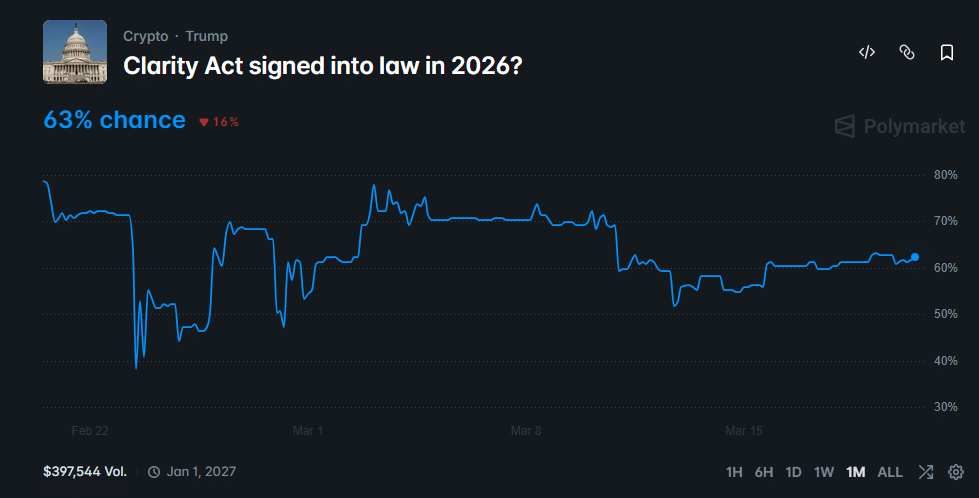
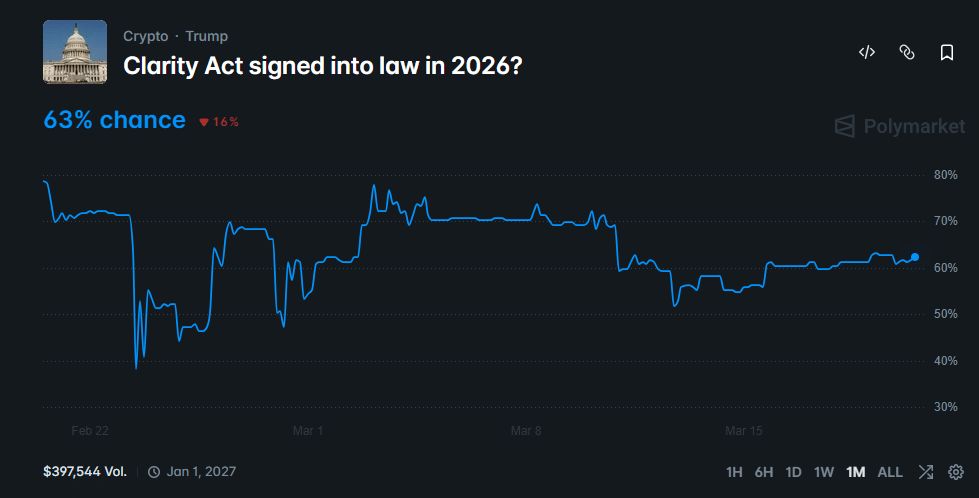
Source: Polymarket

As expected, market optimism on the bill’s passage improved slightly following the recent meetings and updates.

In early March, the chance of the CLARITY Act becoming law dropped to nearly 50% as the White House and the banking industry hit a snag over stablecoin yields.

Whatever the outcome, however, the crypto industry may still be in a better position for clear rules for the road if the SEC continues to issue and codify them.


Final Summary

  • SEC Chair reiterated plans to formalize rulemaking for its recent interpretive guidance on crypto asset classification and how current U.S. law applies to them.
  • According to Senator Lummis, the stablecoin yield issue was ‘99% resolved’ in CLARITY Act talks.

Perguntas relacionadas

QWhat did SEC Chairman Paul Atkins announce regarding crypto asset classification?

APaul Atkins announced that the SEC will soon issue formally proposed rules to codify its recent interpretive guidance on crypto asset classification, which designates most crypto assets as non-securities and categorizes them into five groups.

QHow did the SEC classify digital assets in its latest guidance?

AThe SEC classified digital assets into five categories: digital commodities, collectibles, tools, stablecoins, and securities, explaining how they fit under current U.S. law.

QWhat did Paul Atkins say about the role of courts in relation to the SEC's interpretation?

AAtkins warned that courts could deviate from the SEC's interpretation if they disagree with the rationale, emphasizing that the guidance is just an interpretation.

QWhat is the CLARITY Act, and how does it relate to the SEC's actions?

AThe CLARITY Act is a congressional bill addressing crypto regulation. The SEC's interpretive guidance covers key topics in the bill and is seen as a 'bridge' while Congress works on the legislation.

QAccording to Senator Cynthia Lummis, what progress has been made on the stablecoin yield issue in the CLARITY Act negotiations?

ASenator Lummis stated that the stablecoin yield issue is '99% resolved' and that negotiations on the digital asset portions of the bill are in a good place.

Leituras Relacionadas

Bitcoin Withdrawals Continue: 8 Years of Storage in a Coldcard Cold Wallet Ended in Zero

Coldcard Hardware Wallet Hacked: Losses Mount Due to Vulnerable Seed Generation A critical vulnerability in Coldcard hardware wallets has led to a continued wave of fund thefts. According to Galaxy Research, the total stolen has reached 1,367.05 BTC (approx. $88.6 million) from 4,585 addresses, a significant increase from the initial 594.5 BTC reported on July 30, 2026. Most of the stolen funds remain on the attackers' addresses. The issue is not with the current firmware, which Coinkite has updated, but with seed phrases generated on vulnerable devices between March 2021 and the release of fixed firmware versions. Due to a programmer error, devices switched from using a hardware random number generator to the software-based Yasmarang generator, which was initialized with publicly accessible data like the chip's serial number. This made the seed phrases predictable through offline brute-force attacks, meaning wallets remain at risk until funds are moved to a new wallet generated with the patched firmware. Affected devices include Mk2/Mk3 with firmware 4.0.1–4.1.9 (and up to 5.0.3), Mk4/Mk5 up to version 5.6.0, and Q models up to 1.5.0Q. The only exceptions are seeds created with a high-entropy method like at least 50 independent dice rolls or a strong unique BIP-39 passphrase. All other owners must generate a new seed on the fixed firmware and transfer their assets. A case highlighting the human impact involves a 39-year-old long-term investor who lost 2 BTC (approx. $130,000) in minutes. He had accumulated the Bitcoin over eight years through physical labor, viewing it as a financial lifeline and a retirement plan in a country suffering from hyperinflation. His story underscores that even conservative "buy and hold in cold storage" strategies can be compromised by such underlying technical flaws. From a technical perspective, this incident echoes historical failures where weak random number generators undermined cryptographic security, challenging the assumption that offline storage is automatically foolproof.

cryptonews.ruHá 4m

Bitcoin Withdrawals Continue: 8 Years of Storage in a Coldcard Cold Wallet Ended in Zero

cryptonews.ruHá 4m

Why Bitcoin Holds Above $64,000 After Fed's Hard Pause

**Bitcoin Stabilizes Near $64,000 Following Hawkish Fed Pause** The cryptocurrency market, led by Bitcoin, remained stable around $64,000 despite a volatile reaction to the latest U.S. Federal Reserve meeting. The Fed paused interest rates but signaled a hawkish stance, with three committee members voting for an increase—the highest dissent since 2016. This limits risk appetite but hasn't triggered panic selling. Key market highlights include Bitcoin ETFs seeing a net inflow of $32.1 million, breaking a streak of outflows, while Ethereum ETFs experienced outflows of $18.65 million. Liquidations affected about 90,000 traders. Technically, Bitcoin finds support around $63,000-$63,500, with major resistance near $66,000. While its price is about 49% below its all-time high, institutional demand via ETFs and the absence of mass capitulation support a potential recovery scenario in the second half of the year. Major altcoins showed mixed movements, with Solana attracting capital while Ethereum faced selling pressure despite strong on-chain metrics like a growing staking queue. Regulatory news took a pause as the U.S. Senate delayed the CLARITY Act vote until at least autumn. For the final trading day of July, U.S. inflation and consumer spending data will be crucial. Bitcoin's key levels to watch are $63,000 support and $66,000 resistance. Sustained ETF inflows and Bitcoin holding above $63,000 are seen as positive signs for a potential market recovery later in the year.

cryptonews.ruHá 3h

Why Bitcoin Holds Above $64,000 After Fed's Hard Pause

cryptonews.ruHá 3h

Trading

Spot
活动图片





