July Trading Platform Rankings: Spot Market Falls 35%, Derivatives Trading Remains Resilient

marsbitPublicado em 2026-08-10Última atualização em 2026-08-10

Resumo

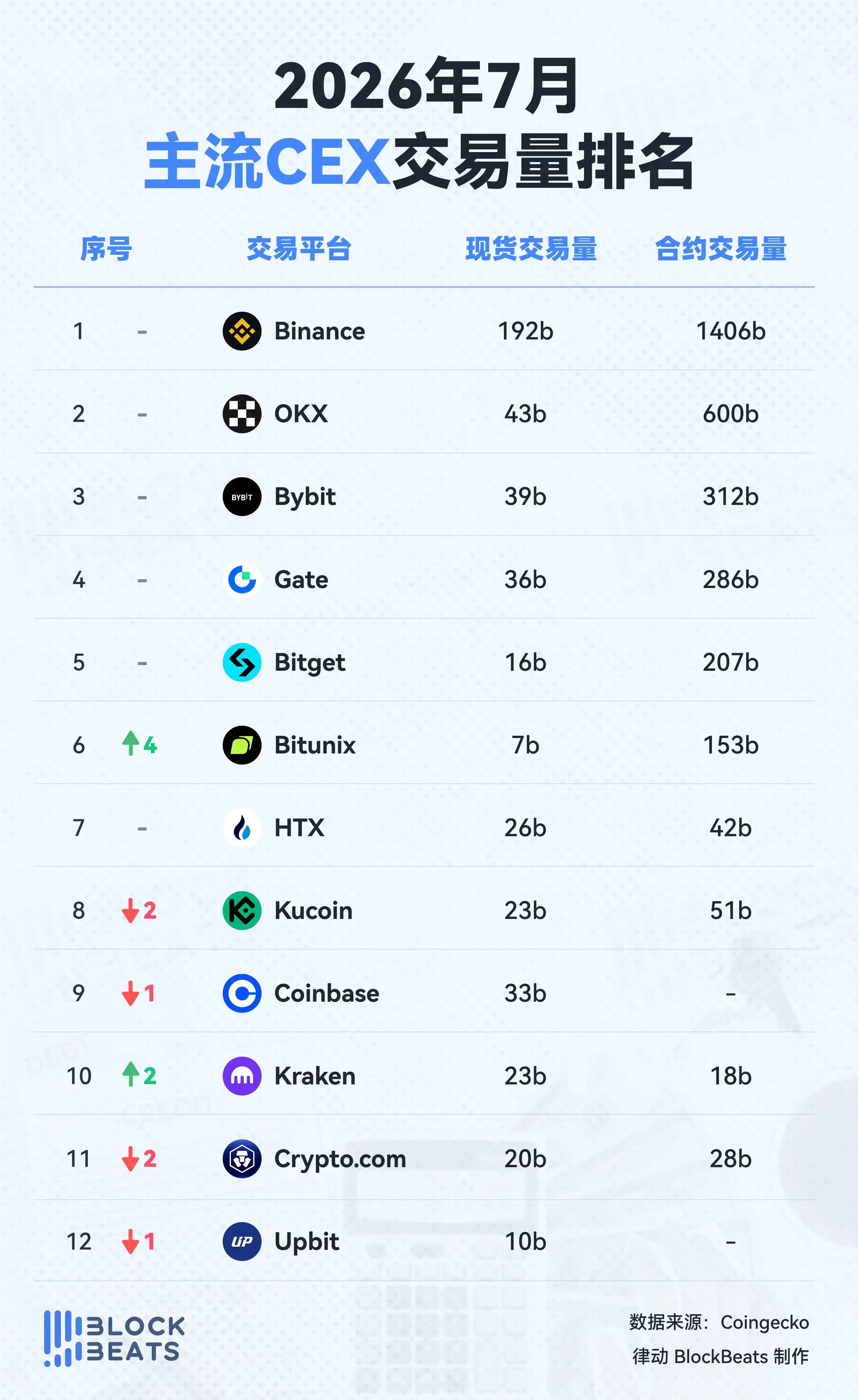
In July 2026, trading volume on mainstream Centralized Exchanges (CEX) showed a significant decline, with spot trading dropping 35.51% compared to June, while perpetual contract trading fell by a lesser 19.59%. This indicates that leveraged trading demand remained relatively more resilient despite an overall market cooldown. Interestingly, CEX website traffic increased by 3.00%, yet app downloads decreased by 2.09%, suggesting that increased user reach did not translate into higher trading activity, with market观望情绪 (wait-and-see sentiment) still dominant. The decentralized exchange (DEX) sector also experienced declines. Perpetual contract volume on mainstream Perp DEX platforms decreased by 26.88%, accompanied by a 10.57% drop in website traffic. A note accompanying the data cautions that部分数据可能存在严重的刷量 / 机器人嫌疑 (some data may be heavily suspected of wash trading/bot activity). Data sources include Coingecko for spot and derivatives, Similarweb for traffic, and点点平台 for download metrics.

In July 2026, the spot trading volume on mainstream CEXs decreased by 35.51% compared to June 2026, while the perpetual contract trading volume decreased by 19.59% compared to June 2026. The decline in spot trading was significantly greater than in derivatives, indicating the overall market is cooling down once again. However, the demand for leveraged trading showed relatively more resilience.
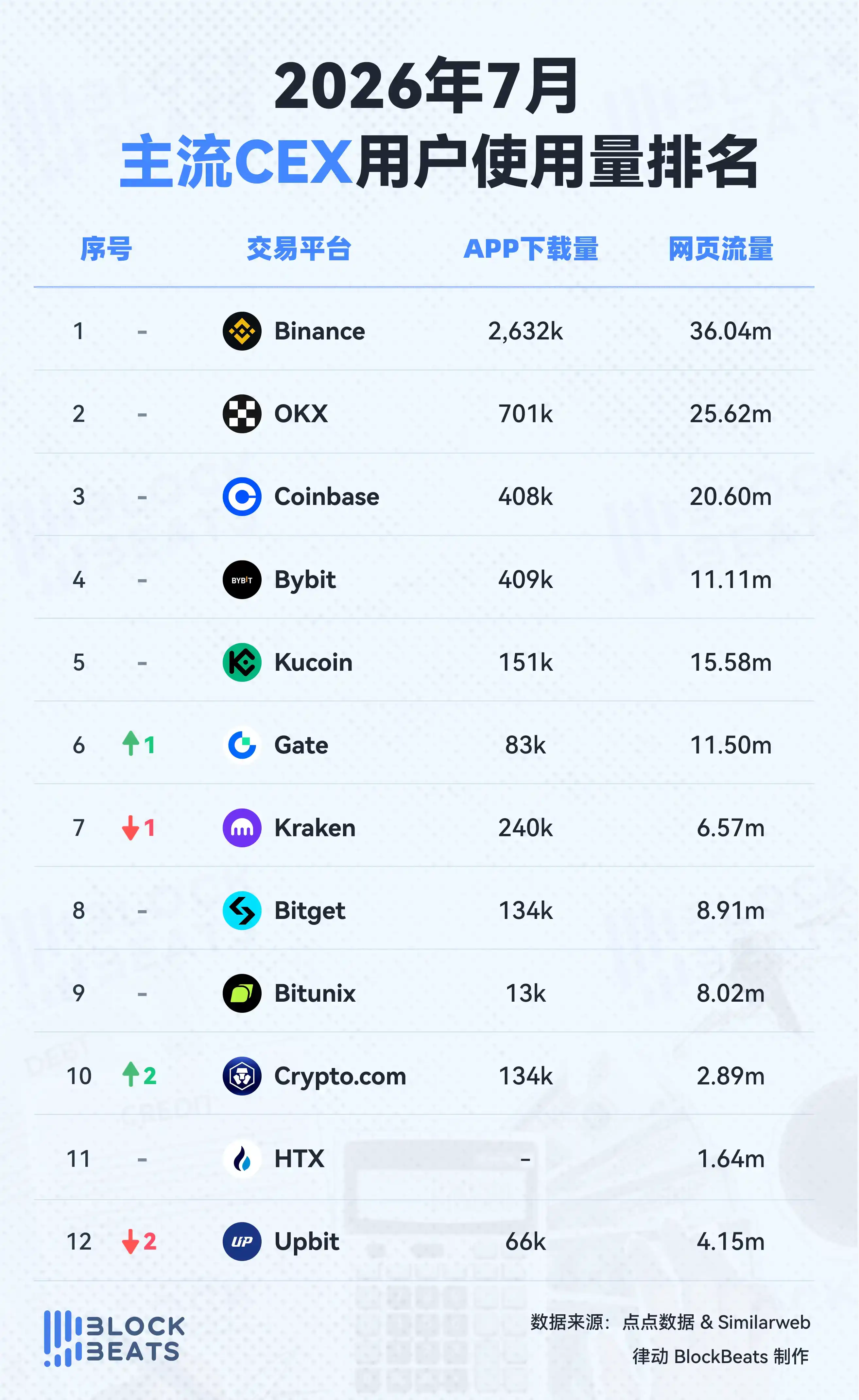
In July, website page views for mainstream CEXs increased by 3.00% compared to June 2026, while app downloads decreased by 2.09%. This user reach did not translate into trading activity, suggesting a dominant sentiment of market watchfulness remains.
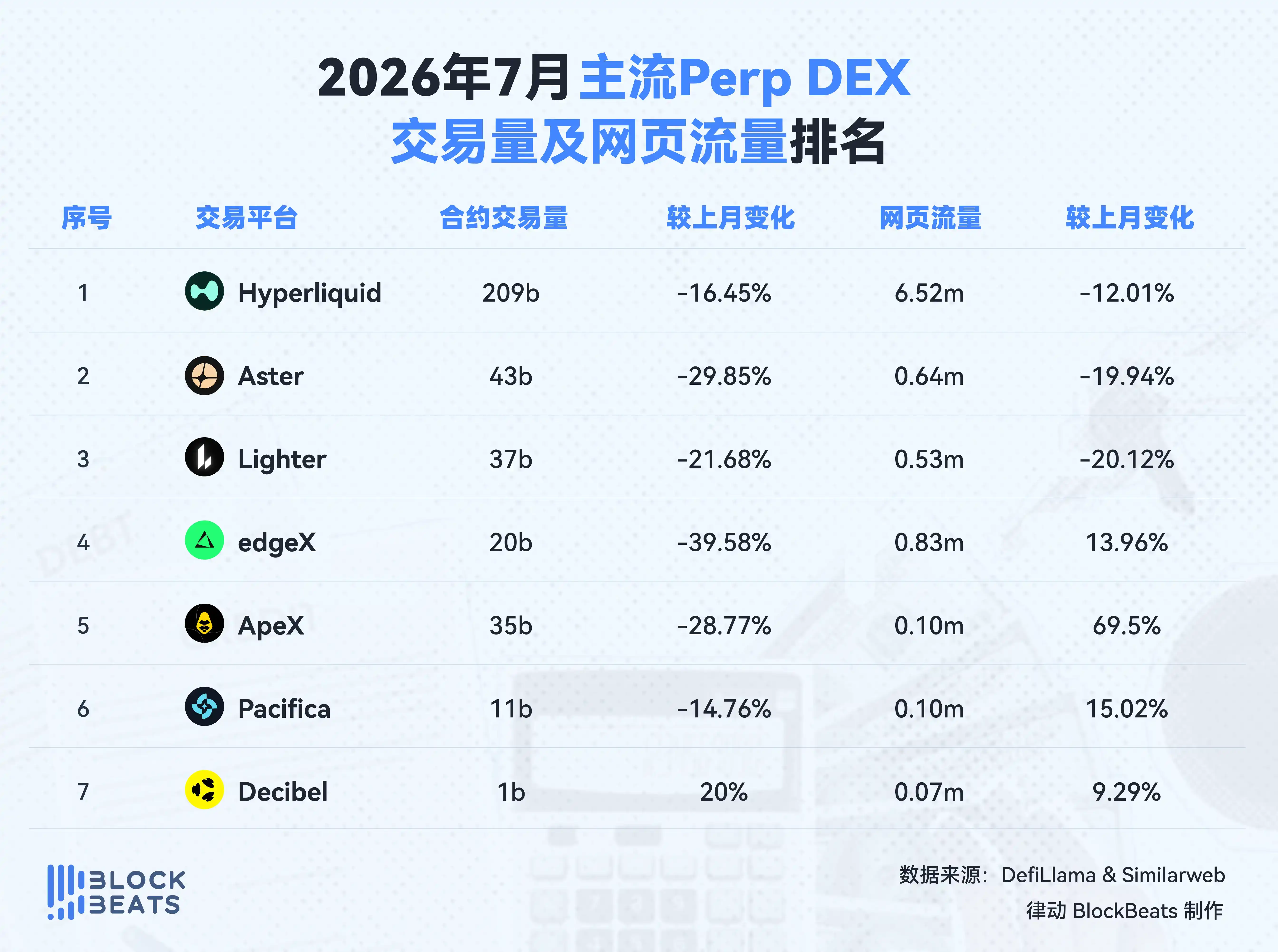
In July, the perpetual contract trading volume on mainstream Perpetual DEXs decreased by 26.88% compared to June 2026, and website page views decreased by 10.57%.
Note: Some data may be heavily influenced by suspected wash trading/bot activity. Spot and derivatives data source: Coingecko; Traffic data source: Similarweb; Download data source: Diandian Platform.


Perguntas relacionadas

QAccording to the article, what were the key percentage changes in spot and perpetual contract trading volumes on mainstream CEXs from June to July 2026?

AFrom June to July 2026, spot trading volume on mainstream CEXs decreased by 35.51%, while perpetual contract trading volume decreased by 19.59%.

QWhat does the article suggest about the relative resilience of different types of crypto trading in July 2026?

AThe article suggests that while the overall market cooled down, leverage trading demand (perpetual contracts) showed relatively more resilience, as its decline was significantly smaller than the decline in spot trading volume.

QHow did website traffic and app download trends for mainstream CEXs in July 2026 contrast with the trading activity trends?

AWebsite traffic for mainstream CEXs increased by 3.00% in July, while app downloads decreased by 2.09%. This indicates user reach did not translate into trading activity, suggesting dominant market观望情绪 (watch-and-see sentiment).

QWhat was the reported change in trading volume and website traffic for mainstream Perpetual DEXs (Perp DEXs) in July 2026?

AFor mainstream Perp DEXs in July 2026, perpetual contract trading volume decreased by 26.88%, and website traffic decreased by 10.57%.

QWhat cautionary note does the article provide regarding the data presented?

AThe article notes that some of the data may be subject to significant刷量 / 机器人嫌疑 (volume inflation/bot activity suspicion).

Leituras Relacionadas

Billions in USDT Flee Korea. Police Powerless in the Fight Against Money Laundering

South Korea is facing a severe and rapidly escalating challenge with crypto-based money laundering. Police data shows cases surged 152-fold in the first half of 2026 compared to all of 2025, with laundering now constituting 79.4% of all detected crypto-related crimes. The primary method is the "Hwanchigi" scheme, which uses cryptocurrency transfers to move illicit funds overseas, bypassing the regulated banking system. Tether (USDT) is the preferred vehicle for converting proceeds from drug trafficking, illegal gambling, and phishing into dollars before moving them to offshore exchanges. Despite enhanced monitoring and enforcement efforts, a stark gap exists between detection and prosecution. While authorities tracked and blocked millions in illegal assets in high-profile cases, arrests have lagged dramatically. In the first half of 2026, only 18 arrests were made despite over 1,200 detected cases. Customs seized approximately $4.92 billion in illegal foreign exchange operations, with over 90% of crypto-related crimes for prosecution flowing through unlicensed channels. The situation highlights a systemic disconnect: blockchain analytics can track transactions nearly in real-time, but the judicial process moves slowly. This asymmetry raises questions about whether detection statistics alone are a meaningful measure of effectiveness in combating money laundering, as the low cost and high speed of these schemes allow criminal networks to scale faster than law enforcement can respond.

cryptonews.ruHá 6m

Billions in USDT Flee Korea. Police Powerless in the Fight Against Money Laundering

cryptonews.ruHá 6m

The $6.4 Billion CRO Accumulation Plan of Trump Media Group Falls Apart

A $6.4 billion plan to create a publicly-listed CRO treasury company, announced a year ago by Trump Media & Technology Group (DJT), Crypto.com, and SPAC Yorkville, has been terminated. The ambitious deal, which aimed to accumulate approximately 6.3 billion CRO tokens (nearly 20% of supply at the time), never progressed beyond a framework agreement. Related plans for a prediction market integrated into Truth Social and ETF custody services by Crypto.com were also shelved, scaled back to a simple marketing partnership. The collaboration followed significant political alignment, with Crypto.com donating to Trump's inauguration and a pro-Trump super PAC, and its CEO meeting with Trump. The SEC also closed an investigation into the exchange shortly before the deal was announced, raising conflict-of-interest concerns. Officially, the termination was attributed to an unfavorable market environment. CRO's price has fallen roughly 70% since the announcement, and the broader market for publicly-traded digital asset treasuries has cooled significantly, with Bitcoin nearly halving from its late-2025 peak. The only completed transaction from the 2025 agreements remains intact: Trump Media's ~$105 million CRO purchase and Crypto.com's $50 million purchase of DJT stock. The termination aligns with DJT's strategic pivot away from crypto; the company is now pursuing a multi-billion dollar all-stock merger with nuclear fusion firm TAE Technologies, shifting its focus to clean energy.

marsbitHá 21m

The $6.4 Billion CRO Accumulation Plan of Trump Media Group Falls Apart

marsbitHá 21m

Tiger Research: The $43 Million Gray Area of Asian Prediction Markets

Tiger Research: Asia's $43 Million Grey Zone in Prediction Markets Western jurisdictions have created regulatory pathways for prediction markets through derivatives law (like the U.S. CFTC framework) or flexible gambling licenses (like the UK's "betting intermediary" category). In contrast, Asia lacks a comparable regulatory architecture. The absence of a general gambling license framework adaptable to private operators, coupled with closed financial product definitions (e.g., positive lists of assets in Korea and Japan), leaves prediction markets in a regulatory grey area. This lack of a clear classification—whether as gambling, financial derivatives, or a novel third category—has not stopped market activity. Significant liquidity, evidenced by over $52 million tied to a single South Korean election, flows to offshore platforms. However, this results in forgone tax revenue (estimated at $4-43 million annually per major Asian market), no consumer protection, and no oversight for market integrity. The core issue is not cultural opposition to gambling, which exists legally in many Asian markets, but a missing institutional design. Without a deliberate regulatory pathway, authorities are left with suboptimal options: expanding criminal sanctions or blocking access, which fail to address the underlying economic activity or achieve key policy goals. Establishing a regulatory foundation requires initiating a formal public discourse to first define prediction markets' legal status and societal value, a foundational step that has yet to occur in most Asian jurisdictions.

marsbitHá 30m

Tiger Research: The $43 Million Gray Area of Asian Prediction Markets

marsbitHá 30m

Trading

Spot
活动图片