Judgment from a Crypto VC: The Final Stop is Here, All Passengers Please Disembark

marsbitPublicado em 2026-05-28Última atualização em 2026-05-28

Resumo

A crypto VC firm declares the end of the line: the era driven by retail speculation and crypto-native ideology is over. The future belongs to the large-scale, institutional adoption of blockchain technology, stripped of its decentralized ethos. While retail became distracted by memecoins, major institutions—banks, payment giants—entered en masse, recognizing blockchain's unparalleled efficiency for value transfer. Their goal isn't to embrace decentralization but to build proprietary, controlled networks, adopting the technology while discarding its foundational philosophy. This marks the transition from a "crypto industry" to a "digital asset economy"—a foundational layer powering mainstream finance, not a separate rebellion. Trillions in assets are poised for tokenization, but largely through traditional, regulated channels. For builders and investors, the old playbook of launching low-float, high-FDV tokens for retail speculation is dead. The new imperative is to build robust infrastructure that serves institutional needs: compliance, security, and seamless integration into existing financial systems. The real opportunity lies not in fighting this shift but in enabling it, as institutions become the primary conduit for onboarding the next billion users and tokenizing the next hundred trillion dollars in assets. The game has fundamentally changed.

Author: Avishay Ovadia (Founding Partner, Collider)

Compiled by: TechFlow

TechFlow Introduction: Collider is an Israeli crypto VC. Although not a large fund, its views can reflect some judgments from upstream industry practitioners.

Its Founding Partner Avishay Ovadia wrote an article on the direction of the crypto industry: The era of retail investors is over. Institutions are not here to 'embrace decentralization'; they are here to take apart the components.

They want blockchain's efficiency, not crypto's ideology. For entrepreneurs and investors, the old playbook is obsolete. The rules of the digital asset economy have completely changed.

Main Text:

For a decade, we told ourselves a fairy tale.

We believed mass adoption of crypto would be a bottom-up revolution. Ordinary people, retail investors, would grow tired of banks, swallow the orange pill, and migrate to a permissionless utopia.

Last year, that fantasy was permanently disproven.

The visitors flooding in were not the users we expected; they were gamblers. They weren't looking for a new financial system; they were looking for a casino with higher leverage. They traded memecoins, took profit from each other, and disappeared into the shadows when the music stopped.

But while retail was busy losing money on memecoins, something more important happened. Those 'giants'—institutions, banks, payment behemoths—did not leave. They went all in.

They weren't here because they believed in decentralization. They discovered blockchain is the most efficient pipeline for moving value ever created. They weren't chasing a technological ideal; they were chasing profits. Larry Fink recently said tokenization is one of two major trends reshaping financial services. We are no longer talking about a niche market, but a $140 trillion transformation.

The Great Transfer of Power

We handed over the keys to the kingdom ourselves. We built the infrastructure, validated the concepts, and then the incumbents came to harvest the territory.

We suffered from immense hubris. We thought we could change them. We thought Bitcoin's miracle could be replicated for any altcoin. We thought they would eventually buy our useless governance tokens, our ghost-town L1s and L2s, and play by our rules. We were wrong. For institutions, relinquishing control isn't 'progress'; it's suicide. Their business models are built on control.

So they didn't come to play in our mud. The vast majority of institutions won't join our DAOs, nor care about our 'community vibes'. They are building their own walled gardens, joining ecosystems like Canton, Zero, Tempo, Kinexys, building orchestration layers that connect traditional platforms to new chains. They are using blockchain, tokenization, instant settlement, self-custody, but stripping away the 'crypto' skin.

They are keeping user privacy, data silos, and profits. They are taking our open-source code, forking our protocols, but not buying our tokens. Swallowing the technology, spitting out the ideology.

The Game's Evolutionary Path

The game has evolved along a predictable, chaotic trajectory to this final station today.

From 2009 to 2014 was the Bitcoin Anarchists phase, a small group of cypherpunks tinkering on the fringe. Then came the Crypto Industry phase, with Ethereum and smart contracts taking center stage. By the 2018 bear market, the narrative shifted to Blockchain Technology, with enterprises trying to unbundle the ledger from the asset, but failing. Then came the rise and spectacular collapse of Web3, with NFTs, GameFi, and the creator economy shining briefly until FTX imploded and turned off all the lights. In 2024, propelled by an election year and the Trump candidacy, the Crypto Industry made a glorious return, only to slide into a season of greed, disgust, and toxicity.

Now, in this new bear market, we have finally arrived at the destination we've been racing towards: the Digital Asset Economy.

This is the final stop. Crypto is no longer an 'industry'; it has become an infrastructure layer. It is the invisible engine powering the world of fintech. It's not crypto eating Wall Street; it's Wall Street eating us.

This is Actually Good News

If you're a purist, this feels like betrayal. If you're a strategist, this is where the real money is.

We have finally reached the node where trillions of dollars are waiting to be deployed. We have entered the 'Distributor Era'. Big money doesn't move without regulation, KYC, and bank-sanctioned rails. DTCC announcing it will tokenize assets held by DTC and support liquid assets like the Russell 1000 index—this isn't a pilot; it's the sound of the floodgates opening.

We are about to tokenize every asset on Earth, from real estate to private credit to government bonds. But most of it won't happen through decentralized swaps on public chains. It will happen through payment giants and banks.

Operating the Machine

Two paths. You can sit in a corner and cry 'the crypto spirit is dead,' or you can recognize we just won the biggest war in financial history. We convinced the world this technology works. Now, we have to build for the people who actually have the capital to use it.

The future of this industry isn't in vaporware tokens. It's embedded in the hard infrastructure serving the new players. It's running today: look at the institutional-grade solutions already broadcasting trillions of dollars in transactions on-chain, trading billions between institutions, tokenizing billions in assets. This is the new application layer.

The New Playbook

Stop being a 'crypto bro.' Start thinking like a fintech veteran.

Think: If every asset on Earth is tokenized, what competitive advantage does buying your particular 'crypto' token have? If you can trade any global asset 24/7, with instant settlement, through a trusted traditional broker, why would you send money to an offshore exchange or sweat over a non-custodial wallet? Why worry about hacks and total loss, instead of trading easily and safely through your existing financial dashboard?

Entrepreneurs, don't build in a vacuum. Before writing the first line of code, visit every distribution link in the chain. Understand their needs, dive deep into their fears: fear of regulatory crackdowns, fear of losing control, fear of unmanageable security incidents. Your job is to create something they can't build themselves but fits perfectly into their existing world.

Investors, the old playbook is dead. The days of early investing in low-float, high-FDV vaporware and praying for retail to provide a 100x exit are over. Digital asset investing is becoming brutally hard. We are moving towards real sales cycles, real utility, and revenue-generating businesses. You need to invest in projects with real moats in a world of open-source technology. 99.99% of tokens don't have that. Finding projects with strong moats, top-tier teams, real usage, token value accrual, institutional adoption, reasonable valuations, healthy vesting schedules, active communities, high liquidity, risk management capabilities, and market opportunity is hard. But it can be done.

Stop fighting the institutions. They *are* the new distribution channels. They will bring the next billion users and the next $100 trillion into the digital asset economy. Even if those users have no idea they're using a blockchain.

The game has changed. The players are bigger. The stakes are higher. Welcome to the final stop. What you do next is up to you.


Perguntas relacionadas

QAccording to the author from Collider VC, what marks the end of the 'crypto fairytale' and the start of a new era?

AThe influx of speculators chasing memecoins and the full-scale entry of large institutions like banks and payment giants, who are adopting blockchain for its efficiency while stripping away its ideological 'crypto' layer, mark the end of the old narrative. This signals the arrival of the 'digital asset economy' era.

QWhat is the author's view on how traditional institutions are adopting blockchain technology?

AThe author believes traditional institutions are not embracing the decentralized, permissionless ideology of crypto. Instead, they are 'harvesting the territory' by taking the open-source technology, forking protocols, and building their own walled-garden ecosystems (like Canton, Zero) to gain efficiency, control, privacy, and profit without buying into the native crypto tokens or communities.

QWhat does the author identify as the 'final destination' for the evolution of the crypto space?

AThe 'final destination' is the 'Digital Asset Economy,' where crypto/blockchain ceases to be a standalone industry and becomes an invisible foundational engine powering the broader financial technology world. It's characterized by the large-scale tokenization of all assets through traditional financial gatekeepers.

QWhat new advice does the author give to entrepreneurs in this new 'digital asset economy'?

AThe author advises entrepreneurs to stop building in a vacuum. They must thoroughly understand the needs and fears (like regulatory risk, loss of control) of traditional distribution channels (banks, payment giants) before writing code. They should build solutions that seamlessly integrate into the existing financial world, serving as the hard infrastructure for these new, powerful players.

QHow has the investment thesis changed for venture capitalists according to the article?

AThe old model of investing in low-float, high-FDV tokens hoping for retail-driven 100x pumps is dead. Investment now requires finding projects with real moats in an open-source world, genuine utility, revenue, institutional adoption, reasonable valuations, healthy tokenomics, and active communities. It's about backing real businesses in the digital asset economy, not speculative assets.

Leituras Relacionadas

ByteDance Adopts Arm CPUs, Jensen Huang: So Sad I Didn't Buy Arm

**Summary:** At Computex 2026, Arm CEO Rene Haas announced that ByteDance and Oracle have adopted Arm's self-designed Arm AGI data center CPU. The company expects significant revenue growth from this product, projecting $20 billion in demand for the 2027/2028 fiscal years. Haas noted that restricting AI-capable CPUs from the US to China is nearly impossible due to their widespread applications. Arm's stock has surged dramatically this year, notably rising 16% after NVIDIA's Arm-based Vera CPU and RTX Spark announcements. A highlight was the informal, humorous on-stage conversation between Haas and NVIDIA CEO Jensen Huang. Huang joked about NVIDIA's failed attempt to acquire Arm and playfully lamented selling his Arm shares. Both executives showed a clear sense of camaraderie and shared regret over the missed merger. Key technical topics were discussed: 1. **AI PC Design:** Huang explained NVIDIA's RTX Spark superchip (with a 20-core Arm CPU) is designed for future AI agents that will autonomously run and use tools on PCs, blending local and cloud processing. 2. **Agent vs. OS:** Huang emphasized the operating system remains crucial, as AI agents rely on its APIs and tools to function. 3. **Growth Constraints:** He identified the shift to "useful AI" that generates profitable tokens as a primary driver for immense, almost limitless, computational demand. Haas outlined Arm's strategy across PC and data centers. For PCs, Arm collaborates with partners like NVIDIA and MediaTek, offering its compute subsystem (CSS) for custom SoCs. In data centers, its Arm AGI CPU (built on TSMC's 3nm process) has gained major partners including OpenAI, Meta, and now ByteDance and Oracle. Arm presented a multi-year roadmap for its in-house CPU line. The article concludes that while GPUs dominated the AI training race, the explosion of AI agents is shifting significant focus to CPUs for inference, state management, and tool orchestration. The industry is trending towards vertical integration, with companies like cloud providers designing chips and chip/IP firms offering full solutions, all competing to deliver more efficient computing per watt.

marsbitHá 16m

ByteDance Adopts Arm CPUs, Jensen Huang: So Sad I Didn't Buy Arm

marsbitHá 16m

New Wall Street Play: Yen Shorts Still Adding, But Japan Stocks Don't Rely on Carry Trade Unwinding

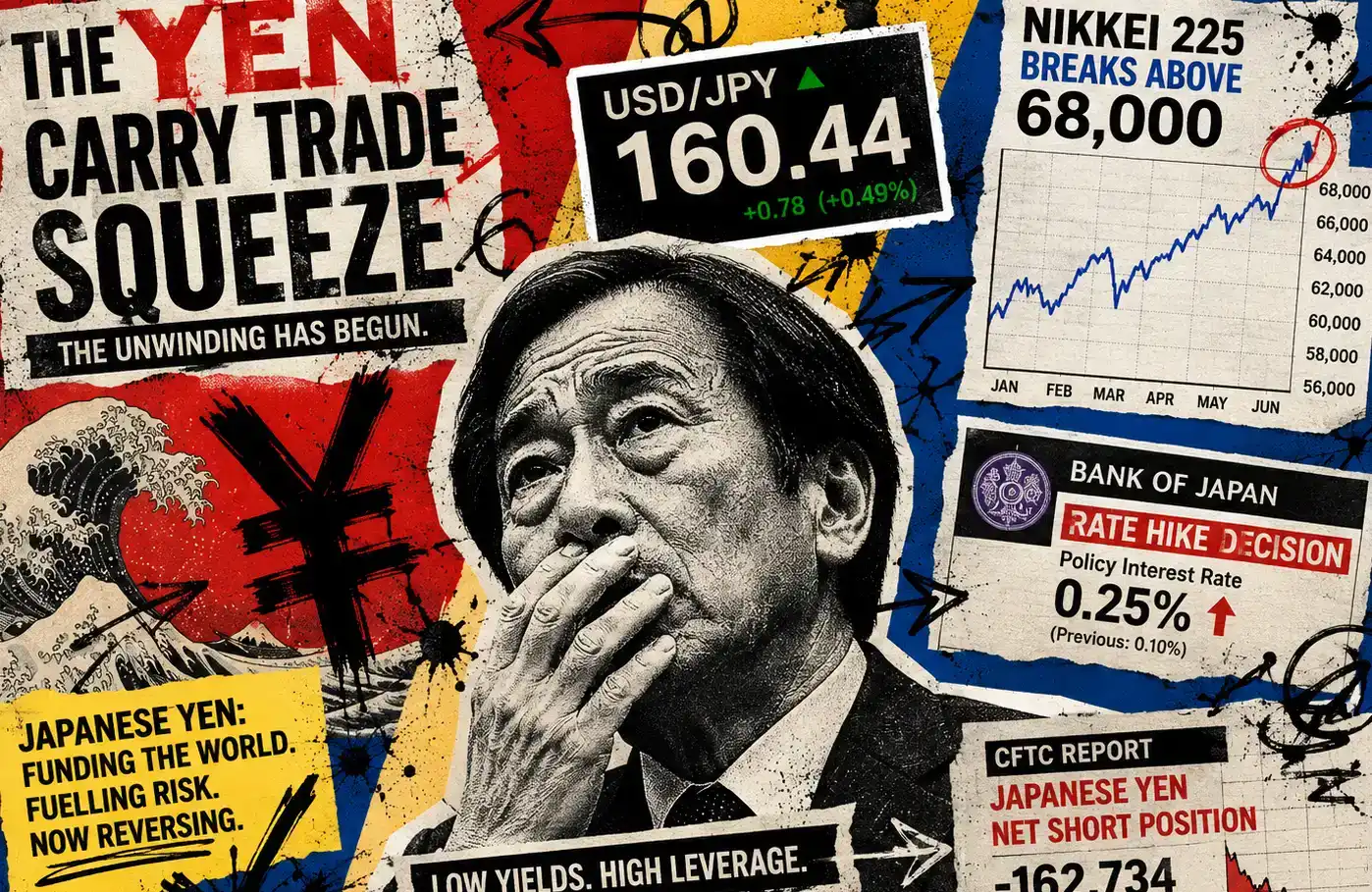
On June 3rd, USD/JPY hit 160.44, its highest level since July 2024, while the Nikkei 225 surged past 68,000 points. Contrary to popular narratives of an imminent "carry trade unwind" akin to August 2024, data reveals a more complex picture. Speculative net short positions in yen futures have actually increased, reaching -114,667 contracts by late May, suggesting traders are doubling down rather than retreating. Meanwhile, Japan's Finance Ministry conducted its largest-ever single-round FX intervention (11.73 trillion yen) in April-May but failed to hold the 160 yen line. The Nikkei's rally is not driven by carry trade dynamics. Foreign investors are aggressively buying Japanese stocks, with net purchases in 2026 running nearly 16 times higher than 2025 levels. This inflow is concentrated in AI and semiconductor-related stocks like SoftBank and Socionext, fueled by positive sector outlooks, rather than being a flight from unwinding yen shorts. Furthermore, the Nikkei has continued climbing despite the Bank of Japan's (BOJ) rate hikes to 0.75%. This disconnect exists because the current equity boom is fueled by AI-driven foreign investment, not reliant on cheap yen funding. However, this relationship remains fragile. Should the BOJ hike rates further (e.g., to 1.0%) while dollar weakness increases carry trade costs, the trajectories of the yen and Japanese stocks could reconverge, potentially triggering volatility.

marsbitHá 21m

New Wall Street Play: Yen Shorts Still Adding, But Japan Stocks Don't Rely on Carry Trade Unwinding

marsbitHá 21m

Broadcom's Q3 Guidance Misses Expectations by $12 Billion, After-Hours Trading Plummets Over 13%, AI Narrative "Cooling"?

On June 3, Broadcom released record Q2 FY26 results with revenue of $22.19B, up 48% YoY, and AI chip sales of $10.8B, up 143%. Adjusted EPS of $2.44 beat estimates. However, its Q3 AI semiconductor revenue guidance of $16B, while up over 200% YoY, fell roughly $1.2B (7%) short of analyst consensus expectations of $17.2B. This miss, coupled with slightly weaker-than-expected software revenue, triggered a severe market reaction. CEO Hock Tan maintained the FY26 AI revenue outlook of over $100B but did not raise it, disappointing investors who had priced in more robust growth. The stock plummeted over 13% in after-hours trading, erasing roughly $270B in market cap. The sell-off extended to peers like Marvell. A key concern for markets, particularly for Chinese optical module suppliers, was Tan's comment that the contribution of AI networking (e.g., Ethernet switches, optical interconnect chips) to AI revenue, currently near 40%, is expected to normalize to around 30% over time, signaling a potential peak in growth for that segment. Despite the guidance shortfall, Tan reiterated that AI demand remains "insatiable" and reaffirmed the long-term target of exceeding $100B in AI revenue by FY27. The reaction highlights the heightened sensitivity and premium valuation placed on AI-exposed stocks, where anything less than stellar guidance can prompt significant profit-taking. The broader question is whether this represents a cooling AI narrative or a correction in overstretched valuations.

marsbitHá 21m

Broadcom's Q3 Guidance Misses Expectations by $12 Billion, After-Hours Trading Plummets Over 13%, AI Narrative "Cooling"?

marsbitHá 21m

Trading

Spot
Futuros
活动图片