JPMorgan Hit With Lawsuit Tied To $328 Million Crypto Ponzi Scheme

bitcoinistPublicado em 2026-03-13Última atualização em 2026-03-13

Resumo

In a proposed class action lawsuit, JPMorgan Chase is accused of enabling a $328 million crypto Ponzi scheme operated by Florida-based Goliath Ventures. The suit alleges the bank ignored red flags and allowed the firm to use its banking infrastructure to process around $250 million, despite Know Your Customer obligations. One plaintiff claims he lost $650,000, including retirement savings. Goliath’s CEO, Christopher Delgado, has been arrested on fraud and money laundering charges. A separate federal case also names Bank of America for its role. The lawsuit argues JPMorgan should have detected and stopped the fraudulent activity.

One of the first named plaintiffs in a new lawsuit against JPMorgan Chase says he lost $650,000 — including retirement savings — to an alleged $328 million crypto Ponzi scheme the bank helped keep running.

Robby Alan Steele is among more than 2,000 investors who say they were defrauded by Goliath Ventures, a Florida-based crypto investment firm that prosecutors say collected hundreds of millions of dollars under false pretenses.

JPMorgan Named As Sole Financial Institution For Goliath

A proposed class action filed Tuesday in the US District Court for the Northern District of California accuses JPMorgan of letting Goliath use its banking infrastructure to pull in investor funds while ignoring warning signs that something was wrong.
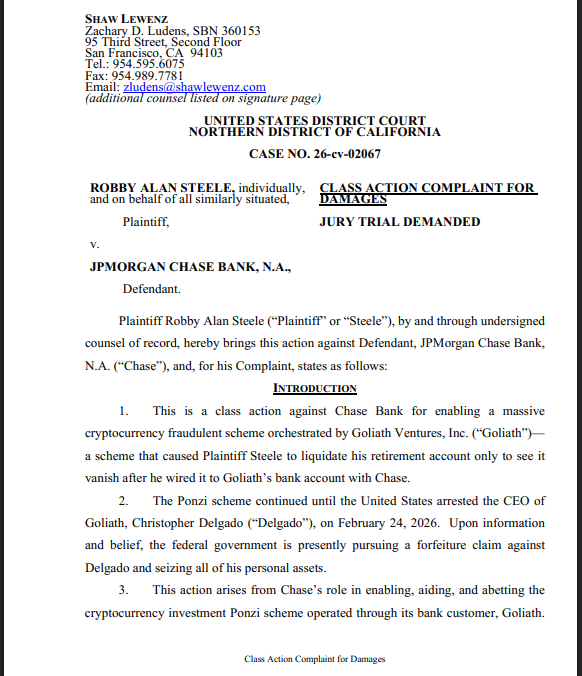
Source: Law.com

According to the complaint, JPMorgan was the only bank holding Goliath’s accounts from January 2023 through mid-2025 — the bulk of the scheme’s run.

During that stretch, roughly $250 million passed through a single JPMorgan account linked to Goliath. About $123 million of that was sent to Goliath’s wallets held at Coinbase.

Attorneys say the sheer volume moving through one account should have triggered scrutiny under federal banking rules that require institutions to know who their customers are and what those customers do with their money.

“Chase, by virtue of its Know Your Customer obligations, actually knew that Goliath was acting as a private equity cryptocurrency pool operator investing money for investors, without being licensed at all to sell these investments,” the complaint states.

BTCUSD now trading at $70,261. Chart: TradingView

Goliath, originally called Gen-Z Venture Firm, operated from January 2023 until January 2026, based on court documents. CEO Christopher Delgado was arrested on Feb. 24 by the US Attorney’s Office for the Middle District of Florida.

He faces wire fraud and money laundering charges. If convicted on all counts, he could spend up to 30 years in federal prison.

Bank Of America Also Appears In Federal Case

A separate federal criminal complaint names Bank of America as well. Prosecutors say Delgado was a co-signatory on a BOA business account used by Goliath, with at least one investor directed to that account by company representatives.

Investor funds, based on the government’s account, were routed through the JPMorgan account, the BOA account, or sent straight to Goliath’s Coinbase wallets — all controlled by Delgado.

The civil lawsuit was filed by attorneys from Shaw Lewenz, Sonn Law Group, and Schwartzbaum. Lead attorney Jordan Shaw said more complaints are coming as the team continues to identify people believed to be involved in the scheme.

Featured image from Unsplash, chart from TradingView

Criptomoedas em alta

Perguntas relacionadas

QWhat is the main allegation against JPMorgan Chase in the lawsuit?

AThe lawsuit alleges that JPMorgan Chase allowed Goliath Ventures to use its banking infrastructure to collect investor funds while ignoring red flags that it was a Ponzi scheme, violating its Know Your Customer obligations.

QHow much money did the lead plaintiff, Robby Alan Steele, allegedly lose in the scheme?

ARobby Alan Steele allegedly lost $650,000, which included his retirement savings.

QWhat was the total amount of the alleged Ponzi scheme and how much passed through a single JPMorgan account?

AThe alleged Ponzi scheme totaled $328 million. Approximately $250 million passed through a single JPMorgan account linked to Goliath.

QWhat charges does Goliath Ventures CEO Christopher Delgado face?

AChristopher Delgado faces charges of wire fraud and money laundering. If convicted on all counts, he could face up to 30 years in federal prison.

QBesides JPMorgan, which other major bank is named in the federal case related to this scheme?

ABank of America is also named in a separate federal criminal complaint, as Delgado was a co-signatory on a BOA business account used by Goliath.

Leituras Relacionadas

In Conversation with Ray Dalio: We Are Currently in an AI Bubble, with 1% of My Portfolio in Bitcoin

Ray Dalio, founder of Bridgewater Associates, warns in an interview that the current AI boom shows classic bubble characteristics, which could lead to significant economic downturns as seen in past cycles like 1929 or 2000. He explains that speculative enthusiasm, fueled by debt and overvaluation, often precedes a crash when rising rates or taxation force asset sales, causing widespread losses and recession. Dalio also outlines his "Big Cycle" theory, describing an approximate 80-year pattern where widening wealth gaps, massive government deficits, and shifting geopolitical power (like China's rise) create internal conflict and global instability. He emphasizes that we are in a late-cycle, transitional phase where traditional powers like the US and UK face decline. For personal wealth protection, Dalio advises diversification beyond cash into assets like stocks, bonds, real estate, and particularly gold, which he prefers over Bitcoin. While he holds about 1% of his portfolio in Bitcoin as a non-printable hard asset, he views gold as more secure from technological or governmental threats. Regarding AI's impact, Dalio believes it will disproportionately benefit capital owners, worsening inequality by replacing both physical and cognitive labor. He suggests that human intuition and emotional intelligence, combined with AI, will be key for future workers. On taxation, Dalio argues that wealth taxes are impractical and risk triggering asset sell-offs, reducing productive investment. He points to the UK as a cautionary example of debt, low productivity, and political strife. Geopolitically, Dalio foresees a more regionalized world, with the US showing weakness in prolonged conflicts like with Iran, akin to past imperial declines. The ideal outcome, he suggests, is coexisting powerful blocs (e.g., Americas, China-Asia Pacific) without major war.

marsbitHá 1h

In Conversation with Ray Dalio: We Are Currently in an AI Bubble, with 1% of My Portfolio in Bitcoin

marsbitHá 1h

Daily 7.2 Trillion KRW: Foreign Capital's Record Net Buying on Friday! Wall Street Says Headwinds for Korean Stock Fund Flows Have Subsided

South Korean stock market sees a dramatic shift in fund flows. On July 31, foreign investors made a record net purchase of approximately KRW 7.2 trillion in KOSPI stocks, marking a fundamental reversal from the persistent large-scale net outflows seen in previous months. This contributed to a significant narrowing of foreign net selling in July to KRW 9.8 trillion, down sharply from KRW 48.4 trillion in June and KRW 44.5 trillion in May. Simultaneously, domestic institutional pressure eased. South Korean pension funds and asset managers turned to a net buying position in July, purchasing KRW 1.0 trillion worth of KOSPI shares, contrasting with net sales in May and June. Market volatility is expected to be dampened by new financial regulations. Effective July 31, the Financial Services Commission tightened access for retail investors to single-stock leveraged ETFs by raising the minimum cash deposit requirement. Trading volumes for these products subsequently dropped to about 50% of their monthly average. Citigroup Research maintains its year-end KOSPI target of 10,000 points. The firm cites several supportive factors: the substantial easing of headwinds from capital outflows, a robust fundamental outlook for the semiconductor sector, historically low market valuations, strong economic fundamentals, and the potential for policy support from financial authorities if needed.

marsbitHá 1h

Daily 7.2 Trillion KRW: Foreign Capital's Record Net Buying on Friday! Wall Street Says Headwinds for Korean Stock Fund Flows Have Subsided

marsbitHá 1h

Thanks to Dice Rolls, Bitcoin Keys Are Stored Offline, But Not Everyone Will Do It

The article discusses using dice rolls to generate secure Bitcoin wallet seeds, providing entropy independent of potentially flawed hardware random number generators. It explains that each fair dice roll offers about 2.585 bits of entropy, with around 50 rolls needed for a standard 12-word seed phrase and 99+ recommended for higher security. This method gained attention after a vulnerability was revealed in some Coldcard hardware wallets, where a faulty firmware RNG (dating back to 2021) compromised generated keys. The analysis notes that while a dice-generated main seed was safe from this specific flaw, other Coldcard functions (like creating paper wallets, backup keys, or passwords) could still be vulnerable if they used the defective RNG. The piece argues that while dice-based entropy is technically robust, the manual process is error-prone, tedious, and unrealistic for most new users, who might make mistakes in recording or inputting rolls. It concludes that while manual entropy generation should remain an option for advanced users, the long-term goal is to develop reliable, user-friendly hardware and software that securely generates randomness without requiring specialized knowledge. Coldcard users are advised to check their firmware version and replace any secondary secrets (like paper wallet keys) created with vulnerable devices, while also considering multi-signature setups with devices from different manufacturers for added security.

cryptonews.ruHá 6h

Thanks to Dice Rolls, Bitcoin Keys Are Stored Offline, But Not Everyone Will Do It

cryptonews.ruHá 6h

Trading

Spot

Artigos em Destaque

Como comprar ONE

Bem-vindo à HTX.com!Tornámos a compra de Harmony (ONE) simples e conveniente.Segue o nosso guia passo a passo para iniciar a tua jornada no mundo das criptos.Passo 1: cria a tua conta HTXUtiliza o teu e-mail ou número de telefone para te inscreveres numa conta gratuita na HTX.Desfruta de um processo de inscrição sem complicações e desbloqueia todas as funcionalidades.Obter a minha contaPasso 2: vai para Comprar Cripto e escolhe o teu método de pagamentoCartão de crédito/débito: usa o teu visa ou mastercard para comprar Harmony (ONE) instantaneamente.Saldo: usa os fundos da tua conta HTX para transacionar sem problemas.Terceiros: adicionamos métodos de pagamento populares, como Google Pay e Apple Pay, para aumentar a conveniência.P2P: transaciona diretamente com outros utilizadores na HTX.Mercado de balcão (OTC): oferecemos serviços personalizados e taxas de câmbio competitivas para os traders.Passo 3: armazena teu Harmony (ONE)Depois de comprar o teu Harmony (ONE), armazena-o na tua conta HTX.Alternativamente, podes enviá-lo para outro lugar através de transferência blockchain ou usá-lo para transacionar outras criptomoedas.Passo 4: transaciona Harmony (ONE)Transaciona facilmente Harmony (ONE) no mercado à vista da HTX.Acede simplesmente à tua conta, seleciona o teu par de trading, executa as tuas transações e monitoriza em tempo real.Oferecemos uma experiência de fácil utilização tanto para principiantes como para traders experientes.

379 Visualizações TotaisPublicado em {updateTime}Atualizado em 2026.06.02

Como comprar ONE

Discussões

Bem-vindo à Comunidade HTX. Aqui, pode manter-se informado sobre os mais recentes desenvolvimentos da plataforma e obter acesso a análises profissionais de mercado. As opiniões dos utilizadores sobre o preço de ONE (ONE) são apresentadas abaixo.

活动图片













