Video Title: 2026 CMU Commencement Keynote Speaker: Jensen Huang
Video Author: Carnegie Mellon University
Compiled by: peggy
Editor's Note: In this speech addressed to the Carnegie Mellon University Class of 2026, Jensen Huang does not portray AI merely as a technological wave. Instead, he contextualizes it within the broader narratives of individual destiny, industrial cycles, and the rebuilding of national capacity.
Starting from his immigrant experience, early jobs, and the failures and restarts in founding NVIDIA, he seeks to illustrate a core judgment: What truly changes a life is not a certain path to success, but the ability to continuously take responsibility, learn from failure, and start anew amidst uncertainty. NVIDIA's growth was built precisely upon a series of misjudgments like 'How hard could it be?' and subsequent re-creations.
Huang's definition of the AI revolution goes beyond a mere 'tool upgrade.' In his view, AI is resetting computing itself: shifting from humans writing programs and computers executing instructions, to machines that understand, reason, plan, and use tools. It will change not only the software industry, but also the organizational structures of manufacturing, energy, healthcare, education, and almost every other industry.
This is also the speech's most crucial practical implication: AI is not just creating a new computing industry, but opening a new industrial era. Chip factories, data centers, power grids, energy systems, and advanced manufacturing will together form the next wave of technological infrastructure. For the United States, this represents an opportunity for re-industrialization; for the graduates, it means their careers are beginning precisely at the dawn of a new industrial cycle.
However, Huang does not shy away from the uncertainties brought by AI. He acknowledges that AI will automate many tasks and cause some jobs to disappear. But he distinguishes between 'tasks' and 'purpose': AI can replace parts of labor processes, but it cannot replace the human abilities to ask questions, define goals, and take responsibility. The real risk is not AI replacing people, but people who cannot use AI being left behind by those who can.
As Carnegie Mellon's motto states: "My heart is in the work." In an era where intelligence is being redefined and industries are being reorganized, Huang's advice to the graduates can be summarized in one sentence: Don't just watch the future; put your heart into it and build it with your own hands.
Below is the full text:
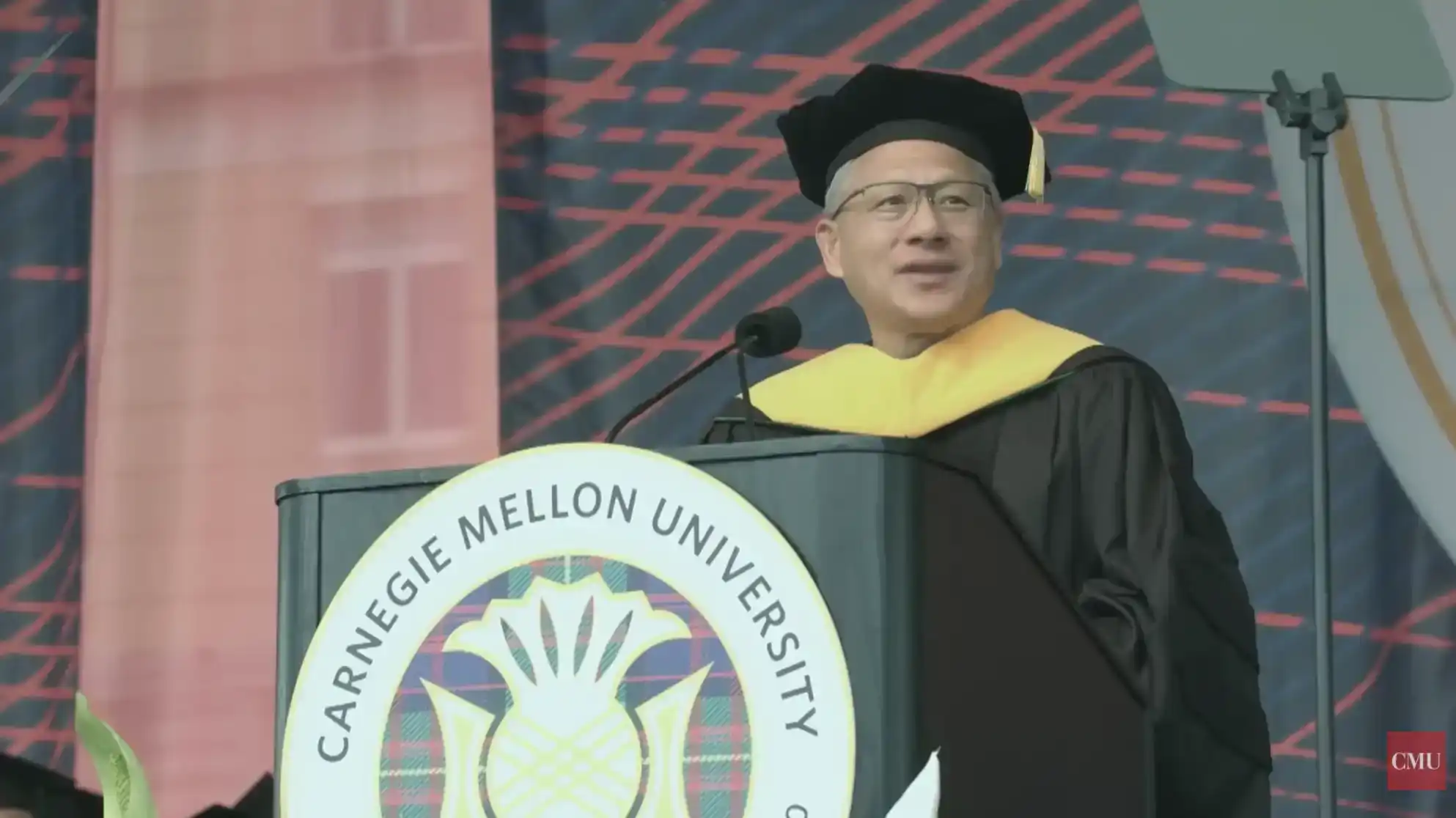
President, Board of Trustees, faculty, distinguished guests, proud parents and families, and most importantly, the Carnegie Mellon University Class of 2026:
Thank you for bestowing this extraordinary honor upon me.
To be here at Carnegie Mellon University means a great deal to me. This is one of the world's greatest universities, and one of the few places that truly "invents the future."
Today is a day of pride and joy, a day when your dreams come true. But this day is not yours alone. Your families, teachers, mentors, and friends have carried you all the way here. Before we talk about the future, let's thank them. Today belongs to them as well.
Graduates, please stand. Stand with me. Come on, everyone.
Especially, turn to your mothers and wish them a Happy Mother's Day. For you, this is just another step in life; for them, it's a dream coming true.
Please sit. CMU students, you are like robots, executing one instruction at a time (laughter).
Alright, everyone focus. I have something important to tell you. Being able to watch you graduate from one of the world's greatest institutions of learning is also their moment. My parents were always immensely proud of me. My journey was their journey as well.
I am the result of their dream coming true. And their dream was the American Dream.
Like many of you here, I am a first-generation immigrant. My father had a dream: to raise his family in America. When I was nine, he sent my brother and me to the United States. We ended up at a Baptist boarding school in Oneida, Kentucky—a small town of a few hundred people in coal country.
Two years later, my parents left everything behind and came to America to reunite with us. They had almost nothing. My father was a chemical engineer, and my mother worked as a maid at a Catholic school. She woke me up at 4 a.m. every morning to deliver newspapers. Later, my brother helped me get a dishwasher job at Denny's. For me back then, that was a major career promotion.
This is the America I know: not easy, but full of opportunity. It is not a guarantee; it is an opportunity. My parents came here because they believed America could give their children a chance. How could we not be romantic about America?
Later, I went to Oregon State University. I met my wife Lori when I was 17. I was the youngest kid in school; we were lab partners in a sophomore class. She was 19, an "older woman." I beat out the other 250 guys in the class to win her heart. We've been married for 40 years now. We have two wonderful children, and they both work at NVIDIA.
When I was 30, I co-founded NVIDIA with Chris Malachowsky and Curtis Priem. They are two exceptional computer scientists. We wanted to build a completely new kind of computer, one that could solve problems ordinary computers couldn't. We had absolutely no idea how to start a company, how to raise money, or how to run NVIDIA.
I just thought to myself: How hard could it be?
It turned out to be very hard. Our first technology didn't even work.
We nearly ran out of money. At one point, I had to fly to Japan to explain to the CEO of Sega that the technology they contracted us to develop wouldn't work. I asked them to release us from the contract we couldn't fulfill, and then I asked them to keep paying us. If we didn't get that money, NVIDIA would vanish.
It was embarrassing, humiliating, and one of the hardest things I've ever had to do.
And the CEO of Sega agreed.
I learned early that being CEO doesn't mean having power; it means bearing responsibility—the responsibility to keep the company alive. I also learned that honesty and humility, even in the business world, can be met with generosity and goodwill.
We used that money to restart the company. And it was from that desperate place that we invented new chip and computer design methodologies that are still in use today.
For 33 years, NVIDIA has reinvented itself time and again. Each time, we ask, "How hard could it be?" And each time, we learn, "Harder than we imagined."
But it is through these experiences that we learned never to see failure as the opposite of success. Each failure is just a moment of learning, a moment to stay humble, a moment to forge character. The resilience forged through setbacks is what gives you the strength to start again.
Today, I am one of the longest-serving CEOs in the tech industry. NVIDIA, and what I and 45,000 incredible colleagues have built together, is the work of my life.
Now, it's your turn to make your dreams come true. And the timing couldn't be better.
My career began at the dawn of the PC revolution. Your careers are beginning at the dawn of the AI revolution. I can't imagine a more exciting time to start the work of your lives.
AI began right here at Carnegie Mellon. In the past 24 hours here, I've heard countless jokes about AI. Carnegie Mellon is one of the true birthplaces of artificial intelligence and robotics. In the 1950s, researchers here created the Logic Theorist, widely considered the first artificial intelligence computer program.
In 1979, Carnegie Mellon founded the Robotics Institute. This morning, I toured some robotics projects. The Robotics Institute was the first academic department entirely dedicated to robotics.
Today, artificial intelligence is beginning to completely reshape computing.
I have witnessed every major computing platform shift: mainframes, personal computers, the internet, mobile internet, and cloud computing. Each wave built upon the last. Each expanded technology's accessibility. Each changed industries and society.
But what is about to happen is bigger than all of them.
Computing is undergoing a complete reset. Nothing like this has happened since modern computing was invented. For the past 60 years, how computing worked remained largely unchanged: humans wrote software, computers executed instructions. That paradigm is over.
Artificial intelligence has reinvented computing. From human programming to machine learning; from software running on CPUs to neural networks running on GPUs; from executing instructions to understanding, reasoning, planning, and using tools. A new industry capable of manufacturing intelligence at scale is emerging. Because intelligence is foundational to all industries. Every single industry will be transformed.
For many, AI brings uncertainty. People see AI writing software, generating images, driving cars, and naturally ask: What comes next? Will jobs disappear? Will people be left behind? Could this technology become too powerful? Every major technological revolution in history has brought both fear and opportunity.
When societies engage with technological progress in an open, responsible, and optimistic way, we expand human potential far more than we diminish it. So, first and foremost, we must be clear-eyed.
Artificial intelligence—the automation of understanding, reasoning, and problem-solving—is one of the most powerful technologies humanity has ever created. Like all transformative technologies before it, it brings immense promise alongside real risks.
The responsibility of our generation is not just to advance AI, but to advance it wisely. Scientists and engineers bear a profound responsibility: to advance both the capability and the safety of AI. Policymakers also have a responsibility to build prudent guardrails, protecting society while allowing innovation, discovery, and progress to continue.
History shows that societies that shrink from technology do not stop progress. They simply forfeit the chance to shape progress and benefit from it. So, the answer is not to fear the future. The answer is to wisely steer it, responsibly build it, and ensure it benefits as many people as possible.
We should not teach people to fear the future. We should engage the future with optimism, responsibility, and ambition. Only a small fraction of the world's population knows how to write software.
But now, anyone can ask AI to help them build something useful. A shop owner can create a website and grow their business. A carpenter can design a kitchen and offer new services to clients. The code is written by AI.
Now, everyone is a programmer.
For the first time, the power of computing and intelligence can truly reach everyone and bridge the digital divide. Like electricity and the internet before it, AI will require trillions of dollars in infrastructure investment. This is the largest technology infrastructure buildout in human history, and a once-in-a-generation opportunity: to reindustrialize America, to restore this nation's ability to build.
To support AI, America will build chip factories, computer factories, data centers, and advanced manufacturing facilities all across the country. AI gives America a chance to build again. Electricians, plumbers, steelworkers, technicians, construction workers—this is your time.
AI is not just creating a new computing industry. It is creating a new industrial age. Powering this new infrastructure will require an enormous energy supply. But it is also driving one of the largest energy infrastructure investments in decades: modernizing the grid, expanding power generation, and accelerating sustainable energy.
Yes, AI will change every job. But the tasks of a job and the purpose of a job are not the same.
Many tasks will be automated. Some jobs will disappear. But many new jobs, and entirely new industries, will also be created.
The task of coding software is increasingly being automated. But with AI, software engineers can expand the scope of solutions they search for, tackling more ambitious problems.
The task of analyzing radiology images is increasingly being automated. But with AI, radiologists will be elevated to a new level, better diagnosing diseases and caring for patients.
AI will not replace humans; it will amplify human capability. That is why, even as AI writes more code and analyzes more scans, the demand for software engineers and radiologists continues to grow.
AI likely won't replace you. But someone using AI better than you might.
So, a good thought experiment is: Do we want our children empowered by AI, or left behind by those who are empowered by AI? No parent wants their child left behind.
So, let's build AI safely. And let's also imagine an optimistic future: one that our children want to be part of and are inspired to help build.
Therefore, we can, and we must, do four things simultaneously: advance the technology safely; set prudent policies; make AI widely accessible; and encourage everyone to participate.
Everyone should own AI. Opportunity should not be limited to those who can code.
Class of 2026, you are entering an extraordinary moment.
A new industry is being born. A new age of science and discovery is dawning.
AI will accelerate the expansion of human knowledge, helping us solve problems once out of reach. We have the chance to bridge the digital divide, bringing the power of computing and intelligence to billions for the first time. We have the chance to reindustrialize America, restore our ability to build, and help create a future more prosperous, more powerful, and more hopeful than the world you inherited.
No generation has ever entered the world with tools more powerful than yours, and no generation has ever had a greater opportunity.
We are all on the same starting line.
This is your moment to shape what happens next. So, run, don't walk.
Carnegie Mellon has a motto I love: "My heart is in the work."
So, put your heart in the work. Create something worthy of your education, worthy of your potential, and worthy of those who believed in you long before the world did.
Congratulations, Carnegie Mellon University Class of 2026.
Original link


















