Japan's Bond Market to Go Fully 'On-Chain'

marsbitPublicado em 2026-05-11Última atualização em 2026-05-11

Resumo

The article details Japan's urgent move to tokenize its Government Bonds (JGBs) on the blockchain, specifically via the Canton Network, in a landmark 2026 proof-of-concept. With over $9 trillion in circulation, JGBs are a cornerstone of Asian institutional collateral, but their legacy settlement system is slow and limited to Tokyo business hours. This inefficiency risks JGBs losing their premier status to faster, 24/7 tokenized U.S. Treasuries, already being settled on Canton by giants like DTCC and JPMorgan. Canton Network was chosen for its unique architecture, enabling atomic, real-time settlements while ensuring strict data privacy and legal compliance—critical for sovereign debt. The shift to "always-on" collateral promises transformative benefits: reducing forced asset sales during market stress by allowing direct collateral posting, eliminating settlement risk in repo transactions, and integrating tokenized commercial bank deposits for institutional-grade cash settlement. This convergence of major sovereign bonds (U.S., Japanese, European) on Canton positions it as a potential new global financial rail, akin to SWIFT for collateral movement. The article frames this as a profound efficiency upgrade within the existing financial system, empowering traditional institutions with superior infrastructure rather than displacing them.

Original Author: Vaidik Mandloi

Compiled and Organized by: BitpushNews

On a Saturday in August 2025, something happened that should have set every cryptocurrency chat group on the internet ablaze. Bank of America, Citadel Securities, the Depository Trust & Clearing Corporation (DTCC), and Société Générale settled a US Treasury repo transaction over a blockchain in real-time over the weekend.

For context, repo is one of the most fundamental trades in institutional finance: one party sells government bonds to another with an agreement to buy them back the next day, typically to raise short-term overnight cash.

This is the 'plumbing' of the financial system. Banks, hedge funds, and central banks use repo daily to manage liquidity, with trillions of dollars flowing through this market. And this was the first time ever such a transaction was settled atomically, nearly instantaneously on a blockchain, outside of market hours, with participants being some of the world's largest financial institutions.

Eight months later, on April 20, 2026, the Japan Securities Clearing Corporation (JSCC), Mizuho Financial Group, Nomura Holdings, and Digital Asset launched a Proof-of-Concept (PoC) aimed at moving Japanese Government Bond (JGB) collateral onto the Canton Network.

JGBs are one of Asia's most critical financial instruments, with over $9 trillion in circulation, making them the single most widely used collateral asset in the region's institutional markets. When banks and hedge funds across Asia need to collateralize their leveraged positions, JGBs are often the go-to choice. And now, that entire collateral system is moving on-chain.

This is arguably the biggest blockchain news of 2026.

This article will analyze why JGBs are the perfect asset to tokenize first, why Canton Network keeps winning institutional orders while public chains battle for retail traffic, and how exactly 'round-the-clock' collateral settlement changes global trading desks.

Why JGBs? Why Now?

For decades, Japan has tried to make the yen a global reserve currency, a wish that never truly materialized. Even today, the yen accounts for only about 4-6% of global reserves, trailing the US dollar, the euro, and even the pound sterling.

But something unintended happened in the process: Japanese government bonds became one of the fastest-growing collateral assets on the Euroclear Collateral Highway—the infrastructure for moving collateral among the world's large financial institutions. Foreign ownership of JGBs has climbed to about 11.9%, meaning roughly ¥144 trillion is held by institutions outside Japan.
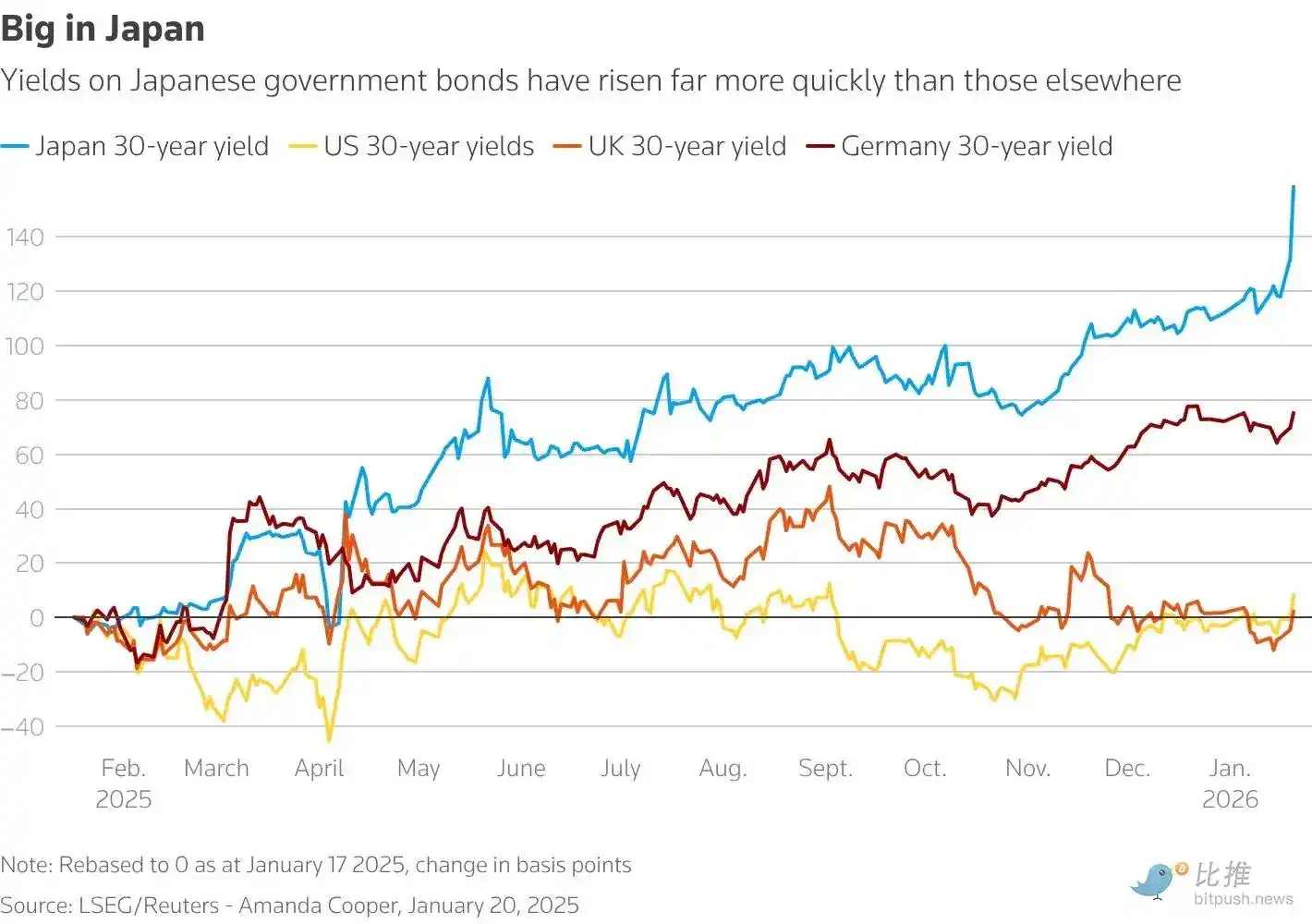
In institutional finance, collateral is everything. Every leveraged position, every derivatives trade, every repo requires high-quality assets as security. Backed by the world's third-largest economy and with virtually no default risk, JGBs are one of the few global assets that qualify. When a hedge fund in Singapore builds a leveraged position, or a bank in London covers a derivatives exposure, JGBs are frequently used as collateral.

Cryptocurrency's most important infrastructure victory is happening inside traditional finance. Without Japan winning the 'currency war,' JGBs have become the operational infrastructure for Asian institutional finance.

The problem is, the entire collateral system operates like it's 1995. Moving JGB collateral between two institutions passes through a layered holding structure: the Bank of Japan (BOJ) at the top, then Hofuri (Japan's securities depository), then a custodian bank, then a sub-custodian. Each layer requires separate reconciliation and operates only during Tokyo business hours (roughly 9 AM to 3 PM JST).

A collateral transfer that should take seconds ends up taking days. During those days, that collateral is 'stuck.' A trading desk in New York needing it at 10 PM has to wait for Tokyo to wake up. A GFMA (Global Financial Markets Association) and BCG study estimates blockchain could unlock $100 billion in trapped collateral globally; for a bank doing $100 billion in daily repo volume, tokenized settlement alone could save $150-300 million annually in operational costs.
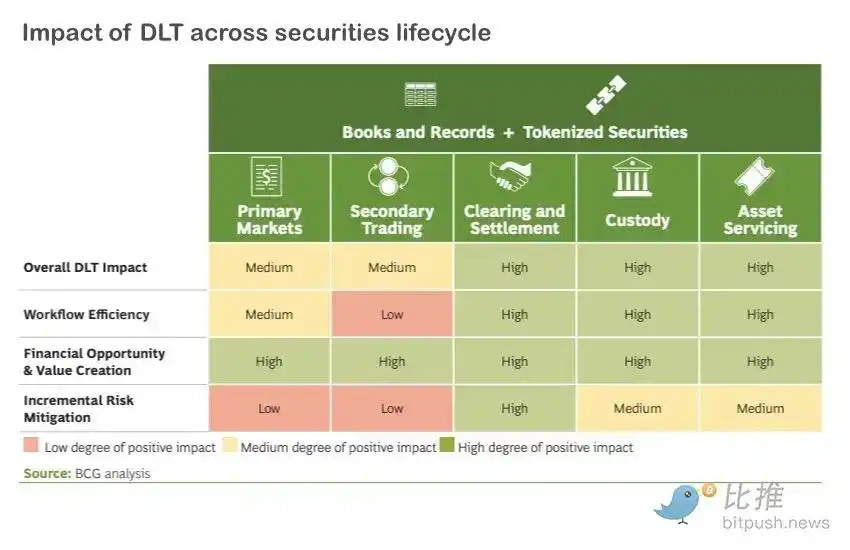
Here's something unsettling for Japan: the US is already moving.

DTCC, which custodies $99 trillion in US securities and processes $3.7 quadrillion in annual transactions, partnered with Digital Asset in December 2025 to tokenize US Treasuries on the Canton Network. This means the core of US securities infrastructure is moving towards 24/7 tokenized settlement.

Broadridge is already processing $354 billion in daily tokenized Treasury repo trades on the same network; JPMorgan's Kinexys has processed over $1.5 trillion in cumulative volume through its on-chain payment rail. US Treasuries are rapidly becoming 'always-on, always-movable' collateral assets, while JGBs remain locked in Tokyo's business hours.

If you're a global fund manager needing to post collateral for a margin call at 2 AM, and you can choose between tokenized US Treasuries that settle instantly or JGBs that you have to wait 6 hours for Tokyo to open to move, you choose US Treasuries every time.

Scale that choice across thousands of trading desks, and JGBs risk losing their 'top-tier collateral' status. For a country whose sovereign debt is deeply interwoven into Asia's financial collateral system, this is even an existential issue. The four companies in the JGB on-chain trial used the word 'urgent' in their press release. Given the pace of US infrastructure evolution, it's hard to disagree.

Why Canton Keeps Winning

When Japan's JSCC had to choose a network for JGB collateral, they chose Canton—the same chain DTCC, Broadridge, and JPMorgan are already using. The reason lies in the extremely stringent demands sovereign bond collateral places on a network.

Sovereign bond collateral has a specific set of requirements most blockchains can't meet. When Mizuho Bank transfers JGB collateral to a counterparty in London, the transaction must comply with Japan's Book-Entry Transfer Act. The blockchain record needs to be synchronized at a legal level with Hofuri's official register.

Every party in the transaction (from clearinghouse to custodian to counterparty) can only see data they are authorized to view under Japanese and international securities law. And the entire process requires atomic settlement—the collateral and payment must move at the same instant, or neither moves.

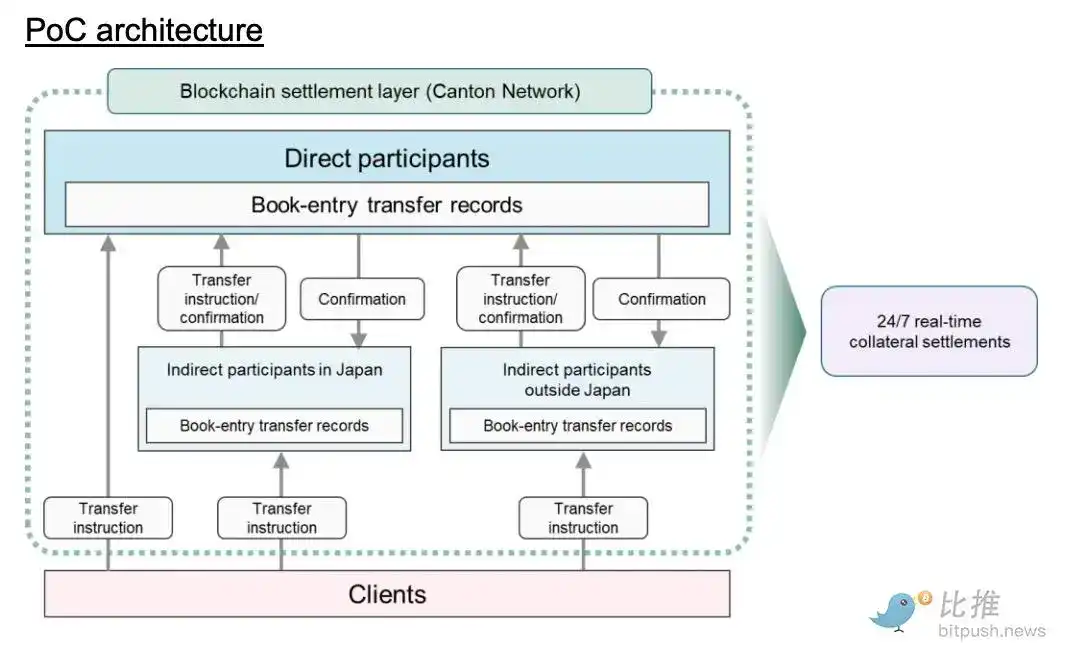
This is an incredibly complex set of constraints. Canton was chosen because its architecture is designed to solve precisely these issues. Each institution runs its own ledger, and cross-institution transactions sync only the data each party is authorized to see. Smart contracts written in Digital Asset's Daml language dictate who can see what and who must authorize each step.

Thus, when JSCC, Mizuho, and Nomura move JGB collateral on Canton, the clearinghouse sees the full picture, Mizuho sees its side, Nomura sees its side, and no one sees anything they shouldn't. Canton is now the only global network enabling three major sovereign bond collateral pools (US Treasuries, Japanese bonds, European bonds) to move across borders, in real-time, 24/7. No other network (public or private) comes close.
What Does 'Round-the-Clock' Collateral Actually Change?

Most coverage of tokenized on-chain settlement stops at 'it's faster.' But speed is just the beginning; the real transformation is in how the system behaves under stress.

Consider what happened in March 2020 during the COVID pandemic. Markets crashed, volatility spiked, and initial margin requirements for equity futures jumped 100% in weeks. Funds unable to meet margin calls were forced to sell assets to raise cash.

But selling assets into a falling market pushes prices lower, triggering more margin calls, forcing more selling. This feedback loop is one of the most dangerous dynamics in finance and nearly broke the system again during the UK LDI pension crisis in September 2022.

How 24/7 tokenized settlement changes this:

  • Direct Collateralization: Currently, when facing a margin call, most funds must first sell assets for cash. With on-chain collateral, funds can directly pledge JGBs or US Treasuries to meet requirements without first converting to cash. The 'forced selling spiral' weakens because fewer institutions dump assets into a falling market just for liquidity.
  • Solving 'Give-to-Get': In traditional repo, the cash lender sends money first and receives collateral later. During this window, one party is exposed. Banks bake this 'intraday exposure' into their haircuts and funding costs.
  • Atomic Execution: With on-chain atomic settlement, both legs of a trade (collateral and cash) move at the same instant. Santander tested this in December 2024, executing $50 million and €50 million in intraday repos on JPMorgan's Kinexys, automatically unwinding them three hours later. Intraday repos, once requiring complex third-party setups or committed credit lines, become routine.

More significantly, in a Canton demo in January 2026, the London Stock Exchange Group (LSEG) brought its Digital Settlement Hub (DiSH) into the trade. DiSH uses tokenized commercial bank deposits as the cash leg, not stablecoins.

This is because banks don't settle billion-dollar trades with USDC—USDC is a private IOU, not 'money good.' DiSH tokens represent actual deposits at regulated banks and can be transferred on-chain 24/7. This solves the cash leg problem, the final piece for institutional adoption. Now, Japan plans to plug JGBs into this same infrastructure.

What This Means

If the JGB trial succeeds, and US Treasuries are already live, with European sovereign bonds also in demos, Canton, in my view, is starting to look like the next SWIFT.

It's a single network becoming the default layer for moving the world's most important collateral across borders. Like SWIFT, once enough institutions join, leaving becomes almost impossible. Network effects compound. Each new sovereign bond class joining benefits existing participants and makes it harder for newcomers to compete.

I think this merits reflection. We in crypto spent years debating decentralization, worrying about single points of failure, building a system no single entity could control the trajectory of. And now, historically the most significant blockchain deployment is converging on a single permissioned network managed by the same institutions that run global finance.

Is this good or bad? It depends on what you believe this is all about. If the goal is to improve capital market efficiency, lower settlement risk, and unlock trillions in trapped collateral, it's working. If the goal was to diminish the power of existing financial institutions, it's doing the opposite—the same gatekeepers are just getting more sophisticated infrastructure.

I don't think that makes it unimportant. Settling government bonds on a blockchain, 24/7, cross-border, atomically, is a genuine upgrade to how global finance operates. But I do think it's worth being honest about what 'kind' of upgrade this is—it's an efficiency revolution: the plumbing is being rebuilt, but the plumbers are the same.


Perguntas relacionadas

QWhat are JGBs, and why are they considered a critical asset in the Asian institutional finance system according to the article?

AJGBs are Japanese Government Bonds. They are considered a critical asset because, with a circulating value exceeding $9 trillion, they are the most widely used single collateral asset in the region's institutional markets. Supported by the world's third-largest economy and virtually default-free, they are a preferred, high-quality asset for securing leverage positions and derivatives transactions across Asia.

QWhat key problem does the current, traditional JGB collateral settlement system face, and what potential does blockchain technology offer to solve it?

AThe current system operates within limited Tokyo business hours, requiring transfers to pass through multiple holding layers, which takes days and leaves collateral 'frozen' and unavailable. Blockchain technology enables real-time, atomic settlement 24/7. This can unlock an estimated $100 billion in trapped collateral globally and save banks billions annually in operational costs by streamlining the process.

QWhy did Japan's JSCC and associated institutions choose the Canton Network for their JGB tokenization proof-of-concept?

AThey chose the Canton Network because its architecture is specifically designed to meet the stringent requirements of sovereign bond collateral. It allows each institution to run its own ledger while synchronizing only authorized data across parties, ensuring compliance with Japanese securities law. Canton is also the network already being used by major US financial infrastructure players like DTCC for US Treasury tokenization, creating a unified system for cross-border collateral movement.

QHow does the article suggest that 24/7 tokenized collateral settlement could fundamentally change financial market behavior during periods of stress, like the March 2020 crash?

AIt could mitigate the dangerous 'forced selling spiral.' During a crash, funds facing margin calls could directly pledge tokenized JGBs or US Treasuries as collateral without first selling assets for cash. This reduces the need to dump assets into a falling market just to raise liquidity, thereby weakening the feedback loop that exacerbates price declines and further margin calls.

QWhat significant comparison does the article make regarding the Canton Network's potential role in the future of global finance, and what underlying irony or contradiction does it highlight about the blockchain deployment?

AThe article suggests Canton is beginning to look like the next SWIFT—a single default network for moving the world's most important collateral across borders. The highlighted irony is that this historically significant blockchain deployment is converging on a single, permissioned network managed by the very incumbent financial institutions it was once thought might be disrupted. It represents an efficiency revolution in the 'plumbing' of finance, but the 'plumbers' (the established gatekeepers) remain the same.

Leituras Relacionadas

From Parallel Finance to Mainstream Finance: The On-Chain Securities Era Ushers in a Historic Window

From Parallel Finance to Mainstream: The Dawn of On-Chain Securities For over a decade, the crypto industry has operated as a parallel financial system with its own currencies, markets, and assets—from Bitcoin and ICOs to DeFi, NFTs, and memecoins. Despite building a robust internal ecosystem, a wall has separated it from the traditional financial world. That barrier is now crumbling. The industry's first act was one of internal evolution: ICOs streamlined fundraising, DeFi recreated financial services on-chain, and layer-2 networks competed for scalability—all within the crypto bubble. While innovative, this cycle remained closed, with capital and users circulating internally, leading to volatile boom-bust cycles. Even Bitcoin ETFs, while attracting Wall Street capital, merely provided a channel to buy crypto assets without bridging the systems. The next, larger narrative is Real-World Assets (RWA) moving on-chain. This involves tokenizing stocks, bonds, funds, and future cash flows. Blockchain can compress the complex traditional processes of trading, settlement, clearing, and custody into a seamless, automated network operating in seconds. This shift is creating a new financial gateway: the native crypto securities broker. This entity will combine functions of an exchange, broker, bank, and custodian into a unified global financial operating system. Consequently, the next major battleground won't be the "public chain wars" focused on speed and cost, but the competition to build the financial infrastructure capable of hosting high-quality, liquid real-world assets. Access to global equities, index funds, or stakes in companies like SpaceX could erase the boundary between crypto and traditional finance, unlocking a market orders of magnitude larger than crypto's current valuation. In summary, after years of creating a separate financial world, crypto's next decade will be defined by its integration into the existing global financial system, marking the true beginning of its largest growth story.

marsbitHá 14m

From Parallel Finance to Mainstream Finance: The On-Chain Securities Era Ushers in a Historic Window

marsbitHá 14m

Wang Chuan: When the Neighbor Old Wang Made 30x on Memory Stocks, How to Avoid Anxiety (Part Six) - The Trap of Commoditized Goods

Wang Chuan: When the Neighbor Lao Wang Made 30x on Storage Stocks, How to Stay Anxiety-Free (Part 6) - The Trap of Commoditized Goods. This essay uses historical and current examples to analyze the cyclical and high-risk nature of the data storage industry. It begins with the 1990s rise and dramatic fall of Iomega, whose stock soared over 160x in 18 months before collapsing 97% from its peak, illustrating the fleeting success of storage "meme stocks." The core problem is that storage products, like DRAM and flash memory, are highly commoditized. This leads to extreme volatility: prices have plummeted over 80% multiple times, and company stocks often crash 95% or go bankrupt. The industry's dynamic is defined by "elastic demand facing heavy-asset, long-cycle, rigid supply." When demand spikes and supply is fixed, prices skyrocket, as seen recently with AI-driven demand for High Bandwidth Memory (HBM). Companies like Sandisk and Micron have reported massive revenue and gross margin jumps (e.g., Sandisk's gross margin rising from 22.5% to 78.3%) despite minimal increases in production volume. However, these high margins are self-defeating. They incentivize massive new capacity investments (hundreds of billions planned from 2026), with supply expected to surge by late 2027. Once new supply meets demand, prices and profits will crash, potentially leading to a scenario where "selling more results in earning less." The article debunks the safety of long-term supply agreements, comparing them to fragile non-aggression pacts easily broken when market conditions shift. It warns that when an industry is highly profitable but trades at low P/E ratios, the risk is greatest, as plummeting prices quickly erase those earnings. Multiple asymmetric risks loom, including economic recession, reduced AI spending, faster-than-expected capacity expansion (especially from Chinese firms), and technological innovations that reduce memory requirements. In conclusion, the storage sector is a cyclical trap where periods of euphoric profits are often precursors to devastating downturns, luring unprepared investors into a "wealth incinerator."

marsbitHá 23m

Wang Chuan: When the Neighbor Old Wang Made 30x on Memory Stocks, How to Avoid Anxiety (Part Six) - The Trap of Commoditized Goods

marsbitHá 23m

Wang Chuan: When the neighbor Lao Wang earned thirty times from investing in memory storage stocks, how can you still avoid anxiety (6) - The trap of homogeneous products

The article, "Wang Chuan: How to Remain Unanxious After Neighbor Lao Wang's Thirty-Fold Gain on Storage Stocks (Part 6) - The Trap of Commoditized Goods," analyzes the cyclical and perilous nature of the data storage industry through historical and current case studies. It begins with the example of Iomega, whose Zip drives led to a stock surge of over 160x in the mid-1990s before collapsing over 97% from its peak due to competition from cheaper CD-R technology. This pattern is characteristic of storage, where products like DRAM are highly commoditized, leading to extreme price volatility. The sector has seen prices crash over 80% multiple times, with companies often facing bankruptcy. The core dynamic is "elastic demand facing heavy-asset, long-cycle, rigid supply." High prices attract new capacity, but the long lead time means supply eventually overshoots, causing sharp price corrections. The current AI-driven boom, exemplified by surging demand for High-Bandwidth Memory (HBM), has led to skyrocketing prices and profit margins for companies like SanDisk and Micron, despite relatively flat production volumes. However, the author warns this high-margin environment is self-defeating. The high profits are already triggering massive new capacity investments (hundreds of billions starting 2026), with supply expected to ramp up by late 2027. When supply catches up, total revenue and profits may fall even as more units are sold. Long-term supply agreements offer little protection, as buyers can find ways to renegotiate if market prices drop, similar to fragile political treaties. Key risks include economic downturns, cuts in AI spending, faster-than-expected capacity expansion (especially from Chinese firms), and innovations in chip/algorithm design that reduce memory needs. A critical trap is that at the cycle's peak, storage stocks often appear cheap with low P/E ratios, luring value investors just before an impending downturn where profits evaporate. The conclusion cautions that for commoditized goods like storage, high margins inevitably destroy themselves, and the current asymmetry favors downside risk over further upside. The neighbor's dream of easy wealth from storage stocks is portrayed as a precarious illusion.

链捕手Há 41m

Wang Chuan: When the neighbor Lao Wang earned thirty times from investing in memory storage stocks, how can you still avoid anxiety (6) - The trap of homogeneous products

链捕手Há 41m

AI PCs Are Here, Going Toe-to-Toe with 120B Models Locally! NVIDIA Redefines the "Personal AI Computer" Foundation with RTX Spark

NVIDIA has redefined the "AI PC" standard with the launch of the RTX Spark super chip at GTC 2026. Boasting 1 petaflop (1000 TOPS) of AI performance, it dwarfs the 45-50 TOPS NPUs in current AI PCs. The SoC features a Blackwell GPU, a 20-core Arm CPU co-designed with MediaTek, and crucially, up to 128GB of unified memory shared between CPU and GPU. This architectural shift enables local execution of 120-billion-parameter large language models with million-token context windows, a massive leap from the 9B-40B models typical on current consumer hardware. Beyond AI, use cases include 12K video editing and high-fps ray-traced gaming. Key to enterprise adoption is a security collaboration with Microsoft. Windows security is upgraded, and NVIDIA's OpenShell sandbox runtime is integrated to safely contain AI agent actions. Major software support comes from Adobe, which announced a deep,底层-level rewrite of Photoshop and Premiere to leverage the unified memory for up to 2x performance gains. Six OEMs, including Dell, HP, Lenovo, and Microsoft Surface, will release RTX Spark-based轻薄本 and compact desktops this fall. However, questions remain about real-world performance,功耗, thermal management in laptops, pricing, and the actual impact of the OpenShell sandbox. The RTX Spark represents a fundamental power shift in the PC industry, moving from an x86 CPU-centric model to a GPU-centric SoC platform, but its ultimate success hinges on the upcoming product rollouts and ecosystem validation.

marsbitHá 55m

AI PCs Are Here, Going Toe-to-Toe with 120B Models Locally! NVIDIA Redefines the "Personal AI Computer" Foundation with RTX Spark

marsbitHá 55m

Trading

Spot
Futuros
活动图片




