Japan plans major shift as crypto moves from payments to securities law

cointelegraphPublicado em 2025-12-10Última atualização em 2025-12-10

Resumo

Japan's Financial Services Agency (FSA) is planning to shift cryptocurrency regulation from the Payment Services Act to the Financial Instruments and Exchange Act (FIEA), treating crypto primarily as investment products rather than payment methods. This move aims to enhance user protection by imposing stricter disclosure rules for initial exchange offerings (IEOs), including mandatory pre-sale information, third-party code audits, and issuer identity disclosure. The new framework also strengthens measures against unregistered platforms and explicitly prohibits insider trading. The regulatory shift coincides with government discussions to implement a flat 20% tax rate on crypto trading profits.

Japan’s financial regulators are preparing to move crypto asset oversight out of the country’s payments regime and into a framework designed for investment and securities markets.

The Financial Services Agency (FSA) on Wednesday released a comprehensive report from the Financial System Council’s Working Group on the regulatory status of cryptocurrencies across multiple sectors.

The document outlines a plan to shift the legal basis for crypto regulation from the Payment Services Act (PSA) to the Financial Instruments and Exchange Act (FIEA), which is the primary law regulating securities markets, issuance, trading and disclosures.

“Crypto assets are increasingly being used as investment targets both domestically and internationally,” the report noted, underscoring the need to protect users by providing regulation that treats crypto as a financial product.

Strengthening data disclosure regulations

One of the core changes brought by bringing crypto under FIEA regulatory scope is strengthening data disclosure requirements for initial exchange offerings (IEOs), or token sales managed by crypto exchanges.

“Crypto transactions conducted by users are similar to securities transactions, and may involve the sale of new crypto assets or the buying and selling already in circulation,” the document reads, highlighting the importance of timely information during IEO sales.
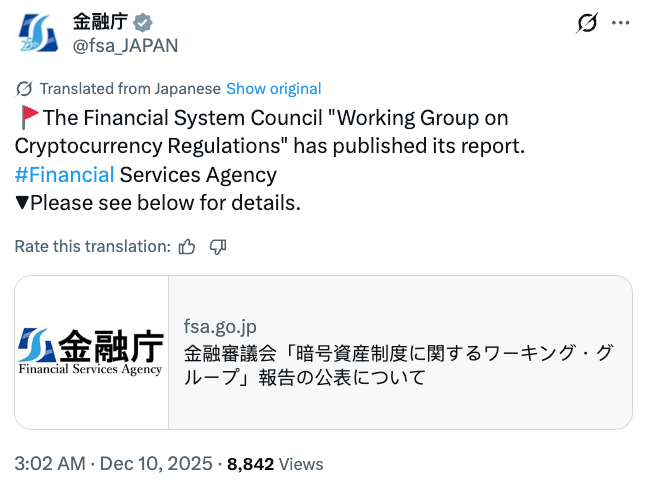
Source: FSA Japan

Among the requirements for IEOs, the proposal mandates that exchanges provide pre-sale disclosures, including detailed information about the core entities behind the offering. It also requires code audits by independent third-party experts and encourages consideration of feedback from self-regulatory organizations.

In addition to exchanges, it places responsibilities on issuers, requiring them to disclose their identities, regardless of whether the project is decentralized, and how tokens are issued and distributed.

Related: Crypto payments coming to PlayStation as Sony plans stablecoin launch in 2026

The proposed framework would also give regulators stronger tools to crack down on unregistered platforms, particularly those operating from overseas or tied to decentralized exchanges. It also includes explicit prohibitions on insider trading, echoing provisions of the European Union’s Markets in Crypto-Assets (MiCA) framework and South Korea’s regulations.

The news came amid the Japanese government’s consideration of plans to reduce the maximum tax rate on crypto profits by imposing a flat rate of 20% on all gains from crypto trading.

On Tuesday, FSA also signaled a cautious stance on permitting derivatives for foreign crypto asset exchange-traded funds, reportedly describing the underlying assets as “not desirable.”

Magazine: When privacy and AML laws conflict: Crypto projects’ impossible choice

Leituras Relacionadas

Altcoin Hacked, Leading to Sharp Price Drop! Also Listed on Major Exchanges!

The price of the NES token plummeted significantly following suspicious activity and large sell-offs detected on the network. Blockchain observers suggested that one wallet minted approximately $55 million worth of NES tokens and began selling them on decentralized exchanges. This selling pressure caused the price of NES to drop by up to 40%. According to the data, the address in question still holds around $18 million worth of NES, indicating that market sell-off pressure may continue. Prior to the incident, it was reported that about $12.35 million worth (62.9 million NES tokens) were transferred to the Ethereum mainnet in the morning (Turkish time), with claims that liquidity was withdrawn and tokens were sold on the market later that evening. However, data regarding the $55 million token mint and the transfer of 62.9 million NES tokens has not been independently confirmed. The NESA team confirmed in a statement that they detected malicious activity exploiting a vulnerability in their Layer 1 network originating from Cosmos EVM. They stated they are working to contain the impact, responded promptly, and will restore services after implementing a software patch and additional measures to ensure secure network operation. Nesa also notified all cryptocurrency exchanges and stated deposit operations will resume after necessary work is completed. The article includes a chart showing the NES price decline following the exploit and concludes with a standard disclaimer that this is not investment advice.

cryptonews.ruHá 44m

Altcoin Hacked, Leading to Sharp Price Drop! Also Listed on Major Exchanges!

cryptonews.ruHá 44m

PeaqOS and World ID Integrate ZK Proofs into Autonomous Robots

The integration of PeaqOS and World ID now allows autonomous machines to verify they are interacting with real, unique individuals without collecting names, photos, or other personal data. This update, available via robotic.sh, enables connected devices to directly request and verify World ID proofs. The system leverages zero-knowledge technology, letting a person prove they are human while maintaining the privacy of their identity. This addresses a key challenge for operators of delivery robots, shared machines, and autonomous systems: how to authenticate a user as genuine without relying on insecure PINs, pickup codes, or traditional identity checks that require personal data collection. Instead of obtaining identifying information, a device receives a cryptographic proof that the user is a real person. PeaqOS acts as a coordination layer, allowing devices to utilize World ID via decentralized identifiers and a device marketplace. A robot can request verification, receive a zero-knowledge proof, and register an auditable record of the interaction—all without exposing underlying personal data. The system also supports uniqueness verification, enabling machines to enforce rules like "one item per person" without maintaining user identity databases. A demonstrated use case involves autonomous medicine delivery: a patient verifies via the World App when placing an order, a pharmacist verifies before loading the medication, and the patient verifies again upon delivery so the robot can confirm the recipient is linked to the order before unlocking the compartment. Similarly, promotional robots could ensure one item per person, and shared vending machines could grant access to verified individuals without requiring accounts or personal data. This integration for PeaqOS-powered robots and devices minimizes the identity information collected or stored while allowing autonomous systems to confirm they are interacting with real humans.

cryptonews.ruHá 2h

PeaqOS and World ID Integrate ZK Proofs into Autonomous Robots

cryptonews.ruHá 2h

Trading

Spot
活动图片