January Crypto Market Analysis: Prices Decline, But Institutional Infrastructure Accelerates

marsbitPublicado em 2026-02-10Última atualização em 2026-02-10

Resumo

January 2026 presented a paradox in the crypto market: prices fell by 25%, yet infrastructure supporting institutional adoption accelerated. While Bitcoin dropped to a 10-month low near $73,000 and leveraged traders liquidated $2.2 billion in positions, institutional developments advanced rapidly. BlackRock identified digital assets as a key 2026 investment theme, DTCC launched production-level tokenization for U.S. Treasuries and equities, and Y Combinator announced it would fund startups in USDC. The sell-off was driven by macro shocks—not crypto-specific weakness—including stress in Japanese government bonds and the nomination of a hawkish Fed chair, triggering global deleveraging. Bitcoin correlated with risk assets rather than acting as a hedge, raising questions about its institutional role. Despite price volatility, regulatory clarity improved, and jurisdictions like Hong Kong and Dubai competed to attract crypto capital. Protocol development continued unabated, with Ethereum and Solana pushing scalability upgrades. However, security losses exceeded $370 million, highlighting operational risks. The divergence between price action and structural progress defines this cycle, indicating that institutional maturity is advancing independently of short-term valuations.

Author: Dhruvang Choudhari (AMINA Bank)

Compiled by: Deep Tide TechFlow

Deep Tide Introduction: January 2026 presented a paradox: crypto prices fell by 25%, but the infrastructure supporting institutional adoption was accelerating. While Bitcoin dropped to a ten-month low of $73,000, BlackRock listed digital assets as a decisive investment theme for 2026.

While leveraged traders liquidated $2.2 billion in positions, the Depository Trust and Clearing Corporation (DTCC) launched production-level tokenization for U.S. Treasuries and stocks. While sentiment indices reached extreme pessimism, Y Combinator announced it would begin funding startups in USDC.

AMINA Bank's analysis points out that this is not a rejection of digital assets, but a repricing within an evolving global monetary system. The divergence between price action and structural progress defines the current phase of the cycle.

Full Text Below:

Introduction

January 2026 presented a paradox: crypto prices fell by 25%, but the infrastructure supporting institutional adoption was accelerating.

While Bitcoin dropped to a ten-month low near $73,000, BlackRock listed digital assets as a decisive investment theme for 2026. While leveraged traders liquidated $2.2 billion in positions, the Depository Trust and Clearing Corporation (DTCC) launched production-level tokenization for U.S. Treasuries and stocks. While sentiment indices reached extreme pessimism, Y Combinator announced it would begin funding startups in USDC.

The first two months of 2026 marked a decisive shift in the digital asset market. What initially seemed like chaotic selling was actually a broad macro repricing driven by sovereign risk, changes in the monetary system, and forced unwinding of global leverage. Unlike previous crypto downturns, this event did not originate from within the digital asset ecosystem itself. It emerged from the outside.

January and February revealed a paradox that is now central to the institutional crypto era. Market prices deteriorated sharply, yet regulatory clarity, infrastructure deployment, and institutional commitment advanced at an unprecedented pace. This divergence between price action and structural progress defines the current phase of the cycle.

This update analyzes how the macroeconomic shock disrupted crypto market structure, why Bitcoin faces an identity challenge as a macro asset, and how institutional capital continues to build amidst volatility rather than retreat from it.

Institutional Expansion Amid Market Weakness

Despite deteriorating spot prices, institutional participation accelerated rather than slowed. This acceleration reveals a fundamental shift in how mature allocators approach digital assets: infrastructure maturity now matters more than price momentum.

Tokenization as a Core Strategy

BlackRock formally listed digital assets and tokenization as decisive investment themes for 2026, alongside AI, as structural drivers for capital markets.

At Franklin Templeton, innovation leadership described 2026 as the beginning of a wallet-native financial system, where stocks, bonds, and funds are held directly in digital wallets, rather than through traditional custody frameworks.

Y Combinator sent a key signal, announcing that starting with the Spring 2026 batch, startups may receive funding in USDC on Ethereum, Base, and Solana. Stablecoin settlements now typically clear in less than a second at a cost below $0.01, offering a clear advantage over cross-border fiat rails.

Reduced Regulatory Friction

Regulatory developments quietly removed long-standing structural barriers. The SEC rescinded previous accounting guidance that hindered banks from offering digital asset custody services. Simultaneously, the Depository Trust and Clearing Corporation (DTCC) launched a production-level tokenization program for U.S. Treasuries, large-cap stocks, and ETFs, confirming the legal equivalence between tokenized securities and traditional securities.

This marks a shift from experimental adoption to an upgrade of internal financial infrastructure.

Regional Competition for Crypto Capital

Jurisdictions are increasingly deploying policy as a competitive lever.

Hong Kong announced zero-tax incentives on qualified digital asset income for funds and family offices, positioning itself as a major institutional crypto hub in Asia. As of January 2026, 11 licensed virtual asset trading platforms are operating.

Meanwhile, Dubai continues to execute its blockchain-first government strategy, aiming for on-chain processing of 50% of public sector transactions by the end of 2026. Crypto penetration in the UAE has reached approximately 39%, representing over 3.7 million users.

Macroeconomic Shock Shattering the Calm

Understanding why institutions continue to build requires understanding what drove the sell-off. The relative stability of 2025 fostered expectations that crypto had entered a low-volatility, institutionally-anchored phase. These assumptions were shattered in January.

Japan and the Unwinding of Global Leverage

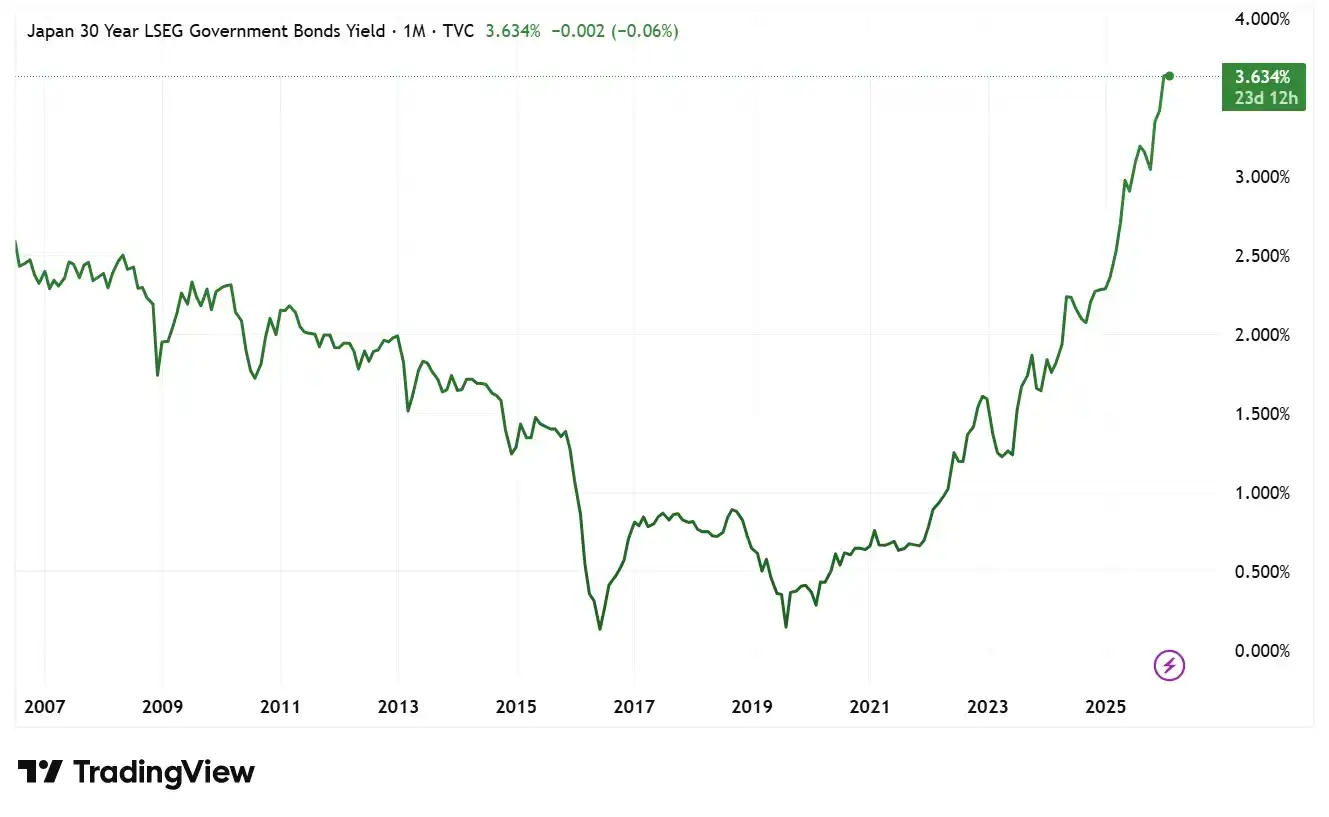
On January 20, 2026, the Japanese Government Bond (JGB) market entered a period of acute stress. The 30-year JGB yield surged over 30 basis points to 3.91%, its highest level in 27 years, following fiscal rhetoric from Prime Minister Sanae Takaichi that heightened concerns about debt sustainability. Japan's debt-to-GDP ratio has exceeded 250%, making it a focal point for global bond markets.

Figure 1: Japan 30-Year Government Bond Yield (Historical)
Source: TradingView

The immediate consequence was the rapid unwinding of the yen carry trade, one of the largest sources of cheap global leverage. As yen funding costs rose, investors were forced to liquidate risk assets to meet margin requirements. Bitcoin fell below $91,000 not due to crypto-specific weakness, but because it served as a liquidity proxy for balance sheet repair.

Warsh Nomination and Monetary Repricing

This pressure escalated on January 30th with the nomination of Kevin Warsh as the next Federal Reserve Chair. Warsh's long-standing preference for higher real interest rates and a significant reduction of the Fed's balance sheet was interpreted as a clear shift away from accommodative monetary policy.

Within 24 hours, the total cryptocurrency market capitalization fell by about $430 billion. Bitcoin fell approximately 7% in a single trading session, while Ethereum and high-beta altcoins experienced double-digit percentage pullbacks. This move reflected a repricing of global dollar liquidity expectations, not speculative panic.

Price Action and Bitcoin's Identity Crisis

The macro shock revealed an uncomfortable truth about Bitcoin's evolution as an institutional asset. The last week of January produced one of the most severe single-day dislocations of the institutional era.

On January 29th, Bitcoin fell from $96,000 to $80,000, a drop of approximately 15% in a single day. The crypto derivatives market liquidated over $2.2 billion in leveraged positions. The significance of this move lies not in its magnitude, but in its correlation characteristics.

Bitcoin failed to decouple from stocks, instead trading in sync with high-beta tech stocks. During a global deleveraging event, it behaved not as a defensive asset, but as a liquidity-sensitive risk instrument.

By early February, sentiment indicators reflected extreme pessimism. The Crypto Fear & Greed Index dropped to 19, and key technical levels, including the 0.786 Fibonacci retracement at $85,400, were decisively broken. The high $70,000s range became the market's primary structural support zone.

Figure 2: Bitcoin Price Decline Driven by Global Macro Events (Jan-Feb 2026)

Source: AMINA Bank

The correlation characteristics raise fundamental questions about Bitcoin's role in institutional portfolios. If it behaves as a high-beta tech proxy rather than a defensive hedge during stress, the allocation thesis must adjust accordingly. Yet, institutional commitment continues regardless, suggesting mature allocators are pricing Bitcoin's long-term structural role, not its short-term correlation behavior.

Protocol Evolution and Competitive Differentiation

While prices fell and macro conditions worsened, foundational layer development continued unabated. This demonstrates a key feature of the current cycle: infrastructure development has decoupled from price momentum.

Ethereum remains focused on scaling through execution efficiency, censorship resistance, and MEV mitigation. The upcoming Glamsterdam upgrade aims to increase the gas limit to 200 million, approaching a throughput of nearly 10,000 TPS theoretically.

Solana is pursuing aggressive performance enhancements. Its Alpenglow upgrade aims to reduce transaction finality from 12.8 seconds to approximately 100-150 milliseconds, positioning it as one of the fastest settlement layers in production.

These technical advancements continue regardless of market sentiment, reflecting long-term capital commitment and engineering development independent of price action.

Security Losses Highlight Operational Risks

Even as institutional infrastructure matures, security incidents highlight ongoing operational vulnerabilities. January 2026 recorded over $370 million in stolen funds, the highest monthly total in nearly a year. Over $311 million in losses stemmed from phishing and social engineering attacks, not smart contract failures.

The single largest event, exceeding $280 million, involved AI-generated voice impersonation targeting hardware wallet users. These incidents emphasize a structural shift in risk. Human and operational vulnerabilities now represent the primary attack surface for institutional crypto participants.

This pattern reinforces why custody frameworks operating under regulatory oversight offer competitive advantages beyond compliance. Operational security protocols, institutional-grade key management, and insurance frameworks have become mandatory requirements.

Conclusion

The retracement of January-February 2026 is not a rejection of digital assets, but a repricing within a changing global monetary system. Crypto now reacts directly to sovereign bond markets, central bank leadership, and geopolitical escalation. This sensitivity introduces volatility, but it also confirms integration.

Simultaneously, institutional adoption, regulatory clarity, and protocol development advanced during the sell-off. Tokenization shifted from narrative to deployed infrastructure, wallet-native finance from theory to implementation.

Early 2026 did not mark a collapse of the crypto market. It marked its first real stress test of institutional maturity. While prices failed the test, the underlying infrastructure passed with flying colors.

The divergence between price action and structural progress will not persist indefinitely, as institutional deployment, regulatory clarification, and infrastructure maturity will ultimately be reflected in market valuations.


Perguntas relacionadas

QWhat was the key paradox observed in the crypto market in January 2026 according to the article?

AThe key paradox was that while crypto prices fell by 25%, the infrastructure supporting institutional adoption was accelerating.

QWhich major financial institution listed digital assets as a definitive investment theme for 2026, alongside AI?

ABlackRock listed digital assets and tokenization as a definitive investment theme for 2026, alongside AI.

QWhat major macroeconomic event in Japan triggered a global deleveraging event that impacted crypto prices?

AAcute stress in the Japanese Government Bond (JGB) market, where 30-year JGB yields surged over 30 basis points to 3.91%, triggered a rapid unwinding of yen carry trades and forced liquidations of risk assets like crypto.

QWhat significant policy change did the SEC make regarding digital asset custody services?

AThe SEC rescinded previous accounting guidance that had prevented banks from offering digital asset custody services.

QHow did Bitcoin's price behavior during the January 2026 sell-off challenge its perceived role as an institutional asset?

ABitcoin failed to act as a defensive asset or decouple from equities. Instead, it traded in sync with high-beta tech stocks, behaving like a liquidity-sensitive risk tool during a global deleveraging event, which raised questions about its role in institutional portfolios.

Leituras Relacionadas

North Korean Hackers Loot $500 Million in a Single Month, Becoming the Top Threat to Crypto Security

North Korean hackers, particularly the notorious Lazarus Group and its subgroup TraderTraitor, have stolen over $500 million from cryptocurrency DeFi platforms in less than three weeks, bringing their total theft for the year to over $700 million. Recent major attacks on Drift Protocol and KelpDAO, resulting in losses of approximately $286 million and $290 million respectively, highlight a strategic shift: instead of targeting core smart contracts, attackers are now exploiting vulnerabilities in peripheral infrastructure. For instance, the KelpDAO attack involved compromising downstream RPC infrastructure used by LayerZero's decentralized validation network (DVN), allowing manipulation without breaching core cryptography. This sophisticated approach mirrors advanced corporate cyber-espionage. Additionally, North Korea has systematically infiltrated the global crypto workforce, with an estimated 100 operatives using fake identities to gain employment at blockchain companies, enabling long-term access to sensitive systems and facilitating large-scale thefts. According to Chainalysis, North Korean-linked hackers stole a record $2 billion in 2025, accounting for 60% of all global crypto theft that year. Their total historical crypto theft has reached $6.75 billion. Post-theft, they employ specialized money laundering methods, heavily relying on Chinese OTC brokers and cross-chain mixing services rather than standard decentralized exchanges. Security experts, while acknowledging the increased sophistication, emphasize that many attacks still exploit fundamental weaknesses like poor access controls and centralized operational risks. Strengthening private key management, limiting privileged access, and enhancing coordination among exchanges, analysts, and law enforcement immediately after an attack are critical to improving defense and fund recovery chances. The industry's challenge now extends beyond secure smart contracts to safeguarding operational security at the infrastructure level.

marsbitHá 29m

North Korean Hackers Loot $500 Million in a Single Month, Becoming the Top Threat to Crypto Security

marsbitHá 29m

Circle CEO's Seoul Visit: No Korean Won Stablecoin Issuance, But Met All Major Korean Banks

Circle CEO Jeremy Allaire's recent activities in Seoul indicate a strategic shift for the company, moving away from issuing a Korean won-backed stablecoin and instead focusing on embedding itself as a key infrastructure provider within Korea’s financial and crypto ecosystem. Despite Korea accounting for nearly 30% of global crypto trading volume—with a market characterized by high retail participation and altcoin dominance—Circle has chosen not to compete for the role of stablecoin issuer. Instead, Allaire met with major Korean banks (including Shinhan, KB, and Woori), financial groups, leading exchanges (Upbit, Bithumb, Coinone), and tech firms like Kakao. This approach reflects a broader industry transition: the core of stablecoin competition is shifting from issuance rights to systemic positioning. With Korean regulators still debating whether banks or tech companies should issue stablecoins, Circle is avoiding regulatory uncertainty by strengthening its role as a service and technology partner. The company is deepening integration with trading platforms, building connections, and promoting stablecoin infrastructure. This positions Circle to benefit regardless of which entity eventually issues a won stablecoin. Allaire also noted the potential for a Chinese yuan stablecoin in the next 3–5 years, underscoring a regional trend of stablecoins becoming more regulated and integrated with traditional finance. Ultimately, Circle’s strategy highlights that future influence in the stablecoin market will belong not necessarily to the issuers, but to the foundational infrastructure layers that enable cross-system transactions.

marsbitHá 57m

Circle CEO's Seoul Visit: No Korean Won Stablecoin Issuance, But Met All Major Korean Banks

marsbitHá 57m

SpaceX Ties Up with Cursor: A High-Stakes AI Gambit of 'Lock First, Acquire Later'

SpaceX has secured an option to acquire AI programming company Cursor for $60 billion, with an alternative clause requiring a $10 billion collaboration fee if the acquisition does not proceed. This structure is not merely a potential acquisition but a strategic move to control core access points in the AI era. The deal is designed as a flexible, dual-path arrangement, allowing SpaceX to either fully acquire Cursor or maintain a binding partnership through high-cost collaboration. This "option-style" approach minimizes immediate regulatory and integration risks while ensuring long-term alignment between the two companies. At its core, the transaction exchanges critical AI-era resources: SpaceX provides its Colossus supercomputing cluster—one of the world’s most powerful AI training infrastructures—while Cursor contributes its AI-native developer environment and strong product adoption. This synergy connects compute power, models, and application layers, forming a closed-loop AI capability stack. Cursor, founded in 2022, has achieved rapid growth with over $1 billion in annual revenue and widespread enterprise adoption. Its value lies in transforming software development through AI agents capable of coding, debugging, and system design—positioning it as a gateway to future software production. For SpaceX, this move is part of a broader strategy to evolve from a aerospace company into an AI infrastructure empire, integrating xAI, supercomputing, and chip manufacturing. Controlling Cursor fills a gap in its developer tooling layer, strengthening its AI narrative ahead of a potential IPO. The deal reflects a shift in AI competition from model superiority to ecosystem and entry-point control. With programming tools as a key battleground, securing developer loyalty becomes crucial for dominating the software production landscape. Risks include questions around Cursor’s valuation, technical integration challenges, and potential regulatory scrutiny. Nevertheless, the deal underscores a strategic bet: controlling both compute and software development access may redefine power dynamics in the AI-driven future.

marsbitHá 1h

SpaceX Ties Up with Cursor: A High-Stakes AI Gambit of 'Lock First, Acquire Later'

marsbitHá 1h

Trading

Spot
Futuros

Artigos em Destaque

O que é $BANK

Bank AI: Um Passo Revolucionário no Futuro da Banca Introdução Em uma era marcada por avanços rápidos na tecnologia, o Bank AI está na interseção da inteligência artificial (IA) e dos serviços bancários. Este projeto inovador visa redefinir o panorama financeiro, melhorando a eficiência operacional, as medidas de segurança e as experiências dos clientes através do poder da IA. Ao embarcarmos nesta exploração do Bank AI, iremos aprofundar no que o projeto implica, suas dinâmicas operacionais, seu contexto histórico e marcos significativos. O que é o Bank AI? No seu cerne, o Bank AI representa uma iniciativa transformadora com o objetivo de integrar a inteligência artificial em várias operações bancárias. Este projeto aproveita as capacidades da IA para automatizar processos, melhorar os protocolos de gestão de risco e melhorar a interação com os clientes através de serviços personalizados. Os principais objetivos do Bank AI incluem: Automatização das Funções Bancárias: Ao aproveitar as tecnologias de IA, o Bank AI visa automatizar tarefas rotineiras, reduzindo o peso sobre os recursos humanos e aumentando a eficiência. Gestão de Risco Melhorada: O projeto utiliza algoritmos de IA para prever e identificar riscos, fortalecendo assim as medidas de segurança contra fraudes e outras ameaças. Personalização dos Serviços Bancários: O Bank AI foca em oferecer produtos e serviços financeiros ajustados, analisando dados e comportamentos dos clientes. Melhoria da Experiência do Cliente: A implementação de soluções impulsionadas por IA, como chatbots e assistentes virtuais, visa proporcionar aos usuários interações mais humanizadas, revolucionando a forma como os clientes se envolvem com os bancos. Com esses objetivos, o Bank AI posiciona-se como um ator crucial para tornar a banca mais eficiente, segura e centrada no usuário. Quem é o Criador do Bank AI? Os detalhes sobre o criador do Bank AI permanecem desconhecidos. Assim, nenhuma pessoa ou organização específica foi identificada nas informações disponíveis. O anonimato que cerca a origem do projeto levanta questões, mas não diminui a sua ambiciosa visão e objetivos. Quem são os Investidores do Bank AI? Semelhante ao criador do projeto, informações específicas sobre os investidores ou organizações que apoiam o Bank AI não foram divulgadas. Sem essas informações, é difícil delinear o apoio financeiro e institucional que pode estar impulsionando o projeto para frente. No entanto, a importância de ter uma sólida base de investimento é fundamental para sustentar o desenvolvimento em um campo tão inovador. Como Funciona o Bank AI? O Bank AI opera em várias frentes inovadoras, focando em fatores únicos que o diferenciam das estruturas bancárias tradicionais. Abaixo estão as principais características operacionais: Automatização: Ao aplicar algoritmos de aprendizado de máquina, o Bank AI automatiza vários processos manuais dentro dos bancos. Isso resulta na redução dos custos operacionais e permite que os trabalhadores humanos redirecionem os seus esforços para atividades mais estratégicas. Gestão de Risco Avançada: A integração da IA nas práticas de gestão de risco equipa os bancos com ferramentas para prever com precisão potenciais ameaças, como fraudes, garantindo que as informações e ativos dos clientes permaneçam seguros. Recomendações Financeiras Personalizadas: Através do aprendizado contínuo a partir das interações com os clientes, os sistemas de IA desenvolvem uma compreensão sutil das necessidades dos usuários, permitindo oferecer conselhos adaptados sobre decisões financeiras. Interações Melhoradas com os Clientes: Utilizando chatbots e assistentes virtuais alimentados por IA, o Bank AI permite uma experiência de cliente mais envolvente, permitindo que os usuários tenham suas dúvidas resolvidas rapidamente, reduzindo assim os tempos de espera e melhorando os níveis de satisfação. Juntas, estas características operacionais posicionam o Bank AI como um pioneiro no setor bancário, estabelecendo novos padrões para a prestação de serviços e a excelência operacional. Cronologia do Bank AI Compreender a trajetória do Bank AI requer uma análise do seu contexto histórico. Abaixo está uma cronologia que destaca marcos e desenvolvimentos importantes: Início de 2010: A conceituação da integração da IA nos serviços bancários começou a ganhar atenção à medida que instituições bancárias reconheciam os potenciais benefícios. 2018: Ocorreu um aumento significativo na implementação de tecnologias de IA, quando os bancos começaram a usar ferramentas de IA como chatbots para atendimento ao cliente básico e sistemas de gestão de risco para melhorar o tratamento de segurança. 2023: A sofisticação da IA continuou a avançar, com a introdução de IA generativa para tarefas mais complexas, como processamento de documentos e análise de investimentos em tempo real. Este ano marcou um salto significativo nas capacidades proporcionadas aos bancos pela tecnologia de IA. 2024-Estado Atual: Neste ano, o Bank AI está em uma trajetória ascendente, com pesquisas e desenvolvimentos em andamento prontos para aprimorar ainda mais as capacidades nas operações bancárias. A exploração contínua das aplicações de IA sugere desenvolvimentos emocionantes por vir. Pontos Chave Sobre o Bank AI Integração da IA na Banca: O Bank AI foca na adoção da inteligência artificial para simplificar os processos bancários e melhorar as experiências dos usuários. Automatização e Foco em Gestão de Risco: O projeto enfatiza fortemente essas áreas, visando transferir o peso das tarefas rotineiras enquanto melhora as estruturas de segurança através de análises preditivas. Soluções Bancárias Personalizadas: Ao aproveitar os dados dos clientes, o Bank AI possibilita serviços bancários ajustados que atendem às necessidades individuais dos usuários. Compromisso com o Desenvolvimento: O Bank AI permanece comprometido com contínuas pesquisas e esforços de desenvolvimento, garantindo a sua adaptabilidade e relevância contínua à medida que a tecnologia continua a evoluir. Conclusão Em resumo, o Bank AI exemplifica um passo crucial em frente na indústria bancária, aproveitando a inteligência artificial para remodelar paradigmas operacionais, melhorar a segurança e promover a satisfação do cliente. Apesar das lacunas de informação em torno do criador e dos investidores, os objetivos claros e os mecanismos funcionais do Bank AI fornecem uma base sólida para sua evolução contínua. À medida que a tecnologia de IA continua a avançar e se fundir com o setor bancário, o Bank AI está bem posicionado para impactar significativamente o futuro dos serviços financeiros, aprimorando a maneira como entendemos e interagimos com a banca.

40 Visualizações TotaisPublicado em {updateTime}Atualizado em 2024.12.03

O que é $BANK

Como comprar BANK

Bem-vindo à HTX.com!Tornámos a compra de Lorenzo Protocol (BANK) simples e conveniente.Segue o nosso guia passo a passo para iniciar a tua jornada no mundo das criptos.Passo 1: cria a tua conta HTXUtiliza o teu e-mail ou número de telefone para te inscreveres numa conta gratuita na HTX.Desfruta de um processo de inscrição sem complicações e desbloqueia todas as funcionalidades.Obter a minha contaPasso 2: vai para Comprar Cripto e escolhe o teu método de pagamentoCartão de crédito/débito: usa o teu visa ou mastercard para comprar Lorenzo Protocol (BANK) instantaneamente.Saldo: usa os fundos da tua conta HTX para transacionar sem problemas.Terceiros: adicionamos métodos de pagamento populares, como Google Pay e Apple Pay, para aumentar a conveniência.P2P: transaciona diretamente com outros utilizadores na HTX.Mercado de balcão (OTC): oferecemos serviços personalizados e taxas de câmbio competitivas para os traders.Passo 3: armazena teu Lorenzo Protocol (BANK)Depois de comprar o teu Lorenzo Protocol (BANK), armazena-o na tua conta HTX.Alternativamente, podes enviá-lo para outro lugar através de transferência blockchain ou usá-lo para transacionar outras criptomoedas.Passo 4: transaciona Lorenzo Protocol (BANK)Transaciona facilmente Lorenzo Protocol (BANK) no mercado à vista da HTX.Acede simplesmente à tua conta, seleciona o teu par de trading, executa as tuas transações e monitoriza em tempo real.Oferecemos uma experiência de fácil utilização tanto para principiantes como para traders experientes.

364 Visualizações TotaisPublicado em {updateTime}Atualizado em 2025.05.09

Como comprar BANK

Discussões

Bem-vindo à Comunidade HTX. Aqui, pode manter-se informado sobre os mais recentes desenvolvimentos da plataforma e obter acesso a análises profissionais de mercado. As opiniões dos utilizadores sobre o preço de BANK (BANK) são apresentadas abaixo.

活动图片