Israeli Military Catching Insiders on Polymarket

Odaily星球日报Publicado em 2026-02-13Última atualização em 2026-02-13

Resumo

Israeli military and civilian prosecutors have charged a reservist soldier and a civilian with using classified military information to profit from bets on the prediction market platform Polymarket. The suspects allegedly leveraged insider knowledge on the timing of military operations to place winning bets, netting over $150,000. One user, identified as "Rundeep," reportedly achieved a 100% success rate in six Israel-related predictions, often betting when odds were below 50%. The case highlights concerns about insider trading on prediction markets, especially regarding sensitive areas like military actions, where such activities could compromise operational security and potentially influence real-world outcomes. Regulatory scrutiny may follow as these platforms face growing scrutiny over their role in public affairs betting.

Original | Odaily Planet Daily (@OdailyChina)

Author | Azuma (@azuma_eth)

Insider information providing an unfair competitive advantage has long been a controversial focus on prediction markets like Polymarket.

Previously, during the US military's operation to capture Venezuelan President Maduro, the odds for related events on Polymarket showed abnormal movements ahead of time (see "When War is Settled Before the News: How Prediction Markets 'Priced' the Maduro Capture Operation 6 Days Early"). If that suspected insider activity could still be explained away by fluctuations in the "Pizza Index," then this time, it can be said that there is definitely an insider on Polymarket, completely confirmed.

Israeli Military Catching "Insiders" Internally

On February 12, Israel's largest English-language newspaper, The Jerusalem Post, reported that the Tel Aviv District Court indicted an Israeli civilian and an Israel Defense Forces (IDF) reservist on Monday, accusing the two of using classified military information to place bets on Polymarket for profit. The court revealed on Thursday that Israeli authorities believe this behavior poses a serious operational security risk during wartime.

According to a statement approved for release by the prosecution, the suspects were arrested in a joint operation by the Israel Security Agency (Shin Bet), the investigation unit under the Ministry of Defense's security agency, and the Israeli police. Investigators suspect that some reservists are using the classified information they access through their military duties to bet on the timing of military operations and profit from it.

Following the investigation, the prosecution stated that it has obtained evidence of misconduct by the civilian and the reservist and has therefore decided to indict the two on charges of "serious security crimes" as well as bribery and obstruction of justice. Meanwhile, the prosecution requested the court to extend the suspects' detention until the conclusion of the trial.

Apart from the information released above, more details of the case remain under a legal gag order, including the identities of the defendants, the specific betting content, and the alleged information flow situation.

Tracing the Insider's Activities

Although we cannot learn the true identity and account information of this insider, the X community had already discovered an account on Polymarket with clearly abnormal behavior. The Jerusalem Post also included a screenshot of this account's profits in its report.
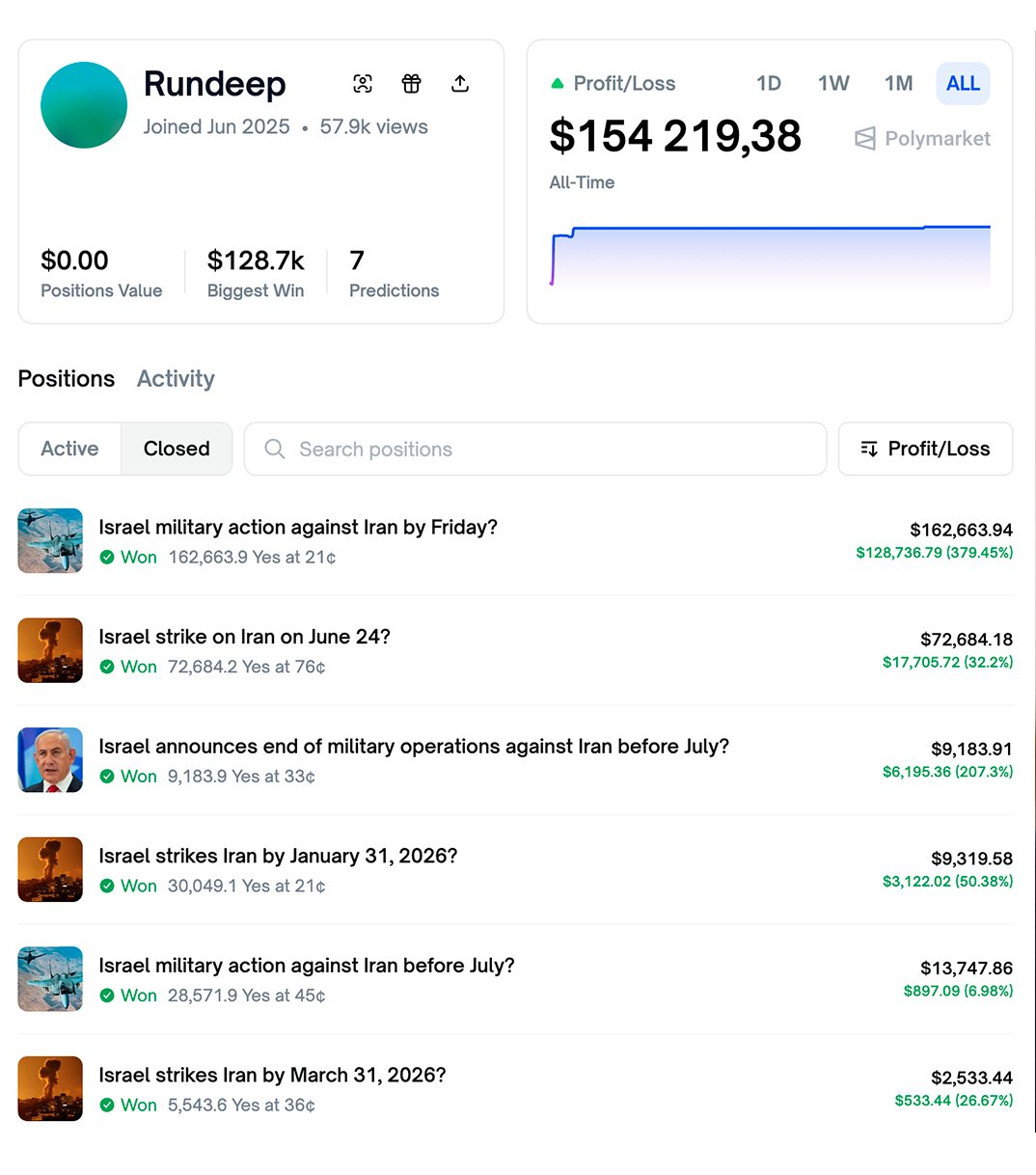
As shown in the image above, this user named Rundeep joined Polymarket in June 2025 and subsequently achieved a 100% win rate in six prediction markets related to Israeli military actions, with five of those bets placed when the probability was below 50%, ultimately profiting over $150,000.

It is worth mentioning that Odaily Planet Daily found that Rundeep had only one loss on Polymarket aside from these "six wins in six attempts." However, this failed prediction was not directly related to Israel but was about "whether the US military would take action against Iran before Saturday (June 21, 2025)"... It seems allied intelligence isn't very reliable after all.

The Real-World Repercussions of Prediction Markets, Truly Frightening to Ponder

Due to Polymarket's open, permissionless nature, anyone can freely place bets on the platform, which objectively provides a more convenient channel for "monetizing information" for those with intelligence advantages — driven by profit, those holding unequal information advantages find it hard to resist the temptation, making it inevitable that insiders will step in to make money.

If such things happened in conventional areas like sports or entertainment, the impact might still be somewhat controllable. But when similar insider betting events occur in sensitive areas like politics or even war, the potential连带 (liándài -连带 means连带, chain, related) terrifying consequences are hard to imagine.

Taking this article as an example, if opposing forces guessed the direction of an Israeli operation in advance through insider betting on Polymarket before the action took place, could it have a huge impact on the subsequent evolution of events? Most people might not easily sympathize with Israel, but in fact, such events could happen to any entity.

In traditional gambling, public affairs such as political elections, legislative outcomes, and wars are usually subject to clear restrictions. Whether prediction markets will face similar regulatory restrictions in the future may involve a long-term regulatory博弈 (bóyì -博弈 means game theory,博弈, struggle,博弈).


Perguntas relacionadas

QWhat is the main subject of the article regarding the Israeli military and Polymarket?

AThe article reports that the Israeli military is prosecuting a civilian and an IDF reservist for allegedly using classified military information to place bets and profit on the prediction market platform Polymarket.

QWhich user on Polymarket was identified by the X community as having suspiciously successful betting activity related to Israeli military actions?

AA user named Rundeep was identified, who achieved a 100% win rate across six prediction markets related to Israeli military actions, with five of those bets placed when the probability was below 50%, earning over $150,000.

QWhat potential risk does the article suggest that insider betting on platforms like Polymarket could pose in the context of military operations?

AThe article suggests that insider betting could pose a severe operational security risk in wartime, as opposing forces might detect upcoming military actions by observing suspicious betting patterns on the prediction market, potentially altering the course of events.

QWhat was the outcome of the single bet that the user Rundeep lost on Polymarket, and what was it about?

ARundeep's only lost bet was on the prediction 'Will the US military take action against Iran by Saturday (June 21, 2025)?', which was not directly related to Israeli operations.

QHow does the article contrast the regulation of traditional betting markets with prediction markets like Polymarket concerning public affairs?

AThe article notes that traditional betting markets often have explicit restrictions on public affairs like political elections, legislation, and war, and it suggests that prediction markets may face a long-term regulatory battle over similar restrictions in the future.

Leituras Relacionadas

As Consensus Accelerates, What Are Young Investors Betting On?

Title: As Consensus Forms Faster, What Are Young Investors Betting On? In the rapid evolution of tech investment, a new generation of young investors is navigating a landscape where AI, robotics, commercial aerospace, and quantum computing are advancing simultaneously. Traditional investment logic based on financial models is giving way to a need for deep technical understanding and the ability to act before industry consensus forms. An analysis of trends from the "WAIC FUTURE TECH" list of young investment leaders reveals key shifts in focus. The first major trend is the movement of AI from the digital screen into the physical world. Investment is shifting from large language models and chatbots towards embodied AI, robotics, AI hardware, and edge computing. While demonstrations generate excitement, the real challenge lies in achieving scalable, reliable, and cost-effective delivery in complex real-world environments like factories and logistics. Success depends not just on algorithms but on the integration of sensors, actuators, and control systems. Second, the competitive focus for large models is moving beyond raw capability toward building an "intelligence flywheel." The goal is to create self-reinforcing systems where user interaction generates data, improving the model, which in turn enhances the user experience and attracts more engagement. Companies that successfully embed AI into workflows to create these closed-loop systems can build lasting value that isn't easily erased by the next model upgrade. Third, facing a potential bottleneck in high-quality human-generated data, investors are looking at new underlying technologies. Reinforcement learning and self-play, as demonstrated by AlphaGo Zero, offer paths for AI to generate its own experience. Scientific foundation models, which aim to build general AI capabilities for fields like life sciences and materials discovery, represent a non-consensus direction that could unlock new frontiers of knowledge and data. Finally, in deep-tech areas like quantum computing, commercial aerospace, and space-based infrastructure, patient capital is essential. These fields have long, uncertain development and validation cycles involving complex engineering, supply chains, and regulations. Investment here requires a long-term view, focusing on foundational team capabilities and the eventual emergence of market demand, even if commercial returns are distant. Collectively, these trends illustrate how young investors are adapting to a new era. They are learning to make earlier, technically-informed judgments, balance hype with real-world viability, and provide the patient capital needed to build the deep-tech foundations of the future.

marsbitHá 4m

As Consensus Accelerates, What Are Young Investors Betting On?

marsbitHá 4m

Can Japan Buy Growth with AI? Will the Bond Market Believe It?

Japan's cabinet has introduced the 2026 Basic Policy on Economic and Fiscal Management and Reform, shifting its primary fiscal target. The new framework moves away from the traditional annual primary balance goal and instead prioritizes a stable reduction of the debt-to-GDP ratio. This change is tied to a strategy of increased "responsible proactive fiscal" spending, aiming to boost long-term growth through investments in strategic sectors like AI, semiconductors, energy, and robotics. The government estimates total public and private investment in 62 key technologies could exceed 370 trillion yen by 2040. The market reaction has been mixed and cautious. While equity markets may respond to policy signals, bond markets are focused on fiscal credibility. Concerns center on whether the weakening of the clear primary balance anchor could lead to looser fiscal discipline. If investors doubt that these strategic investments will generate sufficient productivity gains, tax revenue, and nominal growth to outpace rising interest costs, they may demand higher yields on Japanese Government Bonds (JGBs). Recent volatility in the yen and JGB yields, with the 10-year yield briefly reaching 2.9%, reflects this skepticism. The success of this new framework hinges on two factors: whether Japan can achieve a nominal growth rate consistently higher than its long-term interest rates, and whether future budgets demonstrate disciplined control over bond issuance. The government's narrative is that strategic investment is essential to break Japan's cycle of low growth, aging, and labor shortages. However, the bond market will continuously assess the credibility of this plan, pricing the risk that it may represent fiscal expansion rather than a viable growth strategy.

marsbitHá 41m

Can Japan Buy Growth with AI? Will the Bond Market Believe It?

marsbitHá 41m

Misjudged A-Shares: Resilience, Expectations, and Confidence

China's A-share market recently faced selling pressure, especially in tech sectors, initially triggered by a global tech sell-off that began in South Korea. However, the article argues this is a case of "mistaken injury" and highlights the market's underlying resilience. This resilience stems from three main pillars: **1) Tech Sector Fundamentals:** Unlike Korea's market dominated by a few memory chip stocks, China's tech sector is diversified across computing, communications, electronics, and semiconductors, supported by dual narratives of global AI supply chains and domestic substitution. Core areas like optical modules and fiber optics continue to show strong earnings growth. **2) "National Team" Support:** State-backed institutions and large corporations have made significant market purchases and announced buybacks, providing liquidity and signaling confidence. This is seen as a stabilizing policy signal, often associated with market bottoms. **3) Broader Market Pillars:** Other major sectors are showing endogenous recovery momentum. Consumer stocks benefit from stabilizing CPI and signs of sector recovery (e.g., liquor price hikes). Cyclical sectors like aluminum have high earnings, potential price increases due to tight supply, and low valuations. The financial sector offers stable dividends and low valuations. The conclusion is that the sell-off was driven by external contagion, not a collapse in fundamentals. With strong policy support and recovering momentum across key sectors, the A-share market possesses the toughness to regain stability.

marsbitHá 1h

Misjudged A-Shares: Resilience, Expectations, and Confidence

marsbitHá 1h

Trading

Spot
活动图片




