Israeli Military Catching Insiders on Polymarket

Odaily星球日报Publicado em 2026-02-13Última atualização em 2026-02-13

Resumo

Israeli military and civilian prosecutors have charged a reservist soldier and a civilian with using classified military information to profit from bets on the prediction market platform Polymarket. The suspects allegedly leveraged insider knowledge on the timing of military operations to place winning bets, netting over $150,000. One user, identified as "Rundeep," reportedly achieved a 100% success rate in six Israel-related predictions, often betting when odds were below 50%. The case highlights concerns about insider trading on prediction markets, especially regarding sensitive areas like military actions, where such activities could compromise operational security and potentially influence real-world outcomes. Regulatory scrutiny may follow as these platforms face growing scrutiny over their role in public affairs betting.

Original | Odaily Planet Daily (@OdailyChina)

Author | Azuma (@azuma_eth)

Insider information providing an unfair competitive advantage has long been a controversial focus on prediction markets like Polymarket.

Previously, during the US military's operation to capture Venezuelan President Maduro, the odds for related events on Polymarket showed abnormal movements ahead of time (see "When War is Settled Before the News: How Prediction Markets 'Priced' the Maduro Capture Operation 6 Days Early"). If that suspected insider activity could still be explained away by fluctuations in the "Pizza Index," then this time, it can be said that there is definitely an insider on Polymarket, completely confirmed.

Israeli Military Catching "Insiders" Internally

On February 12, Israel's largest English-language newspaper, The Jerusalem Post, reported that the Tel Aviv District Court indicted an Israeli civilian and an Israel Defense Forces (IDF) reservist on Monday, accusing the two of using classified military information to place bets on Polymarket for profit. The court revealed on Thursday that Israeli authorities believe this behavior poses a serious operational security risk during wartime.

According to a statement approved for release by the prosecution, the suspects were arrested in a joint operation by the Israel Security Agency (Shin Bet), the investigation unit under the Ministry of Defense's security agency, and the Israeli police. Investigators suspect that some reservists are using the classified information they access through their military duties to bet on the timing of military operations and profit from it.

Following the investigation, the prosecution stated that it has obtained evidence of misconduct by the civilian and the reservist and has therefore decided to indict the two on charges of "serious security crimes" as well as bribery and obstruction of justice. Meanwhile, the prosecution requested the court to extend the suspects' detention until the conclusion of the trial.

Apart from the information released above, more details of the case remain under a legal gag order, including the identities of the defendants, the specific betting content, and the alleged information flow situation.

Tracing the Insider's Activities

Although we cannot learn the true identity and account information of this insider, the X community had already discovered an account on Polymarket with clearly abnormal behavior. The Jerusalem Post also included a screenshot of this account's profits in its report.
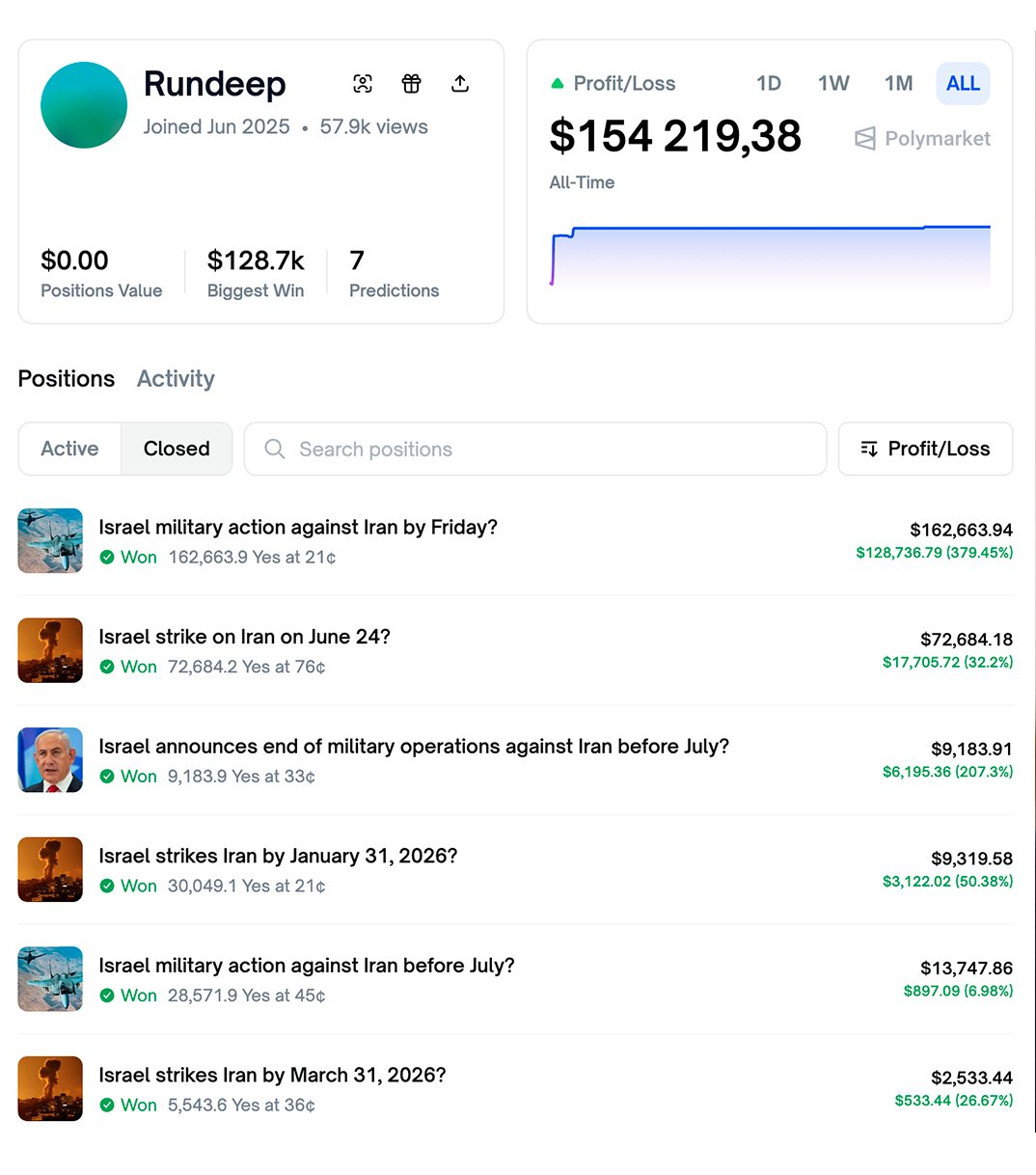
As shown in the image above, this user named Rundeep joined Polymarket in June 2025 and subsequently achieved a 100% win rate in six prediction markets related to Israeli military actions, with five of those bets placed when the probability was below 50%, ultimately profiting over $150,000.

It is worth mentioning that Odaily Planet Daily found that Rundeep had only one loss on Polymarket aside from these "six wins in six attempts." However, this failed prediction was not directly related to Israel but was about "whether the US military would take action against Iran before Saturday (June 21, 2025)"... It seems allied intelligence isn't very reliable after all.

The Real-World Repercussions of Prediction Markets, Truly Frightening to Ponder

Due to Polymarket's open, permissionless nature, anyone can freely place bets on the platform, which objectively provides a more convenient channel for "monetizing information" for those with intelligence advantages — driven by profit, those holding unequal information advantages find it hard to resist the temptation, making it inevitable that insiders will step in to make money.

If such things happened in conventional areas like sports or entertainment, the impact might still be somewhat controllable. But when similar insider betting events occur in sensitive areas like politics or even war, the potential连带 (liándài -连带 means连带, chain, related) terrifying consequences are hard to imagine.

Taking this article as an example, if opposing forces guessed the direction of an Israeli operation in advance through insider betting on Polymarket before the action took place, could it have a huge impact on the subsequent evolution of events? Most people might not easily sympathize with Israel, but in fact, such events could happen to any entity.

In traditional gambling, public affairs such as political elections, legislative outcomes, and wars are usually subject to clear restrictions. Whether prediction markets will face similar regulatory restrictions in the future may involve a long-term regulatory博弈 (bóyì -博弈 means game theory,博弈, struggle,博弈).


Perguntas relacionadas

QWhat is the main subject of the article regarding the Israeli military and Polymarket?

AThe article reports that the Israeli military is prosecuting a civilian and an IDF reservist for allegedly using classified military information to place bets and profit on the prediction market platform Polymarket.

QWhich user on Polymarket was identified by the X community as having suspiciously successful betting activity related to Israeli military actions?

AA user named Rundeep was identified, who achieved a 100% win rate across six prediction markets related to Israeli military actions, with five of those bets placed when the probability was below 50%, earning over $150,000.

QWhat potential risk does the article suggest that insider betting on platforms like Polymarket could pose in the context of military operations?

AThe article suggests that insider betting could pose a severe operational security risk in wartime, as opposing forces might detect upcoming military actions by observing suspicious betting patterns on the prediction market, potentially altering the course of events.

QWhat was the outcome of the single bet that the user Rundeep lost on Polymarket, and what was it about?

ARundeep's only lost bet was on the prediction 'Will the US military take action against Iran by Saturday (June 21, 2025)?', which was not directly related to Israeli operations.

QHow does the article contrast the regulation of traditional betting markets with prediction markets like Polymarket concerning public affairs?

AThe article notes that traditional betting markets often have explicit restrictions on public affairs like political elections, legislation, and war, and it suggests that prediction markets may face a long-term regulatory battle over similar restrictions in the future.

Leituras Relacionadas

Dan Koe: The Counterintuitive Truth—You Don't Need to Remember Everything You Read

Dan Koe: The Counterintuitive Truth — You Don't Need to Remember Everything You Read The central idea is that deliberately trying to remember information is often misguided. True learning isn't about memorizing facts but about having important knowledge surface naturally when needed through use. Most forgetting is normal, not a failure. The article reframes learning using a control theory framework—a four-step feedback loop: having a clear Goal, accurately Sensing your current state, Comparing the gap, and Acting to close it. Most learning stalls because people only do step 2 (blind input) without a goal to create the necessary "error signal" for focused action. The most effective method is to start with output, not input. Begin a meaningful personal project first, and learn only what's necessary to complete it. This project-driven, "just-in-time" learning ensures knowledge is contextual and retained. The concept of a "Second Brain" often fails because it becomes a digital graveyard—over-collected and under-utilized. The goal should be building a "Second Subconscious"—a dynamic system that proactively surfaces relevant ideas during creation, not a static storage vault. Tools like Obsidian+Claude or Eden can help by automating organization and enabling semantic search, but their value depends on linking knowledge to active projects. Ultimately, what matters is not what you store, but what you filter and internalize. Focus on ideas that shape your worldview, use projects as filters, and transform collected material through writing and sharing. AI should be used to reduce friction in research and editing, not to formulate your core views. In conclusion, remembering is a byproduct, not the goal. Knowledge that sticks comes from pursuing personal goals, applying it in real projects, and digesting it through creation. The tools are merely aids; the crucial step is to start doing meaningful work and let the necessary knowledge find you.

marsbitHá 56m

Dan Koe: The Counterintuitive Truth—You Don't Need to Remember Everything You Read

marsbitHá 56m

A New Era: The Fundamental Transformation of China's Entrepreneurs

A profound generational shift is underway among Chinese entrepreneurs. The wealth and influence once dominated by real estate and internet giants is now being claimed by a new wave of founders driving breakthroughs in AI, semiconductors, and robotics. This change is vividly reflected in 2026's wealth rankings. Figures like Zhang Yiming (ByteDance), Liang Wenfeng (DeepSeek), Chen Tianshi (Cambricon), and Wang Xingxing (Unitree Robotics) are ascending. Their wealth stems not from traditional business models but from market expectations for future technological competitiveness, with AI, chips, and smart hardware becoming the primary engines of wealth creation. Their common trait is a foundational focus on technology, often starting from the laboratory rather than a business plan. Examples include Chen Tianshi's decade-long push in AI chips, Liang Wenfeng's core algorithmic innovations at DeepSeek with a compact team, and Zhu Yiming's "no salary until profitable" 9-year journey to build Changxin Memory into a global DRAM player. This transition marks a fundamental shift in China's economic imperative: from commercial expansion and learning to indigenous innovation and deep industrial capability. While the previous generation built the foundational market and infrastructure, this new cohort is tasked with achieving global leadership in core technologies, moving China from "keeping pace" to pioneering original, breakthrough innovations that are industrialized at scale. The baton is being passed to those competing on the world stage through technological originality.

marsbitHá 56m

A New Era: The Fundamental Transformation of China's Entrepreneurs

marsbitHá 56m

Once-Popular Web3 Enters Wave of Layoffs

The once-hot Web3 industry is experiencing a severe wave of layoffs. While many companies attribute job cuts to AI-driven restructuring, the primary reason is often financial pressure. The Web3 sector, at the intersection of tech and finance, has been hit particularly hard. Employees at major cryptocurrency exchanges report sudden, impersonal layoffs—often with system access revoked overnight—and minimal or no severance. Common tactics include setting impossible performance targets or terminating employees for minor policy violations. The working atmosphere has become toxic, marked by intense monitoring, excessive meetings, and management obsessed with control and internal politics rather than product innovation. The industry's core business model is collapsing. Exchange revenue from trading fees and listing charges has plummeted due to a decline in quality projects and retail investor exodus. Events like the massive forced liquidation on October 10th further shattered confidence. Competition from on-chain derivatives platforms and prediction markets is intensifying the downturn. As layoffs continue, displaced workers struggle to find new opportunities. Many transition to the AI sector, but face significant bias from traditional finance and even some AI firms, which view crypto industry experience with suspicion. The current downturn appears more structural than cyclical, driven by unsustainable practices, internal strife, and a failure to innovate, raising questions about the industry's future trajectory.

marsbitHá 1h

Once-Popular Web3 Enters Wave of Layoffs

marsbitHá 1h

Trading

Spot
活动图片