Is XRP Poised To Replace SWIFT As Global Payments Infrastructure?

bitcoinistPublicado em 2026-02-08Última atualização em 2026-02-08

Resumo

The article examines the potential for XRP and Ripple's payment infrastructure to replace the SWIFT network as the global standard for cross-border payments. It highlights SWIFT's limitations in real-time settlement and discusses a significant shift towards faster, digital financial systems. Crypto analyst Archie suggests SWIFT is now testing integration with the XRP Ledger, mimicking Ripple's approach. Analysts speculate that if XRP captures even a small portion of SWIFT's massive annual transaction flow, its value could surge dramatically, with some predictions reaching over $3,000. The piece also draws parallels between XRP's current market cycle and its historic 2016-2018 breakout, noting similar price consolidation and indicator patterns that may signal another major bull run. The integration of Ripple's stablecoin, RLUSD, into core banking platforms is further bridging crypto and traditional finance.

For decades, SWIFT has served as the backbone of global payments, enabling banks to message one another across borders but not to settle value in real time. As global commerce becomes faster, more digital, and more interconnected, the limitations of legacy messaging-based systems are becoming increasingly visible. This has brought renewed attention to XRP and Ripple’s payment infrastructure that aims to enable near-instant, low-cost settlement of value.

From Bank Messaging To Real-Time Settlement Rails

A massive 1.5 quadrillion financial shift is quietly unfolding, and it’s already shaking the foundations of global banking. Crypto analyst Archie has mentioned on X that SWIFT, the decades-old backbone of cross-border payments, is copying Ripple’s playbook for a real-time transfer system and testing the XRP Ledger integration that could flip the script on slow, outdated cross-border payments.

Meanwhile, analysts are suggesting that if XRP captures even a fraction of SWIFT’s estimated $150 trillion annual flow by 2030, the upside could be enormous, while some stated that the altcoin might surge to $3,000+. With Ripple’s RLUSD stablecoin integrating directly into core banking and treasury platforms, the bridge between crypto rails and fiat liquidity is rapidly taking shape.

Currently, there’s a speculation that XRP is being reviewed as a full SWIFT replacement in the US document, and trillions are flowing into the XRP Ledger. Meanwhile, banks like Citi are tokenizing, and Ripple technology is capable of leading the charge. Archie believes that Citi is already somewhere running on Ripple technology.

How The Last Major XRP Breakout Took Shape

A side-by-side comparison chart of XRP’s historical and current market cycles suggests that history may be rhyming once again. Analyst Archie has also pointed out that in the 2016 to 2018 cycle, the price started trading at a low level around $0.003, gradually building along a rising trendline, then dipping in the orange box, before the price exploded to highs near $3.50.

During that period, the Relative Strength Index (RSI) formed a clear low around the 50 level, signaling a momentum reset rather than a breakdown. The current 2025 to 2027 cycle is showing a structurally similar pattern. XRP is consolidating around the dollar mark, following a similar trend line, with a dip marked in an orange box to $0.70, and the formed bottom closer to the 40 mark.
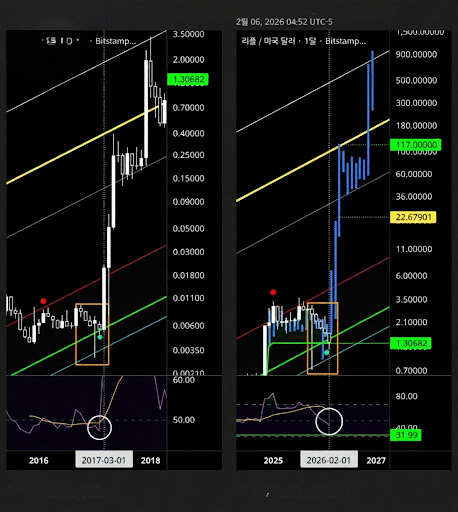
Source: Chart from Archie on X

Archie noted that the patterns in price action, the dips, and the indicator signals across cycles are repeating almost identically. While history never repeats perfectly, these recurring fractal patterns suggest that XRP may be priming for an epic bull run phase, from fractions to dollars, now potentially from dollars to triple digits, like the projected $117 range. Archie is bullish because the riddlers were right all along, and believes Phoenix will rise.

XRP trading at $1.40 on the 1D chart | Source: XRPUSDT on Tradingview.com

Perguntas relacionadas

QWhat is the main limitation of the current SWIFT system that XRP and Ripple aim to address?

ASWIFT enables banks to message one another across borders but does not settle value in real time, whereas XRP and Ripple's payment infrastructure aims to enable near-instant, low-cost settlement of value.

QAccording to the analyst Archie, what significant development is SWIFT undertaking regarding the XRP Ledger?

ASWIFT is copying Ripple's playbook for a real-time transfer system and testing the XRP Ledger integration to improve slow, outdated cross-border payments.

QWhat potential price target for XRP is mentioned if it captures a fraction of SWIFT's annual flow by 2030?

ASome analysts suggest that if XRP captures a fraction of SWIFT's estimated $150 trillion annual flow by 2030, the altcoin might surge to $3,000 or more.

QHow does the current market cycle for XRP (2025-2027) compare to its 2016-2018 cycle, according to the analysis?

AThe current cycle is showing a structurally similar pattern: XRP is consolidating around the dollar mark, following a similar trend line, with a dip to $0.70, mirroring the previous cycle where the price built along a trendline before exploding to highs near $3.50.

QWhat role does Ripple's RLUSD stablecoin play in the broader financial ecosystem, as mentioned in the article?

ARipple's RLUSD stablecoin is integrating directly into core banking and treasury platforms, which is rapidly building a bridge between crypto rails and fiat liquidity.

Leituras Relacionadas

Uncovering the Truth About Agent Commerce, Payments, and Infrastructure

Decoding Agent Commerce, Payments, and Infrastructure: The Reality Over the past year, I've been building infrastructure for the Agent economy, engaging with major players like Stripe, Visa, Coinbase, Google, and dozens of startups. A clear conclusion emerges: true, large-scale demand does not yet exist. Startups face structural challenges. Data points illustrate this gap. Stripe's Agent commerce platform has over 1,000 merchants but only single-digit transacting agents. Visa's Agent payment token requires 9-month KYC and a $250M revenue threshold, accessible only to giants like Amazon. On-chain analysis reveals actual daily Agent transaction volume is around $17k, half of which are test transactions. The article analyzes four potential markets: **1. Agent-to-Merchant (A2M):** Current AI shopping UX is often inferior to traditional e-commerce for visual, comparison-heavy purchases (clothing, electronics). Chat interfaces are a step back. Real merchant interest is defensive "Agent Engine Optimization," fearing future obsolescence, not current demand. Potential exists in high-frequency, low-decision purchases (e.g., food delivery) or simplifying terrible UX (complex checkouts, non-native shoppers), but these require massive consumer distribution channels dominated by giants like DoorDash and Amazon. **2. Agent-to-API (A2A):** Developers already have subscriptions and billing for core APIs (compute, data). The argument for micro-payments via crypto for sub-dollar API calls is addressed by pre-paid balances today. The deeper issue is supplier resistance; major SaaS firms rely on enterprise contracts, not fractional cent pricing. Opportunity lies in the long tail of niche services, but this is a smaller market catering to developers, a historically low-paying group. **3. Agent-to-Agent (A2A):** This remains a theoretical long-term vision with near-zero current transaction volume. It involves unique challenges: discovery, trust, negotiation, dispute resolution. When it materializes, it will require a fundamentally new settlement infrastructure for high-speed, variable-value, multi-party transactions. It's a real long-term bet, but not the current market. **4. Agent-to-Finance (A2F):** This is the only category with existing, paying demand. Integrating AI into financial workflows (trading, portfolio management) is a natural evolution and enables new capabilities like autonomous rebalancing. However, competition favors incumbents with regulatory licenses, compliance infrastructure, and existing client relationships. **The Real Issue:** Why is infrastructure still being built? Incumbents can afford long-term bets, and payment companies see every problem as a nail for their payment hammer. However, payment is just one piece. The core challenge is *coordination*—orchestrating work between Agents and humans, verifying outcomes, and settling results. Payment is part of settlement, which is part of coordination. Companies that solve the coordination problem will subsume payments, not the other way around. Startups lack the infinite runway of giants and must find today's real market, which, after a year of exploration, lies outside these four categories—in an area with real, growing, and underserved activity.

marsbitHá 5h

Uncovering the Truth About Agent Commerce, Payments, and Infrastructure

marsbitHá 5h

Trading

Spot
Futuros
活动图片





