Is Washington About To Kill Crypto Prediction Markets For Good? — Why Congress Suddenly Cares

bitcoinistPublicado em 2026-03-26Última atualização em 2026-03-26

Resumo

On March 25, two separate acts were introduced to ban U.S. congressional staff, members of Congress, and federal officials from trading on prediction markets. Representative Seth Moulton of Massachusetts issued an immediate office-wide ban, calling these markets “playgrounds for corrupt insiders” that create perverse incentives. Separately, Representatives Adrian Smith and Nikki Budzinski introduced the bipartisan PREDICT Act, which would prohibit elected officials, senior appointees, and their families from trading on political and policy outcome markets. Violators would face a 10% fine on the value of the trade and forfeiture of profits. The moves reflect growing concern in Washington over insider trading risks in prediction markets, especially following instances of traders making large profits on geopolitical events. These actions may lead to stricter regulations and increased scrutiny on crypto-based prediction platforms.

Two different acts banning congressional staff, members of congress and federal officials from trading on prediction markets were introduced on Wednesday, March 25, one of them being effective immediately.

Massachusetts Bans Crypto Prediction Market

Washington’s battle against prediction markets rages on. Following a bipartisan Senate bill introduced on Monday that targets sports‐style bets on platforms like Polymarket and Kalshi, democratic representative Seth Moulton of Massachusetts (MA-06) formally banned all of his staff from “participating in prediction markets”, such as the aforementioned, “to trade or hold positions on political, legislative, regulatory, geopolitical outcomes, or any information that is learned in an official capacity”. The press release frames it as the first such explicit office-wide ban in Congress.

Moulton’s rationale is clear: staff are meant to serve constituents, not profit from policy choices and global events. As he views it, prediction markets have become ethically questionable “playgrounds for corrupt insiders”:

Prediction markets have become a playground for corrupt insiders who are able to place bets on things like election outcomes, wars, and even the deaths of public figures. This is creating a perverse incentive structure that poses a genuine threat to American society today.

Congressional staff and the Members they work for exist to serve the constituents of the districts they represent, not to profit off of the very policy decisions and world events that we are here to respond to.

Nebraska Bans Crypto Prediction Market Too

On Nebraska’s side, Congressman Adrian Smith (R-NE-03) and Congresswoman Nikki Budzinski (D-IL-13) introduced the Preventing Real-time Exploitation and Deceptive Insider Congressional Trading Act (PREDICT Act), another bipartisan effort that aims to ban members of Congress, their spouses and children, the president and vice president, and senior appointees from trading on political and policy outcome markets.

Their core argument and statement are very similar to Moulton’s. Recent episodes of little‐known traders making massive profits on contracts tied to war with Iran or the length of government shutdowns have sharpened fears about insider information leaking into these markets. Smith said:

Serving the American people is a privilege, not a pathway to profit. Our commonsense, bipartisan bill will give Americans confidence that the decisions of their elected officials are guided by merit, not personal profit.

Budzinski added:

The American people are tired of politicians using their influence for personal gain, and the rise of prediction markets has made those concerns even more relevant. In recent months, we’ve seen instances of little-known traders making massive profits on events ranging from war with Iran to how long a government shutdown will last, raising necessary questions about the use of inside information.

Breaking the PREDICT Act would trigger a civil fine equal to 10% of the value of the banned trade, plus a requirement to hand over all profits from it to the U.S. Treasury, the announcement states.

A Growing Concern For Washington?

These new episodes come on top of earlier efforts like Rep. Ritchie Torres’s Financial Prediction Markets Public Integrity Act, following the capture of Venezuela’s former dictator Nicolás Maduro, which also targeted insider trading on platforms such as Polymarket.

For on‐chain and offshore prediction markets, a hard ban on US officials could actually de‐risk the space by reducing headline “insider” scandals, but it also raises the odds of stricter KYC and monitoring requirements in the US.

As it becomes increasingly clear that Washington has its attention set on ethically questionable crypto ventures, it is not too far-fetched to think that similar logic could be extended to other high‐beta crypto venues where policy and profit visibly collide (e.g., tokens tightly linked to election or war outcomes). Traders would do well pricing in regulatory overhang alongside usual market risk.
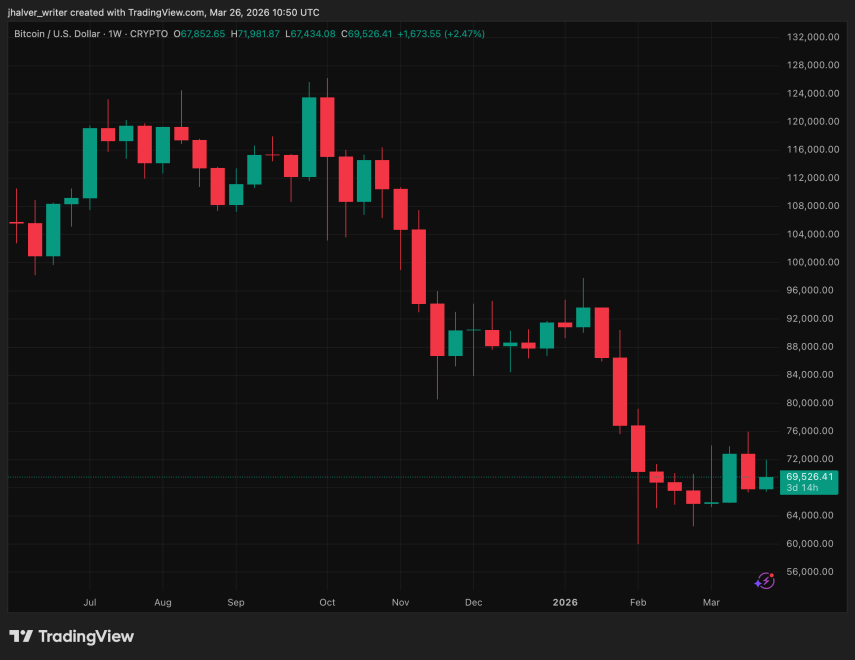
BTC’s price drops slightly after reaching $71k yesterday, trading for around $69k today. Source: BTCUSD on Tradingview

Cover image from Perplexity, BTCUSD chart from Tradingview

Perguntas relacionadas

QWhat is the main reason cited by Representative Seth Moulton for banning his staff from participating in prediction markets?

AMoulton believes staff should serve constituents, not profit from policy choices and global events, and views prediction markets as ethically questionable 'playgrounds for corrupt insiders'.

QWhat is the name of the bipartisan act introduced by Congressman Adrian Smith and Congresswoman Nikki Budzinski to ban trading on political prediction markets?

AThe Preventing Real-time Exploitation and Deceptive Insider Congressional Trading Act (PREDICT Act).

QWhat are the penalties for violating the PREDICT Act according to the announcement?

AA civil fine equal to 10% of the value of the banned trade, plus a requirement to hand over all profits from it to the U.S. Treasury.

QWhich earlier legislative effort targeted insider trading on platforms like Polymarket, as mentioned in the article?

ARep. Ritchie Torres's Financial Prediction Markets Public Integrity Act.

QHow might a hard ban on US officials using prediction markets affect the crypto prediction market space?

AIt could de-risk the space by reducing headline 'insider' scandals but also increase the likelihood of stricter KYC and monitoring requirements in the US.

Leituras Relacionadas

STRC Major De-pegging's First Financial Report, How Will Strategy Repair Its Capital Flywheel?

Bitcoin treasury company Strategy released its Q2 2026 earnings report on July 31. Despite a 6.9% year-over-year revenue increase to $122 million, the company recorded a net loss of $8.22 billion, largely due to $8.32 billion in unrealized losses from Bitcoin price fluctuations. As of quarter-end, Strategy holds 843,775 BTC with an average cost of $75,000 per coin, and Bitcoin per share increased. The report highlights a critical shift in Strategy's capital model following the de-pegging of its key financing tool, STRC (Strategic Coin), which fell below its $100 target. Management's top priority is restoring STRC to its target value, aiming for a recovery by September 8. They rule out discounted STRC issuances and plan to maintain its dividend yield at 12%, instead focusing on bolstering its $3.75 billion cash reserve. Strategy has moved from a one-way "buy-and-hold" Bitcoin strategy to active capital management. This new approach, part of its "Digital Credit Capital Framework," involves flexibly managing its balance sheet across four elements: BTC, USD cash, common stock (MSTR), and digital credit securities like STRC. This allows for BTC monetization (having sold $218.4 million in BTC so far), strategic repurchases of discounted securities, and debt optimization, as seen with a $1.5 billion convertible bond buyback. The company's future hinges on two key tests: successfully re-pegging STRC to restore market confidence in its digital credit system, and a long-term recovery in Bitcoin's price to ultimately support its growth thesis.

marsbitHá 39m

STRC Major De-pegging's First Financial Report, How Will Strategy Repair Its Capital Flywheel?

marsbitHá 39m

STRC's First Financial Report Post-Depegging, How is Strategy Restoring the Capital Flywheel?

On July 31, 2026, Bitcoin treasury company Strategy released its Q2 financial report. Despite a 6.9% year-over-year increase in revenue to $122 million, the company recorded a substantial net loss of $8.22 billion, primarily due to $8.32 billion in unrealized losses from Bitcoin holdings. While Strategy's core Bitcoin strategy remains intact—its holdings grew 11% to 843,775 BTC—the company is undergoing a fundamental shift in its capital model. Following the de-pegging of its key financing tool, the STRCoin (STRC), from its $100 target in May, Strategy has pivoted from a one-directional "raise funds, buy Bitcoin" cycle to a more dynamic, multi-asset capital management approach. A key part of this new framework is the "Monetization Program," through which Strategy has sold approximately $218.4 million worth of BTC to bolster liquidity. The company's top priority is repairing STRC's peg, committing not to issue discounted shares until it returns to its target range. It has initiated a $1 billion buyback program for discounted digital credit securities, having repurchased $28.9 million face value of STRC so far. Management aims to restore the peg around September 8, 2026. Strategy now actively manages a matrix of assets: Bitcoin (for accumulation or strategic sales), USD cash reserves (now at $3.75 billion), common stock (MSTR), and digital credit securities like STRC. This allows for tactical moves like repurchasing discounted debt or equity to capture value. The future success of Strategy's "capital flywheel" hinges on two factors: the short-term ability to successfully re-peg STRC to restore market confidence in its digital credit system, and the long-term price trajectory of Bitcoin, upon which its entire investment thesis ultimately depends.

Odaily星球日报Há 44m

STRC's First Financial Report Post-Depegging, How is Strategy Restoring the Capital Flywheel?

Odaily星球日报Há 44m

With Two Consecutive Quarters of Losses, Coinbase Must Rely on Paths Beyond Trading

Coinbase posted its second consecutive quarterly net loss of $359 million on $1.22 billion in revenue for Q2, highlighting its vulnerability to crypto market cycles where weaker prices and lower volatility reduce user trading. However, the report also reveals a strategic shift in its business model. Despite a 25% quarter-over-quarter decline in global spot trading volume, Coinbase increased its market share to a company-record 10.3%. This suggests its position as a compliant U.S. on-ramp is strengthening even in a cooler market. A key development is the diversification of revenue streams. Transaction revenue fell to $599 million, nearly equaling subscription and services revenue of $555 million. Stablecoin services, generating $292 million, are becoming a crucial revenue "floor." This income, derived from interest on the $20 billion average USDC balance held on its platform, is less tied to daily trading activity. Furthermore, while spot trading volume dropped significantly, derivatives volume held steady at $1.03 trillion. Coinbase is pushing to integrate spot, stablecoin, and derivatives liquidity to create a more interconnected and sticky ecosystem for users. The GAAP net loss includes non-cash expenses like stock-based compensation and crypto asset valuation changes. Its adjusted EBITDA remained positive at $208 million for the 14th straight quarter, indicating core operations can cover ongoing costs. The company is also reducing expenses to manage the downturn. The central question moving forward is whether Coinbase's growing market share, stablecoin revenues, and expanding product integration can sufficiently offset the inherent cyclicality of its core trading business during future market contractions.

marsbitHá 59m

With Two Consecutive Quarters of Losses, Coinbase Must Rely on Paths Beyond Trading

marsbitHá 59m

Trading

Spot
活动图片