Is There More to Kyle Samani's Exit from the Crypto World?

Odaily星球日报Publicado em 2026-02-10Última atualização em 2026-02-10

Resumo

Kyle Samani, co-founder of Multicoin Capital, recently announced his departure from the crypto industry, sparking controversy due to his subsequent critical remarks. Shortly after leaving, he expressed disillusionment with Web3 and blockchain, claiming they are merely financial ledgers with limited impact—a statement he quickly deleted. He later attacked Hyperliquid, accusing it of facilitating crime and operating opaquely, which many viewed as hypocritical given his past success and influence in crypto. This abrupt shift has led to speculation about underlying reasons for his exit. Analysts note that Multicoin Capital continues investing in Hyperliquid, and co-founder Tushar Jain included it in the firm’s future investment themes, while omitting Samani’s favored DePIN sector. Some, like Ran Neuner, suggest Samani may have been forced out due to internal conflicts, possibly bound by non-compete clauses. Despite Samani’s exit, other industry leaders like Tushar Jain, Haseeb Qureshi, and Chris Dixon reaffirm their belief in crypto’s future. They argue that the industry is maturing, moving from pioneers to builders, and compare its evolution to the early internet—foundational infrastructure must precede broader applications. The consensus remains that crypto’s narrative and potential are far from exhausted.

Original | Odaily Planet Daily (@OdailyChina)

Author | Azuma (@azuma_eth)

Just days after Multicoin Capital co-founder Kyle Samani announced his exit from the crypto industry, the goodwill he had accumulated over the years has rapidly eroded.

"Burning Bridges" Is Truly Disgusting

Objectively speaking, Kyle Samani has made positive contributions to the cryptocurrency industry over the years. Whether it's the continuous financial support for early-stage projects (regardless of motive, focusing on the effect) or the narrative guidance and ideological evangelism at the conceptual level, he has directly or indirectly influenced the industry's direction.

From a purely results-oriented perspective, Kyle Samani indeed achieved unimaginable "major results" in the crypto industry. For this reason alone, it's quite reasonable for Hasseb Qureshi to call him the "best investor in the industry" or for Mable to refer to him as a "top player."

  • Odaily Note: Hasseb Qureshi is a partner at Dragonfly Capital. He once stated that "investing is like a sport, and Kyle Samani is the highest scorer of all time, unmatched," details in 《The Man Who Best Shilled SOL Exits the Crypto World》; Mable is a former partner at Multicoin Capital and co-founder of Trends. After Kyle Samani's exit, she wrote a viral article 《The Game Continues, But Kyle's Version Is Over》.

But precisely because of this, the "ugly face" Kyle Samani has frequently shown in the days since his exit is even more repulsive.

First, on the day of his exit, while replying to Stix founder Taran, Kyle Samani stated: "Crypto just isn't as interesting as many people (including myself) once thought. I used to believe in the Web3 vision, believe in DApps, but now I don't. Blockchains are fundamentally asset ledgers. They will reshape finance, but that's about it, not much more."
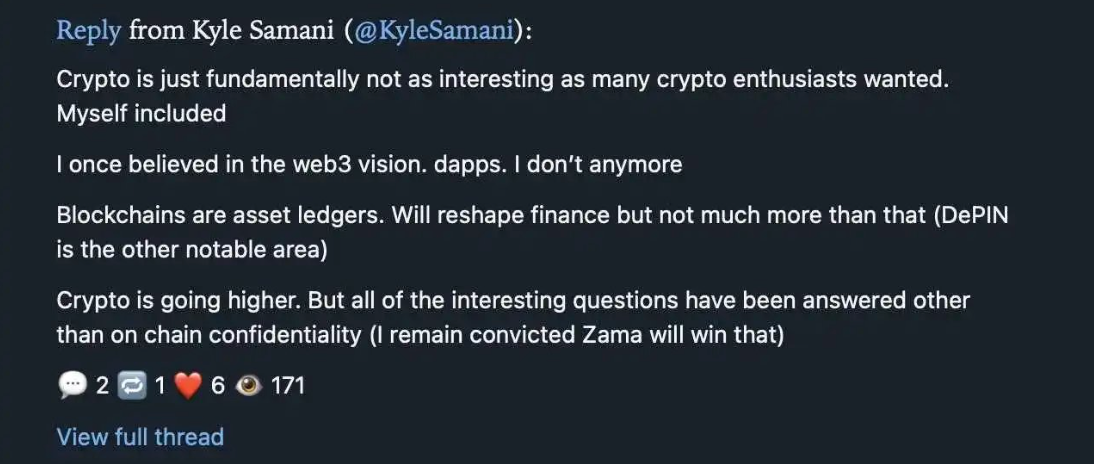
This post was quickly deleted by Kyle Samani... Well, clearly this was his true feeling never revealed before, but the fact that he deleted it at least means he knew "burning bridges" wasn't a good look.

But unfortunately, he didn't stop there. On February 8th, Kyle Samani once again lashed out at the industry that made him: "Hyperliquid embodies almost every negative aspect of cryptocurrency. The founders fled their home country to start it, openly facilitating crime and terrorism, the system is closed-source, and it still requires permission."
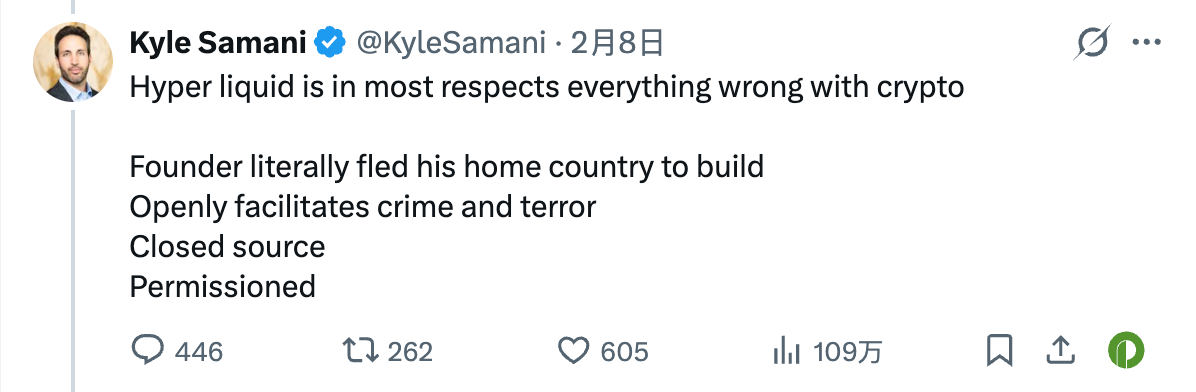
Although being outspoken has always been a controversial label attached to Kyle Samani, this illogical and clearly factually incorrect "mindless rant" was untenable. Coupled with his new identity as an outsider, the statement seemed even more突兀. In the past, Kyle Samani's outrageous remarks could at least gain some group support based on stance (e.g., siding with Solana, long-term criticism of Ethereum). This time, however, he was standing outside the industry, completely negating the entire crypto sector.

The direction of the fallout was predictable: Kyle Samani successfully provoked widespread anger.

It's understandable for someone who lost money in crypto to criticize it; people always need an emotional outlet. But Kyle Samani, a beneficiary who gained immense wealth and achieved class transition in crypto, couldn't wait to turn around and stomp on it immediately after announcing his exit. This inevitably feels hypocritical and disgusting.

To put it bluntly, this is a classic case of "biting the hand that feeds you" — Kyle Samani wants to take away the benefits bestowed by the industry while eagerly cutting ties with it. How can such a huge便宜 exist?

An Eerie Sense of Incongruity: Is There More to the Exit?

Another very incongruous point is that Kyle Samani chose Hyperliquid as his attack target; on the other hand, Multicoin Capital continues to increase its bet on Hyperliquid.

In the same week Kyle Samani announced his exit, on-chain analyst MLM detected multiple large purchases of HYPE by an address suspected to belong to Multicoin Capital (https://hypurrscan.io/address/0xd4d56a30a4a745f8ba732e8b453b7066260fbc10#txs).

Crypto Banter founder Ran Neuner discovered that in the five-year investment theses published the weekend prior by Multicoin's other co-founder, Tushar Jain, Hyperliquid was prominently listed as a representative project for the third thesis, "Financial Globalization," while DePIN, which Kyle Samani had long been extremely bullish on, was completely absent.
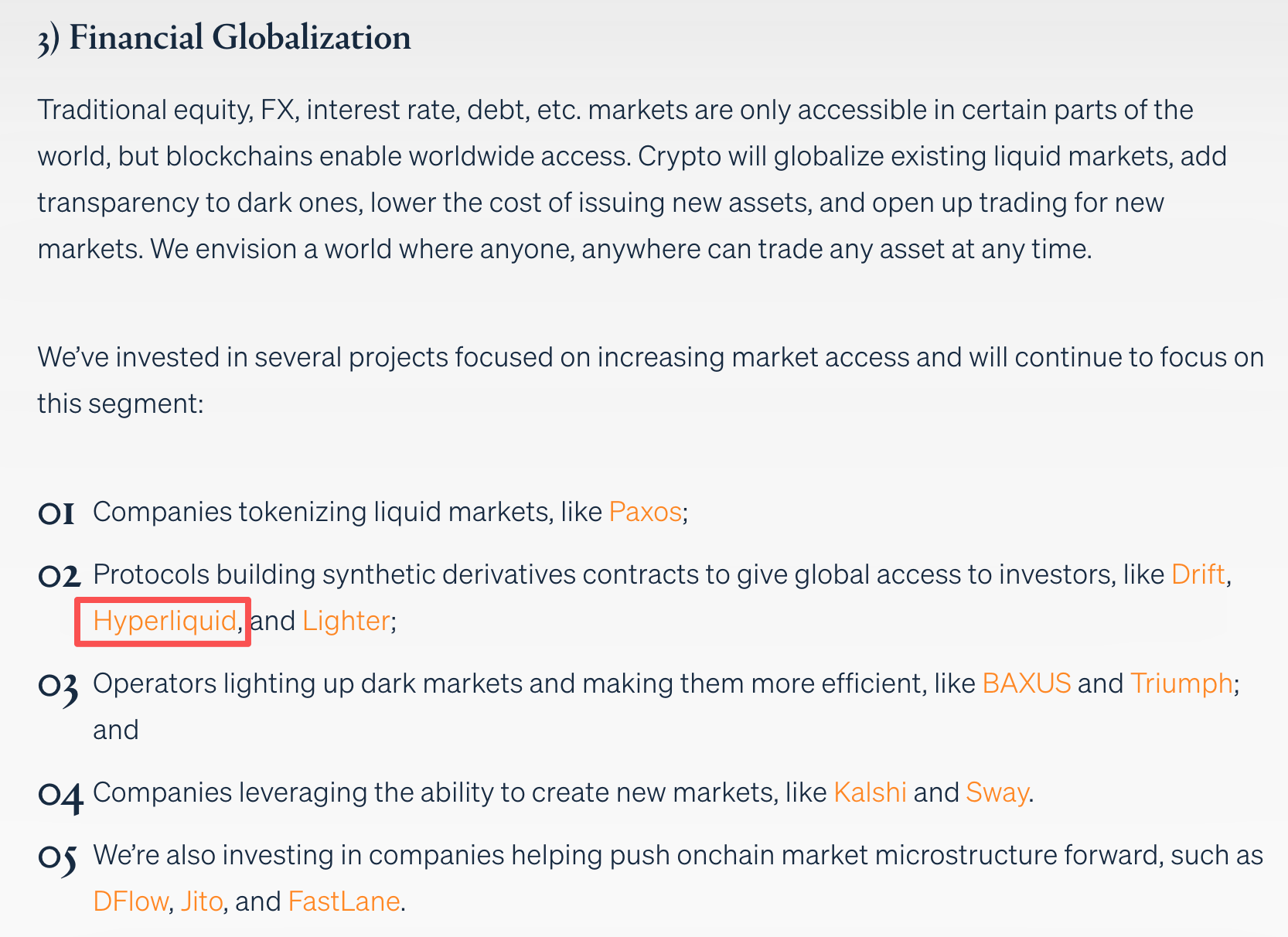
Ran Neuner offered a hypothesis based on this: that Kyle Samani did not leave voluntarily but had conflicts with Tushar Jain, was eventually forced out, and due to non-compete clause restrictions, Kyle Samani had to exit the crypto industry entirely...

Although this speculation lacks any factual evidence, it seems to better explain the aforementioned incongruities and Kyle Samani's sudden attitude shift — Would you rather believe that a top mind long dedicated to the crypto industry suddenly realized its emptiness? Or would you rather believe that Kyle Samani turned his back only because he harbored resentment and could no longer profit from the industry?

Whether out of faith in the industry's future or residual recognition of Kyle Samani's past achievements, emotionally, I lean towards the second possibility. As for the truth, it might only be revealed someday in the future when no one cares about this matter anymore.

No Future for the Crypto Industry?

Over the past few years, we have seen many instances of talent flowing from the crypto world to the AI world, but the exit of a标志性 figure like Kyle Samani has dealt a heavy blow to confidence in the entire crypto industry.

So, does the industry really have no future? This is clearly not a question that can be answered by personal opinion. After Kyle Samani chose to leave, several true thought leaders of comparable stature used their own logic to explain why they remain bullish on the industry's future.

Tushar Jain's信念 remains firm. The eight investment theses he published for Multicoin Capital still focus on the crypto world.

Haseeb Qureshi believes that Kyle Samani's departure is the truest sign of the industry maturing. Pioneers and settlers are often not the same people, this is driven by the laws of human nature — "I remain very bullish on crypto. I know it's strange to say this amidst market turmoil, as people have little patience for dreams that will take a decade to realize. The era of dreamers is over, but the era of builders is coming. This in itself is neither good nor bad."

a16z Crypto partner and Web3 concept pioneer Chris Dixon, drew an analogy with the development规律 of the internet to refute Kyle Samani's view that cryptocurrency can only reshape finance — "Infrastructure and distribution networks often precede new application categories. The internet didn't start with social media, streaming, or online communities, but with packet switching, TCP/IP, and basic connectivity. It was only after hundreds of millions of people came online that entirely new cultural and economic categories emerged. Crypto is likely similar. A reasonable guess is that we need to get hundreds of millions of people on-chain first through financial applications like payments, stablecoins, savings, and DeFi, before we see meaningful adoption in media, gaming, AI, or other areas that might be further out."

The future is created by people. As long as more people share the same consensus, the flame of the crypto narrative can be rekindled.


Perguntas relacionadas

QWhat was Kyle Samani's stated reason for leaving the cryptocurrency industry, as revealed in his deleted post?

AHe stated that he no longer believes in the Web3 vision and DApps, claiming that blockchains are essentially just asset ledgers that will reshape finance and nothing more.

QWhich specific project did Kyle Samani attack after his departure, and what was the nature of his criticism?

AHe attacked Hyperliquid, claiming it 'embodies almost everything wrong with crypto,' accusing it of being founded by people who fled their country, facilitating crime and terrorism, being closed-source, and still requiring permission.

QWhat contradiction or 'weird dissonance' does the article point out regarding Multicoin Capital's actions and Kyle Samani's statements?

AWhile Kyle Samani publicly attacked Hyperliquid, on-chain data showed that Multicoin Capital's address was making large purchases of HYPE (Hyperliquid's token), and his partner Tushar Jain listed Hyperliquid as a key investment theme.

QWhat alternative theory does the article present to explain Kyle Samani's sudden departure and negative comments?

AThe theory is that Kyle Samani did not leave voluntarily but was forced out due to a conflict with his partner Tushar Jain, and his negative comments are a result of his frustration and being bound by a non-compete clause.

QHow do other major industry figures like Chris Dixon and Haseeb Qureshi counter Kyle Samani's pessimistic view on crypto's future?

AChris Dixon compared crypto to the early internet, arguing that financial applications are the foundational infrastructure that will eventually lead to broader adoption in media, gaming, and AI. Haseeb Qureshi stated that the departure of pioneers is a sign of the industry maturing, and the era of builders is now beginning.

Leituras Relacionadas

From South Korea to the United States: Blue-Collar Jobs Are Becoming Increasingly Popular, Thanks to AI

AI is reshaping the labor market's value proposition. The traditional four-year college degree is losing its appeal as a guaranteed career path, while skilled blue-collar trades like electricians, welders, and plumbers are experiencing historic demand and wage premiums. This shift is driven by dual pressures: AI's displacement of certain white-collar roles and a booming need for physical infrastructure and data center construction. Data confirms the trend. In the U.S., vocational school revenue surged, and a significant portion of recent layoffs are AI-related. Surveys show a majority of Gen Z adults plan to pursue blue-collar work, citing better job security against AI automation. Vocational education interest has exploded recently. Experts cite a psychological shift as younger generations seek tangible, AI-resistant careers and avoid high student debt. In many cases, salaries for skilled trades now match or exceed those requiring a bachelor's degree. In South Korea, semiconductor vocational high schools boast near-total employment, with graduates securing high-paying roles at companies like Samsung. The shortage is structural, exacerbated by a retiring baby boomer workforce and massive infrastructure projects. Companies like JPMorgan Chase, Meta, and Lowe's are investing heavily in training programs. However, overcoming historical stigma and a "perception gap" around trade careers remains a key challenge to closing the talent gap.

marsbitHá 1h

From South Korea to the United States: Blue-Collar Jobs Are Becoming Increasingly Popular, Thanks to AI

marsbitHá 1h

Qualcomm: AI Hype Subsides, When Will Smartphones Emerge from the Gloom?

Qualcomm reported its Q3 FY2026 results (ending June 2026), with revenue of $9.95B, down 4% YoY but above expectations. Gross margin declined to 53.1%, pressured by rising costs across manufacturing and memory. Key business segments showed mixed performance: Handset revenue fell 19.6% YoY to $5.09B, dragged by an 11% decline in non-Apple Android shipments and weaker high-end mix. Conversely, Automotive revenue surged 61% to $1.59B, and IoT grew 9% to $1.83B. Core operating profit dropped 41% YoY due to margin compression and higher expenses. Management's Q4 FY2026 guidance projects revenue of $9.7B-$10.5B, in line with consensus, but Non-GAAP EPS guidance of $2.05-$2.25 fell short of expectations. Amidst persistent weakness in its core handset market, Qualcomm is pursuing growth in AI, focusing on Edge AI (smartphones, PCs, automotive) and Data Center AI. Its data center strategy includes four pillars: AI accelerators (e.g., AI200), commercial CPUs (Dragonfly C1000), custom silicon, and connectivity solutions. While these initiatives initially boosted its stock, concerns over AI capital expenditure sustainability have since erased those gains. The company targets $5B in data center revenue for FY2027 and $15B for FY2029. The report concludes that with the traditional handset business still under pressure, the data center opportunity is currently viewed as a longer-term option, and a more conservative valuation based on core operations may be warranted until AI contributions materialize.

marsbitHá 1h

Qualcomm: AI Hype Subsides, When Will Smartphones Emerge from the Gloom?

marsbitHá 1h

From TPU to Self-Evolving Agents: How Jeff Dean Predicts the Next Step in AI

At the 2026 YC Startup School, Jeff Dean outlined his vision for AI's next phase, shifting focus from simply scaling models to building intelligent, autonomous systems. He believes AI's progress is no longer just about creating smarter models, but about integrating them into systems capable of long-term, iterative work, automated experimentation, and continuous learning. This evolution moves the competition from "who has the bigger model" to "who can best organize intelligence." Dean suggests AI capabilities are now comparable to a junior engineer, enabling the automation of complex workflows. However, the true challenge and opportunity lie in managing these AI "workers" at scale. He emphasizes the importance of **context engineering**—structuring tools, memory, and feedback loops—over raw model power. For startups, this means building deep expertise in niche domains where general models currently fail (near 0-1% success rates), leveraging proprietary data, specialized tools, and domain-specific evaluators. A recurring theme is re-examining fundamental constraints. Dean's past work, like moving Google's search index to memory or creating the TPU, stemmed from questioning outdated assumptions about hardware and cost. He sees similar inflection points today, particularly in **specialized inference hardware** to drastically reduce latency and energy consumption for real-time Agent operation. Notably, he points out that in modern AI systems, the dominant cost is often not computation but **data movement**. Reliable, long-running Agents require robust system design, borrowing concepts from distributed computing like checkpointing, state management, and parallel exploration to handle failures and maintain progress over days or weeks. As AI automates execution, the scarcest human skills will shift to **defining clear specifications**, **judging what problems are worth solving** (taste), and designing effective feedback loops. Ultimately, Dean's framework prioritizes understanding the problem deeply, identifying the true bottlenecks, and systematically building closed-loop systems where AI can not only perform tasks but also improve AI itself.

marsbitHá 1h

From TPU to Self-Evolving Agents: How Jeff Dean Predicts the Next Step in AI

marsbitHá 1h

Trading

Spot
活动图片




