Is the Fastest and Deepest Tech Stock Sell-off in History Nearing Its End?

marsbitPublished on 2026-07-19Last updated on 2026-07-19

Abstract

The article discusses whether the historically rapid and severe sell-off in tech momentum stocks is nearing its end. Citing analysis from Goldman Sachs and Morgan Stanley, it notes that the TMT momentum factor has plunged 40% from its peak in just 17 trading days, marking the fastest and deepest such decline on record. Key experts, including Goldman's Mark Wilson, attribute the crash primarily to extreme crowding, high leverage, and structural factors rather than a fundamental deterioration in the economy or corporate earnings. They point to strong underlying data, such as robust bank lending and raised guidance from companies like TSMC, which contrast sharply with the market's price action. While Wilson suggests the momentum unwinding process is likely "approaching its end," he cautions that immediate catalysts for a sharp reversal are lacking. The report highlights extreme internal market stress, with single-stock volatility far exceeding index volatility, and warns that despite the sell-off, positioning in momentum factors remains elevated. It concludes that the core market矛盾 (contradiction) lies in this disconnect between solid fundamentals and violent price corrections driven by positioning and leverage.

Source: Wall Street Insights

Tech momentum trading is experiencing its most severe unwinding in history. In just 17 trading days, the U.S. stock technology momentum factor (TMT MoMo) has plunged 40% from its peak, setting a record for the fastest and deepest drawdown on record, with contagion spreading comprehensively from semiconductors to hedge funds and credit markets.

Mark Wilson, partner and head of EMEA hedge fund business at Goldman Sachs, provided a systematic review of this "brutal rotation" this week. He noted that this sell-off is historically rare in both speed and depth, but its root cause stems more from non-fundamental factors such as crowded positioning and concentrated leverage, rather than a substantial deterioration in the economy or corporate earnings. He stated that the unwinding process for the momentum factor is "nearing its end," but lacks an immediate catalyst for reversal in the short term.

It is noteworthy that this momentum breakdown occurred against a backdrop of overall robust macro and corporate fundamentals—U.S. banks reported a 17% year-on-year increase in corporate lending, TSMC raised its 2026 revenue growth guidance to over 40%, and inflation data also came in moderately below expectations. This divergence between fundamentals and market price action is the core contradiction in the current market.

Tech Momentum Factor Suffers Historic Sell-off, Drawdown Speed and Depth Exceed Historical Median

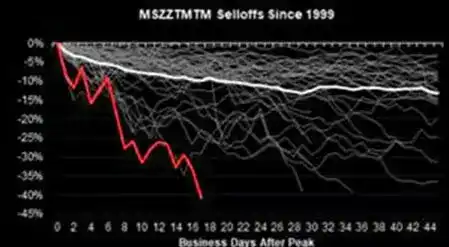
According to data from Morgan Stanley's Quantitative and Derivatives Strategy team (MS QDS), this momentum factor drawdown has lasted 17 trading days, with a peak-to-trough decline of 28%. In comparison, the median momentum factor drawdown since 1999 has been 22%, lasting an average of 33 trading days.

This means the current decline has exceeded the historical median in both speed and depth, marking the most severe episode since the 29% drawdown from December 2022 to February 2023.

The situation is even more extreme in the tech sector. The TMT momentum factor (TMT MoMo) has fallen 40% from its peak. According to MS QDS data, this represents the fastest and deepest sell-off ever for the tech momentum factor.

Looking across various subsectors, South Korea's Kospi index is down 27% from its peak, U.S. AI tech beneficiaries are down 25%, global memory chip stocks are down 36%, and European semiconductors are down 23%. Among these, memory chip stocks account for about two-thirds of the overall decline, while the broader AI beneficiaries are down about 24% from their highs.
Low Surface Volatility Masks High Internal Intensity, Market Risk Structure is Unraveling

Price declines are only the surface manifestation of this turmoil; changes in the market's internal risk structure are equally noteworthy.

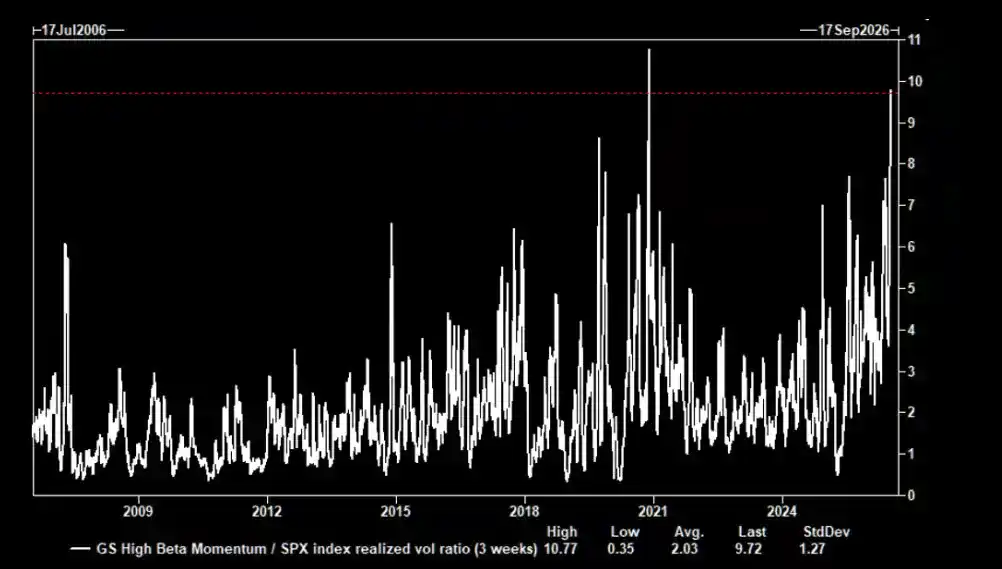
According to Goldman Sachs' volatility trading desk data, the current volatility of Goldman Sachs' High Beta Momentum portfolio (GSPRHIMO) is approximately 10 times that of the S&P 500's volatility. In the historical backtest over the past 20 years, such a stark volatility ratio has only been comparable to the situation during the pandemic shock in November 2020.
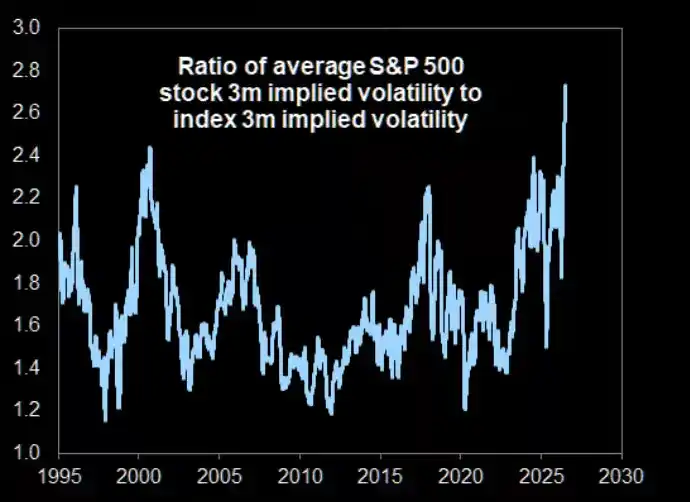
Simultaneously, the gap between single-stock volatility and index volatility has widened to historical extremes. Goldman Sachs data shows that the three-month average implied correlation among S&P 500 constituents fell to a record low of 0.14 this week, causing the S&P 500 index volatility to remain low, while the average implied volatility for single stocks is as high as 40%, 2.8 times that of the index's implied volatility, also setting a historical record.
Positions Remain Crowded, Risks Not Yet Cleared

Despite the recent historic drawdown in the momentum factor, hedge funds' net exposure to it remains high from a long-term perspective. J.P. Morgan data indicates that the combination of current positioning levels and the magnitude of the drawdown continues to make the momentum factor one of the core risks most deserving of caution in the market.

Meanwhile, the Goldman Sachs High Beta Momentum factor has fallen 33% since its June high, with its year-to-date gain plummeting from 60% to just 12%, a development also noted by Mark Wilson.

He cited signs of deleveraging in the Korean market as evidence: reports indicate that approximately one in every 30 South Korean adults had their stock margin accounts forcibly liquidated this week, showing that the deleveraging process has unfolded to a considerable extent.

Fundamentals Remain Sound, Risks Lie in Positioning and Structure

The peculiar aspect of this momentum breakdown is that it occurred against a backdrop of generally positive corporate fundamentals and macroeconomic data.

Mark Wilson pointed out that U.S. bank earnings this week presented an "unmistakably positive reading" of economic conditions: corporate lending grew 17% year-on-year, a record high, covering all economic sectors; U.S. consumer spending tracker growth is in the mid-single digits, with credit card spending up 6%; investment banking-related business lines collectively grew over 40%; large banks' tangible common equity return reached 19%, a post-financial crisis high.

On the tech capital expenditure front, TSMC raised its 2026 revenue growth guidance to over 40% (based on a revenue base exceeding $150 billion), while ASML's earnings report sparked market expectations for a 15% to 30% upward revision in its EPS over the next one to three years.

However, both companies' share prices fell following their earnings announcements, displaying a classic "sell the news" pattern. In contrast, IBM's stock price suffered its largest single-day drop in over 20 years due to large contract delays and underperformance in its consulting business.

Mark Wilson emphasized that this sell-off is "difficult to pinpoint to a clear signal at the fundamental level," reflecting more the influence of structural factors such as positioning, leverage, crowding, and concentration.

Rotation Nearing End, But Reversal Catalyst Still Awaited

Mark Wilson stated that he is inclined to believe the unwinding process for the momentum factor is nearing its end, but he also noted that there is a lack of immediate summer catalysts to drive a market reversal in the short term.

He also suggested that as efficiency and commercial viability improve, new market leadership will gradually emerge, and market breadth will expand accordingly—the Dow Jones Transportation Average breaking to new highs again this week serves as one example.

However, he also warned that the second derivative of earnings growth (i.e., the slowdown in the growth rate) will become increasingly important as the market digests Q2 earnings and enters the summer, while current valuation metrics across the board indicate that tech sector valuations remain elevated.

Furthermore, abnormal breakdowns in correlations are occurring both between traditional asset classes and within them; for example, the three-month correlation between gold and crude oil has fallen to an extreme inverse level in its 35-year history, further increasing the difficulty of risk management and portfolio construction.


Related Questions

QWhat is the historical context of the current tech momentum factor sell-off in terms of speed and depth?

AAccording to the article, the current tech momentum factor (TMT MoMo) sell-off is the fastest and deepest on record, having fallen 40% from its peak in just 17 trading days. Historically, momentum factor drawdowns have a median decline of 22% over an average of 33 trading days.

QAccording to Mark Wilson of Goldman Sachs, what is the primary cause of this momentum factor sell-off?

AMark Wilson of Goldman Sachs attributes the sell-off primarily to structural factors like crowded positioning, concentrated leverage, and high congestion, rather than a deterioration in economic or corporate earnings fundamentals.

QDespite the market sell-off, what positive signals are mentioned regarding the underlying economic and corporate fundamentals?

AThe article highlights robust fundamentals: U.S. bank corporate loan growth at 17%, TSMC raising its 2026 revenue growth guidance to over 40%, and inflation data coming in softer than expected. Bank earnings also showed strong consumer spending and high returns on tangible equity.

QWhat does the data say about the current volatility and risk structure within the market during this event?

AThe volatility of Goldman Sachs's high-beta momentum basket is about 10 times that of the S&P 500, a disparity only seen during the November 2020 pandemic shock. Additionally, the correlation among S&P 500 stocks is at a record low, causing single-stock implied volatility to be 2.8 times higher than index volatility.

QWhat is Mark Wilson's outlook on the momentum factor sell-off and the potential for a market reversal?

AMark Wilson believes the momentum factor unwinding process is 'nearing its end.' However, he notes a lack of immediate catalysts for a sharp reversal in the near term (summer), and warns that valuations remain elevated and that the second derivative of earnings growth (a slowdown in growth acceleration) will become more important.

Related Reads

Mercado Bitcoin begins post-hack reopening without a timeline for withdrawals

Mercado Bitcoin, one of Brazil's largest crypto exchanges, began restoring read-only access to customer accounts in phases on Monday, a week after attackers drained an estimated $49 million from the platform. Access started at 19:00 UTC, with all accounts expected to be viewable by 21:00 UTC, showing holdings as they stood on Nov. 2, the day of the hack. The exchange has yet to say when customers will be able to withdraw funds. Fabricio Tota, vice president of new business, said the exchange hoped read-only access would reassure customers that their assets were still recorded on the platform. He explained that the company opted for "a more conservative approach" to reactivating accounts "to ensure our return happens with the utmost security." The caution follows concerns from blockchain security analysts that attackers were able to access addresses, draining funds through standard transfers rather than a smart contract exploit. Blockchain analysts traced some of the stolen funds to customer deposit addresses, but Mercado Bitcoin says customers won't bear the losses. Tota said the vast majority of assets were never even touched by anyone and were not involved in the incident. On Nov. 4, Mercado Bitcoin pledged to cover all losses with company funds, bolstered by a $20 million investment from stablecoin issuer Tether in July. Tota highlighted that a portion of the stolen funds were also frozen in the hours after the company announced the attack. The next phase of recovery will require users to confirm their registration details before they can move funds. The exchange plans to restore withdrawals via Pix, Brazil's instant payment system, initially allowing customers to withdraw only to accounts in their own name. Tota gave no date for either step. Mercado Bitcoin has yet to explain how the attackers gained access to its wallets. Blockchain data company Bitquery found that as of Nov. 4, wallets linked to the attacker held most of the stolen funds that had escaped freezes, including 106.07 BTC.

cointelegraph2h ago

Mercado Bitcoin begins post-hack reopening without a timeline for withdrawals

cointelegraph2h ago

Avalanche’s AVAX leads crypto gains following NYSE tokenization deal

Avalanche's AVAX token rose as much as 10% on Monday, becoming the top gainer among the 100 largest cryptocurrencies, after the New York Stock Exchange announced plans to use Avalanche's blockchain to settle trades on a new platform for trading tokenized stocks around the clock. AVAX later eased to $8.86, still up over 8% on the day, with a market cap of around $3.95 billion and $439.7 million traded in the past 24 hours. Avalanche's total value locked stands at $633 million, up 4% over the past day. NYSE's head of digital issuance, Dennis Lee, said the exchange is examining how blockchain technology can expand its equities offerings and is picking the right technology for each job. The deal underscores Wall Street's growing effort to use blockchain to make stock trading faster and enable trading outside regular market hours; traditional US markets are open 9:30 am to 4:00 pm EST on weekdays, with trades often taking at least one business day to settle. The NYSE first announced plans for the platform in January, and Ava Labs revealed in September that the exchange had spent about a year testing Avalanche, though the final selection was not confirmed until Monday. Avalanche will record stock trades and help complete transactions on the platform, which will let investors buy and sell digital versions of stocks across different blockchains. Lee said the settlement ledger needs to be fast, reliable, permissioned, cost-predictable, and backed by a large developer community—all of which Avalanche meets. The platform could launch before the end of 2026 pending regulatory approval. Ava Labs chief business officer John Nahas said first conversations with the NYSE began nearly a year ago and called it an important step toward blockchain becoming foundational financial infrastructure. The news comes as other major firms invest in blockchain for faster, round-the-clock trading: Nasdaq plans to invest $100 million in Kraken's parent Payward to launch tokenized stocks by Q2 2027, and the DTCC launched a service in October allowing firms to turn traditional securities into digital tokens. The NYSE deal follows other efforts to bring traditional assets onto Avalanche, including Progmat moving over 452 billion yen in digital securities onto a dedicated Avalanche blockchain in July and Aave Labs' plans for a lending service using tokenized assets as collateral.

cointelegraph3h ago

Avalanche’s AVAX leads crypto gains following NYSE tokenization deal

cointelegraph3h ago

Can using a chip for two more years really help get through the cold winter?

The smartphone industry is grappling with rising memory chip costs that are driving up device prices, forcing manufacturers to find ways to stay competitive. A recent leak about a chip called "SM7635" with a 2.96GHz peak CPU frequency and Adreno 810 GPU suggests Qualcomm may be reusing its Snapdragon 7s Gen3 (originally launched in 2024 at 2.5GHz) yet again. The chip already spawned a 2025 variant (SM7635-AC, renamed Snapdragon 7s Gen4) with a 2.7GHz clock, and the new 2.96GHz version will likely become the Snapdragon 7s Gen5—marking a third generation from one original design. This practice of reusing and overclocking mid-range SoCs is not new. MediaTek's Helio X20/X23/X25/X27 and Dimensity 1100/1200/1300, as well as Qualcomm's Snapdragon 615/616/617, 765/765G/768G, and 778G/778G+/782G, followed similar patterns. Previously, however, this was mainly done to widen the gap between flagship and non-flagship products and give flagship buyers more perceived value—not primarily to cut costs. Mid-range buyers were assumed not to care much about chip model numbers. Now the situation is different. One brand recently launched a mid-to-low-end phone with the Snapdragon 7s Gen4 priced at 3699 yuan—a price that a year ago could buy a flagship with a fifth-generation Snapdragon 8 Elite, roughly three to four times more powerful. While SoC isn't the only cost component, consumers clearly get less value for the same money today. Counterpoint Research reports global smartphone SoC shipments fell 21% year-over-year in Q3 2026. Even flagship lines show signs of chip reuse—the Dimensity 9600M appears to be an overclocked Dimensity 9500. With few flagships using fully-specced memory and storage, rumors suggest next year's devices may widely reuse current-generation flagship SoCs while upgrading memory and storage instead. This helps control costs but may further dampen consumers' willingness to upgrade, making such reuse an unsustainable strategy. Restoring market confidence will require both chipmakers and device brands to offer consumers more tangible benefits.

marsbit6h ago

Can using a chip for two more years really help get through the cold winter?

marsbit6h ago

Trading

Spot
活动图片