Is The Altcoin Market Dead? Why These Cryptocurrencies Have Failed To Move

bitcoinistPublicado em 2026-03-17Última atualização em 2026-03-17

Resumo

The altcoin market has been a source of deep frustration for investors, failing to experience a sustained breakout despite numerous analyst predictions. According to crypto analyst Sykodelic, this stagnation is not due to the asset class being finished, but because the necessary macro backdrop for altcoin expansion never materialized. Altcoins are highly dependent on excess liquidity, performing best when money is loose, economic activity is strong, and investors are willing to move beyond Bitcoin. Sykodelic's analysis compares the OTHERS index (tracking cryptocurrencies outside the top ten) with two macro indicators: Federal Reserve Net Liquidity and the Purchasing Managers’ Index (PMI). Historically, these three have moved in tandem. During the 2020/2021 cycle, all rose together, with the OTHERS index surging from below $100 billion to nearly $600 billion. However, in the current cycle, Fed Net Liquidity has oscillated without a clear trend, and the PMI spent 26 consecutive months in contraction until returning to expansion in January 2026. Consequently, the OTHERS index has chopped sideways. Now, conditions may be improving. Fed net liquidity appears to have bottomed and reversed upward, while the PMI has moved into expansion territory (registering 52.6% in January 2026). These changes could finally build the foundation for an altcoin season, with Sykodelic’s chart projecting a potential rise in the OTHERS index market cap to the $560 billion range.

The altcoin market has become a source of deep frustration for crypto investors during this cycle. Despite numerous forecasts from analysts, a clear and sustained altcoin phase has yet to appear in recent months.

This has led to growing frustration as traders wait for a broad breakout among altcoins. But according to crypto analyst Sykodelic, that frustration misses the bigger picture. Altcoins have not failed because the asset class is finished. They have failed to move because the macro backdrop that normally leads to major altcoin expansions never arrived.

Altcoins Are Stuck In A Liquidity Desert

Altcoins are the part of the crypto market most dependent on excess liquidity. They tend to perform best when money is loose, economic activity is improving, and crypto participants are willing to move further out of Bitcoin and invest in other cryptocurrencies. That environment, according to Sykodelic, has never truly shown up in force this cycle.

The chart Sykodelic shared places the OTHERS index, which tracks the total market capitalization of cryptocurrencies outside the top ten, alongside two macro indicators: the Federal Reserve Net Liquidity and the Purchasing Managers’ Index (PMI). The interesting thing is that those three have always moved in the same direction.
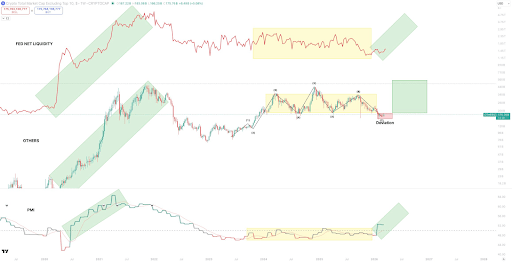
Source: Chart from Sykodelic on X

During the 2020/2021 cycle, for example, all three moved in the same direction. The Fed Net Liquidity rose very fast, PMI was in expansion, and the OTHERS index increased from a market cap below $100 billion to almost $600 billion.

The current cycle has told a different story. Fed Net Liquidity spent the better part of two years in a prolonged ranging pattern and oscillating without a clear directional trend. The PMI, meanwhile, spent most of that stretch in contraction, registering below 50 for 26 consecutive months before returning to expansion in January 2026. The OTHERS index, reflecting these conditions faithfully, has chopped sideways without the rally needed for an altcoin season.

The Setup For An AltSeason May Finally Be Forming

Once the diagnosis is established, the next step is what could come next for the possibility of an altcoin season. Interestingly, Sykodelic’s analysis also looks at what may be changing now for the altcoin market. According to the analyst, the correct environment is being built for the alt expansion.

His chart suggests Fed net liquidity has bottomed and started to reverse upward, while PMI has moved back above contraction territory and into expansion. For instance, the ISM Manufacturing PMI registered 52.6% in January 2026, which is a 4.7-percentage-point jump from December’s reading of 47.9%. The PMI fell to 52.4 in February 2026 from 52.6 in January but remained above market expectations of 51.8.

Those two changes, taken together, could begin building the exact background that altcoins were missing. The green projection box to the right of the current price, as drawn on the chart above, targets a move back to the $560 billion range for the OTHERS index market cap.

Overall crypto market at $1.01 trillion on the 1D chart | Source: TOTAL2 on Tradingview.com

Perguntas relacionadas

QAccording to the article, why has the altcoin market failed to see a sustained breakout in recent months?

AThe altcoin market has failed to move because the macro backdrop that normally leads to major altcoin expansions, namely excess liquidity and economic expansion, never arrived this cycle.

QWhat two key macro indicators does analyst Sykodelic correlate with the performance of the altcoin market?

AThe two key macro indicators are the Federal Reserve Net Liquidity and the Purchasing Managers’ Index (PMI).

QWhat was the primary reason given for why altcoins are particularly sensitive to these macro conditions?

AAltcoins are the part of the crypto market most dependent on excess liquidity, performing best when money is loose, economic activity is improving, and investors are willing to take risks beyond Bitcoin.

QWhat recent changes in the macro indicators suggest a potential setup for an altcoin season is forming?

AFed net liquidity has bottomed and started to reverse upward, while the PMI has moved back above 50 into expansion territory, as seen in January and February 2026.

QWhat is the projected price target for the OTHERS index market cap, as indicated by the green box on the analyst's chart?

AThe projection targets a move back to the $560 billion range for the OTHERS index market cap.

Leituras Relacionadas

In Jinjiang, Fujian, a Storage Super Unicorn Lies Quiet

In Fujian's Jinjiang, a city known for sportswear, lies a quiet semiconductor giant: Fujian Jinhua Integrated Circuit Co. (JHICC). Once a promising domestic DRAM manufacturer alongside Yangtze Memory and ChangXin Memory Technologies (CXMT), its journey was derailed in 2018 when the U.S. placed it on an Entity List and filed criminal charges for alleged trade secret theft. This halted production for years. A turning point came in February 2024 when a U.S. federal court found JHICC not guilty. However, it had lost crucial time. While CXMT soared to become a top-valued A-share company in 2024, JHICC, with an estimated valuation of 80 billion RMB, was just restarting. Its current output is primarily customized DDR4 chips, not the advanced DDR5/HBM demanded for AI, but it still benefits from the broader memory chip upcycle. JHICC's story is tied to Chen Zhengkun, a veteran engineer who left Micron to lead the venture. Founded in 2016 with state-backed funding, JHICC partnered with Taiwan's UMC to develop DRAM technology. Rapid progress was cut short by the U.S. actions, which Micron initiated, partly due to its heavy reliance on the Chinese market. Post-sanctions, Chen's team worked to rebuild the production line with reduced reliance on U.S. technology. According to its records, JHICC achieved small-scale production and revenue growth under immense pressure. It now focuses on the stable "niche" DRAM market (e.g., TVs, routers) with a monthly capacity of ~40,000 wafers, aiming for 60,000 by 2026. It holds over 1,000 patents but remains on the Entity List. For Jinjiang, investing in JHICC was a bold industrial leap. The local government provided unwavering financial and logistical support during the crisis, helping the company survive. JHICC has become the anchor for a growing local semiconductor cluster. Though its scale lags behind domestic peers, JHICC's persistence symbolizes a hard-won foothold in a global market long dominated by Samsung, SK Hynix, and Micron. Having missed one boom, it seeks a place in the new AI-driven memory supercycle.

marsbitHá 1h

In Jinjiang, Fujian, a Storage Super Unicorn Lies Quiet

marsbitHá 1h

Trading

Spot
活动图片




