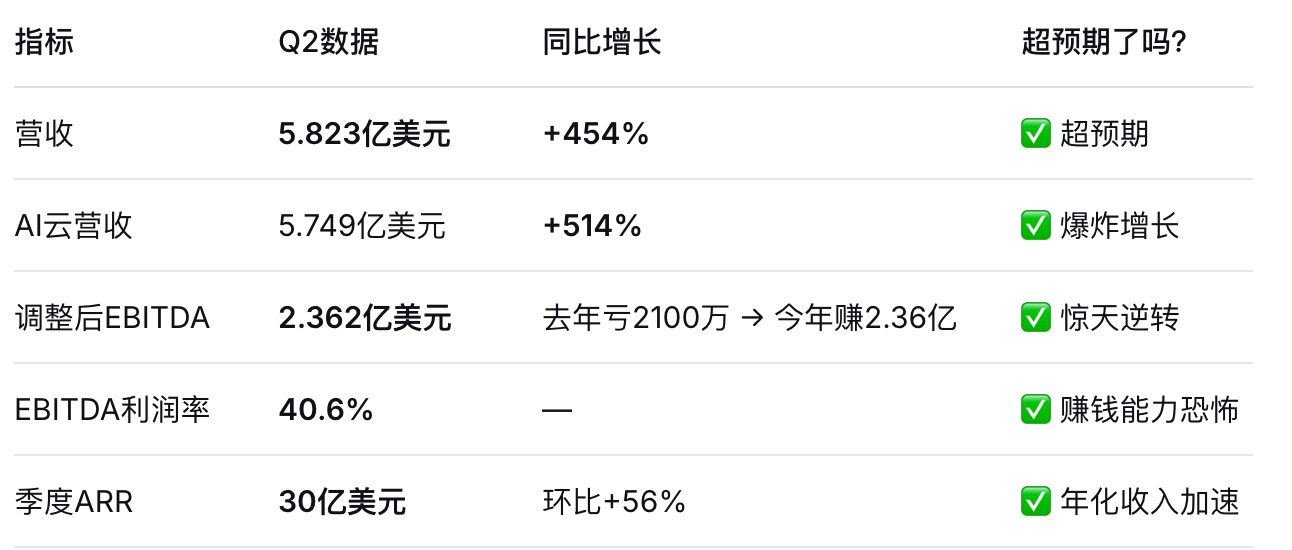
I. First, Look at a Table: How Explosive is the Q2 Data?
II. Holding $40 Billion in Orders, 2027 Production Capacity Already Insufficient
Retail investors always care about one question: Can this company's stock still rise in the future?
Look at these three data points and you'll understand:
① Total customer commitments exceed $40 billion
Signed 4 major contracts in Q2, averaging over $10 billion each. Total contract value grew nearly 4x quarter-over-quarter. New customer contract value grew over 9x for the quarter.
② 2027 production capacity can already be fully sold out
Management's exact words: Under current contract terms, the company is fully capable of selling all planned 2027 production capacity. But they are "intentionally" holding some back—waiting for price increases.
③ Year-end power signing target raised to 5 Gigawatts (GW)
A step up from previous guidance, with over 1GW of new capacity added annually starting from 2027. Power is the "land" for AI computing power; whoever controls more is the landlord.
III. Q4 is the Key: The Catalyst for the Next Surge?
Multiple orders each worth over $10 billion are set to go live concentratedly by the end of Q4.
What does this mean?
The company's full-year 2026 revenue guidance is $3.0-3.4 billion. It did about $980 million in the first half, meaning it needs $2.0-2.4 billion in the second half to meet the target. With major orders concentrated in H2, especially Q4, Q4 is the moment of truth.
If volume scales successfully in Q4, 2027 revenue expectations will be revised upwards further, valuation multiples will compress rapidly, and the stock price will naturally follow.
IV. Is the Valuation Expensive? Do the Math.

A Price-to-Sales ratio of 18x is indeed not cheap. But if 2027 revenue reaches approximately $13.7 billion (which the current order backlog fully supports), the valuation would quickly de-risk to around 6x.
Simply put: Whether it's expensive depends on its ability to convert orders into revenue. Q2 has proven it can, and Q4 will prove it again.
V. One More Detail: Older GPUs Can Still Generate Steady Profits
The article mentions an interesting point: NVIDIA's A100 GPU from 2020 is still signing new contracts in 2026, with contracts running through 2029.
What does this mean?
Many people think GPUs become obsolete in two years, but in reality, older chips can still generate consistent revenue in inference workloads. The tens of billions in capital expenditure Nebius is deploying isn't a one-time burn; it can generate cash flow for 5-8 years. The long-term return on investment might be much higher than the market expects.
VI. Also Glance at the Risks
No stock is perfect. Key risks to watch:
Heavy Capex: Spent $5.7 billion in Q2, full year will continue heavy investment.
GAAP Losses: Still unprofitable on a GAAP basis due to depreciation and interest expenses.
Insider Selling: A director sold over 50% of their holdings, a signal worth noting.
Fierce Competition: CoreWeave, AWS are all fighting for the same pie.
Core Conclusion
The Q2 results have firmly established the fact that "NBIS can make money." With $40B in orders, 5GW of power secured, and 2027 capacity already spoken for—the certainty of growth is higher than most AI concept stocks. The catalyst of concentrated major order go-lives in Q4 has yet to materialize, and this could be the core driver for the next leg up in the stock price.