Is Cardano Over? Charles Hoskinson Warns Of A “Wave Of Failures” — And His Own Community Is Furious

bitcoinistPublicado em 2026-06-04Última atualização em 2026-06-04

Resumo

Cardano co-founder Charles Hoskinson has issued a severe warning, predicting a "wave of failures," forced consolidation, and DeFi shutdowns across the Cardano ecosystem in the second half of 2026. His comments followed the sudden shutdown announcement of TapTools, a major analytics and infrastructure platform for Cardano, citing unsustainable costs. Hoskinson framed this not as an isolated incident but a sign of deeper ecosystem stress, acknowledging that a proposed treasury-funded index to support projects never materialized. He subsequently announced he was "taking a break." The crypto community reacted with strong criticism. Prominent figures accused Hoskinson of overselling Cardano's potential and failing to deliver on promises, leaving investors to suffer. The ecosystem faces significant challenges: Cardano's Total Value Locked (TVL) ranks only 28th, its 2026 summit was canceled, engineering funding was slashed, and ADA's price has fallen below $0.20 for the first time in over five years. Hoskinson's own bleak assessment raises fundamental questions about Cardano's ability to reverse its current trajectory.

Charles Hoskinson, co-founder of Cardano and Input Output Global, sparked one of the most uncomfortable public debates in the blockchain’s history this week — warning in a video posted on YouTube that the second half of 2026 will bring a wave of project failures, forced consolidation, and DeFi shutdowns across the ecosystem, as ADA fell below $0.20 for the first time in more than five years.

The catalyst was the June 2 announcement by TapTools — Cardano’s most widely used analytics and infrastructure platform, serving over one million users and powering backend data for hundreds of Cardano-native token protocols across four years — that it will wind down operations within two weeks.

The closure follows the departure of five senior team members including both co-founders, the COO, the CTO, and a backend developer who had stepped into technical leadership after the founders left, per TapTools’ official statement. Infrastructure costs, software development expenses, and support obligations had become impossible to sustain, the company said. TapTools added it remains open to acquisition discussions.
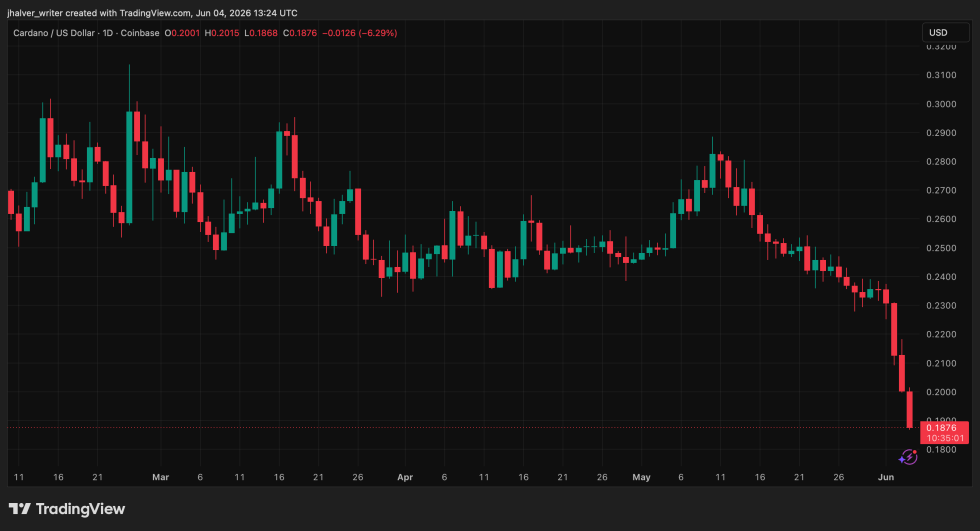
ADA's price trends to the downside on the daily chart. Source: ADAUSD on Tradingview

Hoskinson’s Warning — And The ADA Fallout

Responding in a video on the same day, Hoskinson framed TapTools’ exit not as an isolated event but as a leading indicator of deeper ecosystem stress. A substantial portion of older Cardano projects are no longer in an investable state, he said — and the H2 2026 environment will force many into the same position.

He pointed to JX Door’s earlier collapse as a warning sign that went unheeded, and acknowledged that a treasury-funded index he had proposed to backstop struggling ecosystem projects never materialized. “I came up with the plan of an index. It did not get executed,” he said in the video, per the YouTube posting, placing partial responsibility on Cardano’s governance community for failing to act when opportunities were available.

Hoskinson subsequently posted on X that he is “taking a break” — three words that landed heavily given the timing.

The Community Fires Back

The response from prominent voices in the crypto community was swift and pointed. Andreas Svanevik (@ASvanevik), CEO of Nansen, addressed Hoskinson’s implicit question about what he could do to help directly: “It’s not about what he can do NOW,” Svanevik wrote on X. “The problem is he sold Cardano as something it never was. And people believed him. Now they will all suffer the consequences together.”

The post drew significant engagement and amplified a sentiment that had been building in the community for months — that Hoskinson’s long-standing promises about Cardano’s institutional potential and developer adoption had set expectations the network could not match. @Pledditor’s post on X added further community context to the criticism, reflecting frustration that had been building across ADA holders as the ecosystem continued to lose ground.

The Structural Picture

The numbers behind the debate are difficult to argue with. Cardano’s total value locked stands at approximately $123.85 million — placing it 28th by chain TVL on DeFiLlama, behind Stellar, NEAR, Aptos, and Mantle, and roughly two orders of magnitude below Ethereum’s $39.9 billion.

The 2026 Cardano Summit was canceled after the community voted down treasury funding. Engineering proposals for 2026 were cut to $46.8 million from $97.5 million the prior year. The van Rossem hard fork was postponed to allow further testing. ADA is currently trading at approximately $0.20 — its lowest level in more than five years.

The question Hoskinson’s own comments raise — whether Cardano can reverse a trajectory that its own founder is now publicly describing in near-apocalyptic terms — is one the ecosystem has no clean answer to heading into what he himself calls the hardest half of the year.

Cover image from Grok, ADAUSD chart from Tradingview

Criptomoedas em alta

Perguntas relacionadas

QWhat specific event did Charles Hoskinson cite as a catalyst for his warning about Cardano's ecosystem, and what was its impact?

AThe catalyst was the announcement by TapTools, Cardano's most widely used analytics and infrastructure platform, that it would wind down operations within two weeks. This event signaled deeper ecosystem stress to Hoskinson, contributing to his warning about a coming wave of project failures.

QHow did prominent voices in the crypto community, like Andreas Svanevik, respond to Hoskinson's warning and his role in Cardano's situation?

AAndreas Svanevik, CEO of Nansen, responded critically on X. He argued that the problem stemmed from Hoskinson selling Cardano as something it never was, setting unrealistic expectations about its institutional potential and developer adoption that the network failed to meet.

QWhat are some key metrics mentioned in the article that illustrate Cardano's current challenges in the broader blockchain landscape?

AKey metrics include Cardano's Total Value Locked (TVL) of approximately $123.85 million, ranking 28th among chains, and ADA's price falling below $0.20 for the first time in over five years. The article also notes the 2026 Cardano Summit was canceled and engineering proposals were significantly cut from $97.5 million to $46.8 million.

QWhat internal failure did Hoskinson acknowledge regarding a proposed plan to support struggling Cardano projects?

AHoskinson acknowledged that a treasury-funded index he had proposed to backstop struggling ecosystem projects never materialized. He stated, 'I came up with the plan of an index. It did not get executed,' placing partial responsibility on Cardano's governance community for failing to act.

QWhat major implication does Charles Hoskinson's warning raise for the future of the Cardano ecosystem according to the article's conclusion?

AHoskinson's warning raises the question of whether Cardano can reverse its current negative trajectory, which he himself describes in near-apocalyptic terms. The ecosystem faces this challenge heading into what he calls the hardest half of the year (H2 2026), with no clear answer provided.

Leituras Relacionadas

From Gold to Bitcoin: Fixed Supply + Institutional Frenzy, Might It Repeat the 'Explosive' Price Trend?

"From Gold to Bitcoin: Fixed Supply and Institutional Frenzy May Lead to 'Explosive' Price Rally Analysts suggest Bitcoin's price action could mirror gold's over the past two decades, following the launch of spot Bitcoin ETFs. Gold ETFs, introduced in 2004, drove gold's price surge to a current market cap near $28 trillion. Both gold and Bitcoin are non-yielding stores of value, with prices driven purely by investor sentiment rather than cash flows or credit. Gold ETFs experienced dramatic cycles: explosive growth, painful drawdowns, and slow recoveries, with each cycle reaching higher peaks. Bitcoin ETFs, approved in early 2024, saw rapid institutional adoption but are now facing similar volatility. Recent warnings highlight the risk of significant ETF outflows disrupting the current rebound. BlackRock's IBIT, a leading Bitcoin ETF, has sold nearly 100,000 BTC to meet redemptions while still holding over 733,000. The core parallel is fixed supply: when demand surges, prices explode, but demand is often volatile and wave-like, not steady. Institutional interest, through ETFs and corporate adoption, remains a key support pillar, helping to cushion sell-offs. If Bitcoin captures even a fraction of gold's role as a store of value, its upside potential is immense, though the path will be marked by high volatility. For investors, focusing on long-term trends and managing risk is crucial as this 'price explosion' narrative unfolds."

Foresight NewsHá 2m

From Gold to Bitcoin: Fixed Supply + Institutional Frenzy, Might It Repeat the 'Explosive' Price Trend?

Foresight NewsHá 2m

Why Is AI Agent Shopping Hard to Popularize?

The article argues that the popular narrative of "AI agent shopping" – equipping AI with a wallet to autonomously handle purchases – is fundamentally flawed and oversimplifies the complexity of shopping. It deconstructs shopping into two core actions: **information retrieval** (standardized, easily automated) and **value judgment** (deeply subjective and human-centric). The narrative mistakenly assumes AI can fully handle both. Value judgment itself has two layers: **evaluation** (assessing options against criteria) and **demand definition** (setting the criteria, weights, and values). The latter is inherently human and dynamic, as preferences are not fixed but constructed during the decision-making process ("constructive preferences"). The real dividing line for automation is not product standardization, but whether the **act of choosing** itself holds experiential value. For mundane purchases (e.g., printer paper), full AI delegation works. For experiential goods (e.g., wine, furniture), the joy of selection is core to consumption, so AI should act as an assistant that narrows options, leaving the final choice to humans. The "AI wallet" concept confuses three separate elements: decision-making, execution, and fund custody. Current payment industry solutions (e.g., from Stripe, Mastercard, Google, Visa) show that limited, scoped payment authorization tokens are sufficient for most consumer scenarios, not full fund custody. The true use case for autonomous AI wallets is in **B2B procurement** and **machine-to-machine (M2M) settlements** for standardized, high-frequency, low-value transactions. The real bottlenecks for AI shopping are not payment technology, but **1) the lack of trusted data sources** (e.g., fake reviews, counterfeit goods) and **2) the impossibility of automating human demand definition**. The conclusion is that the focus should be on safely automating the assessment and filtering process while reserving for humans the rights to define their criteria and enjoy the final act of choice. For experiential goods, the platform's competitive advantage shifts to providing a superior selection experience.

Foresight NewsHá 59m

Why Is AI Agent Shopping Hard to Popularize?

Foresight NewsHá 59m

After Nine Months of Shorting, a Full Turn to Long: Renowned Trader Opens Bitcoin Positions Around 64K, Crypto Market Long-Short Divergence Intensifies

After nine months of being short, prominent crypto trader Doctor Profit has closed all his bearish positions and started buying Bitcoin near $64,000, signaling a complete bullish reversal. He argues that structural market changes—such as impending U.S. regulation (CLARITY Act) and institutional adoption via securities tokenization—are rewriting the traditional four-year cycle script, potentially bringing the market bottom forward from the widely expected September/October timeframe. This view finds some technical support from on-chain analyst gumsays, who notes a bullish divergence on Bitcoin's weekly chart has persisted for 147 days, nearing the 161-day duration seen before the 2022 cycle low. However, cycle researcher Jake Pahor presents a counter-argument based on historical data. Analyzing patterns since 2014, he identifies three common features of past bear market bottoms: a ~12-month duration from peak to trough, a sustained period of extreme fear (with a proprietary risk score below 20), and the price falling below Bitcoin's realized price (~$53,000 currently). The current cycle, only nine months from its October 2025 peak, meets none of these conditions. The debate highlights a market torn between "front-running" a potential early bottom driven by new fundamentals and waiting for confirmation through traditional on-chain and sentiment metrics. While Doctor Profit opts for aggressive buying, Pahor maintains a disciplined, tiered accumulation strategy, continuing weekly buys at current risk levels but reserving larger orders for if more extreme fear emerges.

marsbitHá 1h

After Nine Months of Shorting, a Full Turn to Long: Renowned Trader Opens Bitcoin Positions Around 64K, Crypto Market Long-Short Divergence Intensifies

marsbitHá 1h

Senior Trader's Confession: How to Trade Market's False Expectations?

Veteran trader's case study: trading the market's "wrong expectations". This trade centered on a textbook "expectation error" after a weak CPI report. While the market initially priced in broad monetary easing (sending Nasdaq to 30,060), the crucial 30-year real yield hit a 20-year high. This signaled a fractured transmission mechanism: short-term rates eased, but long-term funding costs (vital for tech valuations) refused to fall. The trader executed five short positions on the Nasdaq (NQ) as it fell from 30,060 to 28,768. The core methodology: don't just trade the data, but analyze the market's implied causal chain and identify where it breaks. In this case, the chain was: Weak CPI → Policy Easing → Lower Long-Term Funding Costs → NQ Valuation Expansion. The break occurred between policy easing and long-term rates. The "veto variable" – long-term real yields – refused to confirm the bullish narrative. Trades were structured around "fast variables" (price) temporarily repairing while "slow variables" (funding conditions) remained broken. The article outlines a repeatable framework: 1) Map the market's implied causal chain. 2) Identify the veto variable. 3) Observe if it rejects the narrative. 4) Enter when price still follows the old script. 5) Choose the cleanest asset expression (e.g., short NQ, not broad S&P). 6) Define both invalidation and fulfillment exit conditions. The key insight: Alpha often comes not from an information edge, but from a "reaction function edge" – recognizing when the market is applying an outdated causal logic to new data. The critical question: What causal chain is the market's first reaction relying on, and is that chain still valid today?

marsbitHá 1h

Senior Trader's Confession: How to Trade Market's False Expectations?

marsbitHá 1h

Trading

Spot

Artigos em Destaque

Como comprar ADA

Bem-vindo à HTX.com!Tornámos a compra de Cardano (ADA) simples e conveniente.Segue o nosso guia passo a passo para iniciar a tua jornada no mundo das criptos.Passo 1: cria a tua conta HTXUtiliza o teu e-mail ou número de telefone para te inscreveres numa conta gratuita na HTX.Desfruta de um processo de inscrição sem complicações e desbloqueia todas as funcionalidades.Obter a minha contaPasso 2: vai para Comprar Cripto e escolhe o teu método de pagamentoCartão de crédito/débito: usa o teu visa ou mastercard para comprar Cardano (ADA) instantaneamente.Saldo: usa os fundos da tua conta HTX para transacionar sem problemas.Terceiros: adicionamos métodos de pagamento populares, como Google Pay e Apple Pay, para aumentar a conveniência.P2P: transaciona diretamente com outros utilizadores na HTX.Mercado de balcão (OTC): oferecemos serviços personalizados e taxas de câmbio competitivas para os traders.Passo 3: armazena teu Cardano (ADA)Depois de comprar o teu Cardano (ADA), armazena-o na tua conta HTX.Alternativamente, podes enviá-lo para outro lugar através de transferência blockchain ou usá-lo para transacionar outras criptomoedas.Passo 4: transaciona Cardano (ADA)Transaciona facilmente Cardano (ADA) no mercado à vista da HTX.Acede simplesmente à tua conta, seleciona o teu par de trading, executa as tuas transações e monitoriza em tempo real.Oferecemos uma experiência de fácil utilização tanto para principiantes como para traders experientes.

1.3k Visualizações TotaisPublicado em {updateTime}Atualizado em 2026.06.02

Como comprar ADA

Discussões

Bem-vindo à Comunidade HTX. Aqui, pode manter-se informado sobre os mais recentes desenvolvimentos da plataforma e obter acesso a análises profissionais de mercado. As opiniões dos utilizadores sobre o preço de ADA (ADA) são apresentadas abaixo.

活动图片