Is Bitcoin’s Reset Complete? BTC Steadies Above $70K as Markets Debate the Next Move

bitcoinistPublicado em 2026-02-10Última atualização em 2026-02-10

Resumo

After a sharp decline to $60,000, Bitcoin has stabilized above $70,000, though the recovery remains fragile. On-chain data shows significant deleveraging, with a major whale selling over $340 million in BTC and reducing holdings from $11 billion to $2.2 billion. Open interest also fell sharply, indicating reduced market leverage and momentum. While some view the sell-off as a healthy reset, others caution it may be a bull trap. Key support is at $60,000, with resistance near $73,000–$75,000. Broader factors like equity market rebounds and ETF inflows provide some stability, but the market awaits clearer signals from macro conditions and institutional conviction.

After one of its sharpest swings in over a year, Bitcoin (BTC) is attempting to find balance. Prices have stabilized above $70,000 following a rapid drop to $60,000 last week, but the calm has done little to settle the broader debate; is this a completed reset, or just a pause before another move lower?

The recent volatility has flushed out leverage, forced large players to cut risk, and shifted sentiment from optimism to caution. While dip buyers have returned, on-chain data, derivatives metrics, and macro signals suggest the market remains in a fragile holding pattern rather than a clear recovery.
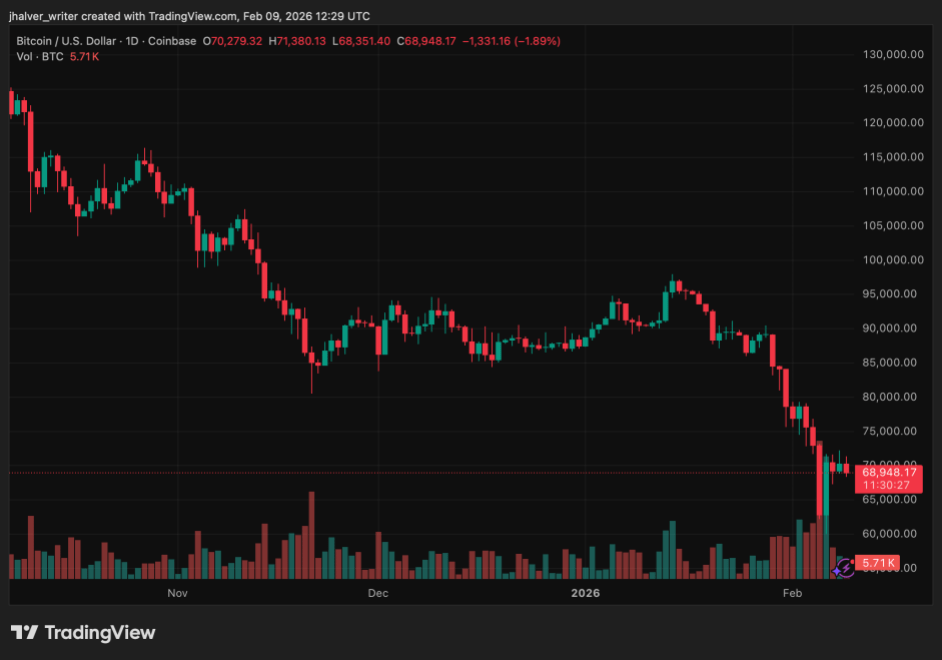
BTC's price trends to the downside on the daily chart. Source: BTCUSD on Tradingview

Whales Step Back as Leverage Unwinds

One of the clearest signs of the reset came from whale activity. On-chain data shows that the so-called Hyperunit whale sold more than $340 million in Bitcoin, sending the funds to Binance after months of aggressive, leveraged trading across crypto markets. The move followed a major liquidation on a large Ethereum position, which reportedly resulted in losses of roughly $250 million.

At its peak, the wallet held over $11 billion in Bitcoin. Holdings have since fallen to about $2.2 billion, signaling a shift away from expansion toward capital preservation.

The selling coincided with a broader decline in Bitcoin open interest, which fell from around $61 billion to near $49 billion, pointing to widespread deleveraging rather than fresh short positioning.

This reduction in leverage has eased immediate downside pressure but has also reduced momentum, leaving Bitcoin without strong directional conviction.

Bitcoin Price Stabilizes, But Signals Remain Mixed

Bitcoin was trading around $70,000–$71,000 in Asian hours on Monday, holding steady after last week’s rapid rebound. Technical indicators still show weak momentum, with subdued volume and no clear signs of either buyers or sellers being firmly in control.

Market participants are split. Some analysts argue that the recent washout has removed excess risk and created conditions for a healthier base. Others warn that similar rebounds in this cycle have turned into bull traps, especially when driven by short-term traders rather than long-term accumulation.

Support near $60,000 remains a key level to watch, while resistance between $73,000 and $75,000 is seen as a test for any sustained upside.

Macro, Sentiment, and Structural Questions

Beyond price action, broader factors are shaping the debate. Global equity markets rebounded, helping risk assets stabilize, while US spot Bitcoin ETFs recorded modest inflows as investors selectively bought the dip.

At the same time, concerns around long-term narratives, from Bitcoin’s safe-haven role to emerging discussions about quantum computing risks, continue to hover in the background.

Bitcoin’s ability to hold above $70,000 suggests the forced reset may be largely complete. Whether that turns into a durable recovery or another leg lower will depend on liquidity, conviction from larger players, and how markets respond to upcoming macro data.

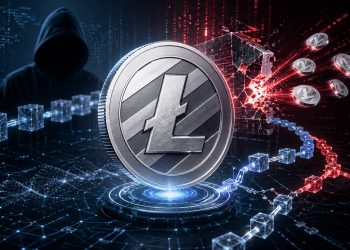
Cover image from ChatGPT, BTCUSD chart on Tradingview

Perguntas relacionadas

QWhat is the current price range of Bitcoin and what key level is being watched for support?

ABitcoin is currently trading around $70,000–$71,000, with the key support level to watch near $60,000.

QWhat significant action did the 'Hyperunit whale' take, and what did it signal?

AThe 'Hyperunit whale' sold more than $340 million in Bitcoin, sending the funds to Binance. This move, which followed a major liquidation on a large Ethereum position, signaled a shift away from aggressive, leveraged trading toward capital preservation.

QWhat does the decline in Bitcoin open interest indicate about the market?

AThe decline in Bitcoin open interest, which fell from around $61 billion to near $49 billion, points to widespread deleveraging across the market rather than the establishment of fresh short positions.

QAccording to the article, what are the two opposing views among analysts regarding the recent price action?

ASome analysts argue the recent washout has removed excess risk and created conditions for a healthier base, while others warn that similar rebounds have turned into bull traps, especially when driven by short-term traders rather than long-term accumulation.

QBesides price, what broader factors are influencing the Bitcoin market debate?

ABroader factors include the rebound in global equity markets, modest inflows into US spot Bitcoin ETFs, and lingering concerns around long-term narratives such as Bitcoin's safe-haven role and emerging discussions about quantum computing risks.

Leituras Relacionadas

Xiaohongshu's Second Great Voyage, This Time Sailing Towards AI

Xiaohongshu's Second Voyage: Navigating Towards AI Since ChatGPT's emergence, Xiaohongshu's founder Mao Wenchao has been acutely aware of AI's potential threat, recognizing that the life advice people seek from chatbots overlaps directly with his platform's core business. Founded in 2013 as a PDF shopping guide for Chinese tourists, Xiaohongshu evolved into a massive community where millions share authentic, personal experiences—from product reviews to travel tips. This vast repository of "I've tried this" human judgment became its most valuable asset. However, the rise of AI, which delivers instant answers, challenges the very need for users to sift through numerous personal notes. Fearing its treasure trove of lived experience could become mere training data for others, Xiaohongshu is proactively adapting. In 2026, it established a dedicated AI division (Dots), launched RED Skill to turn user experiences into usable AI tools, and acquired the AI search product "Diandian." Its investments now extend to AI firms like MiniMax and hardware startups, moving upstream to address needs before they even become search queries. The platform's commercialization strategy is also evolving. With a newly acquired payment license and tools like the AIPS model to track consumer decision journeys, Xiaohongshu aims to seamlessly integrate recommendations with transactions, embedding commerce within AI-generated answers. Yet, a critical tension remains. While building smarter machines to organize and leverage its human experiences, Xiaohongshu must prevent AI from drowning out the authentic, flawed, and trustworthy "I've tried this" voices that built its community. Its core challenge is to harness AI's power without letting the map—the machine's perfect, synthesized answer—replace the territory of genuine human experience. This balance between technological advancement and preserving human trust defines its current journey and its future.

marsbitHá 24m

Xiaohongshu's Second Great Voyage, This Time Sailing Towards AI

marsbitHá 24m

SharpLink CEO: How to Understand Ethereum Developers Just Exceeded 1 Million?

SharpLink CEO reflects on the milestone of Ethereum surpassing 1 million historical developers, emphasizing that this figure represents the largest pool of technical talent ever assembled around an open, permissionless blockchain network. While approximately 232,000 developers remain active, the key question for the crypto industry is not which chain is fastest, but where the best builders choose to build long-term. Ethereum's advantage lies in a decade-long accumulation of infrastructure, standards, tools, liquidity, and a cohesive culture, making it the default operating system for programmable finance. This developer base is tackling complex challenges: the Glamsterdam upgrade aims to enhance scalability while preserving core principles; synchronous composability seeks to unify Rollup ecosystems; and significant efforts are underway for post-quantum security. Ethereum's deeper network effects stem from composability and shared standards (like the EVM and Solidity), creating a flywheel of more developers, tools, and liquidity. Three reinforcing strengths cement Ethereum's lead: credible neutrality (secured by ~900k validators), a modular architecture with interconnected Rollups, and a culture that attracts top researchers. The ecosystem is consolidating as the trusted coordination layer for internet-native finance, favored by large institutions valuing security and liquidity. The future of Ethereum is being built by this global community of founders and architects.

链捕手Há 39m

SharpLink CEO: How to Understand Ethereum Developers Just Exceeded 1 Million?

链捕手Há 39m

A Clod of Chinese Soil Chokes Two Japanese Giants

"Chinese Soil Chokes Japanese Giants" The production of a key electronic specialty gas, tungsten hexafluoride (WF6), vital for manufacturing AI chips, was halted by two leading Japanese producers—Kanto Denka and Central Glass. Their shutdown was not due to a technological failure but a sudden, critical shortage of a raw material they had long taken for granted: ultra-high-purity (6N-grade) tungsten powder, which is almost entirely sourced from China. Following a quiet Chinese export announcement in January 2026, tungsten powder shipments to Japan dropped to zero for months. Despite frantic efforts, Japanese companies found no viable alternative; imported powder was three times more expensive and lacked the required purity. Their existing stockpiles were exhausted by mid-2026. WF6 is essential for depositing tungsten into the microscopic contact holes of High Bandwidth Memory (HBM) chips, which are crucial for advanced processors like those from Nvidia. While Japanese firms had mastered producing ultra-pure WF6 gas, their entire supply chain relied on China's 6N tungsten powder—a dependency now revealed as a fatal vulnerability. China's dominance in this "soil" results from decades of painstaking R&D by companies like Xiamen Tungsten and China Tungsten & Hightech. They overcame immense technical hurdles, such as separating chemically similar molybdenum from tungsten, to achieve mass production of the world's purest tungsten powder. With their primary suppliers gone, Kanto Denka and Central Glass announced a permanent halt to WF6 production starting July 1, 2026. This immediately created a supply crisis for major semiconductor manufacturers like Samsung and SK Hynix, forcing them to urgently seek and certify new Chinese suppliers for WF6 itself. The reversal marks a dramatic shift: China has moved from exporting low-value raw materials to controlling the high-purity foundation of a critical global tech supply chain, upending a long-established industrial hierarchy.

marsbitHá 1h

A Clod of Chinese Soil Chokes Two Japanese Giants

marsbitHá 1h

Trading

Spot
Futuros

Artigos em Destaque

Como comprar MOVE

Bem-vindo à HTX.com!Tornámos a compra de Movement (MOVE) simples e conveniente.Segue o nosso guia passo a passo para iniciar a tua jornada no mundo das criptos.Passo 1: cria a tua conta HTXUtiliza o teu e-mail ou número de telefone para te inscreveres numa conta gratuita na HTX.Desfruta de um processo de inscrição sem complicações e desbloqueia todas as funcionalidades.Obter a minha contaPasso 2: vai para Comprar Cripto e escolhe o teu método de pagamentoCartão de crédito/débito: usa o teu visa ou mastercard para comprar Movement (MOVE) instantaneamente.Saldo: usa os fundos da tua conta HTX para transacionar sem problemas.Terceiros: adicionamos métodos de pagamento populares, como Google Pay e Apple Pay, para aumentar a conveniência.P2P: transaciona diretamente com outros utilizadores na HTX.Mercado de balcão (OTC): oferecemos serviços personalizados e taxas de câmbio competitivas para os traders.Passo 3: armazena teu Movement (MOVE)Depois de comprar o teu Movement (MOVE), armazena-o na tua conta HTX.Alternativamente, podes enviá-lo para outro lugar através de transferência blockchain ou usá-lo para transacionar outras criptomoedas.Passo 4: transaciona Movement (MOVE)Transaciona facilmente Movement (MOVE) no mercado à vista da HTX.Acede simplesmente à tua conta, seleciona o teu par de trading, executa as tuas transações e monitoriza em tempo real.Oferecemos uma experiência de fácil utilização tanto para principiantes como para traders experientes.

312 Visualizações TotaisPublicado em {updateTime}Atualizado em 2026.06.02

Como comprar MOVE

Discussões

Bem-vindo à Comunidade HTX. Aqui, pode manter-se informado sobre os mais recentes desenvolvimentos da plataforma e obter acesso a análises profissionais de mercado. As opiniões dos utilizadores sobre o preço de MOVE (MOVE) são apresentadas abaixo.

活动图片