Is Bitcoin’s Reset Complete? BTC Steadies Above $70K as Markets Debate the Next Move

bitcoinistPublicado em 2026-02-10Última atualização em 2026-02-10

Resumo

After a sharp decline to $60,000, Bitcoin has stabilized above $70,000, though the recovery remains fragile. On-chain data shows significant deleveraging, with a major whale selling over $340 million in BTC and reducing holdings from $11 billion to $2.2 billion. Open interest also fell sharply, indicating reduced market leverage and momentum. While some view the sell-off as a healthy reset, others caution it may be a bull trap. Key support is at $60,000, with resistance near $73,000–$75,000. Broader factors like equity market rebounds and ETF inflows provide some stability, but the market awaits clearer signals from macro conditions and institutional conviction.

After one of its sharpest swings in over a year, Bitcoin (BTC) is attempting to find balance. Prices have stabilized above $70,000 following a rapid drop to $60,000 last week, but the calm has done little to settle the broader debate; is this a completed reset, or just a pause before another move lower?

The recent volatility has flushed out leverage, forced large players to cut risk, and shifted sentiment from optimism to caution. While dip buyers have returned, on-chain data, derivatives metrics, and macro signals suggest the market remains in a fragile holding pattern rather than a clear recovery.
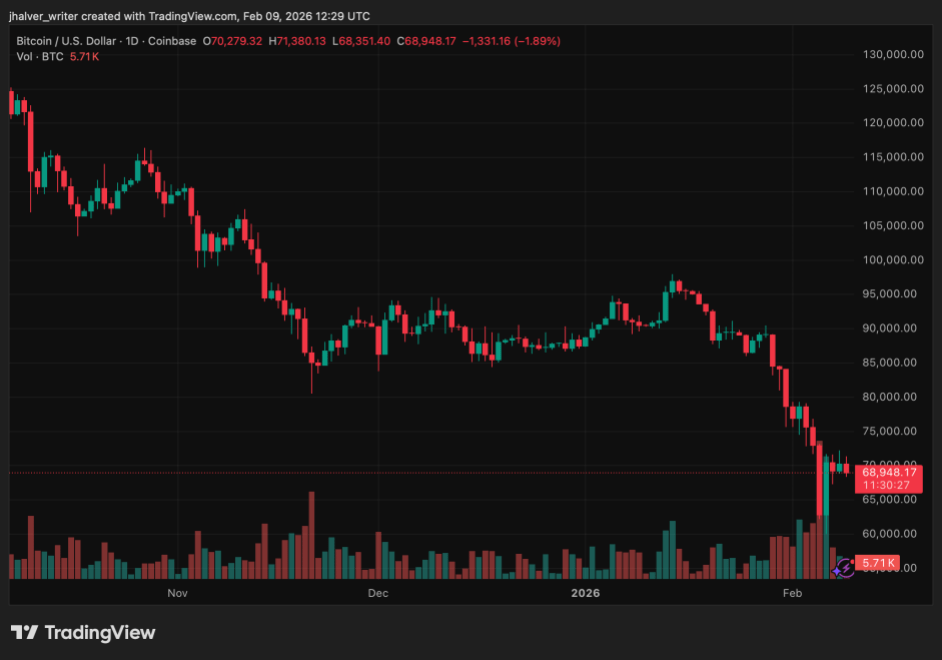
BTC's price trends to the downside on the daily chart. Source: BTCUSD on Tradingview

Whales Step Back as Leverage Unwinds

One of the clearest signs of the reset came from whale activity. On-chain data shows that the so-called Hyperunit whale sold more than $340 million in Bitcoin, sending the funds to Binance after months of aggressive, leveraged trading across crypto markets. The move followed a major liquidation on a large Ethereum position, which reportedly resulted in losses of roughly $250 million.

At its peak, the wallet held over $11 billion in Bitcoin. Holdings have since fallen to about $2.2 billion, signaling a shift away from expansion toward capital preservation.

The selling coincided with a broader decline in Bitcoin open interest, which fell from around $61 billion to near $49 billion, pointing to widespread deleveraging rather than fresh short positioning.

This reduction in leverage has eased immediate downside pressure but has also reduced momentum, leaving Bitcoin without strong directional conviction.

Bitcoin Price Stabilizes, But Signals Remain Mixed

Bitcoin was trading around $70,000–$71,000 in Asian hours on Monday, holding steady after last week’s rapid rebound. Technical indicators still show weak momentum, with subdued volume and no clear signs of either buyers or sellers being firmly in control.

Market participants are split. Some analysts argue that the recent washout has removed excess risk and created conditions for a healthier base. Others warn that similar rebounds in this cycle have turned into bull traps, especially when driven by short-term traders rather than long-term accumulation.

Support near $60,000 remains a key level to watch, while resistance between $73,000 and $75,000 is seen as a test for any sustained upside.

Macro, Sentiment, and Structural Questions

Beyond price action, broader factors are shaping the debate. Global equity markets rebounded, helping risk assets stabilize, while US spot Bitcoin ETFs recorded modest inflows as investors selectively bought the dip.

At the same time, concerns around long-term narratives, from Bitcoin’s safe-haven role to emerging discussions about quantum computing risks, continue to hover in the background.

Bitcoin’s ability to hold above $70,000 suggests the forced reset may be largely complete. Whether that turns into a durable recovery or another leg lower will depend on liquidity, conviction from larger players, and how markets respond to upcoming macro data.

Cover image from ChatGPT, BTCUSD chart on Tradingview

Criptomoedas em alta

Perguntas relacionadas

QWhat is the current price range of Bitcoin and what key level is being watched for support?

ABitcoin is currently trading around $70,000–$71,000, with the key support level to watch near $60,000.

QWhat significant action did the 'Hyperunit whale' take, and what did it signal?

AThe 'Hyperunit whale' sold more than $340 million in Bitcoin, sending the funds to Binance. This move, which followed a major liquidation on a large Ethereum position, signaled a shift away from aggressive, leveraged trading toward capital preservation.

QWhat does the decline in Bitcoin open interest indicate about the market?

AThe decline in Bitcoin open interest, which fell from around $61 billion to near $49 billion, points to widespread deleveraging across the market rather than the establishment of fresh short positions.

QAccording to the article, what are the two opposing views among analysts regarding the recent price action?

ASome analysts argue the recent washout has removed excess risk and created conditions for a healthier base, while others warn that similar rebounds have turned into bull traps, especially when driven by short-term traders rather than long-term accumulation.

QBesides price, what broader factors are influencing the Bitcoin market debate?

ABroader factors include the rebound in global equity markets, modest inflows into US spot Bitcoin ETFs, and lingering concerns around long-term narratives such as Bitcoin's safe-haven role and emerging discussions about quantum computing risks.

Leituras Relacionadas

Saeed Al-Marri: How Tokenization Unlocks New Opportunities for Shipping Funds

Said Al-Marri: How Tokenization Opens New Opportunities for Shipping Funds For centuries, commercial shipping has been a capital-intensive asset class limited to institutional funds and shipping dynasties. Said bin Saleh Al-Marri, CEO of Ethra Invest and Ethra Ship, aims to break down these barriers by combining Real World Asset (RWA) tokenization with conservative private equity principles. This bridges decentralized finance (DeFi) with the physical realities of global trade. Tokenization allows fractional ownership of ships on a blockchain, giving smaller investors access to previously inaccessible markets. However, Al-Marri warns it is not a regulatory loophole or a cure for asset illiquidity. The core physical risks are isolated in Special Purpose Vehicles (SPVs) for qualified investors. While tokenization enhances transparency and ownership record-keeping, Al-Marri stresses that a liquid secondary market depends on transparent asset valuation and must not interfere with ship operations managed by professionals. Regarding legal enforcement, smart contracts cannot physically seize a ship. Legal recourse still relies on traditional maritime courts, ship mortgages, and flag state laws, with blockchain records needing to mirror legal ownership in the SPV perfectly. Beyond ownership, the industry faces administrative hurdles like paper-based bills of lading. Al-Marri argues the bottleneck is legal and operational standardization, not technology. He advocates for a hybrid model combining digital trade documents and programmable settlements with support from regulated financial institutions, rather than a full crypto replacement for tools like Letters of Credit. A major challenge is decarbonizing the global fleet by 2050. Transitioning to green fuels requires massive upfront investment. Al-Marri emphasizes a conservative, holistic approach to underwriting these projects, evaluating technology, fuel availability, safety, and resale value. Investments must be justified under conservative forecasts, not just optimistic ones. By combining pragmatic risk management with digital infrastructure, leaders like Al-Marri show that the evolution of maritime finance is about mobilizing capital to build a modernized and sustainable global fleet, not just putting ships on a blockchain.

cryptonews.ruHá 13m

Saeed Al-Marri: How Tokenization Unlocks New Opportunities for Shipping Funds

cryptonews.ruHá 13m

Six Years Later, UNI Finally Welcomes Its Own "Buyback Bull"

After years of debate, Uniswap's UNI token has finally entered a 'buyback bull' phase following the long-awaited activation of its fee-switch mechanism. The UNIfication proposal, executed in December 2025, redirected a portion of protocol fees from select pools and Unichain sequencer revenue into a treasury (TokenJar) dedicated to buying back and permanently burning UNI. Initial market reaction was muted due to modest early burn rates. A significant shift occurred in July 2026 with the launch of Robinhood Chain. Uniswap's immediate deployment there skyrocketed trading volume, making it a top fee-generator. Subsequently, governance votes extended the fee mechanism to v4 pools and Robinhood Chain, causing protocol revenue to nearly triple. Daily funds directed to UNI burns rose sharply, with Robinhood Chain contributing over half. This transitioned UNI's narrative from a governance token to a cash-flow asset backed by a perpetual automatic buyer. UNI's price, which had languished around $2.30 in early June, nearly doubled to approach $4.60 by late July. Analysts credit this to the tangible cash flow from fees rather than mere speculation. Unlike many newer projects where buybacks are offset by large investor unlocks, UNI's six-year history has resulted in a widely distributed and relatively clean supply, allowing the buyback pressure to effectively impact the secondary market. The key test will be whether trading activity, particularly on Robinhood Chain, sustains after its initial gas subsidies expire.

marsbitHá 18m

Six Years Later, UNI Finally Welcomes Its Own "Buyback Bull"

marsbitHá 18m

Only 153 Venture Capital Firms Invested in July: Is the Crypto VC Industry Experiencing a 'Mass Extinction'?

In July 2026, only 153 unique venture capital firms participated in disclosed crypto funding rounds, marking the lowest monthly count since November 2020. This figure represents an 87% decline from the peak of 1,177 firms in 2022. Overall, the first seven months of 2026 saw crypto projects raise approximately $11.78 billion across 481 rounds. This crypto VC contraction contrasts sharply with the broader venture capital landscape, where global VC investment reached a record $560.4 billion in H1 2026, heavily fueled by major AI company financings. This shift in capital allocation has drawn funds away from the crypto sector. Within crypto, funding is highly concentrated. Trading platforms, prediction markets, and payment sectors absorbed 53% of the total capital. While early-stage deals remain frequent, the largest sums flow to a few late-stage rounds and mergers & acquisitions, which surged to $7.23 billion in Q2 2026. The market is consolidating around top funds like a16z crypto and Dragonfly, which successfully raised new multi-billion dollar funds, while many smaller firms have retreated. Analysts describe this as a "great extinction" for crypto VCs, where capital is becoming more selective, favoring proven business models and assets over early-stage speculation. This raises the bar for project quality, funding efficiency, and viable exit paths.

marsbitHá 39m

Only 153 Venture Capital Firms Invested in July: Is the Crypto VC Industry Experiencing a 'Mass Extinction'?

marsbitHá 39m

Trading

Spot

Artigos em Destaque

Como comprar MOVE

Bem-vindo à HTX.com!Tornámos a compra de Movement (MOVE) simples e conveniente.Segue o nosso guia passo a passo para iniciar a tua jornada no mundo das criptos.Passo 1: cria a tua conta HTXUtiliza o teu e-mail ou número de telefone para te inscreveres numa conta gratuita na HTX.Desfruta de um processo de inscrição sem complicações e desbloqueia todas as funcionalidades.Obter a minha contaPasso 2: vai para Comprar Cripto e escolhe o teu método de pagamentoCartão de crédito/débito: usa o teu visa ou mastercard para comprar Movement (MOVE) instantaneamente.Saldo: usa os fundos da tua conta HTX para transacionar sem problemas.Terceiros: adicionamos métodos de pagamento populares, como Google Pay e Apple Pay, para aumentar a conveniência.P2P: transaciona diretamente com outros utilizadores na HTX.Mercado de balcão (OTC): oferecemos serviços personalizados e taxas de câmbio competitivas para os traders.Passo 3: armazena teu Movement (MOVE)Depois de comprar o teu Movement (MOVE), armazena-o na tua conta HTX.Alternativamente, podes enviá-lo para outro lugar através de transferência blockchain ou usá-lo para transacionar outras criptomoedas.Passo 4: transaciona Movement (MOVE)Transaciona facilmente Movement (MOVE) no mercado à vista da HTX.Acede simplesmente à tua conta, seleciona o teu par de trading, executa as tuas transações e monitoriza em tempo real.Oferecemos uma experiência de fácil utilização tanto para principiantes como para traders experientes.

350 Visualizações TotaisPublicado em {updateTime}Atualizado em 2026.06.02

Como comprar MOVE

Discussões

Bem-vindo à Comunidade HTX. Aqui, pode manter-se informado sobre os mais recentes desenvolvimentos da plataforma e obter acesso a análises profissionais de mercado. As opiniões dos utilizadores sobre o preço de MOVE (MOVE) são apresentadas abaixo.

活动图片