Is a Strong Ruble Good? Not for the Budget: Treasury Already Short 1.5 Trillion

cryptonews.ruPublicado em 2026-08-19Última atualização em 2026-08-19

Resumo

The Russian budget has lost about 1.5 trillion rubles in revenue since the start of 2026 due to the ruble being stronger than the government's planned exchange rate. The budget was based on an average annual rate of 92.2 rubles per US dollar, but the actual average for the first seven and a half months was just 76.9 rubles. This discrepancy creates a significant shortfall, as every ruble of appreciation against the dollar reduces annual budget revenues by 140–160 billion rubles. When accounting for oil and gas revenues, the sensitivity is even higher, with potential annual losses reaching up to 2.5 trillion rubles. So far this year, the budget has already missed out on roughly 1.7 trillion rubles. The ruble's exchange rate has shown considerable volatility in 2026, ranging from a low near 71 rubles per dollar in May to over 85 rubles by mid-August. Despite this recent weakening, the year's average remains well below the budget target, creating a structural deficit in oil and gas revenues. Forecasts suggest the final average rate for 2026 will be around 80–82 rubles, which would result in a budget shortfall of about 1.6 trillion rubles. A strong ruble reduces import costs and inflation but also cuts the ruble earnings of exporters and threatens the funding of social obligations. The gap between the planned and actual rate is attributed not only to oil price dynamics but also to the fiscal rule mechanism, which can influence the currency's direction. The Ministry of Finance ...

The Russian budget has missed out on approximately 1.5 trillion rubles since the beginning of 2026 due to the national currency strengthening beyond planned indicators, according to expert estimates. The financial model for the current year was based on an average annual exchange rate of 92.2 rubles per U.S. dollar, but the actual average for the first seven and a half months was only 76.9 rubles. This discrepancy creates a significant gap between planned and actual revenues, as a 1-ruble appreciation of the national currency against the dollar reduces the budget's annual income by 140–160 billion rubles.

When accounting for oil and gas revenues, the treasury's sensitivity to the exchange rate may be even higher: each ruble in the average annual rate is equivalent to approximately 160 billion rubles in revenues, meaning potential losses for the year could reach 2.5 trillion rubles. Over the nearly eight months that have passed, the budget has already missed out on about 1.7 trillion rubles. More conservative estimates show that a 1-ruble decrease in the average exchange rate leads to state losses of about 140 billion rubles per year, corresponding to a revenue shortfall of 1.4 trillion rubles for the elapsed period.

Exchange Rate Dynamics and Monthly Statistics

The exchange rate in 2026 has shown significant volatility, directly affecting the filling of the state treasury. According to Central Bank of Russia archives, the average monthly values were as follows:

  • January — about 77.56 rubles;

  • February — about 76.85 rubles;

  • March — about 80.76 rubles;

  • April — about 76.94 rubles;

  • May — about 73.01 rubles (year's low);

  • June — about 73.54 rubles;

  • July — about 77.80 rubles;

  • August (as of mid-month) — about 82.32 rubles.
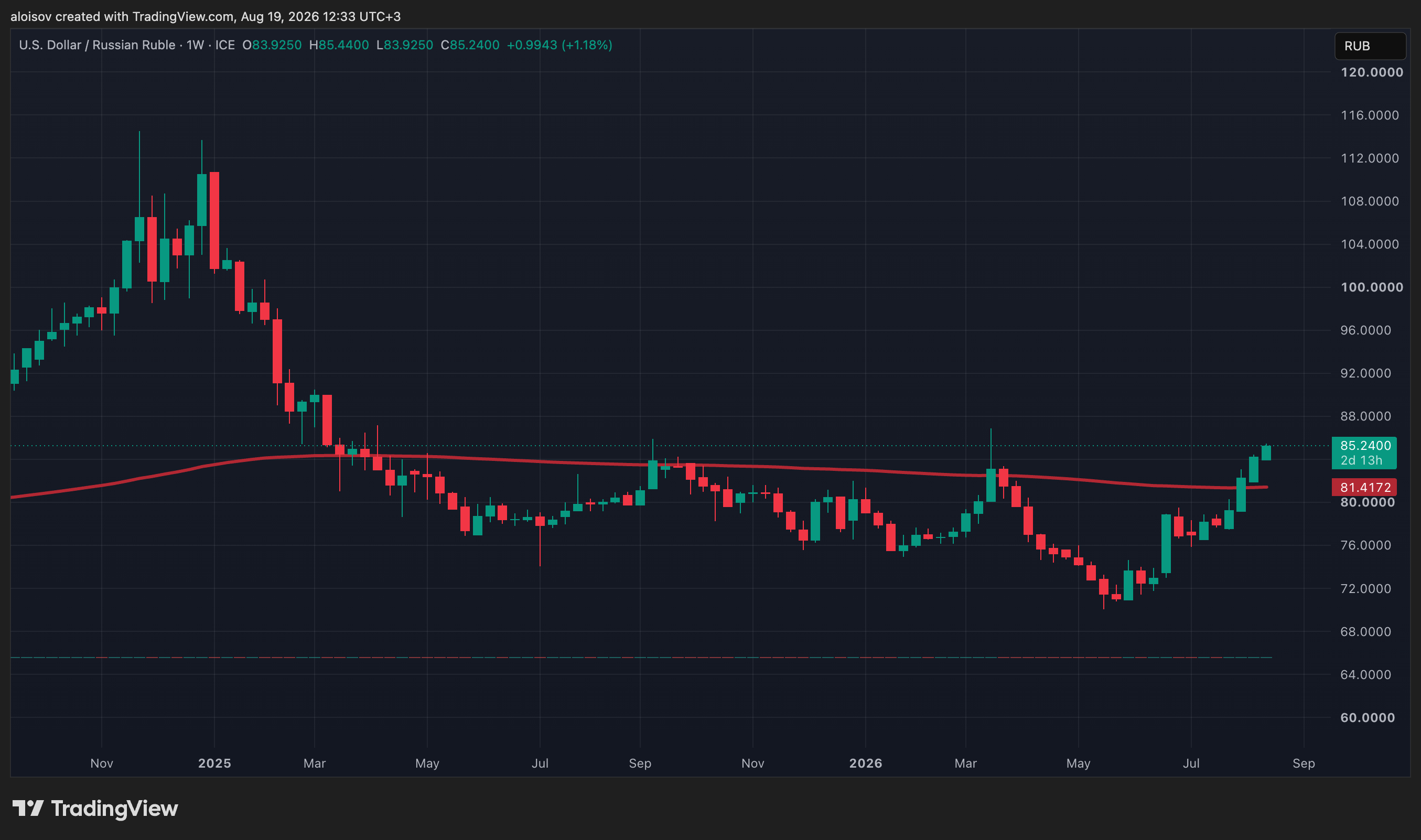
1-week RUB/USD chart

In May, the national currency reached lows around 70.79–71 rubles per $1, after which a steady weakening began. Since the start of summer, the rate gradually rose, and this process accelerated in August: from 79.46 rubles at the beginning of the month, it climbed to 85.16 rubles by August 19. The official Central Bank of Russia exchange rate on that date was 85.1645 rubles per U.S. dollar. Despite the recent weakening, the average for the year remains significantly below the budget target, confirming a structural deficit in oil and gas revenues.

Forecasts and the Balance of Economic Interests

To fulfill the financial plan, the exchange rate would need to stay above 101 rubles/$ until the end of the year, which seems unlikely. Forecasts indicate that the final average annual exchange rate will be around 80–82 rubles, and under this scenario, the budget will miss out on about 1.6 trillion rubles by the end of 2026. A strong national currency makes imports cheaper and restrains inflation, but simultaneously reduces the ruble revenue of exporters and creates risks for fulfilling social obligations due to falling budget revenues—this fundamental conflict defines the current economic agenda.

The significant deviation of the actual exchange rate from the planned parameter poses a challenge for meeting expenditure obligations without adjusting macroeconomic forecasts. Current dynamics suggest that budgetary policy will be forced to adapt to conditions of a stronger ruble than assumed when drafting the financial plan.

AI Opinion

From the perspective of machine data analysis, the observed gap between the planned and actual exchange rate is not solely due to oil price dynamics—the budget rule mechanism, which can itself move the rate in both directions, also plays a role. The cut-off price for oil is fixed at $59 per barrel of Urals: when this level is exceeded, the Ministry of Finance buys foreign currency for reserves, weakening the ruble; when it falls below, the Ministry sells it, supporting the ruble. Earlier this year, the ministry halted foreign currency sales under this rule, removing some dollar supply from the market and adding pressure on the exchange rate regardless of oil prices.

Similar episodes of mismatch between planned and actual exchange rates have occurred before, under different cut-off prices. The question is how sustainable the current ruble weakening will be into autumn and how the parameters of the budget rule will respond.

end-content

Perguntas relacionadas

QAccording to the article, what is the main negative consequence of a strong ruble for the Russian budget?

AThe main negative consequence is a significant shortfall in budget revenues. Due to the ruble being stronger than planned, the budget has already lost about 1.5 trillion rubles (with estimates ranging to 1.7 trillion) in 2026, as a stronger ruble reduces the ruble value of export revenues, primarily from oil and gas.

QWhat was the planned average annual exchange rate for 2026, and what was the actual average for the first seven and a half months?

AThe financial model for 2026 was based on an average annual exchange rate of 92.2 rubles per US dollar. The actual average exchange rate for the first seven and a half months of the year was 76.9 rubles per US dollar.

QHow does the 'budget rule' mechanism mentioned in the article influence the ruble's exchange rate?

AThe budget rule stabilizes the ruble by linking it to oil prices. When the price of Urals oil exceeds a 'cut-off' price (set at $59 per barrel), the Finance Ministry buys foreign currency for reserves, which weakens the ruble. When the price is below the cut-off, it sells currency from reserves, supporting (strengthening) the ruble. Earlier in 2026, the ministry halted these sales, removing a source of dollar supply from the market and contributing to ruble strength independent of oil prices.

QWhat is the predicted range for the final average annual exchange rate in 2026, and what budget shortfall does this scenario imply?

AForecasts indicate the final average annual exchange rate for 2026 will be around 80-82 rubles per US dollar. Under this scenario, the Russian budget is expected to receive approximately 1.6 trillion rubles less than planned by the end of the year.

QThe article mentions a fundamental conflict in the economy due to the ruble's strength. What are the two opposing effects?

AThe fundamental conflict is that a strong ruble has both positive and negative effects. Positively, it makes imports cheaper and helps curb inflation. Negatively, it reduces the ruble-denominated revenue of exporters (especially in the oil and gas sector), which leads to lower budget revenues and creates risks for fulfilling the government's social spending obligations.

Leituras Relacionadas

Trade.xyz Enters the Prediction Market: Who Has Cheaper Fees Compared to Polymarket?

Trade.xyz has launched its prediction market product, "Events," on the Hyperliquid mainnet. Its initial week saw modest activity: $180k in volume and 263 users. The platform aims to integrate prediction markets into a "universal exchange" vision alongside its existing perpetual contracts. A key focus is its fee structure compared to incumbent Polymarket. Trade.xyz uses Hyperliquid's spot trading fees: a fixed 0.07% for Takers and 0.04% for Makers, with volume-based discounts and additional reductions for HYPE token stakers. Fees are charged upon position closure or settlement. Polymarket employs a dynamic model: Makers pay no fees and receive rebates, while Taker fees vary by market category and are calculated as `C × feeRate × p × (1-p)`, where `p` is the outcome probability. This makes fees highest near 50/50 odds and lower as probability approaches 0% or 100%. In a 50% probability scenario for a $100 Taker trade, Polymarket fees (0.04%-0.07% parameter) range from $1 to $1.75, significantly higher than Trade.xyz's ~$0.07. However, for highly probable outcomes (e.g., 99%) or for Maker orders, Polymarket can be cheaper or even free (e.g., Geopolitics markets). While Trade.xyz currently lags far behind Polymarket in scale, it leverages Hyperliquid's existing liquidity and user base. Its potential lies in combining prediction markets with its proven perpetuals infrastructure, positioning it as a possible challenger in the evolving prediction market space.

marsbitHá 2h

Trade.xyz Enters the Prediction Market: Who Has Cheaper Fees Compared to Polymarket?

marsbitHá 2h

Bankless Swap Strategy Success Methodology: How to Screen Undervalued Tokens from VVV to Hyperliquid?

Title: Bankless on Identifying Undervalued Tokens: From VVV to Hyperliquid Summary: In a shifting crypto market, the investment focus is moving from infrastructure narratives to applications with verifiable business models and revenue. This Bankless podcast discussion with Austin Barack of Relayer Capital analyzes how tokens like Venice (VVV), Hyperliquid (HYPE), Pump.fun (PUMP), and ether.fi (ETHFI) can be evaluated based on their fundamentals. Key points include: 1) The market is shifting from chasing growth narratives to finding the intersection of growth and reasonable valuation. 2) Token value is increasingly linked to observable value flow through mechanisms like protocol revenue used for buybacks/burns (e.g., Venice, Hyperliquid). However, this is not a direct equivalent to stock dividends, as token rights are less formalized. 3) Revenue quality and sustainability matter more than just the amount. For instance, Pump.fun's low valuation reflects market skepticism about meme coin trading longevity, despite its resilient revenue over two years. 4) Market categorizations can lag behind business evolution. ether.fi is now primarily a neo-bank/payments platform, not just a restaking protocol, which may create a pricing disconnect. 5) While real revenue can provide a valuation floor and reduce correlation with crypto cycles, these tokens are not fully decoupled from broader market trends. The core argument is that the next phase of crypto valuation will be driven by applications that convert real usage into sustainable revenue and credibly share a portion of that value with token holders, moving towards an application-based economy.

marsbitHá 2h

Bankless Swap Strategy Success Methodology: How to Screen Undervalued Tokens from VVV to Hyperliquid?

marsbitHá 2h

Trading

Spot
活动图片