Iran Launches Bitcoin Payment Platform For Strait Of Hormuz Insurance

bitcoinistPublicado em 2026-05-18Última atualização em 2026-05-18

Resumo

Iran has launched a maritime insurance platform named "Hormuz Safe" for cargo transiting the Strait of Hormuz, with insurance payments settled in Bitcoin. According to a report from Iran's Fars News Agency, the state-backed initiative could generate significant revenue and embeds Bitcoin into a critical global shipping corridor. The platform offers cryptographically verifiable policies for cargo moving through the Persian Gulf and surrounding waterways, with coverage beginning upon payment confirmation. This move occurs amid heightened geopolitical tensions in the strait, a vital chokepoint for global oil shipments. The report did not specify technical details on Bitcoin payment processing or identify external partners.

Iran has launched a new maritime insurance platform for cargo moving through the Strait of Hormuz, with payments settled in Bitcoin, according to a report from Iran’s semi-official Fars News Agency. The project places Bitcoin inside one of the world’s most politically sensitive shipping corridors, where energy flows, sanctions pressure and maritime risk have become increasingly intertwined.

Iran Officially Turns To Bitcoin

Fars reported that the platform, called “Hormuz Safe,” has begun offering insurance for maritime cargo passing through the Strait of Hormuz. The outlet said a document obtained by its reporter showed Iran’s Ministry of Economic Affairs and Finance had been working since early Ordibehesht, the second month of the Iranian calendar, on a plan to make management of the strait possible through insurance. The same report said the scheme could issue maritime insurance policies and financial responsibility certificates, potentially generating more than $10 billion in revenue for Iran.

The most crypto-relevant element is the settlement layer. Fars said the platform’s rules provide “fast, cryptographically verifiable” insurance policies for cargo moving through the Persian Gulf, the Strait of Hormuz and surrounding waterways. “Payments are settled with Bitcoin,” the report said, adding that cargo is covered “from the moment of confirmation” and that owners receive a signed receipt.

That wording makes the story more specific than a generic Bitcoin-payment initiative. The Fars report names Bitcoin directly, rather than referring only to crypto assets, stablecoins or blockchain-based payment rails. It also frames the product not as a consumer-facing wallet or exchange service, but as infrastructure for a maritime insurance and compliance process around ships and cargo.

Related Reading: Bitcoin Social Euphoria Hits Yearly High Amid CLARITY Act Buzz

The launch comes amid heightened scrutiny of the Strait of Hormuz, the narrow waterway between Iran and Oman that connects the Persian Gulf with the Gulf of Oman and Arabian Sea. The US Energy Information Administration has called Hormuz the world’s most important oil chokepoint, noting that oil flows through the strait averaged 21 million barrels per day in 2022, equal to about 21% of global petroleum liquids consumption.

The geopolitical context has become even more acute in recent months. Iran had begun allowing some Chinese vessels to transit the Strait of Hormuz after an understanding over Iranian management protocols for the waterway. Iran had severely restricted transit following the start of US and Israeli strikes on February 28, while a US blockade on Iranian ports after an early-April ceasefire had prolonged the crisis in a corridor through which one-fifth of global oil and natural gas transit.

Fars did not provide technical details on how Bitcoin payments are received, whether the platform uses on-chain settlement directly, third-party custody, internal accounting, or conversion into local or foreign currency. It also did not identify counterparties, underwriters, wallet infrastructure, or any external insurers connected to the platform.

At press time, BTC traded at $76,685.
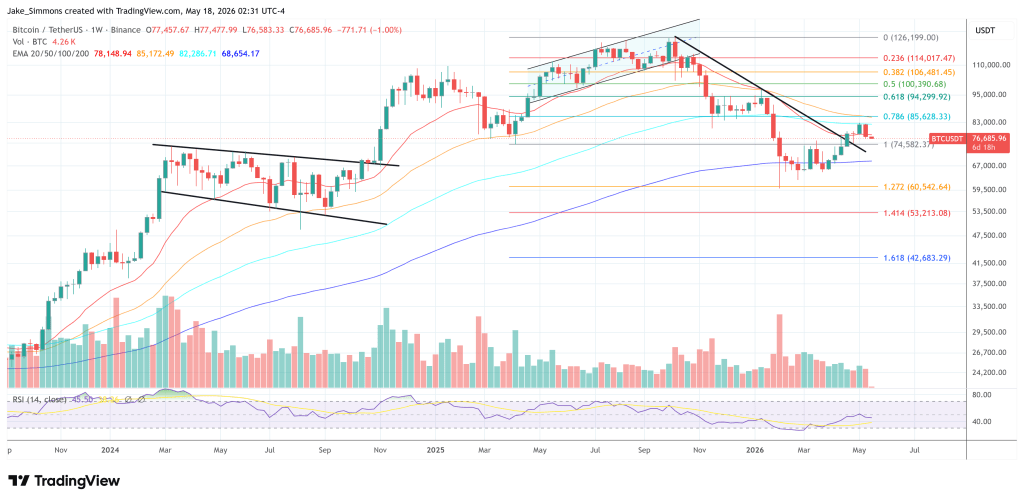
Bitcoin bulls rejected at the 100-week EMA, 1-week chart | Source: BTCUSDT on TradingView.com

Perguntas relacionadas

QWhat is the name of the new Bitcoin-based maritime insurance platform launched by Iran, and which waterway does it specifically cover?

AThe platform is called 'Hormuz Safe,' and it offers insurance for maritime cargo passing through the Strait of Hormuz and surrounding waterways like the Persian Gulf.

QAccording to the Fars News Agency report, what specific cryptocurrency is used for payment settlement on the 'Hormuz Safe' platform?

APayments on the 'Hormuz Safe' platform are settled with Bitcoin.

QWhat major geopolitical and economic significance does the Strait of Hormuz hold, as mentioned in the article?

AThe Strait of Hormuz is described as the world's most important oil chokepoint, with oil flows averaging 21 million barrels per day in 2022, equal to about 21% of global petroleum liquids consumption.

QWhat details about the Bitcoin payment process did the Fars report notably NOT provide, according to the article?

AThe report did not provide technical details on how Bitcoin payments are received, whether the platform uses on-chain settlement directly, third-party custody, internal accounting, or currency conversion. It also did not identify counterparties, underwriters, wallet infrastructure, or any external insurers.

QWhat was the approximate price of Bitcoin (BTC) at the time the article was published?

AAt press time, BTC traded at $76,685.

Leituras Relacionadas

In Jinjiang, Fujian, a Storage Super Unicorn Lies Quiet

In Fujian's Jinjiang, a city known for sportswear, lies a quiet semiconductor giant: Fujian Jinhua Integrated Circuit Co. (JHICC). Once a promising domestic DRAM manufacturer alongside Yangtze Memory and ChangXin Memory Technologies (CXMT), its journey was derailed in 2018 when the U.S. placed it on an Entity List and filed criminal charges for alleged trade secret theft. This halted production for years. A turning point came in February 2024 when a U.S. federal court found JHICC not guilty. However, it had lost crucial time. While CXMT soared to become a top-valued A-share company in 2024, JHICC, with an estimated valuation of 80 billion RMB, was just restarting. Its current output is primarily customized DDR4 chips, not the advanced DDR5/HBM demanded for AI, but it still benefits from the broader memory chip upcycle. JHICC's story is tied to Chen Zhengkun, a veteran engineer who left Micron to lead the venture. Founded in 2016 with state-backed funding, JHICC partnered with Taiwan's UMC to develop DRAM technology. Rapid progress was cut short by the U.S. actions, which Micron initiated, partly due to its heavy reliance on the Chinese market. Post-sanctions, Chen's team worked to rebuild the production line with reduced reliance on U.S. technology. According to its records, JHICC achieved small-scale production and revenue growth under immense pressure. It now focuses on the stable "niche" DRAM market (e.g., TVs, routers) with a monthly capacity of ~40,000 wafers, aiming for 60,000 by 2026. It holds over 1,000 patents but remains on the Entity List. For Jinjiang, investing in JHICC was a bold industrial leap. The local government provided unwavering financial and logistical support during the crisis, helping the company survive. JHICC has become the anchor for a growing local semiconductor cluster. Though its scale lags behind domestic peers, JHICC's persistence symbolizes a hard-won foothold in a global market long dominated by Samsung, SK Hynix, and Micron. Having missed one boom, it seeks a place in the new AI-driven memory supercycle.

marsbitHá 2h

In Jinjiang, Fujian, a Storage Super Unicorn Lies Quiet

marsbitHá 2h

Trading

Spot
活动图片




