Investing $5 Billion: Cerebras Uses a 'Redemption Bond' to Enter Sam Altman's Hall of Gods

marsbitPublicado em 2026-05-14Última atualização em 2026-05-14

Resumo

Cerebras Systems, the chipmaker known for its massive wafer-scale WSE-3 processor, is making a dramatic IPO push with a $48 billion valuation. This move follows a crucial deal with OpenAI, where Cerebras will provide 750 megawatts of computing power over three years. In exchange, OpenAI receives warrants for a 10% stake in Cerebras, valued at around $5 billion. This agreement, termed a "computing ransom note," secures Cerebras a place within Sam Altman's influential network while sacrificing a significant portion of its potential profits from the deal. The partnership has supercharged Cerebras's market prospects, granting it a premium valuation and positioning it as a core OpenAI partner. The article frames this as part of "Altman Economics," where OpenAI leverages its model sovereignty to extract concessions from hardware suppliers, reshaping the AI hardware landscape into a hierarchy of sovereigns and vassals.

On Wall Street's monitors, the flames of the digital oracle burn ever brighter.

This week, the chip industry's 'maverick', Cerebras Systems, charged towards an IPO with a valuation of $48 billion

This is the largest listing of 2026, a commercial ritual imbued with both sanctity and brutality.
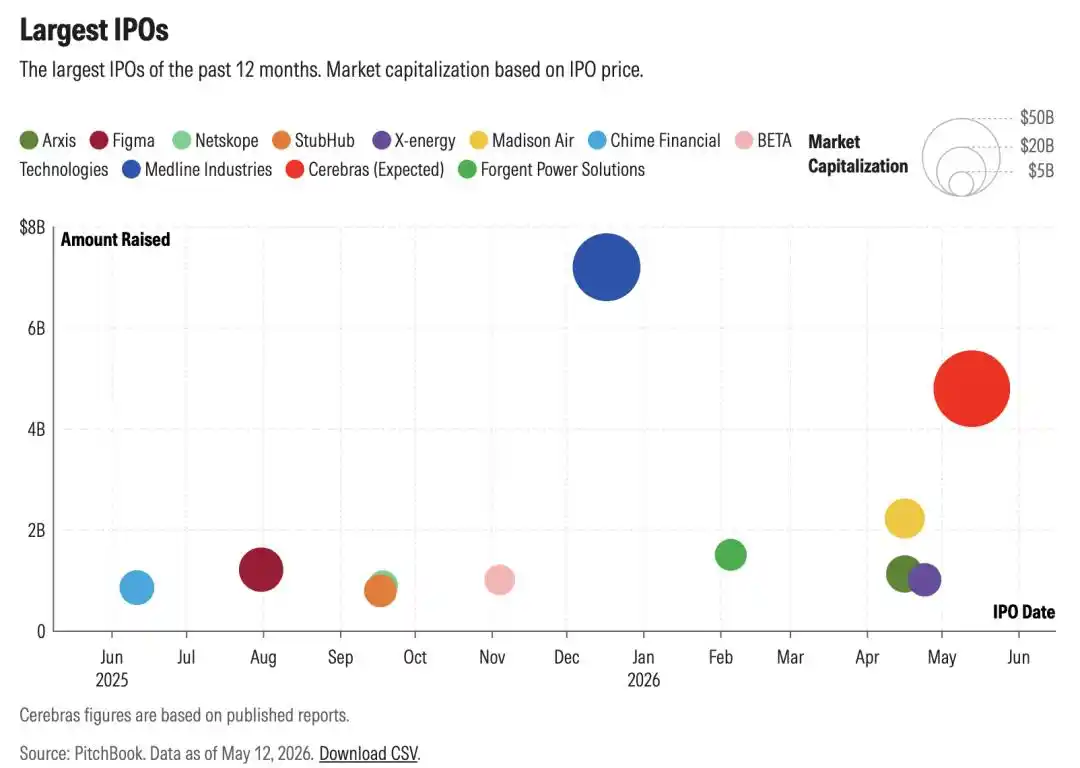
To squeeze into Sam Altman's 'Hall of Gods', Cerebras personally cut away 10% of its own 'flesh and blood'—stock warrants worth approximately $5 billion.

This is no longer a simple IPO. It is a tribute from underlying hardware to model sovereignty, paid in the twilight of an era.

And standing behind all this prosperity is the man known as the 'new lord of Silicon Valley'.

The Return of Brutalist Aesthetics

It Forged a 'Silicon-based Leviathan'

If Nvidia proudly calls its B200 chip an exquisite postage stamp, then Cerebras's flagship product, WSE-3, is a massive dinner plate.
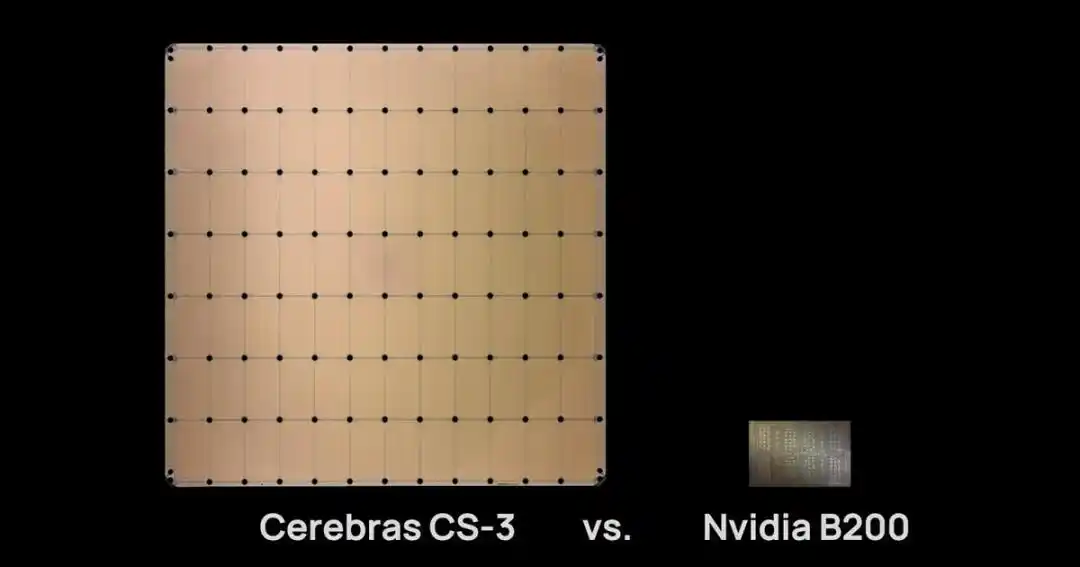
For the past three decades, the semiconductor industry's creed has been 'miniaturization'—dancing on a pinhead, stacking transistors at the nanoscale.

But Cerebras took a counterintuitive path: Since memory bandwidth is the Achilles' heel of AI inference, why not just make the entire wafer into a single chip.

This 'silicon-based leviathan' is nearly half a square foot in size, featuring over 4 trillion transistors (19 times that of Nvidia's B200), 900,000 AI-optimized cores, and 125 petaflops of AI compute—making its total computing power 28 times that of the B200.

Its design is fundamentally about 'trading space for time': etching cores directly onto a single 12-inch wafer, flattening the 'memory wall' where data shuttles between the chip and external storage.

This brutalist aesthetic shows terrifying dominance in the 'Age of Inference':

When running top-tier models from OpenAI, Cognition, Meta, etc., it can achieve a throughput speed of up to 3000 tokens per second, outpacing traditional GPUs by 70 times.
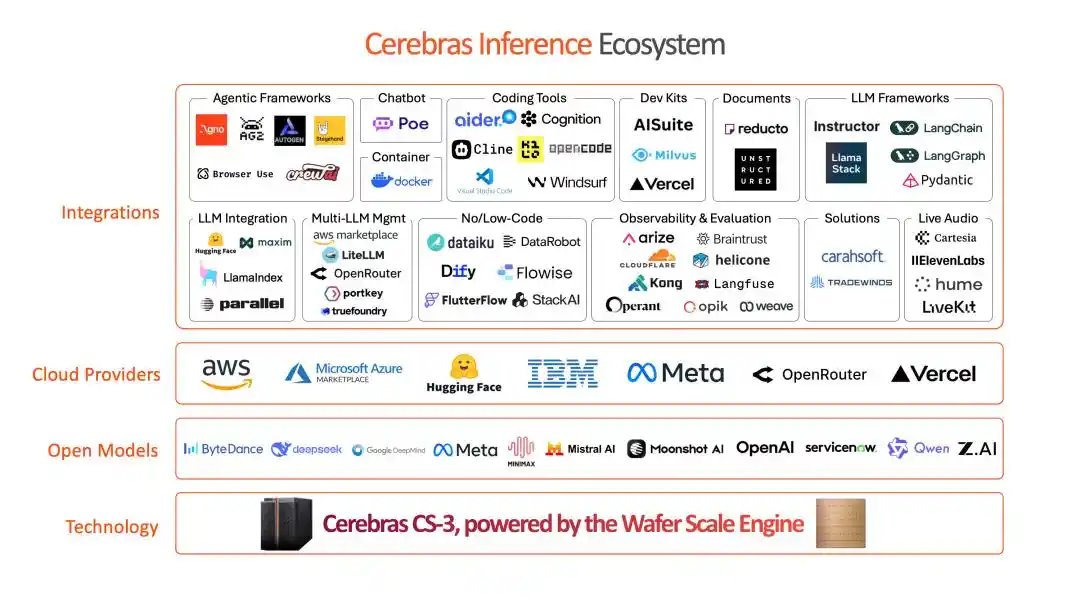
However, in 2026, the hardest technology, if it can't be converted into the fastest Tokens, is just expensive sand.

Eighteen months ago, Cerebras was a forlorn geek.

In 2025, its revenue was only $510 million, almost entirely from a single customer, the UAE's G42. It operated at a loss of $145.9 million, forcing the postponement of its IPO plans.
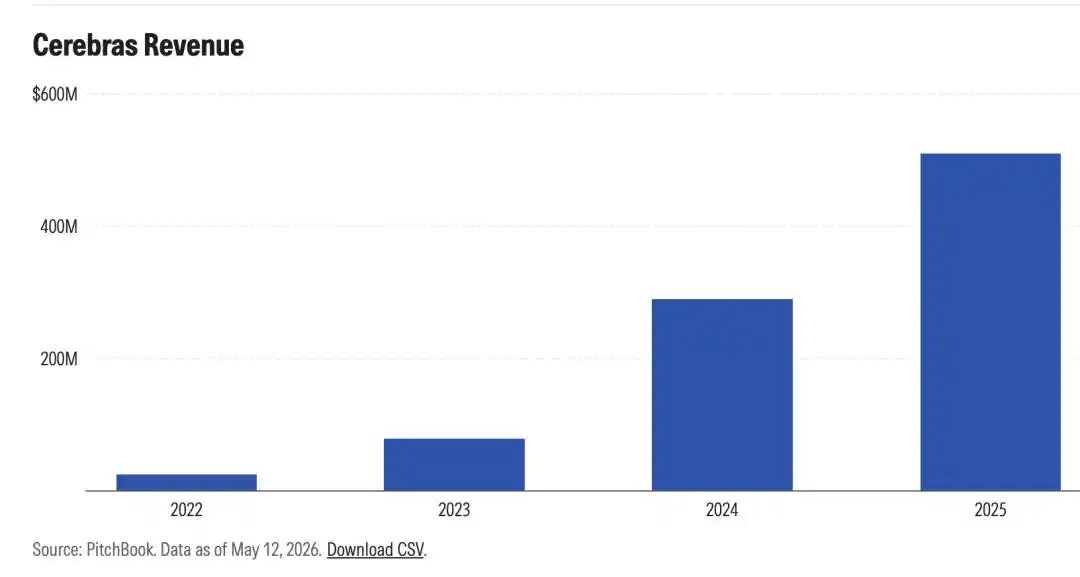
Despite possessing performance surpassing Nvidia's, its fate hung on the checkbook of a single client, like an orphan at constant risk of drowning.

Until it knocked on the door leading to Sam Altman's inner circle.

The $5 Billion 'Redemption Bond'

The Golden Ticket to the Future

In the world of AI, Moore's Law is giving way to the 'Law of the Circle'.

In exchange for survival and explosive growth, Cerebras signed an agreement that left outsiders dumbfounded: providing OpenAI with 750 megawatts of computing capacity over the next three years.

Calculated at current market prices (750 MW is roughly worth $9 billion annually), this deal could bring about $27 billion in revenue and $10 billion in gross profit.

For a company still in the red last year, this was a lifeline.

More tellingly, these 750 megawatts constitute just one-fortieth of the total computing power OpenAI believes it will need by 2030. This leftover order is enough to catapult Cerebras from a 'marginal player' to a market focal point.

But there is no free lunch, only expensive endorsements.

In exchange, Cerebras must gradually grant stock warrants to OpenAI. Upon exercise, OpenAI would hold 10% of Cerebras's shares—worth about $5 billion at the offering price midpoint of $155.

This means Cerebras generously offered up half the potential future profits from this mega-deal as a 'tribute' directly to OpenAI.

This is not an equal exchange. This is the AI era's 'computing power redemption bond'.

OpenAI is the 'lord' holding the power to allocate traffic and demand, while Cerebras is a heavily armored knight providing advanced tools of production—to enter the lord's domain, the knight must pay homage and share half his spoils.
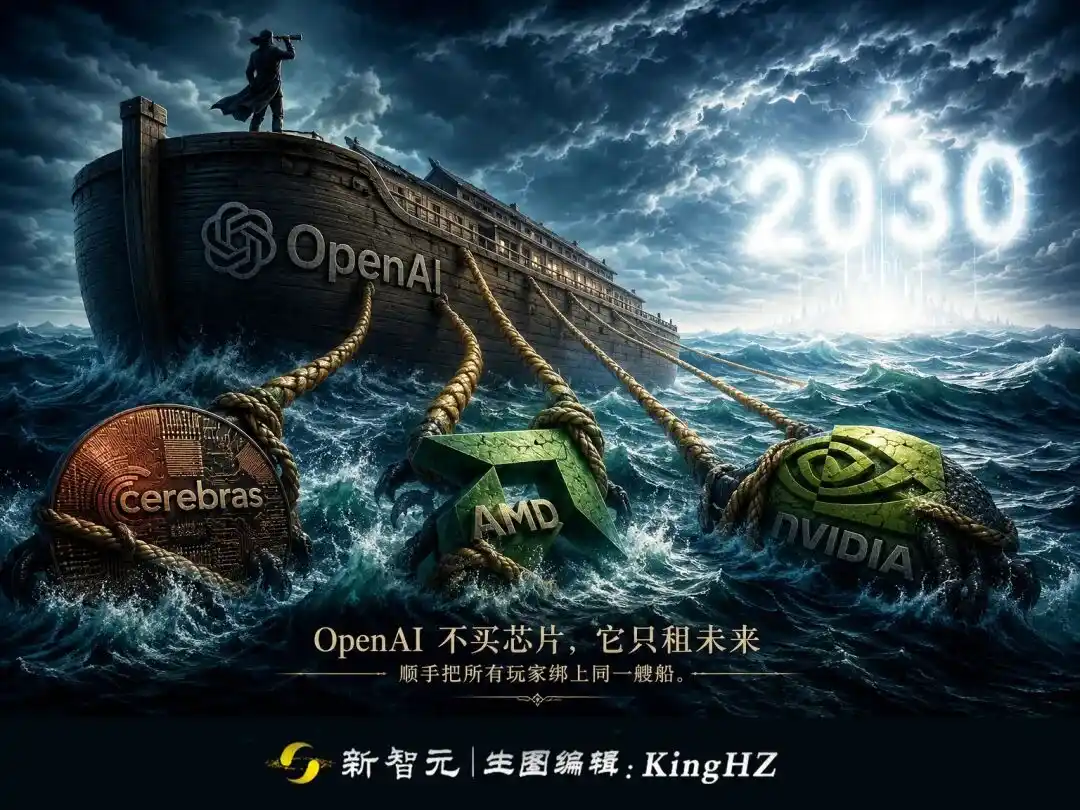
Once branded as OpenAI's core blood ally, Cerebras's price-to-sales (P/S) ratio instantly skyrocketed to 15 times, a level even Nvidia must respectfully acknowledge.

'Altmanomics'

He Is Cashing Out the Hardware Giants

Cerebras is not the only computing power enterprise bowing to Sam Altman.

Last October, AMD's stock doubled after reaching a similar agreement with OpenAI; earlier, Nvidia was rumored to have deepened its ties with OpenAI through a $30 billion financing round.

A clear map of power is emerging: OpenAI is evolving from a software company into a global 'tax authority' over the AI hardware landscape.

Sam Altman's true ambition is not merely to acquire data centers for training and running its models, but to quietly expand the group of companies and investors who have a 'vested interest in OpenAI's success.'

He is weaving a vast web of an 'interest community'.
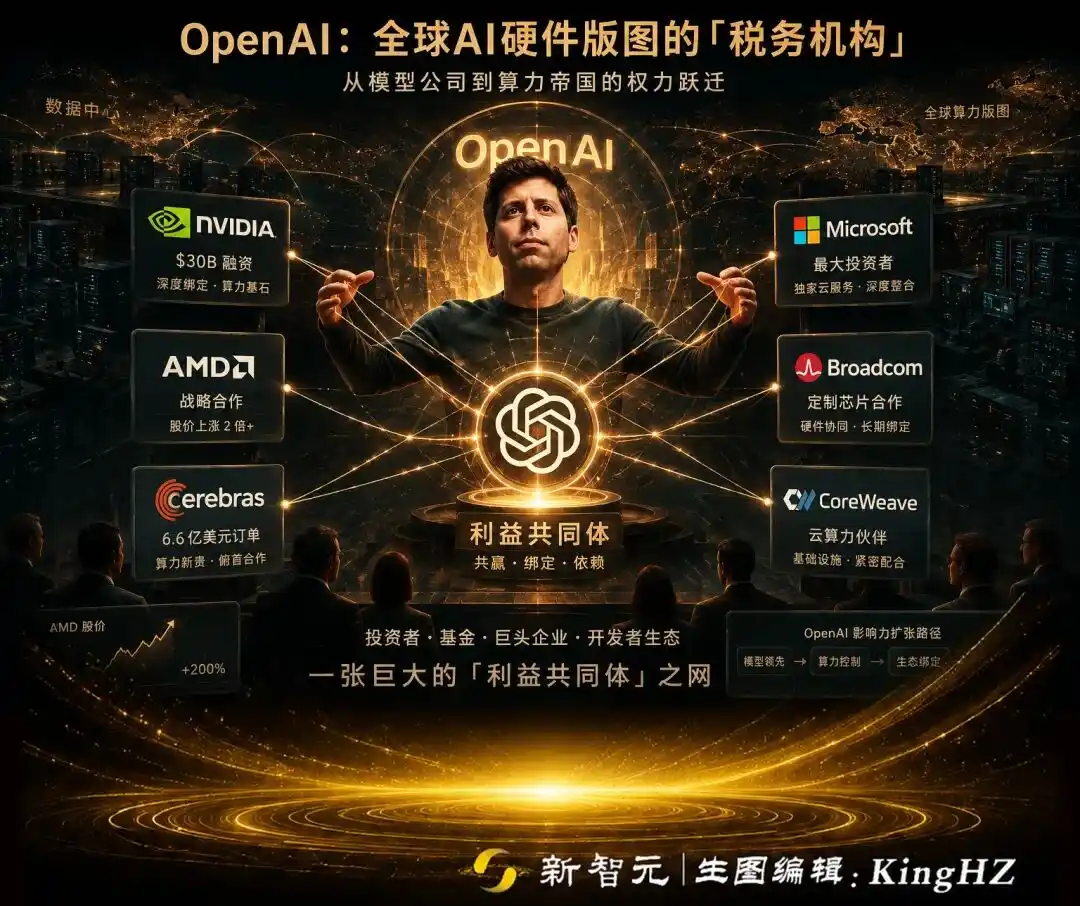
OpenAI doesn't buy chips; it only rents the future—and in the process, binds all players to the same ship.

For hardware vendors: Even with profits halved, obtaining the 'OpenAI certification' and a 15x P/S valuation is a worthwhile deal.

For Sam Altman: He not only secures the computational foundation for the next decade but also becomes a shareholder in all potential competitors.
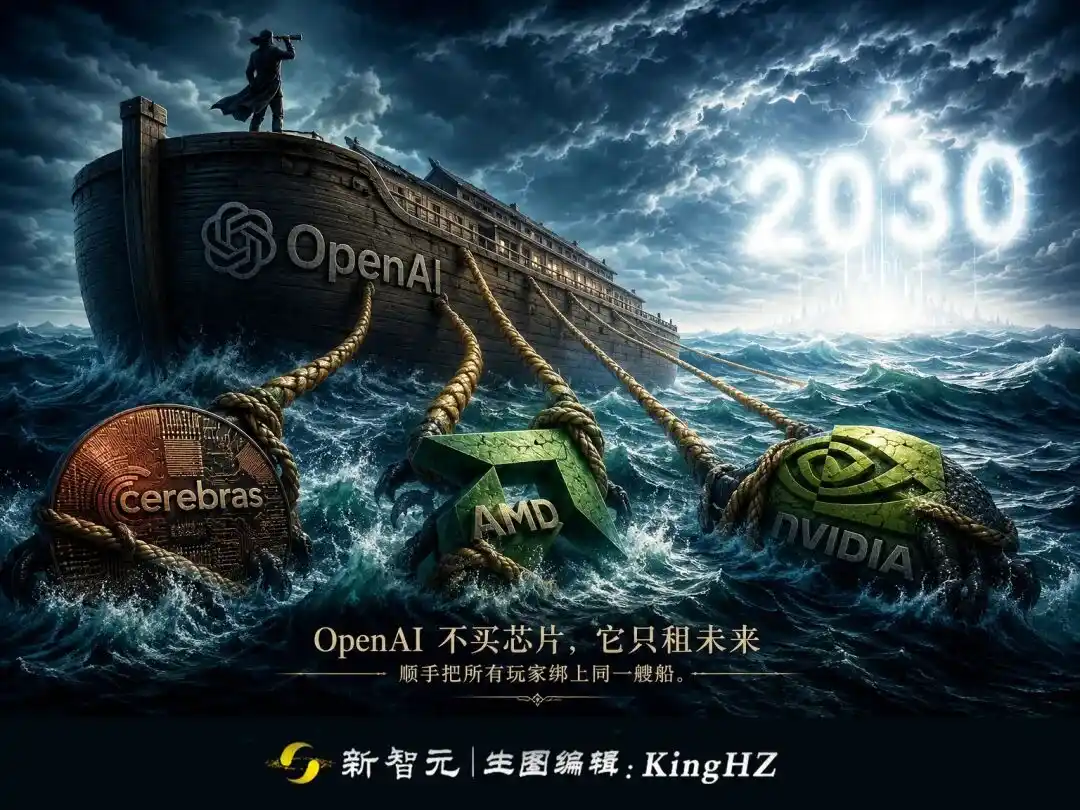
This is the essence of 'Altmanomics': In the second half of the AI race, whoever defines the demand for models holds the 'power to tax' the underlying supply chain.

Can $48 Billion Buy a Seat at the Power Table?

This Thursday, Cerebras's IPO received 20 times oversubscription. The pricing range was raised to $150-$160 per share, implying a valuation of $48 billion, coinciding with semiconductor stocks rising 53% cumulatively from their March lows.
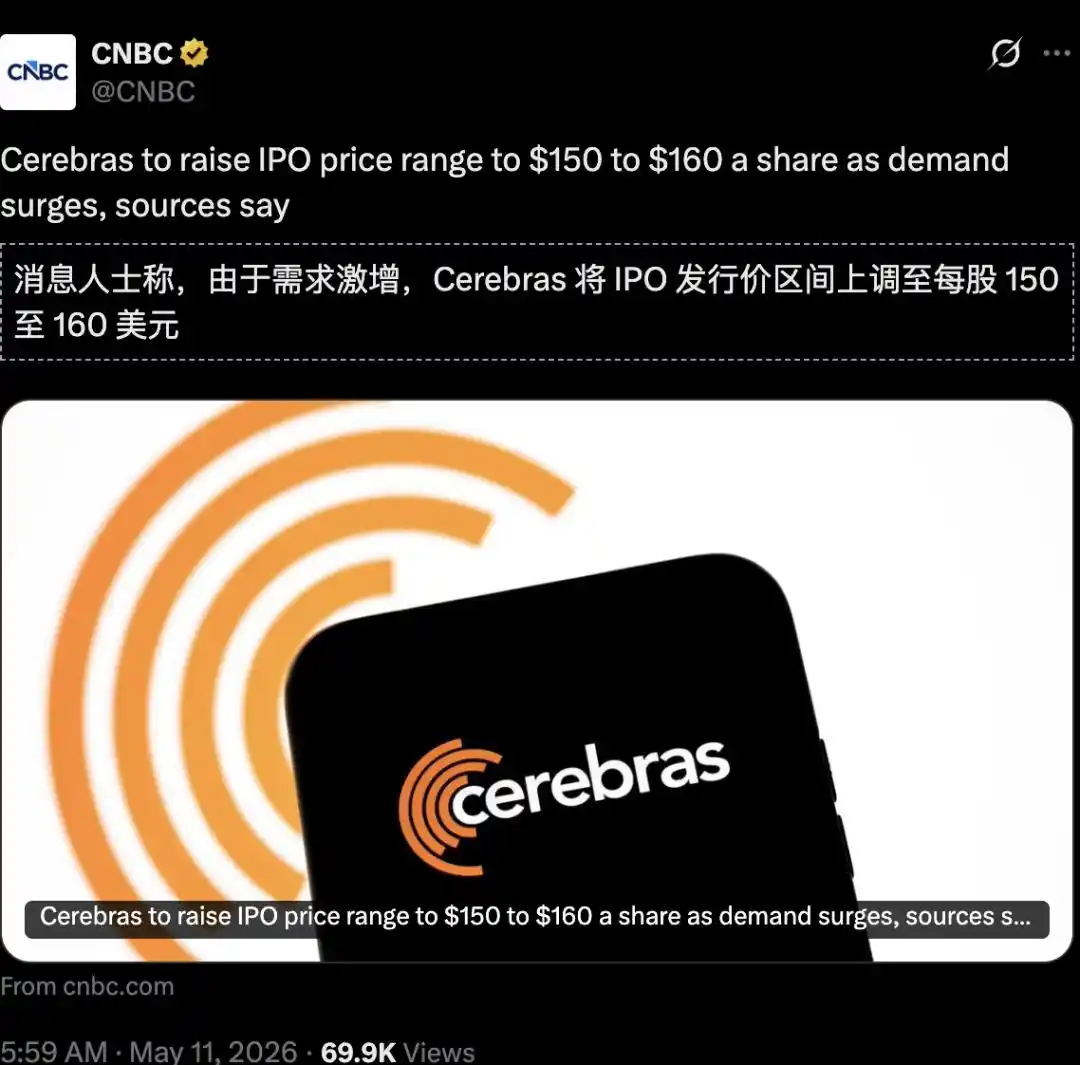
The capital market's frenzy is almost blind. They no longer care whether Cerebras lost $140 million last year or if its P/S ratio has already surpassed Nvidia's.

They are buying a kind of 'certainty'.

In the uncertain landscape of 2026, what identity tag is more certain than being a 'Core Partner of OpenAI'?

This is precisely the most intriguing aspect of this IPO. Cerebras's high valuation is essentially a market premium for the 'Altman endorsement'.

Conclusion: Sovereignty or Vassalage?

This 2026 listing marks the semiconductor industry's entry into a brutal era of stratification.

Future chip companies have only two paths:

Either, like Nvidia, rely on first-mover advantage to build their own ecological empire and become the rule-maker; or, like Cerebras, offer up half their soul in a high-stakes gamble for a ticket into the core circle.

If you cannot become a god, then become the most expensive offering.

This is not just a technological battle; it's a battle for sovereignty.

In every megawatt of electricity flows the 'tribute' from chipmakers to Silicon Valley's new overlord.

References:

https://x.com/FT/status/2054141078710768006

https://www.ft.com/content/3f77f8ad-16b8-4f97-ae55-0bd2e31122fa?syn-25a6b1a6=1

https://www.theinformation.com/newsletters/ai-agenda/startup-helping-openai-optimize-ai-cerebras-chips

https://www.morningstar.com/stocks/why-ai-chip-designer-cerebras-is-2026s-hottest-ipo-yet

This article is from the WeChat public account "Xin Zhi Yuan," author: Xin Zhi Yuan, editor: KingHZ


Criptomoedas em alta

Perguntas relacionadas

QWhat is the core technology and design philosophy behind Cerebras Systems' WSE-3 chip, and how does it differ from traditional chip designs?

ACerebras Systems' WSE-3 chip employs a radical design philosophy that contrasts with the traditional industry focus on miniaturization. Instead of shrinking components, it uses an entire 12-inch silicon wafer to create a single, massive chip. This 'brute-force' approach, described as 'trading space for time,' is aimed at eliminating the 'memory wall' bottleneck by providing immense on-chip memory bandwidth. It contains over 4 trillion transistors (19x more than NVIDIA's B200), 900,000 AI-optimized cores, and delivers 125 petaflops of AI computing power. Its key difference is its monolithic wafer-scale design versus the traditional multi-chiplet or discrete GPU designs, prioritizing high-speed data access for AI inference.

QWhat was the crucial strategic deal Cerebras made with OpenAI to enable its 2026 IPO, and what were the key terms?

AThe crucial deal was a multi-year agreement where Cerebras committed to supply 750 megawatts of computing capacity to OpenAI. In exchange for this massive, revenue-guaranteeing contract—valued at approximately $27 billion in revenue and $10 billion in gross profit over three years—Cerebras granted OpenAI warrants. Upon exercise, these warrants would give OpenAI a 10% equity stake in Cerebras, valued at around $5 billion based on the IPO's mid-range share price. This deal, framed as a 'ransom note' or 'tribute,' provided Cerebras with the financial credibility and market validation needed for a successful high-valuation IPO.

QHow does the article characterize the evolving power dynamic in the AI industry, particularly regarding OpenAI's role?

AThe article characterizes the power dynamic as a shift where OpenAI is evolving from a software company into a dominant 'tax authority' or 'feudal lord' over the global AI hardware landscape. By securing large, long-term compute capacity deals from hardware makers like Cerebras, AMD, and NVIDIA—often in exchange for equity or favorable terms—OpenAI is locking in its future compute foundation. More importantly, it is weaving a vast 'community of interest,' binding these suppliers to its success. This grants OpenAI 'taxation rights' over the hardware supply chain, as it defines model demand and controls access to the most lucrative market segments.

QWhat does the term 'Altmanomics' (Altman Economics) refer to in the context of this article?

AIn this article, 'Altmanomics' refers to the strategic and economic model pioneered by OpenAI's Sam Altman. Its essence is that in the later stages of the AI race, the entity that defines the demand for AI models gains the power to 'tax' the underlying hardware supply chain. Instead of merely purchasing chips, OpenAI 'rents the future' by making long-term capacity deals that often include equity stakes. This strategy allows OpenAI to secure its computational base at favorable rates while simultaneously making shareholders and partners out of potential hardware competitors, thereby consolidating its ecosystem power and ensuring alignment of interests.

QAccording to the article's conclusion, what two paths are available for semiconductor companies in the new AI era, as exemplified by NVIDIA and Cerebras?

AThe article concludes that semiconductor companies now face two distinct paths: 1) Become a rule-maker like NVIDIA, which uses first-mover advantage and ecosystem strength to establish its own empire and dictate distribution rules. 2) Become a vassal or 'high-value offering' like Cerebras, which trades a significant portion of its potential sovereignty and profits (through equity and deals) to a dominant AI platform (OpenAI) in exchange for a guaranteed, high-value ticket into the core industry circle. The choice is between maintaining sovereign control or becoming a strategically important, yet subordinate, partner to the new 'lords' of silicon.

Leituras Relacionadas

Must-Watch Events Next Week|CLARITY Act Could Face Senate Vote; SpaceX, Circle to Report Earnings (8.3-8.9)

**Summary: Key Events and Developments to Watch (August 3-9)** The upcoming week is marked by significant financial disclosures, key legislative deadlines, and notable product updates. **Major Financial Events:** Several companies are scheduled to release their Q2 2026 earnings. American Bitcoin (ABTC) will report on August 3, followed by SpaceX and Hut 8 Mining Corp. on August 4, and Circle on August 5. Notably, a significant portion of SpaceX shares (up to 12% of total shares) will be unlocked on August 6 following their earnings release. **Key Legislative Deadline:** The U.S. Senate faces an August 7 deadline to secure 60 votes for the CLARITY Act, a bipartisan bill aiming to establish a federal regulatory framework for cryptocurrencies. The Senate may hold a full vote on the bill during the week. **Economic Data:** The U.S. July Non-Farm Payrolls report will be released on August 7, providing crucial labor market data. **Technology & Product Updates:** * **Shutdowns:** DeFi portfolio tracker Zapper and wallet app Ctrl Wallet will cease operations on August 3. * **Upgrades:** LayerZero will deprecate its v1 relayers on August 3. XRP Ledger's new version 3.3.0, featuring five new functions, is expected next week. * **AI:** Elon Musk announced that the advanced Grok 4.6 AI model is set for release around August 7. * **Bitcoin:** The BIP-110 forced signaling for a potential Bitcoin network change is scheduled to begin around August 8. **Other Notable Events:** Chinese robotics firm Unitree Tech has set its preliminary price inquiry for its IPO for August 5. South Korean exchange Upbit will delist AQT and AERGO tokens on August 3.

marsbitHá 3m

Must-Watch Events Next Week|CLARITY Act Could Face Senate Vote; SpaceX, Circle to Report Earnings (8.3-8.9)

marsbitHá 3m

Stocks Are Plummeting More Sharply Than Cryptocurrencies. Where Has the Money Gone?

Stock Markets Plunge Deeper Than Cryptocurrencies: Where Did the Money Go? In late July, Seoul's Kospi index triggered circuit breakers for two consecutive days, plummeting over 40% from its June high. The collapse was led by heavyweight stocks like SK Hynix, whose record profits still disappointed investors, and devastating leveraged ETFs, with one major product losing over 83% of its value. This signaled a global, forced deleveraging targeting the most crowded trades. Interestingly, while stocks exhibited extreme volatility akin to crypto markets, Bitcoin rose nearly 15% in July after a prior steep drop. Analysis shows the money fleeing equities did not flow into Bitcoin. Instead, Bitcoin had already absorbed its sell-off in May-June, when U.S. spot Bitcoin ETFs saw historic outflows. The true safe-haven beneficiary was gold, whose price rose over 20% year-on-year, highlighting a decoupling between Bitcoin and gold as "digital gold." The sell-off was a targeted unwinding of leveraged positions in tech and semiconductors, accelerated by broker-dealer risk management and shifts in the AI narrative, including new competition from Chinese memory chipmakers. The retreat path was clear: from high-valuation tech stocks to cash and U.S. Treasuries, then to gold. For Bitcoin to attract sustained institutional inflows, conditions like eased global liquidity pressure, a "soft-landing" Fed rate cut, and U.S. regulatory clarity via legislation like the stalled CLARITY Act are needed. Currently, Bitcoin is not a safe haven but an already-cleared asset. Its low correlation with tech stocks, however, makes it a potential diversification play for institutional portfolios once the storm passes. The money isn't here yet, but the positioning is underway.

marsbitHá 3m

Stocks Are Plummeting More Sharply Than Cryptocurrencies. Where Has the Money Gone?

marsbitHá 3m

In Conversation with Ray Dalio: We Are Currently in an AI Bubble, with 1% of My Portfolio in Bitcoin

Ray Dalio, founder of Bridgewater Associates, warns in an interview that the current AI boom shows classic bubble characteristics, which could lead to significant economic downturns as seen in past cycles like 1929 or 2000. He explains that speculative enthusiasm, fueled by debt and overvaluation, often precedes a crash when rising rates or taxation force asset sales, causing widespread losses and recession. Dalio also outlines his "Big Cycle" theory, describing an approximate 80-year pattern where widening wealth gaps, massive government deficits, and shifting geopolitical power (like China's rise) create internal conflict and global instability. He emphasizes that we are in a late-cycle, transitional phase where traditional powers like the US and UK face decline. For personal wealth protection, Dalio advises diversification beyond cash into assets like stocks, bonds, real estate, and particularly gold, which he prefers over Bitcoin. While he holds about 1% of his portfolio in Bitcoin as a non-printable hard asset, he views gold as more secure from technological or governmental threats. Regarding AI's impact, Dalio believes it will disproportionately benefit capital owners, worsening inequality by replacing both physical and cognitive labor. He suggests that human intuition and emotional intelligence, combined with AI, will be key for future workers. On taxation, Dalio argues that wealth taxes are impractical and risk triggering asset sell-offs, reducing productive investment. He points to the UK as a cautionary example of debt, low productivity, and political strife. Geopolitically, Dalio foresees a more regionalized world, with the US showing weakness in prolonged conflicts like with Iran, akin to past imperial declines. The ideal outcome, he suggests, is coexisting powerful blocs (e.g., Americas, China-Asia Pacific) without major war.

marsbitHá 3h

In Conversation with Ray Dalio: We Are Currently in an AI Bubble, with 1% of My Portfolio in Bitcoin

marsbitHá 3h

Daily 7.2 Trillion KRW: Foreign Capital's Record Net Buying on Friday! Wall Street Says Headwinds for Korean Stock Fund Flows Have Subsided

South Korean stock market sees a dramatic shift in fund flows. On July 31, foreign investors made a record net purchase of approximately KRW 7.2 trillion in KOSPI stocks, marking a fundamental reversal from the persistent large-scale net outflows seen in previous months. This contributed to a significant narrowing of foreign net selling in July to KRW 9.8 trillion, down sharply from KRW 48.4 trillion in June and KRW 44.5 trillion in May. Simultaneously, domestic institutional pressure eased. South Korean pension funds and asset managers turned to a net buying position in July, purchasing KRW 1.0 trillion worth of KOSPI shares, contrasting with net sales in May and June. Market volatility is expected to be dampened by new financial regulations. Effective July 31, the Financial Services Commission tightened access for retail investors to single-stock leveraged ETFs by raising the minimum cash deposit requirement. Trading volumes for these products subsequently dropped to about 50% of their monthly average. Citigroup Research maintains its year-end KOSPI target of 10,000 points. The firm cites several supportive factors: the substantial easing of headwinds from capital outflows, a robust fundamental outlook for the semiconductor sector, historically low market valuations, strong economic fundamentals, and the potential for policy support from financial authorities if needed.

marsbitHá 3h

Daily 7.2 Trillion KRW: Foreign Capital's Record Net Buying on Friday! Wall Street Says Headwinds for Korean Stock Fund Flows Have Subsided

marsbitHá 3h

Trading

Spot

Artigos em Destaque

Como comprar GODS

Bem-vindo à HTX.com!Tornámos a compra de Gods Unchained (GODS) simples e conveniente.Segue o nosso guia passo a passo para iniciar a tua jornada no mundo das criptos.Passo 1: cria a tua conta HTXUtiliza o teu e-mail ou número de telefone para te inscreveres numa conta gratuita na HTX.Desfruta de um processo de inscrição sem complicações e desbloqueia todas as funcionalidades.Obter a minha contaPasso 2: vai para Comprar Cripto e escolhe o teu método de pagamentoCartão de crédito/débito: usa o teu visa ou mastercard para comprar Gods Unchained (GODS) instantaneamente.Saldo: usa os fundos da tua conta HTX para transacionar sem problemas.Terceiros: adicionamos métodos de pagamento populares, como Google Pay e Apple Pay, para aumentar a conveniência.P2P: transaciona diretamente com outros utilizadores na HTX.Mercado de balcão (OTC): oferecemos serviços personalizados e taxas de câmbio competitivas para os traders.Passo 3: armazena teu Gods Unchained (GODS)Depois de comprar o teu Gods Unchained (GODS), armazena-o na tua conta HTX.Alternativamente, podes enviá-lo para outro lugar através de transferência blockchain ou usá-lo para transacionar outras criptomoedas.Passo 4: transaciona Gods Unchained (GODS)Transaciona facilmente Gods Unchained (GODS) no mercado à vista da HTX.Acede simplesmente à tua conta, seleciona o teu par de trading, executa as tuas transações e monitoriza em tempo real.Oferecemos uma experiência de fácil utilização tanto para principiantes como para traders experientes.

174 Visualizações TotaisPublicado em {updateTime}Atualizado em 2026.06.02

Como comprar GODS

Discussões

Bem-vindo à Comunidade HTX. Aqui, pode manter-se informado sobre os mais recentes desenvolvimentos da plataforma e obter acesso a análises profissionais de mercado. As opiniões dos utilizadores sobre o preço de GODS (GODS) são apresentadas abaixo.

活动图片












