Intraday Quantitative Sentiment Fluctuation Analysis Report — December 17, 2025

marsbitPublicado em 2025-12-17Última atualização em 2025-12-17

Resumo

BTC Market Sentiment Analysis Report — 2025.12.17 Over the past 24 hours, BTC market sentiment showed a pattern of initial rise, subsequent decline, and eventual stabilization. Overall sentiment gradually retreated from high positive levels into negative territory, with signs of stabilization by the end of the session, though momentum remained weak. Key情绪 (sentiment) extreme points (where |CED| > 10) were observed. The session began with a sharp rise in sentiment to an extreme positive value (CED peak: +19.80) between 09:45-12:00, though price failed to follow, showing a clear divergence. From 12:00-18:00, sentiment gradually declined while prices moved within a narrow range. During the evening (18:00-24:00), sentiment turned negative, with CED dropping to -16.63, accompanied by significant price volatility. From midnight to early morning (00:00-09:45), sentiment oscillated within negative levels before converging, with prices stabilizing. During periods of extreme sentiment (|CED| > 10), price volatility increased significantly, with a higher probability of declines during negative sentiment phases. Neutral sentiment periods corresponded to relatively stable price action and balanced market forces. Notably, extreme positive sentiment often preceded price corrections, indicating that excessive optimism tended to signal adjustments. The market completed a V-shaped emotional cycle, moving from extreme positivity through deep negativity back to neutrality, suggesting a full ...

Over the past 24 hours, BTC market sentiment exhibited a first rise, then fall, and finally stabilization fluctuation pattern. Overall sentiment gradually declined from a high positive range to a negative range, with signs of stabilization appearing towards the end of the session, albeit with weak momentum.

Analysis of Extreme Sentiment Time Points (|CED| > 10)
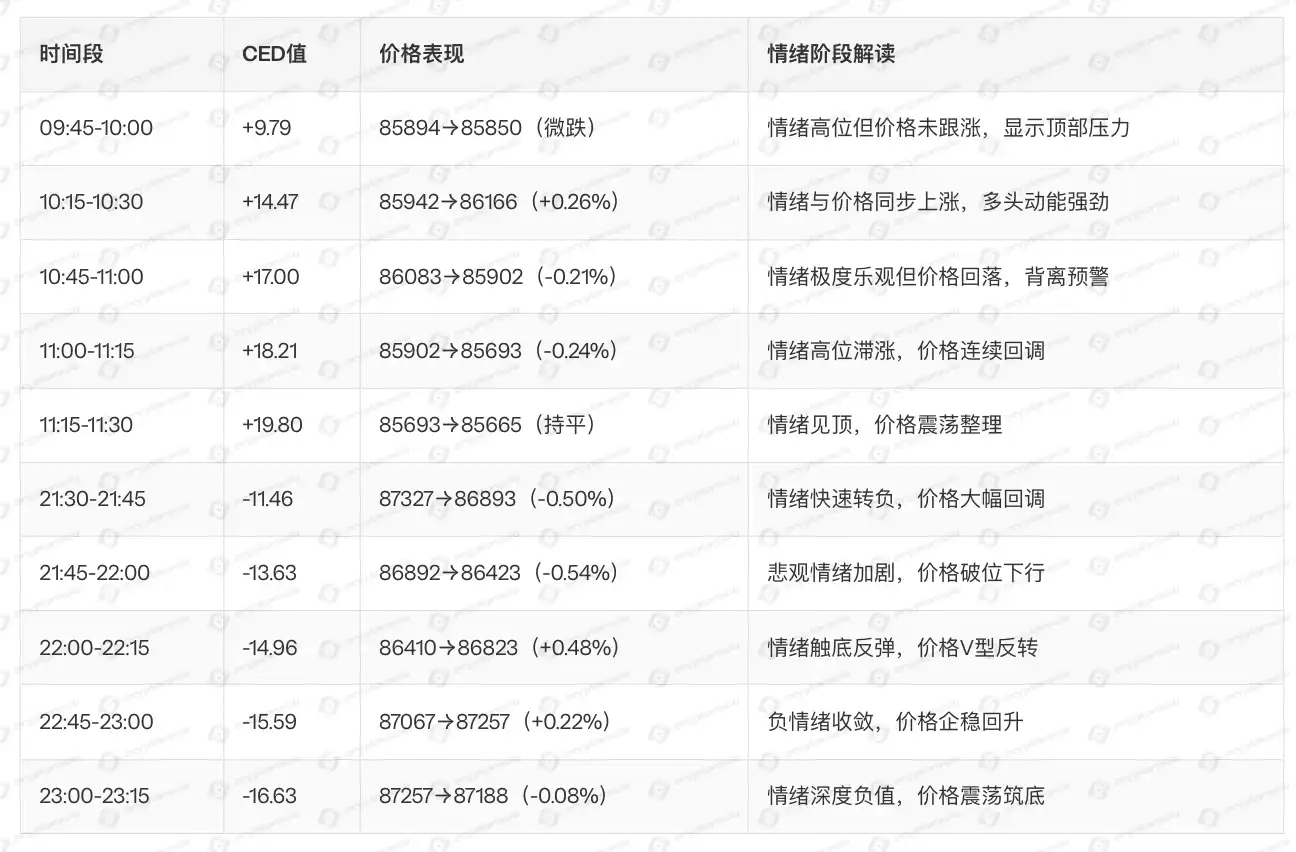
Sentiment Change Rhythm

  • Morning Session (09:45-12:00): Sentiment rapidly surged to extreme positive values (CED peak +19.80), but prices failed to rise correspondingly, showing a significant divergence.
  • Afternoon to Evening (12:00-18:00): Sentiment gradually declined, with prices fluctuating within a narrow range.
  • Evening (18:00-24:00): Sentiment sharply turned negative, with CED dropping to a low of -16.63, accompanied by significant price volatility.
  • Early Morning to Morning (00:00-09:45): Sentiment oscillated and converged within the negative range, with prices stabilizing and recovering.

II. Relationship Between Extreme Sentiment Ranges and Market Trends
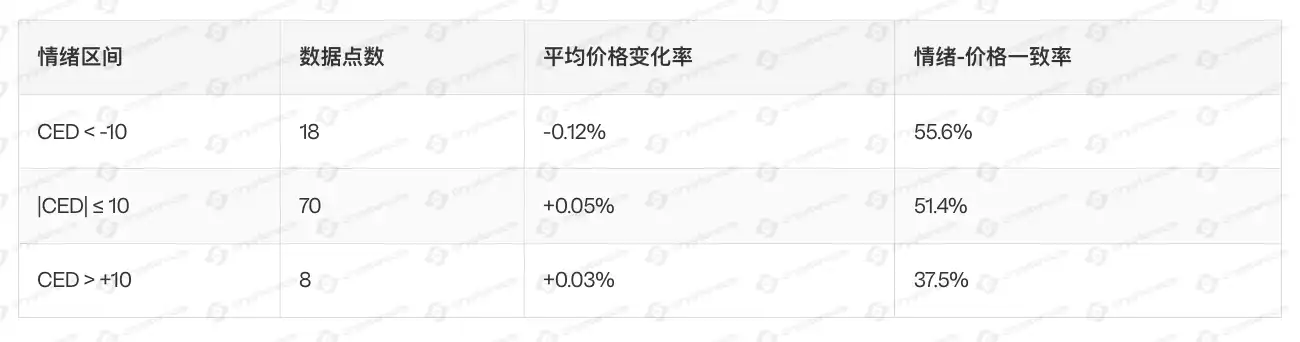
Trend Conclusions:

  • Extreme Sentiment Phase (|CED| > 10): Price volatility significantly amplifies, with a higher probability of declines in negative sentiment ranges.
  • Neutral Sentiment Range: Price changes are relatively stable, with a relative balance between bullish and bearish forces.
  • Sentiment-Price Consistency: Extreme positive sentiment often shows a clear divergence with prices, indicating that excessive optimism tends to foreshadow adjustments.

III. Summary of Current Market Conditions
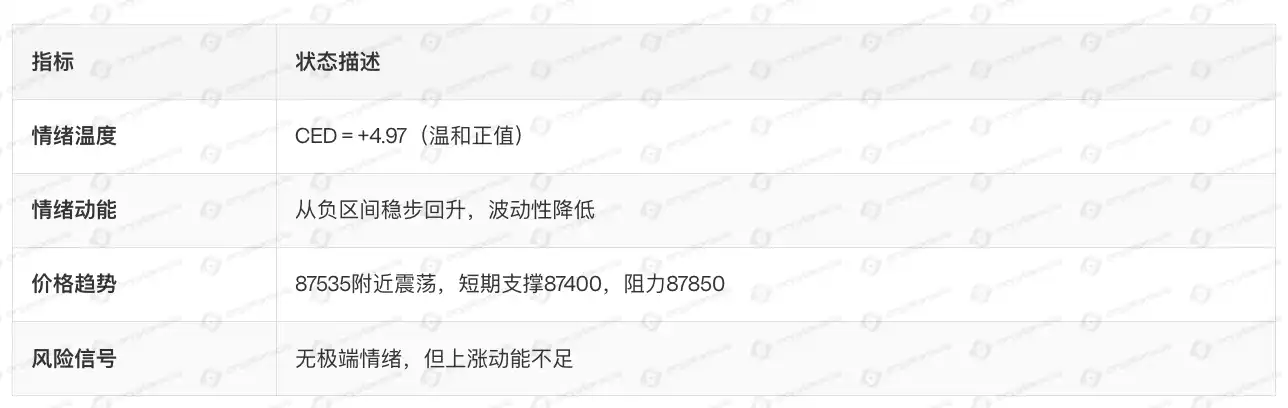
IV. Core Conclusions

  • Sentiment Completed a V-Shaped Cycle: From extreme positive values through deep negative values back to neutral, market sentiment has undergone a full release cycle.
  • Price Resilience Emerged: Despite significant sentiment fluctuations, prices formed strong support within the 87,000-88,000 range.
  • Short-Term Expectation of Volatility: Sentiment momentum is weak, lacking clear directional drivers, and is expected to continue a range-bound consolidation pattern.
  • Breakout Signals to Monitor: If CED consistently stabilizes above +5 and breaks through 88,000 with volume, it may initiate a new round of upward movement.


Criptomoedas em alta

Perguntas relacionadas

QWhat was the overall pattern of BTC market sentiment over the past 24 hours as described in the report?

AThe overall pattern was 'first rising, then falling, and finally stabilizing'. Sentiment started high in the positive zone, gradually fell into negative territory, and showed signs of stabilizing by the end of the period, albeit with weak momentum.

QAt what time did the sentiment reach its peak positive extreme value (CED), and what was notable about the price action at that time?

AThe sentiment reached its peak positive extreme value (CED of +19.80) during the morning session (09:45-12:00). It was notable that the price failed to rise synchronously, showing a significant divergence.

QWhat was the lowest CED value recorded and during which period did this occur?

AThe lowest CED value recorded was -16.63, which occurred during the evening session (18:00-24:00).

QAccording to the trend conclusions, what is the relationship between extreme sentiment (|CED| > 10) and price action?

ADuring periods of extreme sentiment (|CED| > 10), price volatility significantly amplifies, with a higher probability of price declines occurring during negative sentiment intervals.

QWhat are the key support level and potential signal for a new rally mentioned in the core conclusions?

AThe key support level is in the 87,000-88,000 range. A potential signal for a new rally would be if the CED consistently stabilizes above +5 and the price breaks above 88,000 with increasing volume.

Leituras Relacionadas

Welcome to the New Crypto World: Only This Time, The Place Where You Lose Money Is Called the Stock Market

Welcome to the New Crypto World: Only This Time, the Place to Lose Money is Called the Stock Market. The article depicts a future (2026) where global stock markets, particularly tech stocks, are exhibiting behaviors and risks reminiscent of the cryptocurrency world. The narrative centers on a sharp crash in South Korea's KOSPI index and leading stocks like SK Hynix, highlighting widespread retail losses, leverage-induced liquidations, and extreme volatility. It argues that a significant shift in market dynamics is underway: pricing is increasingly driven by narratives (like the AI boom) over fundamental valuation, amplified by high leverage and the rapid, emotion-fueled consensus formed on social media. Former crypto traders, seeking new opportunities, brought their high-risk strategies—chasing narratives, using leverage—into equity markets, focusing on sectors like AI and semiconductors. Ironically, data suggests some major tech stocks have recently shown greater volatility and faster crashes than Bitcoin, which is becoming relatively more stable and "stock-like" through institutional adoption. The piece details how leveraged ETFs in Korea, particularly those tied to single stocks, created a vicious cycle of forced selling that exacerbated the market plunge. It concludes that while stocks retain underlying fundamentals, the *trading* of them has undergone a "de-rationalization": markets now prioritize themes, social media sentiment, and leveraged bets over traditional analysis. In a paradoxical twist, Bitcoin is striving to become more like a traditional asset, while a segment of the stock market is becoming more like crypto—a cycle of grand stories, crowded trades, easy leverage, and the pervasive, often misplaced, belief that one can exit before everyone else. The final, poignant wish from a Korean retail investor—to go back to life before trading and get their money back—underscores that markets offer no refunds.

marsbitHá 6m

Welcome to the New Crypto World: Only This Time, The Place Where You Lose Money Is Called the Stock Market

marsbitHá 6m

Feishu Has Become Doubao

This may be the most important day in the ten-year history of Feishu. On July 30, ByteDance announced a major restructuring via internal email. Feishu, an independent operation for a decade, will no longer function separately and will lose its independent sales and marketing teams. Its product team is being integrated into Doubao AI, and its Go-to-Market strategy merges into the Volcano Engine's To B system. This move signals a strategic pivot, not a failure of Feishu. The era where Feishu sought to be an all-encompassing super-app for productivity is ending. AI has become the dominant logic. Industry trends show a shift from building platform "entrances" to embedding AI directly into workflows, as seen with Microsoft Copilot and Google's Gemini. Data reveals the driver: over 90% of Feishu's new clients in Q2 2026 purchased its AI products. Enterprises are now buying integrated AI solutions, not standalone software. By integrating Feishu's deep enterprise workflow scenarios, Doubao evolves from a consumer-facing chatbot into a powerful enterprise productivity engine. This gives Doubao a critical asset: real-world business application. Concurrently, ByteDance established the "Creative Services Platform," unifying its previously fragmented sales fronts (Feishu, Doubao, Volcano Engine) into a single customer-facing entity. This represents ByteDance's first genuine shift to thinking like a true To B company, organizing around client needs rather than internal product silos. The restructuring underscores that AI is no longer just a business line but foundational infrastructure. Doubao is becoming the new organizational core, mirroring TikTok's past ascendancy. This demonstrates a profound shift: AI is beginning to reshape corporate structures, determining resource allocation and strategic priorities. ByteDance is likely just the first of many companies to undergo such an AI-driven reorganization.

marsbitHá 17m

Feishu Has Become Doubao

marsbitHá 17m

The Second Half of the RWA Issuance Race: Amidst the Utilization Dilemma, Trillions Worth of On-Chain Assets Awaken

RWA (Real-World Asset) tokenization has surged to a record $32 billion in on-chain value. However, a structural challenge has emerged: approximately 87% of these tokenized assets are inactive, not participating in DeFi lending or trading activities. This "utilization gap" highlights a key question: what happens after assets are brought on-chain? Data shows a stark contrast among major platforms. While Securitize leads in scale ($4.9B), it has a DeFi utilization rate of only 0.7%. Similarly, Ondo Finance ($3.5B) sees about 2.7% utilization. In contrast, Maple Finance, with a smaller $2.3B in assets, achieves a 62% utilization rate by embedding its assets directly into lending activities from the outset. Three primary factors contribute to low utilization: 1) **Asset Nature**: Tokenized treasuries are often held for yield, not traded. 2) **Regulatory Barriers**: Securities laws and KYC requirements restrict free movement into permissionless DeFi pools. 3) **Infrastructure Gaps**: A lack of deep secondary markets, real-time pricing, and mature clearing mechanisms hinders liquidity. The RWA narrative is now shifting from a "race to issue" to a "battle for application." While native lending protocols like Maple have inherent advantages, distribution channels are becoming critical. The success of products like SyrupUSDG on platforms like Robinhood Crypto demonstrates that access to existing user bases can accelerate adoption far more effectively than protocol-led efforts alone. The $32 billion milestone validates the feasibility of tokenization, but low utilization underscores that bringing assets on-chain is just the first step. The true test for the sector is enabling these assets to circulate, be utilized, and create new economic value within the DeFi ecosystem.

marsbitHá 17m

The Second Half of the RWA Issuance Race: Amidst the Utilization Dilemma, Trillions Worth of On-Chain Assets Awaken

marsbitHá 17m

Trading

Spot

Artigos em Destaque

Como comprar O

Bem-vindo à HTX.com!Tornámos a compra de O1 exchange (O) simples e conveniente.Segue o nosso guia passo a passo para iniciar a tua jornada no mundo das criptos.Passo 1: cria a tua conta HTXUtiliza o teu e-mail ou número de telefone para te inscreveres numa conta gratuita na HTX.Desfruta de um processo de inscrição sem complicações e desbloqueia todas as funcionalidades.Obter a minha contaPasso 2: vai para Comprar Cripto e escolhe o teu método de pagamentoCartão de crédito/débito: usa o teu visa ou mastercard para comprar O1 exchange (O) instantaneamente.Saldo: usa os fundos da tua conta HTX para transacionar sem problemas.Terceiros: adicionamos métodos de pagamento populares, como Google Pay e Apple Pay, para aumentar a conveniência.P2P: transaciona diretamente com outros utilizadores na HTX.Mercado de balcão (OTC): oferecemos serviços personalizados e taxas de câmbio competitivas para os traders.Passo 3: armazena teu O1 exchange (O)Depois de comprar o teu O1 exchange (O), armazena-o na tua conta HTX.Alternativamente, podes enviá-lo para outro lugar através de transferência blockchain ou usá-lo para transacionar outras criptomoedas.Passo 4: transaciona O1 exchange (O)Transaciona facilmente O1 exchange (O) no mercado à vista da HTX.Acede simplesmente à tua conta, seleciona o teu par de trading, executa as tuas transações e monitoriza em tempo real.Oferecemos uma experiência de fácil utilização tanto para principiantes como para traders experientes.

310 Visualizações TotaisPublicado em {updateTime}Atualizado em 2026.06.29

Como comprar O

Como comprar PROS

Bem-vindo à HTX.com!Tornámos a compra de Pharos (PROS) simples e conveniente.Segue o nosso guia passo a passo para iniciar a tua jornada no mundo das criptos.Passo 1: cria a tua conta HTXUtiliza o teu e-mail ou número de telefone para te inscreveres numa conta gratuita na HTX.Desfruta de um processo de inscrição sem complicações e desbloqueia todas as funcionalidades.Obter a minha contaPasso 2: vai para Comprar Cripto e escolhe o teu método de pagamentoCartão de crédito/débito: usa o teu visa ou mastercard para comprar Pharos (PROS) instantaneamente.Saldo: usa os fundos da tua conta HTX para transacionar sem problemas.Terceiros: adicionamos métodos de pagamento populares, como Google Pay e Apple Pay, para aumentar a conveniência.P2P: transaciona diretamente com outros utilizadores na HTX.Mercado de balcão (OTC): oferecemos serviços personalizados e taxas de câmbio competitivas para os traders.Passo 3: armazena teu Pharos (PROS)Depois de comprar o teu Pharos (PROS), armazena-o na tua conta HTX.Alternativamente, podes enviá-lo para outro lugar através de transferência blockchain ou usá-lo para transacionar outras criptomoedas.Passo 4: transaciona Pharos (PROS)Transaciona facilmente Pharos (PROS) no mercado à vista da HTX.Acede simplesmente à tua conta, seleciona o teu par de trading, executa as tuas transações e monitoriza em tempo real.Oferecemos uma experiência de fácil utilização tanto para principiantes como para traders experientes.

301 Visualizações TotaisPublicado em {updateTime}Atualizado em 2026.06.29

Como comprar PROS

O que é VERONA

I. Introdução ao Projeto VERONA é uma blockchain construída para todos, em todo o lado, através da abstração da cadeia. Utilizando a sua camada de Abstração Generalizada, a VERONA distingue-se por integrar funcionalidades complexas de blockchain, como contas, assinaturas e interoperabilidade, diretamente ao nível do protocolo. Esta abordagem permite a interação com aplicações de blockchain sem a necessidade de compreender as tecnologias subjacentes.1) Informação Básica Nome: VERONA (VERONA)III. Links Relacionados Link do site oficial: https://xion.burnt.com/ Whitepaper: https://xion.burnt.com/whitepaper.pdf Exploradores: https://explorer.burnt.com/ Mídias Sociais: https://x.com/burnt_xion Nota: A introdução ao projeto provém dos materiais publicados ou fornecidos pela equipa oficial do projeto, que é apenas para referência e não constitui aconselhamento de investimento. A HTX não se responsabiliza por quaisquer perdas diretas ou indiretas resultantes.

945 Visualizações TotaisPublicado em {updateTime}Atualizado em 2026.06.22

O que é VERONA

Discussões

Bem-vindo à Comunidade HTX. Aqui, pode manter-se informado sobre os mais recentes desenvolvimentos da plataforma e obter acesso a análises profissionais de mercado. As opiniões dos utilizadores sobre o preço de A (A) são apresentadas abaixo.

活动图片